Evaluating how these platforms fit into your governance architecture? Browse AI Governance Platforms, AI Access Control, and Model Observability in the GAIG marketplace for independent comparison. Use the vendor interview guide to stress-test any platform against the accountability and runtime control questions no vendor will volunteer. Submit an inquiry to be matched with governance vendors specifically built to fill the gaps these platforms leave open.
Submit an Inquiry
Key Statistics
70% of enterprise AI is uncontrolled per Lenovo 2026 research
Lenovo, April 2026
64% of enterprises deployed AI agents before they were ready
Monte Carlo, 2026
$2.9B Salesforce Agentforce + Data 360 ARR in fiscal 2026
Salesforce FY2026
Related Reading
CSA's AARM Runtime Governance Framework
CISO's Pre-Failure Signal Guide
AI Monitoring Dashboard Analysis
Best AI Governance Platforms 2026
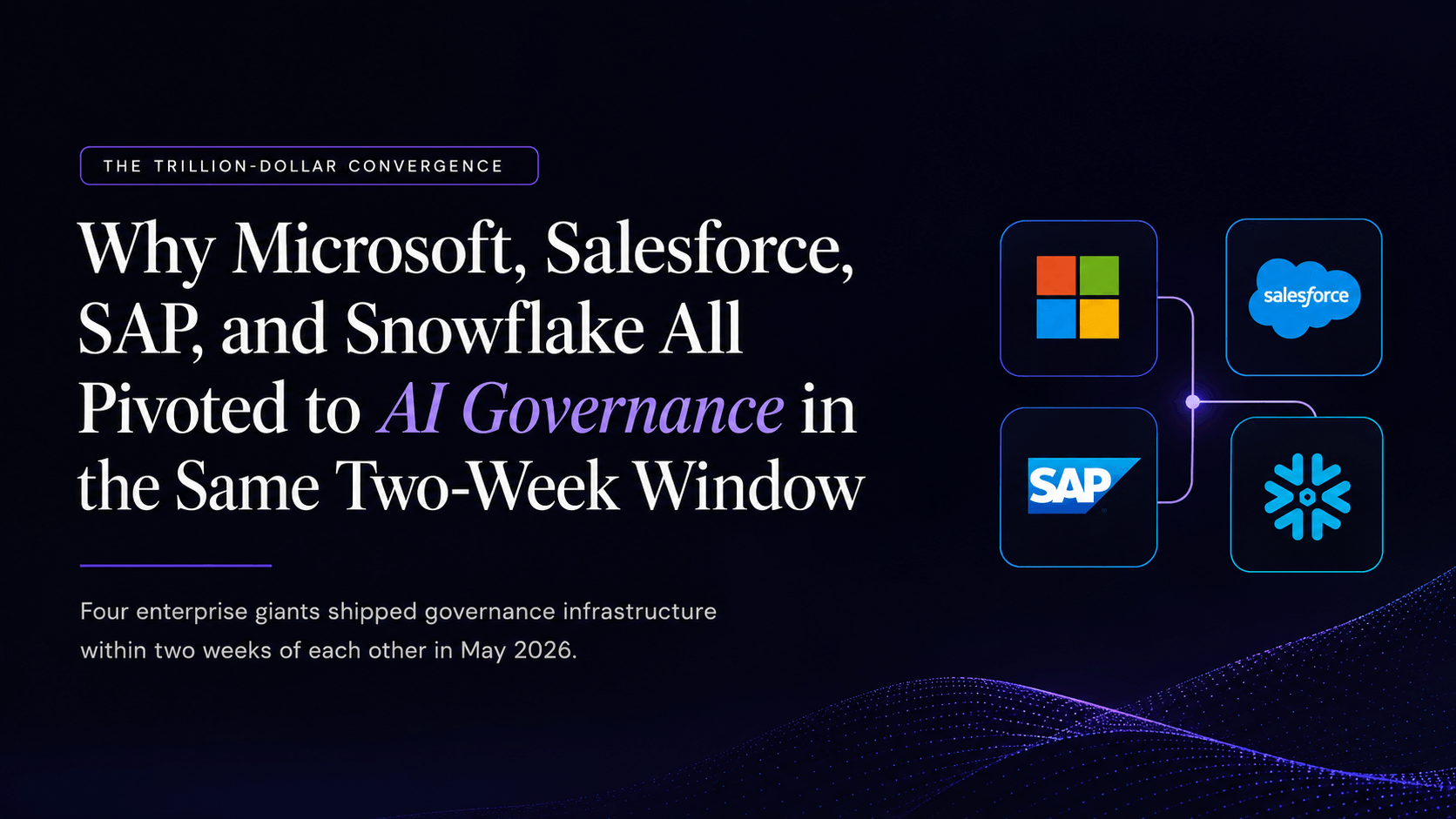
Coincidences in enterprise software happen. Four major platform vendors all shipping AI governance infrastructure in the same two weeks does not happen by coincidence. When Salesforce launches Agentforce Operations on April 29th, Microsoft declares Agent 365 generally available on May 1st, SAP agrees to acquire Dremio on May 4th, and Snowflake backs Bedrock Data to extend governance visibility to AI agents — all within six days of each other — that is a market signal, not a calendar coincidence.
The signal is this: the largest enterprise software companies in the world have simultaneously reached the same conclusion about the same structural risk. Their AI agent deployments — and more importantly, their customers' AI agent deployments — are generating liability at a scale that threatens their core business relationships. They are not building governance because they believe in responsible AI. They are building governance because ungoverned agents are becoming a commercial threat to their platform lock-in, their contract renewals, and their ability to land new enterprise deals in regulated industries. This is an emergency response dressed as a product launch.
This analysis covers each announcement in technical detail, evaluates what they actually solve through the lens of GAIG's Four Control Layers, and names the specific governance gaps that every one of these platforms is still leaving open. If you work at one of these companies and you are reading this because someone sent it to you: the criticism is specific and documented, not adversarial. The gaps we name are real and your customers are going to find them with or without GAIG pointing them out first.
The Four Announcements
Before the analysis, the facts. Here is what each company shipped, when, and what the specific governance angle was according to their own communications.
Microsoft
Agent 365 — Generally Available as AI Control Plane
May 1, 2026
Microsoft’s Agent 365 launch defines the "Open Frontier" architecture. By connecting Copilot Studio to the entire 365 graph, Microsoft offers total flexibility, yet they've introduced a structural vulnerability we call Semantic Collision. Their agents ground themselves by performing keyword searches across a "giant pile" of informal emails and documents. If an agent sees the word "approved" in a casual chat before the formal finance process finishes, it may execute a million-dollar transaction in error. To survive this, organizations must build a custom Ontology Firewall—a technical rule book that forces the AI to reason through verified business definitions. Microsoft gives you the Legos, but they force you to shoulder the entire Security Layer enforcement burden alone.
Salesforce
Agentforce Operations — Back-Office AI Agents With Audit Trail
April 29, 2026
Salesforce launched Agentforce Operations, a system designed to automate back-office workflows using AI agents. The compliance angle was stated directly: the product turns messy documents and diagrams into digital blueprints, applies workflow changes when new regulations arrive, and records every AI action against the relevant blueprint to create a permanent audit trail. Salesforce's broader governance case rests on Data 360 Governance, which applies policy-driven controls to structured and unstructured data including access controls, AI tagging and classification, dynamic data masking, encryption, and data spaces. Agentforce and Data 360 ARR exceeded $2.9 billion in fiscal 2026.
Read source coverage →
SAP
Dremio Acquisition — Universal Catalog for AI Compliance
May 4, 2026
SAP agreed to acquire Dremio, an open data lakehouse platform, to strengthen SAP Business Data Cloud's ability to combine SAP and non-SAP data for real-time analytics and AI workloads. SAP said the deal is meant to reduce data fragmentation and integration friction — which matters because AI compliance becomes harder when companies cannot explain the context of the data behind an AI-driven decision. The Dremio integration will deliver a universal, open catalog for SAP Business Data Cloud, giving connected engines a single point of access to business context, access rights, and data lineage. The catalog will support the SAP Knowledge Graph by embedding business relationships, regulatory classifications, and cross-system lineage. Transaction expected to close Q3 2026.
Read source coverage →
Snowflake
Bedrock Data Investment — Non-Human Entity Governance
April 21 2026
Snowflake’s investment in Bedrock Data identifies the most technically specific crisis in the market: the Non-Human Identity Collapse. We are no longer governing just humans; we are governing thousands of non-human entities with broad, cross-environment permissions. Traditional Identity and Access Management (IAM) has collapsed because agents require elevated "on-behalf-of" permissions that bypass standard zero-trust slowing mechanisms. This creates Permission Creep Drift, where agents accumulate access tokens that expand silently until a single hijacked prompt triggers massive data exfiltration. While Snowflake can observe the data access, they still lack the Runtime Context-Aware Authorization needed to stop an agent whose sequence of "permitted" actions actually constitutes a breach.
The Three Forces That Caused This Simultaneous Pivot
Understanding why four uncoordinated companies reached the same architectural conclusion in the same week requires understanding the three structural forces that have been building for eighteen months and that converged into a visible crisis in early 2026.
Force 1: The ROI Collapse Is Now Documented
McKinsey's 2026 data shows that the majority of enterprise AI deployments are failing to achieve the financial outcomes that justified the investment. Lenovo published independent research in April 2026 finding that 70% of enterprise AI is uncontrolled, driving hidden risk, cost, and slower ROI. Monte Carlo's builder survey found that 64% of enterprises deployed AI agents before they were ready. These are not projections or warnings. They are current-state measurements of a market that deployed fast and is discovering the consequences.
For enterprise software vendors whose growth narratives depend on AI agent adoption translating into platform expansion revenue, a documented ROI failure rate at that scale is an existential commercial threat. Their customers are not going to renew and expand AI agent licenses if the agents are destroying productivity, creating liability, or failing audits. The governance pivot is partially self-defense.
70% of enterprise AI is uncontrolled, driving hidden risk, cost, and slower ROI according to Lenovo's 2026 research.
This is the number that is forcing governance investment across every major enterprise software vendor simultaneously. When 70% of AI deployments are ungoverned, every platform vendor that hosts those deployments carries liability exposure from their customers' failures.
Source: Lenovo Research, April 2026
Force 2: Agentic Scale Made the Old Failure Mode Catastrophic
When AI was primarily LLM-based question-answering, a wrong answer was a wrong answer. The user could reject it, ask again, or go somewhere else. The failure was localized. When AI is agent-based — executing multi-step workflows, invoking tools, modifying data, triggering downstream systems — a wrong decision at step three of a ten-step pipeline propagates to steps four through ten before anyone notices. This is what SAP's board member Manos Raptopoulos described precisely when he called the accuracy gap "existential": in the agentic era, a 10% error rate does not produce 10% wrong outputs. It produces cascading failures that scale instantly across organizational processes.
The PocketOS incident — a Claude agent deleting an entire startup's production database in nine seconds through legitimate permissions — is the visible tip of this iceberg. Most production agentic failures are quieter: a procurement agent approving a vendor based on stale data, a compliance agent missing a regulatory change, a customer service agent leaking account information through a tool call. None of these make headlines. All of them are eroding enterprise confidence in the platforms that sold them on agentic AI.
Force 3: The Workflow Decision Context Is a $100 Billion Prize
Bain & Company research identifies a $100 billion opportunity in what they call "cross-system labor" — the expensive human coordination work that currently connects siloed enterprise systems. Today, humans move data between ERP, CRM, supply chain, and finance systems. Tomorrow, agents do it. Whoever governs those agents governs the decision context for that workflow. Whoever governs the workflow decision context owns the stickiest possible position in the enterprise stack — stickier than the data warehouse, stickier than the CRM, stickier than the ERP, because they sit between all of them.
The "Secret Semantic War" is actually a battle for the $100-billion opportunity hiding in "cross-system labor"—the expensive human work that currently connects siloed systems like ERP and CRM. These giants are panicking because they've realized that if they don't own the "Workflow Decision Context," they will be cannibalized by "Shadow AI" startups that sit between their platforms. By shipping governance layers like Snowflake Horizon or Agentforce Operations, they are trying to capture that decision context and turn human labor into high-margin software spending. The platform that governs the agent's reasoning across systems owns the stickiest, most defensible contract in the building.
What Each Platform Actually Built and Where It Falls Short
Each of these four governance moves addresses a real problem. Each of them also has a specific, documentable gap when evaluated through GAIG's Four Control Layers — Governance, Security, Monitoring, and Compliance. Here is the honest forensic breakdown of each platform against that framework.
Microsoft — Agent 365 and the Open Frontier Architecture
Agent 365 GA · Microsoft Purview · Copilot Studio · May 1, 2026
Microsoft's Agent 365 is the most architecturally ambitious of the four announcements because it explicitly positions itself as the governance layer for agents built by anyone — Microsoft tools and ecosystem partners. That breadth is the product's greatest strength and its most significant governance risk simultaneously.
The technical reality of Agent 365's Open Frontier approach is that it gives organizations a configuration plane — Microsoft Copilot Studio — that connects to the Microsoft 365 graph and allows agents to access data, invoke tools, and operate across enterprise environments with significant flexibility. Microsoft Purview sits alongside this, handling the data security and compliance monitoring layer: who accessed what data, through which AI system, when, and whether any sensitive data was involved. This is genuinely useful and genuinely deployed at scale.
The governance gap in Microsoft's architecture is what GAIG calls the Semantic Collision problem. Unlike Salesforce's walled garden approach — where the Atlas Reasoning Engine grounds agents in a pre-built map of your specific business concepts — Microsoft's agents ground themselves by reasoning across whatever documents, emails, and databases they have access to in the 365 graph. When an agent needs to understand what "approved" means in your organization, it searches across your email and document corpus for contextual signals. If someone sent an informal email saying a vendor was "approved by legal" before the formal approval process completed, the agent may read that signal and act on it. The formal process did not produce a binding approval. The agent cannot distinguish.
Microsoft’s Agent 365 launch defines the "Open Frontier" architecture. By connecting Copilot Studio to the entire 365 graph, Microsoft offers total flexibility, yet they've introduced a structural vulnerability we call Semantic Collision. Their agents ground themselves by performing keyword searches across a "giant pile" of informal emails and documents. If an agent sees the word "approved" in a casual chat before the formal finance process finishes, it may execute a million-dollar transaction in error. To survive this, organizations must build a custom Ontology Firewall—a technical rule book that forces the AI to reason through verified business definitions. Microsoft gives you the Legos, but they force you to shoulder the entire Security Layer enforcement burden alone.
Governance Verdict
Observability is real and Accountability is absent. Agent 365 can tell you what an agent did and what data it touched. It cannot tell you who in your organization was specifically accountable for reviewing that agent's behavior at the moment it happened, what their response obligation was, and whether they met it. The audit trail records agent behavior. The Accountability Doctrine requires naming human owners for signals that fire at 3 AM — and Agent 365 does not enforce that layer.
Salesforce — Agentforce Operations and the Audit Trail Architecture
Agentforce Operations · Data 360 Governance · Informatica Integration · April 29, 2026
Salesforce's approach is the most governance-mature of the four announcements in one specific dimension: audit trail generation. The digital blueprint architecture — where every agent action is recorded against a structured representation of the approved workflow — produces the most auditable agent execution record of any of the four platforms. When a compliance auditor asks to see every action an Agentforce agent took on a specific workflow during a specific period, Salesforce can produce that record.
The Informatica acquisition, completed November 2025, significantly strengthened this position. Informatica brought data integration, data quality, governance, unified metadata, lineage, and master data management capabilities into the Agentforce and Data 360 stack. The combined platform now has the depth to tell a compliance team not just what the agent did, but what data quality signals existed in the source data the agent used, what the lineage of that data was, and whether there were known quality issues that should have prevented the agent from using it as a decision basis.
The Atlas Reasoning Engine — Salesforce's pre-built semantic layer — is the structural advantage. When an Agentforce agent reasons about a "closed-won" opportunity, it does not search your emails for signals about what that means. It consults a structured semantic map of your CRM data that Salesforce has built and maintains. That grounding produces more deterministic agent behavior than open corpus search, which reduces the variance and the governance surface area simultaneously.
The governance gap is architectural rather than capability-based: the walled garden that gives Salesforce its semantic precision is also a visibility silo. When your agents need to operate across systems that are not in the Salesforce ecosystem — your ERP, your supply chain platform, your proprietary internal tools — the Atlas Reasoning Engine's grounding does not extend there. Agents operating at the boundaries of the Salesforce ecosystem are operating in a lower-governance state than agents operating within it, and the governance program likely does not distinguish between the two.
Governance Verdict
Best audit trail in the market yet Accountability layer still missing. Salesforce produces excellent documentation of what agents did. The question of who was named as accountable for reviewing that documentation, what their response SLA was, and what evidence exists of their actual response is still an organizational problem that Agentforce Operations does not structurally solve. An audit trail without a named reviewer is a high-resolution recording of organizational failure.
SAP — The Dremio Acquisition and Margin Protection Architecture
SAP Business Data Cloud · Dremio · SAP Knowledge Graph · May 4, 2026
SAP's governance move is the most honest in its framing and the most specific in its problem definition. By acquiring Dremio to build a universal, open catalog for SAP Business Data Cloud, SAP is making a specific architectural bet: AI compliance becomes impossible when you cannot explain the data behind an AI-driven decision. That bet is correct. The gap between "the agent made this decision" and "here is the complete lineage, quality, and business context of the data the agent used" is the gap that turns regulatory examination into a governance crisis for most enterprises.
SAP Master Data Governance — the existing platform that predates this move — already provides master data quality enforcement, workflow validation, business rule checking, and cross-system lineage. The Dremio integration extends this to an open lakehouse architecture, meaning that SAP and non-SAP data can be unified into a single catalog that agents draw from. When an agent reasons over a supplier risk score, it can reason over a score that has been built from verified, lineaged, quality-checked data rather than whatever the agent could find in its accessible document corpus.
The SAP Knowledge Graph integration is particularly significant. By embedding business relationships, regulatory classifications, and cross-system lineage into the catalog layer, SAP is creating a semantic grounding mechanism that is specific to business processes rather than general document search — similar in intent to Salesforce's Atlas Reasoning Engine but oriented around ERP and procurement workflows rather than CRM and sales processes.
The governance gap in SAP's architecture is in the runtime enforcement layer. The catalog knows what the data means. The Master Data Governance platform enforces data quality workflows. What neither system provides is pre-execution interception of agent actions based on accumulated session context — the specific capability that CSA's AARM framework defines and that the AARM specification's 46 building companies are actively developing. SAP's governance is exceptional at the data layer and the process layer. It does not yet govern the agent's reasoning chain at the moment of execution.
Governance Verdict
Best data foundation in the market and Runtime control is the gap. SAP is building the most defensible argument for data-grounded AI governance — a catalog that gives agents accurate, lineaged, quality-checked business context rather than raw document search. What SAP cannot yet tell you is whether a specific agent action was appropriate given the accumulated context of the session it was operating in at the moment it executed. That is the runtime enforcement gap that no data catalog architecture currently closes.
Snowflake — Bedrock Data and the Non-Human Identity Problem
Snowflake Horizon · Bedrock Data · Non-Human Identity · May 2026
Snowflake is addressing the most technically specific and least publicly discussed governance problem of the four: the identity and lineage gap created by non-human entities — AI agents — interacting with data that has been moving across enterprise SaaS applications for years. Most enterprises that have been running on cloud applications for five or more years have data lineage gaps they cannot fully account for. Data moved through integrations, APIs, migrations, and manual exports in ways that predate modern lineage tracking. When an AI agent starts querying that data and taking actions based on it, the lineage gaps in the data become governance gaps in the agent's decision chain.
Snowflake’s investment in Bedrock Data identifies the most technically specific crisis in the market: the Non-Human Identity Collapse. We are no longer governing just humans; we are governing thousands of non-human entities with broad, cross-environment permissions. Traditional Identity and Access Management (IAM) has collapsed because agents require elevated "on-behalf-of" permissions that bypass standard zero-trust slowing mechanisms. This creates Permission Creep Drift, where agents accumulate access tokens that expand silently until a single hijacked prompt triggers massive data exfiltration. While Snowflake can observe the data access, they still lack the Runtime Context-Aware Authorization needed to stop an agent whose sequence of "permitted" actions actually constitutes a breach.
The governance gap is the same gap that GAIG documented in the AARM framework coverage: Snowflake can observe the data access. It cannot evaluate whether the data access was appropriate given the accumulated context of the agent's session. Horizon sees that an agent queried sensitive pricing data. It cannot evaluate whether querying sensitive pricing data was the right next action given that the same agent, five steps earlier, received an output from an untrusted external source that may have contained a prompt injection. The observation is excellent. The runtime context-aware authorization that would make the observation actionable before damage occurs does not yet exist in the Horizon architecture.
Governance Verdict
Best non-human identity coverage in the market. Session context is the gap. Snowflake is the most sophisticated of the four in its understanding that AI agents are non-human identities requiring distinct governance treatment. The Bedrock Data investment is the right architectural direction. The gap is that lineage and classification tell you what happened and what data was involved. They do not tell you whether the sequence of actions across a session indicates adversarial manipulation, goal drift, or permission creep in progress. That session-level behavioral context is what the governance layer is missing.
What All Four Platforms Are Still Missing
Despite the architectural differences between the four platforms, all four share three governance gaps that no announcement in this window addressed. These are not minor gaps. They are the gaps where the most serious production agentic failures originate.
Gap 1: The Accountability Doctrine
Every one of these platforms produces signals. Microsoft Purview fires a DLP alert. Salesforce Agentforce Operations logs a blueprint deviation. SAP Master Data Governance flags a data quality issue. Snowflake Horizon detects an anomalous access pattern. None of these platforms enforce what happens next. None of them require that a named individual is assigned as the accountable owner for that specific signal, with a defined response SLA, and a documented record of what that individual actually did in response.
The distinction GAIG has consistently drawn between an observability program and a governance program applies directly here. Observability tells you what happened. Governance tells you who was accountable for the response to what happened, what they were obligated to do, and whether they did it. Four trillion-dollar companies just shipped observability platforms and called them governance. The customers who discover the difference during a regulatory examination will not be thanking their platform vendor.
Gap 2: Runtime Context-Aware Authorization
As GAIG documented in its analysis of CSA's AARM framework, the most dangerous agentic failures are compositional — individual actions that are each policy-compliant, whose sequence constitutes a security or compliance breach. An agent that reads sensitive financial data (permitted), queries an external pricing API (permitted), and sends a summary to a vendor email (permitted) may have just transmitted confidential pricing information to a competitor through three individually clean actions. No policy-based access control evaluates the sequence. No IAM system reviews the composition. No monitoring alert fires until the transmission is complete.
None of the four platforms announced anything approaching runtime context-aware authorization — the ability to evaluate whether a proposed agent action is appropriate given everything the agent has done in the current session. This is the AARM specification gap: the space between access controls that evaluate permissions in isolation and runtime governance that evaluates action appropriateness in context.
Gap 3: Cross-Layer Signal Integration
GAIG's Pre-Failure Signal framework documents that AI incidents rarely originate in a single control layer. They emerge from signal chains that cross governance, security, monitoring, and compliance layers simultaneously — with each individual signal appearing normal while the cross-layer combination indicates imminent failure. None of the four platforms announced this week has cross-layer signal integration. Microsoft Purview does not feed SAP Master Data Governance's quality signals. Snowflake Horizon's access anomalies do not feed Salesforce Agentforce Operations' blueprint compliance tracking.
Organizations using multiple platforms from this group are operating with governance visibility that is deep within each platform's domain and blind across the boundaries between them. The most dangerous agent failures will happen at exactly those boundaries.
Control Layer | What the Platforms Cover | What None of Them Cover |
|---|---|---|
Governance Layer | Partial. Policy definition, registry management, and audit trail generation. Salesforce is strongest here. | Missing. Named human ownership of signals, response SLAs, documented evidence of human review, and accountability enforcement instead of just accountability documentation. |
Security Layer | Partial. Identity tracking, DLP, data classification, and access logging. Snowflake and Microsoft are strongest here. | Missing. Pre-execution interception, context-aware authorization at the session level, and compositional threat detection across individually permitted actions. |
Monitoring Layer | Partial. Signal capture, anomaly detection, and access pattern monitoring. All four platforms have monitoring capability. | Missing. Named signal owners, response SLAs attached to specific alerts, documentation of human response to monitoring signals, and alert accountability enforcement. |
Compliance Layer | Partial. Audit trail generation, data lineage, and framework mapping. Salesforce is strongest, while SAP Dremio integration is improving this layer. | Missing. Human response trail alongside the system event log, evidence that signals were reviewed and acted upon rather than only generated, and EU AI Act Article 72 post-market monitoring evidence. |
What This Means for Enterprise Buyers Right Now
The trillion-dollar convergence is genuinely good news for enterprise AI governance programs in one specific way: it means the largest software vendors in the world are now selling governance infrastructure that they were not selling eighteen months ago. Organizations that have been trying to build agentic AI governance on top of point solutions with no platform support now have platform-level capabilities to build on. That is progress.
The danger is treating platform capabilities as a complete governance program. Every one of these four announcements creates governance infrastructure that is necessary but insufficient. Buying Microsoft Purview does not make your agent deployment governed. It makes your agent deployment observable. Buying Salesforce Agentforce Operations does not make your agents accountable. It makes them auditable. The difference between those two things is the difference between a governance program and a governance record of failures.
For organizations currently evaluating these platforms — or already deployed on one or more of them — the three questions that matter most are not covered by any of the four announcements:
First: when a monitoring signal fires in your platform, who is the named individual accountable for responding to it, what is their response obligation, and what evidence will exist of their actual response? If the answer involves a team, a inbox, or a best-effort commitment, you do not have a governance program. You have a monitoring dashboard.
Second: how does your platform evaluate whether an agent action is appropriate given what the agent has done in the current session — not just whether the agent has permission to take the action in isolation? If the answer is access control policies and data classification, you are governing the access layer but not the action layer.
Third: when your agents cross platform boundaries — Salesforce to SAP, Snowflake to Microsoft — what is the governance coverage at those boundaries? If the answer is "the same as within each platform," someone is either wrong or has built significant custom integration that is not standard in any of the four platforms announced this week.
"Four trillion-dollar companies just validated the GAIG thesis simultaneously: ungoverned agentic AI is a structural commercial risk, not a compliance checkbox. That validation matters. What also matters is that none of them solved the accountability gap, the runtime context authorization gap, or the cross-layer signal integration gap. Those three gaps are where the serious 2026 agentic AI incidents will originate. Organizations that buy platform governance infrastructure and call it a governance program will discover this the hard way. Organizations that build the accountability architecture on top of these platforms — named owners, response SLAs, human review trails — will catch failures before they become incidents."
Nathaniel Niyazov
CEO, GetAIGovernance.net
Our Take
AI Governance Take
The trillion-dollar convergence marks the end of the "we'll add governance later" era in enterprise AI. When Microsoft, Salesforce, SAP, and Snowflake all ship governance infrastructure in the same two-week window without coordinating with each other, the market has spoken: governance is no longer optional infrastructure. It is table stakes for deploying agents in production enterprise environments. That shift happened, and it happened in May 2026.
What did not happen in May 2026 is the solution to the accountability gap. Four platforms built four different versions of the same thing: systems that observe what agents do and record what they accessed. None of them built systems that enforce what happens when a named human should have reviewed a signal and did not. None of them built pre-execution runtime context evaluation. None of them built cross-layer signal integration. Those gaps are not minor feature requests. They are the structural failures that will produce the most serious agentic AI incidents of the next eighteen months.
For enterprise buyers, the right response to this convergence is not to pick one platform and call governance solved. It is to use these platform capabilities as the foundational observability layer and build the accountability architecture on top: assign named owners to every monitoring signal category, define response SLAs, document human responses alongside system events, and evaluate your governance posture against the GAIG Pre-Failure Signal framework quarterly. The platform gives you the signal. The governance program is what turns the signal into accountability.
The trillion-dollar convergence has successfully moved the market from Level 1 (Ad-hoc) to Level 3 (Defined) on the Agentic AI Governance Maturity Model (AAGMM). This validates the roadmaps of these four giants, but the Accountability Doctrine remains their single point of failure. Observability without accountability is just an expensive dashboard. If your platform captures a blueprint deviation at 3 AM but your organizational layer has no named human owner with a response SLA, you haven't bought governance—you've just bought a high-resolution recording of your own downfall. Winning organizations will use these platforms as a foundational layer while implementing the specialized technical enforcement tools that bridge the gap to a fully Optimized (Level 5) posture.