Why You Can Trust GetAIGovernance + Our Research
Every vendor on this page was evaluated against the same criteria using public documentation, funding disclosures, integration listings, customer evidence, and independent industry recognition. No vendor paid to be ranked. Rankings reflect our independent editorial assessment of each platform's fit, depth, and differentiation within the AI governance category. BE AWARE, THE NUMBER RANKINGS "#1, #2... DO NOT MEAN THE COMPANY IS BETTER THAT IS JUST HOW THEY WERE LISTED. ONE COMPANY IS NOT BETTER BECAUSE OF THE AMOUNT OF FUNDING OR THE TIME THEY'VE BEEN ACTIVE.
AI governance has become a required layer in enterprise AI adoption, but most organizations evaluating platforms are trying to solve different problems without realizing it. Some need to track regulatory exposure. Others need internal approval workflows across competing teams. Some are trying to understand what their deployed models are doing in production right now. These are distinct challenges, yet the market groups them all under the same label.
The result is a category where "AI governance platform" gets applied to systems operating at completely different layers of the AI lifecycle. Buyers compare platforms that are not direct substitutes, end up with tools that cover one or two layers well and leave the rest unaddressed, and build governance programs that look complete on paper but fail when real operational pressure arrives.
AI governance platforms structure how decisions are made, reviewed, documented, and approved across the lifecycle of AI systems. They define policies, assign ownership, evaluate risk, and maintain evidence for internal stakeholders, auditors, and regulators. They function as coordination infrastructure across teams. This separates them from monitoring platforms, which track model performance and drift; security platforms, which protect systems from adversarial behavior; and compliance platforms, which map systems to regulatory frameworks. Governance platforms define how decisions about those systems get made and who is accountable for them.
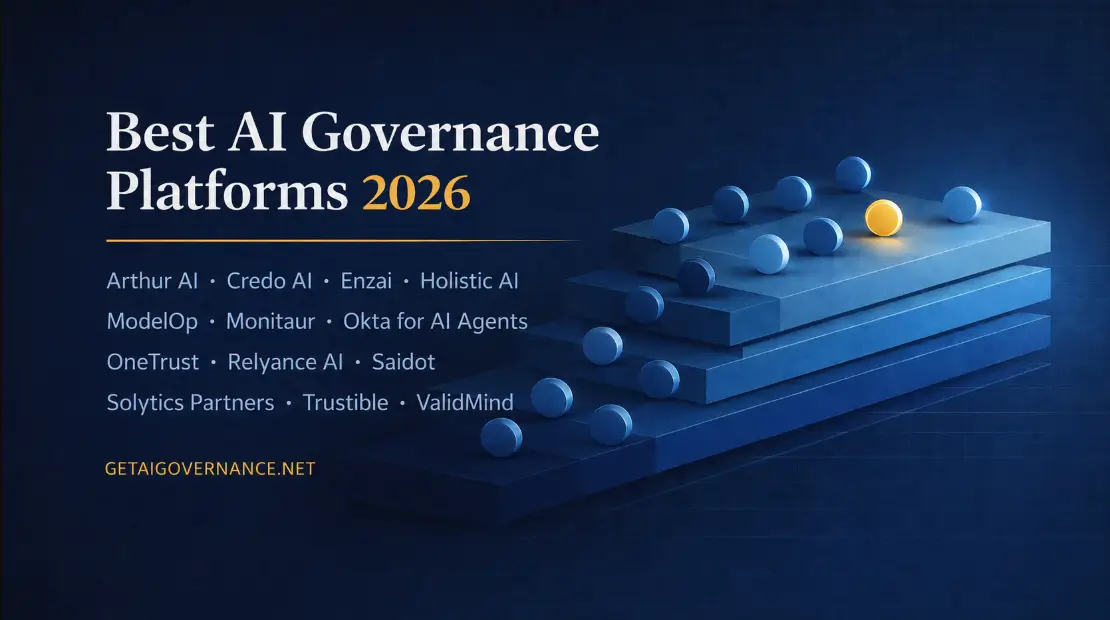
This guide compares thirteen AI governance platforms organized around the fourteen capabilities that constitute the governance stack, as defined in our AI Governance Capabilities framework. Two platforms — ModelOp and ValidMind — each cover two capabilities, which is noted in their entries. Every other platform anchors one capability where its depth is most defensible. The goal is not to rank platforms by company size or funding, but to clarify which system fits which operational problem.
What AI Governance Platforms Actually Do
AI governance platforms help companies manage how AI systems get approved, documented, and watched over time. They don’t build the AI, monitor how it performs every day, or protect it from hackers. Instead, they act like a coordination system that sits on top of everything else. They help decide who reviews an AI idea, how risky it is, what papers need to be filled out, who gives the final approval to use it, and what proof is kept to show the process was followed correctly.
Its also good to note that not all AI is the same, so not all governance should be the same either. Some AI tools are simple and low risk, while others make big decisions that can affect people’s lives or money. Because of this, different types of AI need different kinds of governance. One single platform cannot properly handle every type of AI and every level of risk at the same time. The platforms in this guide focus on different parts of governance, and companies often need more than one to cover everything properly.
Right now, most companies handle this in a messy way — through emails, spreadsheets, and quick chats in the hallway. Someone on a team comes up with an AI idea. Then another person decides how risky it is. Someone else checks if it follows company rules or the law. A group of people might approve it. Then someone has to write everything down. Each of these steps is part of governance. The problem is that when this process is messy and unclear, things get missed or done wrong. That’s where problems and risks show up later. The platforms in this guide help fix different parts of this process, some more technically than others.
How We Evaluated These Platforms
Governance Capability Depth: Does the platform deliver genuine operational depth in its primary capability, or surface-level coverage of many things at once?
Third-Party Validation: What independent analyst recognition, named customer evidence, or industry awards verify the placement?
Lifecycle Coverage: Does governance operate pre-deployment, post-deployment, or across both?
Technical Integration: How deeply does the platform connect to real AI infrastructure, rather than depending on what teams choose to document?
Regulatory Alignment: Which specific frameworks and laws does the platform address, and how?
Buyer Fit: What company size, industry, and internal buyer does this serve best?
The AI Governance Platforms: A Quick Overview
ModelOp appears twice in this table because their platform covers two distinct governance capabilities: Operational Governance / Lifecycle and Agentic AI Governance & Execution Authority Boundaries. Each entry addresses a different functional need. No other platform in this guide covers more than one capability.
A quick look at all nine platforms covered in this guide:
Platform | Pricing | Primary Capability | Best For |
|---|---|---|---|
Contact for pricing | Runtime Control | Organizations deploying LLMs and autonomous agents that need enforcement at the point of execution rather than detection after the fact | |
Contact for pricing | Risk & Control Definition | Global enterprises standardizing policy and risk classification across large, multi-framework AI portfolios | |
Contact for pricing | Workflow & Decision Layer | Organizations standing up structured AI intake and approval processes, especially those with EU AI Act or ISO 42001 obligations | |
Contact for pricing | Visibility & Discovery | Enterprises that need automated shadow AI discovery before formal governance controls can be applied | |
Contact for pricing | Operational Governance / Lifecycle, and Agentic AI Governance & Execution Authority Boundaries | Large enterprises managing AI portfolios across multiple teams, regulatory environments, and AI types simultaneously | |
Contact for pricing | Technical Assurance & Monitoring | Regulated enterprises, particularly insurance and financial services, that need production governance tied to real system behavior | |
Contact for pricing | Identity Governance for AI Systems | Enterprises bringing AI agents under the same identity controls that govern human employees and service accounts | |
Contact for pricing | Third-Party AI Governance | Compliance-led enterprises already operating within OneTrust's privacy or risk ecosystem and needing vendor AI oversight at scale | |
Contact for pricing | Data Governance | Enterprises that need real-time visibility into how AI systems consume, move, and expose enterprise data | |
Contact for pricing | AI Bill of Materials & Supply Chain Risk | European organizations prioritizing component-level AI transparency and EU AI Act provenance requirements | |
Contact for pricing | Regulated Industry Model Risk Governance | Banks, insurers, and financial services firms operating under SR 26-2, PRA SS1/23, OSFI E-23, MAS FEAT, RBI FREE-AI, or equivalent supervisory frameworks | |
Contact for pricing | Compliance & Evidence | Large enterprises and government agencies operationalizing governance from manual processes into repeatable, auditable workflows | |
Contact for pricing | Agentic AI Governance & Execution Authority Boundaries, and Policy-as-Code | Regulated financial institutions building machine-executable governance for AI agents and traditional model portfolios simultaneously |
The Best AI Governance Platforms:
Arthur AI #1 — Best for Runtime Control and LLM Enforcement at the Point of Execution
Most Purpose-Built Platform for Enforcing AI Policy During Execution
Choose Arthur AI if: your organization has LLMs or AI agents operating in production and you need controls that block harmful outputs, prompt injection attempts, and unauthorized tool access in real time — before those actions complete, not after a logging system surfaces them.
Founded: 2018
HQ: New York, NY
Company Size: ~51 employees
Funding: $63M total — $42M Series B (September 2022) led by Acrew Capital and Greycroft, with Index Ventures and Work-Bench participating
Recognition: Google Cloud Marketplace availability (January 2026); AWS Marketplace availability; Secure Privacy named Arthur as best for agentic AI governance among purpose-built platforms (June 2026)
Arthur AI's runtime governance platform includes two products that address the execution layer directly. Arthur Shield is a firewall for LLM applications that runs between the application and the model endpoint, detecting PII leakage, hallucinations, prompt injection attempts, and toxic language in real time. It deploys as SaaS or on-premises and evaluates both incoming prompts and outgoing responses before they reach users. The Agent Discovery & Governance (ADG) platform, launched in December 2025, extends that enforcement to autonomous agents — discovering all agents running in an environment, monitoring their behavior in production, and enforcing policy controls on what those agents can access and do.
Most governance platforms in this article operate at the documentation and workflow layer. They define what AI systems should do, record who approved them, and maintain evidence for auditors. Arthur operates at the execution layer. Shield intercepts requests and responses in milliseconds, applying configurable rules that block unsafe outputs or flag them for human review. The ADG platform applies the same logic to agents that chain multiple tool calls together across long-running workflows — the class of system where documentation-based governance has the least traction, because no human can review every intermediate step at machine speed.
Arthur has been available on Google Cloud Marketplace since January 2026 and on AWS, with native integrations into Vertex AI, BigQuery, LangChain, LlamaIndex, CrewAI, and the OpenAI Agents SDK. Their regulatory alignment maps specifically to the EU AI Act's Annex III high-risk system obligations and the OWASP Top 10 for LLM Applications, which covers prompt injection, sensitive information disclosure, and excessive agency — the three categories of harm that runtime enforcement is designed to prevent. For organizations under NIST AI RMF, Arthur's Shield and ADG telemetry map to the Govern, Map, Measure, and Manage functions by producing continuous behavioral evidence from production systems.
Arthur sits at a different position in the governance stack than every other platform in this guide. The buyer who needs Arthur is not primarily asking "have we documented our AI systems?" They are asking "what is this agent doing right now, and can we stop it if the answer is wrong?" The platform is best suited for engineering and security teams deploying LLMs and agents at production scale, where governance has to be operational rather than aspirational. Organizations evaluating Arthur should pair it with a policy and risk management platform — Credo AI or Trustible, depending on their compliance requirements — because runtime enforcement without policy definition leaves you stopping things without knowing which things to stop.
✓ What We Like
Real enforcement, not detection: Arthur Shield blocks unsafe outputs before they reach users, rather than logging them for later review.
Agent-specific governance: The ADG platform was built from the ground up for autonomous agents, not retrofitted from traditional ML monitoring.
Cloud marketplace availability: Available on both Google Cloud Marketplace and AWS, which simplifies procurement for organizations already committed to those environments.
Framework-agnostic architecture: Integrates with LangChain, LlamaIndex, CrewAI, OpenAI Agents SDK, PydanticAI, and Haystack without requiring teams to rewrite agent code.
Behavioral evidence generation: Continuous production telemetry supports NIST AI RMF and EU AI Act Annex III documentation requirements automatically.
Open-source tools: Arthur Bench for LLM evaluation and Arthur Engine for monitoring and guardrails are available on GitHub under permissive licenses.
⚠ What to Know
Arthur is an execution-layer platform, not a full governance lifecycle system. Organizations also need policy definition, risk assessment, and compliance documentation tools.
The ADG platform was launched in December 2025, making enterprise deployment evidence still early compared to Arthur Shield's longer production history.
Deep configuration of Shield's rule sets requires engineering involvement — this is not a tool compliance teams can stand up independently.
Named enterprise customer references are less prominent in public documentation compared to some other platforms in this guide.
Governance Coverage
Runtime Control
LLM Prompt and Output Enforcement
Agent Discovery and Behavioral Monitoring
Policy Enforcement at Execution
Behavioral Evidence Generation
Regulatory Frameworks
EU AI Act (Annex III High-Risk Obligations)
NIST AI RMF (Govern, Map, Measure, Manage)
OWASP Top 10 for LLM Applications
OWASP Top 10 for Agentic Applications
Best For
Engineering and security teams: Organizations deploying LLMs and agents in production who need enforcement infrastructure, not compliance documentation.
Cloud-native AI environments: Teams building on Google Cloud or AWS who want governance that runs natively in their existing infrastructure.
Regulated industries with agentic deployments: Financial services, healthcare, and government organizations where autonomous agent actions carry direct operational, legal, or financial consequences.
Pricing: Not publicly listed. Enterprise sales conversations required. Contact Arthur AI directly or request a match through GetAIGovernance.net.
Credo AI #2 — Best for Risk Classification and Control Mapping Across Regulatory Frameworks
Most Externally Validated Risk and Policy Governance Platform
Choose Credo AI if: you are managing AI across multiple business units and need a centralized system that standardizes how models, applications, agents, and datasets are classified, evaluated, and approved against regulatory and internal policy requirements — and you need independent analyst validation that the approach is sound.
Founded: 2020
HQ: Palo Alto, CA
Company Size: ~70 employees
Funding: $41.3M (Series A-II / Series B)
Recognition: Forrester Wave Leader, AI Governance Platforms, Q3 2025; Fast Company Most Innovative Companies 2026, ranked #6 in Applied AI; Gartner Market Guide inclusion
Credo AI's governance platform, centered on their GAIA (Governance AI Assistant) orchestration layer, operates as a centralized governance system across an organization's AI portfolio. GAIA translates regulatory requirements from the EU AI Act, NIST AI RMF, ISO 42001, and other frameworks into operational policy packs — structured controls that governance teams apply to AI systems during intake and ongoing review. The platform connects risk classification, policy definition, and control mapping into a single workflow rather than treating them as separate administrative tasks.
The Forrester Wave Leader placement in Q3 2025 reflects Credo AI's position as the platform with the most mature approach to what Forrester calls "governance orchestration" — the process of coordinating risk decisions across multiple frameworks simultaneously without duplicating work. A financial services firm subject to both the EU AI Act and NIST AI RMF requirements does not need to run two separate assessment processes; GAIA maps controls across both frameworks and surfaces where a single control satisfies obligations in multiple regimes. That cross-mapping capability is where Credo AI's depth shows most clearly.
The platform extends into agentic AI with registries and governance workflows for autonomous systems, giving organizations visibility into how agents are deployed and how they interact with enterprise infrastructure. This is earlier-stage than Credo AI's core risk and policy capabilities — their agent governance story is developing rather than fully proven — but it reflects where the market is heading and positions organizations to apply the same governance disciplines to agents that they have already established for traditional models.
Credo AI is deployed in large enterprises operating in regulated environments across financial services, healthcare, energy, and government. The Fast Company MIC recognition and Forrester Wave Leader placement give procurement teams the external validation signals they need to justify selection. Organizations evaluating Credo AI should be prepared for an implementation process that requires coordination across legal, compliance, data, and technical teams; the platform's breadth means it touches more internal stakeholders than most of its competitors.
✓ What We Like
Independent analyst recognition: Forrester Wave Leader and Gartner Market Guide inclusion provide the external validation that enterprise procurement teams require.
Cross-framework control mapping: GAIA maps a single control to multiple regulatory frameworks simultaneously, reducing duplication for organizations subject to more than one regime.
Policy pack architecture: Pre-built policy packs for EU AI Act, NIST AI RMF, and ISO 42001 reduce the time required to stand up initial governance programs.
Governance orchestration depth: The platform coordinates intake, classification, assessment, approval, and ongoing oversight without treating each as a separate system.
Agentic AI visibility: Early support for governing autonomous systems and agent-based workflows, with registries and approval workflows for agents.
⚠ What to Know
Credo AI requires coordination across legal, compliance, data, and technical teams for full implementation — this is not a tool one function can stand up alone.
Deep technical model evaluation is less developed than their policy and workflow capabilities; organizations needing production monitoring should pair Credo AI with a monitoring platform.
Enterprise pricing and sales process are standard for this market segment but represent a meaningful commitment compared to mid-market alternatives.
Agent governance capabilities are still maturing relative to their core risk and compliance functions.
Governance Coverage
Risk & Control Definition
AI Inventory / RegistryPolicy Workflows
Approval Systems
Cross-Framework Control Mapping
Governance Orchestration
Evidence Generation
Agentic AI Governance (Emerging)
Regulatory Frameworks
EU AI Act
NIST AI RMF
ISO 42001
GDPR
HIPAA
Best For
Global enterprises: Organizations managing AI across multiple business units and regulatory regimes who need a single classification and control mapping system.
Regulated industries: Financial services, healthcare, energy, and government teams where governance must satisfy multiple overlapping frameworks simultaneously.
AI governance and risk teams: Programs where the primary challenge is standardizing how different teams assess and approve AI systems, not just documenting what those systems do.
Pricing: Not publicly listed. Enterprise sales conversations required. Contact Credo AI directly or request a match through GetAIGovernance.net.
Enzai #3 — Best for AI Governance Intake and Approval Workflow Infrastructure
Best Governance Workflow Platform Built on Legal Architecture
Choose Enzai if: your organization needs to stand up a structured intake, assessment, and approval process for AI systems — especially one that must hold up under EU AI Act, ISO 42001, or UK public sector scrutiny — and you want a platform whose governance frameworks were built by lawyers who worked on those regulations, not adapted from generic GRC templates.
Founded: 2021
HQ: Belfast, Northern Ireland
Company Size: ~30–50 employees
Funding: $4M seed (Cavalry Ventures, Seedcamp)
Recognition: ISO/IEC 27001 certified; active deployment in UK public sector and Fortune 500
Enzai's Platform is built around what its founders call "governance-by-design" — embedding regulatory controls into the point where AI systems enter an organization, before any development or procurement spending happens. The founders are a corporate AI regulation lawyer who worked at leading London law firms and a software engineer with over a decade of enterprise product experience. That combination shows up in the compliance framework library: pre-built frameworks for the EU AI Act, ISO 42001, NIST AI RMF, Colorado AI Act, and NYC Local Law 144 that were written by legal professionals who understand what auditors and regulators actually examine, rather than frameworks assembled from public documentation by a product team.
The Platform's intake function uses dynamic questionnaires that adapt based on the type of AI system being submitted — the questions asked for a third-party vendor product differ from those asked for an internally built agentic system or a hybrid deployment. Risk tiers are assigned automatically based on intake responses, routing each submission to the appropriate stakeholders for review. Procurement, IT, legal, and compliance teams receive tasks inside the systems they already use, including Jira, ServiceNow, and Slack, so governance coordination doesn't require people to learn a new tool. One-click reporting generates structured system reports that aggregate risk assessments, policy evidence, data lineage, and human oversight documentation into a single exportable PDF or Word file, which is what external auditors and regulators ask for.
Enzai's verified deployments include a top-five US city managing AI governance across departments with strict public transparency requirements, and a Fortune 500 manufacturing and retail corporation operating across the US and Europe under complex industrial regulations. The municipal deployment is particularly notable because public sector AI governance requires community-facing transparency documentation — Enzai's "Transparency Card" feature generates explainable summaries of how each system operates, which satisfies the kind of public disclosure obligations that exist in cities and states with AI transparency laws. The Platform is ISO 27001 certified and hosted on AWS or Microsoft Azure with data residency controls.
Enzai has raised $4M in seed funding, the least of any company in this guide, and that number cuts both ways. A small raise can mean a company is early and thinly capitalized. It can equally mean a company is generating enough revenue that it has not needed to go back to the market. Enzai's accounts are filed publicly at Companies House under registration NI681546, and buyers who treat vendor financial stability as a procurement criterion can read them and form their own view. The caveat that carries more weight for a procurement team is a different one: both of Enzai's flagship deployments, a top-five US city and a Fortune 500 manufacturer, appear in public documentation as anonymized case studies, so buyers who need attributable references should ask for them directly. On the platform itself, Enzai's legal-first architecture gives them a genuinely differentiated position in the workflow and decision layer compared to platforms that treat compliance framework alignment as a feature rather than a founding discipline.
✓ What We Like
Legal-first framework library: Pre-built compliance frameworks written by practicing AI regulation lawyers, covering EU AI Act, ISO 42001, NIST AI RMF, Colorado AI Act, and NYC LL144.
Dynamic intake questionnaires: Questions adapt based on AI system type, deployment context, and data usage — reducing irrelevant friction while capturing the information that actually matters for risk decisions.
Public sector deployment evidence: Active use in a top-five US city and Fortune 500 environments provides credible reference points for both government and large enterprise buyers.
One-click audit reporting: Generates structured system reports for external auditors without requiring governance teams to manually assemble documentation.
Workflow integration: Pushes governance tasks into Jira, ServiceNow, and Slack so cross-functional stakeholders don't have to learn new tooling.
ISO 27001 certified: Provides baseline information security assurance for enterprise and public sector procurement requirements.
⚠ What to Know
Seed-stage company with $4M raised — vendor financial stability is a legitimate evaluation criterion for enterprise procurement teams with multi-year horizon requirements.
Both major named deployments appear in public documentation as anonymized case studies, not attributed reference customers.
The platform is strongest at intake and approval workflows; organizations also needing production monitoring or deep technical model validation require additional tools.
UK and EU regulatory alignment is the core design context — organizations primarily navigating US state-specific frameworks may need to evaluate how well those are covered.
Governance Coverage
Workflow & Decision Layer
AI Intake and Approval
AI RegistryPolicy Management
Compliance Frameworks
Risk Assessments
Audit Logging and Evidence Capture
Transparency Enablement
Regulatory Frameworks
EU AI Act
ISO 42001
NIST AI RMF
Colorado AI Act
NYC Local Law 144
UK AI Policy Principles
ISO/IEC 27001
Best For
Organizations with EU AI Act or ISO 42001 obligations: Companies that need compliance frameworks written by legal professionals rather than mapped from public documentation.
Public sector organizations: Government agencies and municipalities managing AI transparency requirements and public disclosure obligations alongside governance controls.
Enterprises standing up governance programs from scratch: Organizations that currently manage AI intake through email and spreadsheets and need a structured, scalable process that legal and compliance teams can actually operate.
Pricing: Not publicly listed. Contact Enzai directly or request a match through GetAIGovernance.net.
Holistic AI #4 — Best for AI Visibility and Shadow System Discovery
Best for Automated Discovery Across the Enterprise AI Estate
Choose Holistic AI if: you cannot reliably answer the question "what AI systems are running across this organization right now?" and you need automated scanning infrastructure to surface shadow AI before formal governance controls can be applied.
Founded: 2020
HQ: London, UK
Company Size: ~79 employees
Funding: $15M+ raised (Mozilla Ventures, Tola Capital)
Recognition: Gartner Magic Quadrant for AI Governance Platforms, Challenger (June 2026), with a first-place ranking in the Risk and Compliance use case and a top-three ranking for Agentic Governance in the accompanying Critical Capabilities analysis; Leader, Avasant Responsible AI Platforms RadarView (2025); Everest Group Major Contender; Modulos named Holistic AI as operating at the intersection of compliance and runtime enforcement among governance platforms (May 2026)
Holistic AI's governance platform includes Guardian Agents, a continuous discovery and enforcement architecture that operates in two modes. Sentinel Agents scan cloud platforms, code repositories, GitHub, Databricks, AWS, Azure, and 20+ additional integrations on a continuous basis, surfacing AI systems that were never formally registered — including model dependencies embedded in codebases and third-party applications that teams didn't know counted as AI. Operative Agents move beyond detection into real-time intervention, applying kill switches, blocking access, and revoking privileges when systems operate outside defined governance parameters.
Most AI governance programs operate on an incomplete inventory. Systems arrive through developer experimentation, vendor SaaS updates, and business unit purchasing decisions that bypass formal review. A policy framework applied to the wrong set of systems, because the right set was never documented, produces governance records that look complete while covering only a fraction of the actual AI estate. Holistic AI's Guardian Agents address that foundational problem before any of the documentation and workflow layers above it can function correctly. You cannot risk-classify, approve, or monitor systems you do not know exist.
Beyond discovery, the platform includes bias detection, robustness testing, and LLM evaluation capabilities that feed technical evidence into governance workflows. The adversarial testing work deserves attention on its own terms. Holistic AI's research arm, HAI Labs, publishes at major AI conferences and competes in red-teaming and jailbreaking events, and that research feeds back into the platform's evaluation tooling. For EU AI Act compliance, Holistic AI applies a Red, Amber, Green risk classification framework that maps discovered systems to the Act's risk tiers with structured scoring. This positions them at the intersection of visibility and technical assurance. The Modulos analysis from May 2026 specifically noted that Holistic AI is one of the few compliance-first platforms to have built genuine runtime intervention capabilities through the Operative Agents architecture rather than stopping at observation.
Holistic AI is well suited for organizations with complex cloud environments and large numbers of AI systems accumulated over several years without centralized tracking. Their integration footprint covers the environments where enterprise AI actually lives, meaning cloud providers, code repositories, and the SaaS platforms used by line-of-business teams, rather than only the environments where governance teams think AI should live. The Gartner Challenger placement in June 2026, combined with a first-place ranking in the risk and compliance use case, gives procurement teams an independent signal that the discovery-plus-enforcement approach holds up under analyst scrutiny.
✓ What We Like
Guardian Agents architecture: Continuous automated scanning across cloud environments, codebases, and SaaS, rather than a periodic audit that surfaces what was already known.
Operative Agents with real intervention capability: The platform can act on what it discovers. Kill switches, privilege revocation, and access blocking are available.
Wide integration footprint: AWS, Azure, GitHub, Databricks, Hugging Face, and 20+ additional platforms cover the environments where enterprise AI actually accumulates.
Gartner Challenger with a top use-case ranking: Independent analyst placement in the 2026 AI Governance Platforms Magic Quadrant, with first place in the risk and compliance use case and a top-three position for agentic governance.
Adversarial testing depth: HAI Labs contributes published research and competitive red-teaming results back into the platform's evaluation capabilities, which is a different class of evidence than a feature list.
EU AI Act risk classification: Red, Amber, Green scoring maps discovered systems to the Act's risk tiers with a consistent methodology across the full estate.
⚠ What to Know
Discovery capability requires real access to cloud environments and codebases. The scope of what gets surfaced depends on which integrations are enabled and what access Holistic AI is granted.
The platform spans multiple governance layers, which makes scoping an initial implementation more complex than single-capability platforms.
Technical evaluation features require data science or engineering involvement. Compliance teams cannot operate them independently.
At roughly $15M raised and around 50 employees, Holistic AI is a mid-size vendor competing against platforms with substantially larger balance sheets. Buyers with multi-year vendor stability requirements should weigh that alongside capability.
Named enterprise customer references in public documentation are less specific than for some other platforms in this guide.
Governance Coverage
Visibility & Discovery
AI Inventory / Registry
Shadow AI DetectionRisk Assessments
Bias and LLM Evaluation
Technical Assurance Workflows
Runtime Intervention (Operative Agents)
Regulatory Frameworks
Best For
EU-exposed enterprises: Organizations requiring structured risk classification aligned with EU AI Act expectations across a large, partially undocumented AI estate.
Organizations with visibility gaps: Companies that have accumulated AI systems over years without centralized tracking and need to establish a complete inventory before governance can scale.
Technical governance teams: Programs that want governance decisions supported by model evaluation evidence, not only documentation of what systems were intended to do.
Pricing: Not publicly listed. Enterprise sales conversations required. Contact Holistic AI or request a match through GetAIGovernance.net.
ModelOp #5 — Best for Enterprise-Wide AI Lifecycle Governance and Agentic AI Delivery
Best System-of-Record for Managing AI Across the Full Lifecycle at Portfolio Scale
Choose ModelOp if: your organization is managing AI across multiple business units, regulatory environments, and AI types — machine learning models, generative AI, agentic systems, and third-party tools — and you need a single coordinated system that governs all of them from intake through retirement without relying on fragmented team-level processes.
Founded: 2016
HQ: Chicago, IL
Company Size: ~45 employees
Funding: ~$10M Series B
Recognition: Gartner Magic Quadrant for AI Governance Platforms, Visionary (2026); Forrester Notable Provider; Fidelity named as reference customer; Gartner Peer Insights featured
Note: ModelOp covers two capabilities in this guide — Operational Governance / Lifecycle and Agentic AI Governance & Execution Authority Boundaries. This entry addresses both. The MADE engine covers lifecycle governance; per-use-case agent approvals and network-level agent blocking address agentic governance. Both are part of the same platform.
ModelOp's platform is built around a system-of-record architecture that gives enterprises a single source of truth for every AI system in their environment — traditional machine learning models, generative AI applications, autonomous agents, and third-party AI tools — across their full lifecycle from intake to retirement. Their MADE engine (Model AI Delivery Engine), launched in June 2026, is the operational core of this lifecycle management: it coordinates governance checkpoints at every stage of an AI system's existence, applies enforceable controls, and maintains the continuous documentation chain that auditors and regulators examine. Fidelity is a named reference customer, which matters in a market where most platforms avoid naming who actually uses them at scale.
The Gartner Magic Quadrant Visionary placement in 2026 reflects ModelOp's position as the platform with the most complete lifecycle automation story among mid-market governance vendors. ModelOp's 50+ technology integrations connect governance processes to the actual systems where AI is built and deployed — MLOps tools, cloud platforms, data pipelines, and enterprise applications — rather than requiring teams to manually register systems in a separate governance interface. That integration depth is what separates a system-of-record approach from a documentation approach: the record updates because the system is connected to what's actually happening, not because someone remembered to update a form.
The agentic governance capabilities in ModelOp address the specific problem that traditional lifecycle governance frameworks were not designed for: AI systems that take actions sequentially across tools and APIs, where each individual step looks authorized but the cumulative chain of actions can exceed what any human approved. ModelOp's per-use-case approval workflows require explicit authorization for what an agent is allowed to do in each deployment context, rather than approving the agent once and trusting it indefinitely. Network-level blocking of unapproved agents prevents systems from operating outside their approved scope — which is different from detecting that they did so after the fact. The A2A (agent-to-agent) and MCP tool governance capabilities address the multi-agent architectures where autonomous systems delegate tasks to other autonomous systems, creating accountability chains that require governance at each handoff.
ModelOp is best suited for large enterprises where the primary governance challenge is not whether policies exist, but whether those policies are applied consistently across a complex and distributed AI portfolio. The platform's value scales with organizational complexity — it becomes more useful the more AI systems, teams, and regulatory regimes it has to coordinate across. Smaller organizations with limited AI portfolios will find the platform's breadth more than they currently need, but will have a governance infrastructure that can absorb significant growth without a platform replacement decision.
✓ What We Like
Gartner MQ Visionary placement: Independent analyst recognition that validates ModelOp's position in the enterprise governance market.
Named reference customer: Fidelity as a public reference gives enterprise procurement teams a credible signal that the platform works at financial services scale.
MADE engine: Coordinates governance checkpoints across the full AI lifecycle with enforceable controls, not optional documentation steps.
50+ technology integrations: Connects to the systems where AI actually lives rather than requiring manual registration in a separate interface.
Per-use-case agent approvals: Agents are authorized for specific deployment contexts, not globally approved once and trusted indefinitely.
Network-level agent blocking: Prevents unapproved agents from operating, rather than detecting that they did after the fact.
⚠ What to Know
Designed for large enterprises with complex governance structures — the platform's value scales with organizational complexity and AI portfolio size.
Implementation effort scales with the number of systems, teams, and environments being connected — scoping that work upfront is important.
Deep technical model testing and quantitative validation are not ModelOp's primary focus; organizations with those needs should pair it with a technical assurance platform.
The agentic governance capabilities, while technically substantive, were launched in 2025–2026 and have a shorter production track record than the lifecycle management features.
Governance Coverage
Operational Governance / Lifecycle
Agentic AI Governance & Execution Authority Boundaries
AI Inventory / RegistryAI Discovery
Risk Assessments
Policy Workflows
Approval Systems
Evidence Generation
Third-Party AI Oversight
Governance System of Record
Lifecycle Coordination
Regulatory Frameworks
EU AI Act
NIST AI RMF
ISO 42001
SR 26-2 (formerly SR 11-7)
HIPAA
GDPR
Best For
Large enterprises: Organizations managing AI across multiple business units, regulatory regimes, and AI types who need a single coordinated governance layer.
Operationally complex industries: Financial services, healthcare, insurance, manufacturing, and government where AI deployment spans multiple teams and governance cannot depend on individual coordination.
Enterprise AI leadership teams: CIOs and Chief AI Officers who need a unified governance record across both business stakeholders and technical infrastructure.
Pricing: Not publicly listed. Enterprise sales required. Contact ModelOp or request a match through GetAIGovernance.net.
Monitaur #6 — Best for Technical Assurance and Behavioral Evidence in Production
Best for Production Governance Tied to Real System Behavior
Choose Monitaur if: you have AI systems actively making consequential decisions in production — particularly in insurance or financial services — and you need governance documentation that reflects how those systems actually behave, not how they were approved to behave at deployment.
Founded: 2019
HQ: Boston, MA
Company Size: ~26 employees
Funding: ~$10M Series A (2024)
Recognition: Forrester Strong Performer and Customer Favorite, AI Governance Platforms Q3 2025; Forrester noted "customers particularly appreciate Monitaur's domain expertise in insurance and financial services"
Monitaur's platform is built around a "policy-to-proof" architecture — Define, Manage, Automate — that connects governance policies to evidence of how AI systems actually behave in production. Their FlightSim synthetic testing tool runs structured test scenarios against deployed models to identify edge cases and establish performance boundaries. The Common Controls Library maps observed model behavior and FlightSim outputs directly to governance frameworks, producing documentation aligned with NIST AI RMF that reflects what the system did rather than what a team wrote about it. The result is evidence that holds up when auditors ask to see it, because it comes from the production system rather than from the people managing it.
The Forrester Strong Performer placement and Customer Favorite designation reflect Monitaur's depth in a specific niche: regulated enterprises where AI models make ongoing consequential decisions in live environments. Their Fortune 200 insurance case study covers 44 models operating across 9 billion transactions with 4,400 governance controls — a scale and domain specificity that most platforms in this market cannot match with comparable reference evidence. Insurance carriers face domain-specific regulatory requirements around model governance that general enterprise platforms often address only at the framework level. Monitaur's control library includes insurance-specific alignment alongside broader NIST AI RMF coverage.
The gap that Monitaur fills is the one between initial approval and ongoing accountability. Most governance programs are designed for the approval moment — when a system goes through review, gets classified, receives documented sign-off, and enters production. What happens after that is typically handled by monitoring tools that produce performance metrics rather than governance evidence. Monitaur sits at the intersection: it monitors production behavior and converts that behavioral data into the governance records that risk and compliance teams need, rather than producing dashboards for engineering teams. The live model registry continuously updates ownership, deployment context, validation status, and governance history as systems operate, so the governance record reflects current reality rather than the state of the system at initial deployment.
Monitaur's limitation is breadth. The platform excels in production governance but does not cover the full pre-deployment workflow that organizations also need — policy definition, intake processes, risk classification from scratch. Organizations evaluating Monitaur should plan to pair it with a platform that handles pre-deployment governance, such as Credo AI for policy and control definition or Trustible for workflow operationalization, and use Monitaur specifically for the production evidence generation that those platforms don't deliver.
✓ What We Like
FlightSim testing: Structured synthetic test scenarios generate behavioral evidence from model performance rather than from documentation that teams fill out.
Common Controls Library: Maps observed model behavior to NIST AI RMF and insurance regulatory requirements, producing framework-aligned evidence automatically.
Verified scale evidence: Fortune 200 insurance case study covering 44 models, 9 billion transactions, and 4,400 governance controls is a specific and credible reference point.
Forrester Strong Performer and Customer Favorite: Independent analyst recognition that reflects actual customer experience, not just analyst assessment.
Live model registry: Continuously updated system of record tied to production behavior rather than static approval records.
Insurance and financial services depth: Domain-specific regulatory alignment that general enterprise platforms typically lack.
⚠ What to Know
Monitaur's primary strength is production governance — organizations also need complementary tools for pre-deployment policy definition and intake workflows.
The platform's deepest reference evidence comes from insurance; financial services and regulated industry buyers get the most specific fit.
Smaller platform (~26 employees) compared to some enterprise governance vendors — vendor stability is a relevant procurement consideration for multi-year engagements.
The Forrester Wave noted "inconsistency in the release dates of planned capabilities," which is worth tracking during evaluation.
Governance Coverage
Technical Assurance & Monitoring
AI Inventory / Registry
Risk Assessments
Evidence Generation
Production Monitoring
Synthetic Testing (FlightSim)
Automated Control Mapping
Regulatory Frameworks
NIST AI RMF (Govern, Map)
EU AI Act (Emerging)
Insurance-Specific Regulatory Alignment (NAIC)
Best For
Financial services and insurance carriers: Post-deployment governance of regulated AI systems where models make ongoing consequential decisions and domain-specific regulatory requirements apply.
Organizations with production AI portfolios: Enterprises where the gap between initial approval and ongoing governance has grown to the point where compliance documentation no longer reflects how systems are actually behaving.
AI risk and governance teams: Programs that need evidence based on real system behavior rather than periodic manual documentation of what systems were intended to do.
Pricing: Not publicly listed. Enterprise sales conversations required. Contact Monitaur directly or request a match through GetAIGovernance.net.
Okta for AI Agents #7 — Best for Identity Governance and Access Control for AI Agents
Most Externally Validated Platform for Non-Human Identity Governance
Choose Okta for AI Agents if: AI agents are running in your enterprise — whether you sanctioned them or not — and you need the same identity controls governing human employees applied to those agents: discovery, directory registration, least-privilege access enforcement, credential management, and a kill switch when something goes wrong.
Founded: 2009 (Okta for AI Agents: GA April 30, 2026)
HQ: San Francisco, CA
Company Size: ~6,000+ employees
Funding: Public company (NASDAQ: OKTA)
Recognition: 2026 AI Breakthrough Award for AI Security Innovation (announced June 27, 2026), recognized alongside NVIDIA, Snowflake, Dell, AMD, Qualcomm, and Intuit; Gartner Magic Quadrant Leader for Access Management
Okta for AI Agents, which went generally available on April 30, 2026, extends Okta's identity platform to AI agents as first-class identities. The product addresses a specific failure pattern that 90% of organizations currently have: agents running in production with no visibility into where they are, what they can access, or what they are doing. Okta's approach registers each agent in the Universal Directory — the same directory that holds human employee identities — with a unique identity, assigned human owner, and lifecycle policies that govern the agent from creation to retirement. The Agent Gateway acts as a centralized control plane for agent-to-resource connections, logging all tool calls, authorization decisions, and access attempts for audit and forensic review.
The credential management architecture addresses the specific problem of over-privileged, long-lived agent credentials. Most organizations deploy agents with broad access scoped during development, then never review that access afterward — the same over-permissioning pattern that has plagued human IAM for years, now running at machine speed without any of the established controls. Okta for AI Agents provides agents with short-lived, scoped credentials rather than permanent tokens, enforces least-privilege policies across every tool call, and maintains Universal Logout capability to terminate all sessions associated with a compromised or misbehaving agent in milliseconds. The XAA (Cross App Access) protocol, which Okta developed as an open standard, governs how agents connect to enterprise applications across vendor boundaries, replacing ad-hoc user consent prompts with policy-based access decisions managed through the identity provider.
The AI Breakthrough Award for AI Security Innovation, announced June 27, 2026 — one day before this article's publication — is the freshest third-party credential in this guide. It was recognized alongside technology companies with very different scale profiles, which reflects the significance Okta's non-human identity architecture has in the current market. The 8,200+ integrations in the Okta Integration Network are now extending to AI agent platforms specifically, with native support for Boomi, DataRobot, and Google Vertex AI agents. This means organizations can bring agents from major platforms into the same governed identity infrastructure, rather than managing agent identities separately in each platform's own tooling.
Okta is the largest company in this guide by employee count and the only publicly traded one. That scale is both the reason their identity governance for AI agents is the most externally validated option available and the reason it may be more platform than smaller organizations need for an initial agent governance problem. Organizations evaluating Okta for AI Agents should assess whether their existing Okta investment covers this capability or whether a separate SKU applies, and whether their agent deployment complexity justifies the integration work that applying enterprise identity controls to a distributed agent population requires.
✓ What We Like
2026 AI Breakthrough Award: Independent recognition for AI Security Innovation, announced June 27, 2026 — the most current third-party credential in this entire guide.
First-class agent identities: Agents are registered in the Universal Directory with unique identities, human owners, and lifecycle policies — the same governance framework applied to human employees.
Short-lived credentials: Agents receive scoped, time-limited access rather than permanent tokens, enforcing least-privilege at every tool call.
Agent Gateway: Centralized control plane logging all tool calls, authorization decisions, and access attempts across agent-to-resource connections.
Universal Logout: Kill switch that terminates all sessions for a compromised or misbehaving agent across connected systems in milliseconds.
XAA protocol: Open standard for cross-application agent access, replacing ad-hoc consent with policy-based decisions managed through the identity provider.
8,200+ integrations: Okta Integration Network extended to AI agent platforms including Boomi, DataRobot, and Google Vertex AI.
⚠ What to Know
Okta for AI Agents went GA on April 30, 2026 — enterprise deployment evidence is still accumulating relative to Okta's core identity platform.
This is an identity governance tool, not a full AI governance lifecycle platform — organizations also need policy, risk classification, and compliance documentation capabilities.
Integration with Okta's existing IAM infrastructure is a prerequisite; organizations not already on Okta face a larger implementation scope.
Pricing for AI Agents capabilities is not publicly listed as a separate SKU — existing Okta customers should confirm whether current contracts include this or require an upgrade.
Governance Coverage
Identity Governance for AI Systems
Agent Discovery
Non-Human Identity Lifecycle Management
Least-Privilege Access Enforcement
Credential Management
Audit Logging and Activity Monitoring
Regulatory Frameworks
EU AI Act
NIST AI RMF
OWASP Top 10 for Agentic Applications
SOC 2
FedRAMP (Okta platform)
Best For
Existing Okta enterprise customers: Organizations already managing human and service account identities through Okta, where extending the same governance to AI agents is the logical next step in the same infrastructure.
Enterprises with agent sprawl: Organizations where AI agents have proliferated across cloud environments and SaaS platforms faster than any governance process has been able to track them.
Security and IAM teams: Identity and access management functions that need to extend their established controls to the new class of autonomous, non-human entities operating in the enterprise.
Pricing: Not publicly listed as a separate SKU. Contact Okta directly or request a match through GetAIGovernance.net.
OneTrust #8 — Best for Third-Party AI Governance at Enterprise Scale
Best for Extending Vendor Risk Infrastructure into AI Supplier Oversight
Choose OneTrust if: a significant portion of your AI risk comes from vendor-provided systems rather than internally built ones, and you need to extend the same procurement governance, vendor assessment workflows, and ongoing monitoring that you already apply to other third parties into the AI systems those vendors provide.
Founded: 2016
HQ: Atlanta, GA
Company Size: ~2,500+ employees
Funding: $1B+ raised
Recognition: Gartner Magic Quadrant for AI Governance Platforms, Visionary (2026); Gartner Leader for Privacy Management Software
OneTrust AI Governance extends the company's existing third-party risk, privacy, and data governance infrastructure into AI-specific oversight. The EU AI Act places obligations on deployers of AI systems, not only their developers — meaning organizations that buy AI-powered products from vendors bear legal responsibility for how those systems behave and must demonstrate they assessed and monitored them appropriately. OneTrust's procurement governance workflows, vendor questionnaire infrastructure, and contractual management capabilities, built over years of third-party risk management work, translate directly into that compliance requirement in ways that purpose-built AI governance platforms currently cannot match.
The Gartner Magic Quadrant Visionary placement in 2026 reflects OneTrust's position as the platform where compliance-led enterprises consolidate governance across overlapping regulatory frameworks — GDPR, the EU AI Act, DORA, HIPAA, and CCPA — rather than managing separate programs for each. Organizations already using OneTrust for privacy management or vendor risk find that extending AI governance through the same platform reduces the coordination overhead of managing multiple systems and the integration complexity of connecting them. The AI governance module sits inside the same operational structure as broader compliance programs, which means legal, risk, and compliance teams can apply the processes they already know to AI systems without adopting new tooling.
OneTrust's specific strength in third-party AI governance comes from the procurement layer — the moment when an organization is evaluating whether to adopt a vendor AI system. Their vendor assessment workflows can require AI vendors to complete structured capability and security questionnaires, document their own governance practices, and accept contractual obligations around how their systems behave in the buyer's environment. That pre-procurement governance is increasingly what regulators examine when they want to know how a deployer assessed the AI systems it chose to use. OneTrust's existing supplier management infrastructure handles that workflow at a scale that AI-specific platforms are not yet equipped to match.
OneTrust's limitation is depth of technical AI capability. The platform is strongest at policy enforcement, documentation, workflow management, and cross-framework compliance — the compliance layer. It does not provide deep technical model evaluation, behavioral monitoring in production, or runtime enforcement. Organizations that also need those capabilities should plan to integrate OneTrust with a platform that provides technical assurance, such as Monitaur for production monitoring or Arthur AI for runtime enforcement. For organizations primarily managing regulatory and vendor risk rather than model behavior, OneTrust covers more of the relevant governance surface than any other platform in this guide.
✓ What We Like
Mature third-party risk infrastructure: Procurement governance, vendor questionnaires, and supplier management built over years and now extended to AI vendors specifically.
Ecosystem integration: Connects AI governance to existing privacy, data governance, and risk workflows organizations already operate.
Cross-framework compliance: GDPR, EU AI Act, DORA, HIPAA, and CCPA managed within a single compliance operational structure.
Enterprise scale: 2,500+ employees and $1B+ raised — organizational stability that multi-year enterprise procurement requires.
Gartner MQ Visionary: Independent analyst placement in the AI Governance Platforms market.
⚠ What to Know
Technical AI model evaluation and production behavioral monitoring are not OneTrust's primary focus — organizations with those requirements need additional platforms.
Maximum value for organizations already using OneTrust for privacy or risk management; standalone adoption for AI governance only leaves the ecosystem integration advantage untapped.
Platform breadth can create implementation complexity — scoping initial AI governance deployment within OneTrust requires clear prioritization.
Enterprise pricing model with no public pricing reflects the sales process required at this scale.
Governance Coverage
Third-Party AI Governance
AI Inventory / RegistryRisk Assessments
Policy Workflows
Approval Systems
Evidence Generation
Governance Workflow Integration
Vendor Risk Management
Regulatory Frameworks
Best For
Existing OneTrust customers: Organizations extending AI governance into a compliance ecosystem they already operate, rather than adopting a net-new platform.
Compliance-led enterprises: Legal, risk, and compliance teams that own AI governance and need it to sit inside an established compliance operational structure.
Privacy-first organizations: Companies where AI governance must align tightly with data governance and privacy obligations under GDPR, CCPA, or equivalent frameworks.
Pricing: Not publicly listed. Enterprise sales conversations required. Contact OneTrust or request a match through GetAIGovernance.net.
Relyance AI #9 — Best for AI Data Governance and Real-Time Data Flow Tracking
Best for Tracking How AI Systems Consume and Expose Enterprise Data in Real Time
Choose Relyance AI if: you need to know what your AI systems are doing with enterprise data right now — not what your data governance documentation says they should do, but what is actually happening across code, cloud, SaaS, and third-party AI components at this moment.
Founded: 2020
HQ: Mountain View, CA
Company Size: ~84 employees
Funding: $62M total — Series B led by Thomvest Ventures with participation from M12 (Microsoft Ventures), Menlo Ventures, and Unusual Ventures (October 2024)
Recognition: RSAC 2026 presenter; SOC 2 Type II certified; Coinbase, Notion, Canva, ClickUp, Zuora, and Yelp as named customers
Relyance AI's platform includes Lyo, which became commercially available on March 23, 2026, as what Relyance describes as the first autonomous data defense engineer built specifically for AI agent interactions with enterprise data. Lyo is powered by Relyance's AI Data Journeys technology and the Data Exposure Graph, which continuously monitors and attaches business and behavioral context to data activity across code, cloud infrastructure, MCP servers, SaaS applications, identities, third parties, and AI agents running simultaneously. The Zuora CIO is on record describing Lyo as closing the gap between threat detection and action during agent scaling, with critical workflows monitored and contextually understood within 15 minutes of implementation.
Traditional data governance tools were built to show where data lives — scanning for sensitive information and categorizing it. That approach breaks when AI agents are involved, because agents don't just access data at fixed locations. They pull data from multiple sources, transform it, pass it to other systems, call external APIs with it, and trigger workflows that move data in directions no static scan can anticipate. The Data Exposure Graph tracks those dynamic flows from source code through model inference in real time, mapping relationships between AI agents, the data they access, and the systems they interact with. When an agent has overprivileged access to sensitive data — a credit score database it needs for one task but that stays accessible for all subsequent tasks — the graph surfaces that combination as a risky relationship, not just a static access permission.
Lyo's third-party vendor risk management component identifies and monitors vendor-supplied AI components including third-party MCP servers — the integration layer that agentic systems use to call external tools. MCP servers represent a meaningful supply chain risk because they broker data flows between agents and enterprise systems, and their governance is often weaker than the agents that rely on them. Relyance AI's visibility into MCP-mediated data flows is one of the few capabilities in the governance platform market that addresses the agentic supply chain at the data layer rather than the identity or policy layer.
The customer list — Coinbase, Notion, Canva, ClickUp, Zuora, and Yelp — reflects the platform's natural fit in organizations with large API-connected data ecosystems and significant regulatory exposure around how that data moves. The Microsoft M12 and Thomvest-led $62M funding provides operational stability for an 84-person team building infrastructure that requires continuous integration maintenance across cloud providers, SaaS platforms, and AI frameworks. Organizations evaluating Relyance AI should assess their data flow complexity and regulatory exposure first; the platform delivers its most distinctive value when the question "what is our data doing?" genuinely cannot be answered by examining static access logs.
✓ What We Like
Lyo autonomous data defense engineer: Commercially available March 2026, designed specifically for the dynamic data flows that AI agents create rather than static enterprise data positions.
Data Exposure Graph: Maps relationships between AI agents, data assets, and identity permissions in real time — surfaces risky combinations rather than individual permissions.
MCP server visibility: Tracks data flows through third-party MCP servers that broker agent-to-enterprise-system connections, addressing a supply chain risk that few governance platforms reach.
Named enterprise customers: Coinbase, Notion, Canva, ClickUp, Zuora, and Yelp are specific and credible reference points.
Microsoft M12 participation: Strategic investor involvement signals platform relevance across Microsoft cloud infrastructure environments.
SOC 2 Type II certified: Information security assurance for enterprise procurement requirements.
⚠ What to Know
Relyance AI is a data security and governance platform first — organizations also need policy, workflow, and compliance documentation capabilities from other platforms.
Lyo reached commercial availability in March 2026 — large-scale enterprise deployment evidence is still accumulating.
Maximum value in organizations with complex, API-connected data ecosystems; simpler environments with centralized data infrastructure will see less differentiation.
The platform straddles AI governance and AI security — buyers should be clear which function is owning the evaluation and what integration with their existing security stack looks like.
Governance Coverage
Data Governance
AI Data Flow Tracking
Data Lineage
Privacy Compliance Monitoring
Third-Party Vendor Risk (AI Components)
Agent Data Interaction Monitoring
Identity-to-Data Intelligence
Regulatory Frameworks
GDPR
EU AI Act
CCPA
HIPAA
NIST AI RMF
Best For
Enterprises with API-heavy data ecosystems: Organizations where data moves continuously across cloud services, SaaS applications, and AI agents in ways that static scans cannot track.
Privacy-regulated environments: Companies under GDPR, CCPA, or HIPAA where the question is not just what data exists but what AI systems are doing with it in real time.
Security and data governance teams: Functions responsible for understanding how AI agent adoption is changing data flows across enterprise infrastructure.
Pricing: Not publicly listed. Contact Relyance AI directly or request a match through GetAIGovernance.net.
Saidot #10 — Best for AI System Component Transparency and Supply Chain Risk Governance
Closest Available Implementation of AI Bill of Materials Governance
Choose Saidot if: you need to document and track the components, models, datasets, and frameworks that make up your AI systems — particularly for EU AI Act provenance requirements — and you want a knowledge graph architecture that maps those relationships and connects them to compliance obligations.
Founded: 2019
HQ: Helsinki, Finland
Company Size: ~19 employees
Funding: Not publicly disclosed
Recognition: Azure AI Foundry Agent Catalogue integration; EU AI Act implementation partner
Editorial note on this placement: AI Bill of Materials and Supply Chain Risk governance is the most nascent capability in this guide. No platform currently provides comprehensive AIBOM coverage as a dedicated governance function. Saidot's knowledge graph architecture — which tracks AI system components, policy framework mappings, and model lineage — is the closest available implementation among governance platforms. Buyers with primary AIBOM requirements should treat this as an emerging category where the market is still forming and complement Saidot's component tracking with dedicated supply chain security tooling.
Saidot's platform uses a knowledge graph architecture to map relationships between AI systems, their components, the policies that govern them, and the regulatory frameworks those policies address. Where traditional governance platforms store AI system information in flat registries — a record per system with attributes attached — Saidot's graph structure captures how systems relate to each other, which components they share, what dependencies exist between them, and how a policy change in one place propagates through connected systems. For supply chain governance specifically, this means the platform can track which models, datasets, and agent frameworks a system uses, where those components came from, and what compliance obligations attach to each one under the EU AI Act's provenance requirements.
Saidot's EU AI Act compliance tooling reflects their Finnish origins and their focus on the European market, where AI Act implementation is an active operational requirement rather than a future consideration. Their Agent Catalogue integration with Azure AI Foundry allows organizations running agents on Microsoft infrastructure to register and govern those agents through Saidot's knowledge graph, giving Microsoft-aligned enterprises a path to component-level AI transparency without building custom tracking infrastructure. Risk classification workflows align with the EU AI Act's risk tier structure, and the platform's knowledge graph approach to mapping systems to obligations means changes in regulatory requirements can be applied to all affected systems simultaneously rather than requiring manual updates system by system.
The honest assessment of Saidot's position here is that the AIBOM capability they provide is adjacent to what the AI Bill of Materials concept requires in its fullest form — provenance tracking of models, datasets, prompts, agent frameworks, inference servers, and toolchain libraries with vulnerability scanning capabilities. Saidot tracks component relationships and policy mappings well. A dedicated AIBOM infrastructure would also scan those components for security vulnerabilities, flag when a dependency is compromised, and generate structured provenance documentation in formats that auditors and regulators can examine against security standards. Saidot covers the governance layer of that problem more than the security layer. Organizations with full AIBOM requirements should evaluate whether complementary tooling from the security category covers what Saidot does not.
At $1,500–$3,500 per month with published pricing, Saidot is the most accessible platform in this guide by cost structure — a signal of their mid-market positioning and European enterprise target market. The $1,500 entry point covers organizations that need structured EU AI Act compliance tooling without an enterprise sales process and without the implementation overhead that larger governance platforms require. For organizations primarily facing EU AI Act documentation requirements and wanting a structured, affordable entry point into component-level governance, Saidot offers a path that the enterprise platforms in this guide do not.
✓ What We Like
Knowledge graph architecture: Captures relationships between AI components, policies, and regulatory obligations — changes propagate through connected systems automatically.
Azure AI Foundry integration: Agent Catalogue integration allows Microsoft-environment organizations to govern agents through Saidot's graph without custom infrastructure.
Published pricing: $1,500–$3,500/month makes evaluation and procurement accessible without an enterprise sales process.
EU AI Act alignment: Risk classification and compliance tooling built specifically for European regulatory requirements.
Component relationship tracking: Maps dependencies between AI system components in ways that flat registries cannot represent.
⚠ What to Know
AIBOM as a fully developed governance capability does not yet exist in the platform market — Saidot provides component tracking and lineage governance, not comprehensive supply chain vulnerability scanning.
Smallest team in this guide (~19 employees) — vendor stability is a genuine consideration for multi-year governance infrastructure decisions.
Primary market focus is European organizations and Microsoft-aligned infrastructure; US-centric buyers with limited EU exposure may find the platform's regulatory depth less relevant.
Funding is not publicly disclosed, which limits third-party assessment of financial stability.
Governance Coverage
AI Bill of Materials (Component Tracking)
AI System Lineage
Knowledge Graph Governance
Risk Classification (EU AI Act)
Policy Framework Mapping
Agent Catalogue (Azure AI Foundry)
Regulatory Frameworks
Best For
European organizations: Companies under direct EU AI Act obligations who need structured risk classification and component transparency tooling at an accessible price point.
Microsoft Azure environments: Organizations running AI agents on Azure AI Foundry who want to register and govern those agents through a knowledge graph without building custom tracking infrastructure.
Mid-market enterprises: Organizations that need structured EU AI Act compliance tooling without an enterprise sales cycle or large implementation overhead.
Pricing: $1,500–$3,500/month. Contact Saidot directly or request a match through GetAIGovernance.net.
Solytics Partners #11 — Best for Regulated Financial Services Model Risk Governance
Deepest Model Risk Governance Platform for Regulated Financial Institutions
Choose Solytics Partners if: you are a bank, insurer, or financial services firm subject to SR 26-2, PRA SS1/23, OSFI E-23, or equivalent supervisory frameworks, and you need an AI governance platform whose model risk management capabilities were built for regulatory examination, not adapted from general enterprise compliance tooling.
Founded: Pre-2020. The model risk management practice predates the AI governance platform category
HQ: US | Canada | EU | MENA | APAC
Company Size: 600+ employees globally
Funding: Privately held. Bootstrapped, with no venture capital raised
Recognition: Chartis RiskTech Quadrant Category Leader for AI Governance Solutions (December 2025); RegTech100 2026; #45 in Chartis RiskTech100 2026, up 33 places from #78 in 2025; Regulation Asia Awards for Excellence 2025 Winner; Best Gen AI and LLM Use Case at Middle East Banking Summit 2026; Triple Victory at Chartis STORM 2024
Solytics Partners operates three connected products that together cover the regulated financial services model risk governance lifecycle. MRM Vault is the governance and assurance layer: a centralized model and AI inventory with risk tiering, configurable workflows for approvals and attestations, immutable audit trails with full model and decision lineage, and regulatory reporting pre-built for SR 26-2, EU AI Act, and 10+ additional frameworks. NIMBUS Verify is the model validation and evaluation platform: bias, fairness, robustness, and explainability validation; adversarial testing and prompt injection resilience; AI security assessment across prompts, data, and access vectors. NIMBUS Sentinel is the enforcement layer: a multi-layer adaptive enforcement engine that combines hallucination detection, policy enforcement, reasoning integrity validation, and runtime safeguards across agentic and Gen AI systems.
The Chartis RiskTech Category Leader placement for AI Governance Solutions in December 2025 is the most credible third-party recognition available in the financial services risk technology space. Chartis positions Solytics Partners in the enterprise solutions quadrant, the segment defined by completeness of offering and high market potential, as distinct from best-of-breed point solutions. Solytics Partners climbed from "One to Watch" in the Chartis RiskTech100 2024 to #78 in 2025 and #45 in 2026, a 33-place advance in a single year, which reflects active platform development rather than a static market position. The RegTech100 placement and the Regulation Asia award provide additional independent recognition across geographies that Chartis alone does not cover.
Solytics Partners entered the market through model risk management in financial services before AI governance existed as a platform category. Their client base spans banks, card networks, wealth managers, insurers, fintechs, exchanges, and other regulated financial enterprises across North America, Europe, the Middle East, Africa, India, and East Asia, covering more than 20 countries. That footprint matters for organizations subject to multiple supervisory frameworks at once. A bank operating in the UK and the UAE faces both PRA SS1/23 and CBUAE requirements, and Solytics Partners has operational experience in both markets. SR 26-2, which replaced SR 11-7 as the primary US model risk management guidance in April 2026, requires materiality-based tiering of models, ongoing monitoring tied to validation assumptions, and aggregate model risk assessment across portfolio dependencies. Solytics Partners addressed all three in MRM Vault before most AI governance platforms existed.
Seven years of bootstrapped, organic growth is relevant context for procurement teams evaluating financial stability. Solytics Partners has reached meaningful commercial scale and profitability without venture capital, which means its revenue reflects actual market demand rather than funded growth. For a platform anchoring the most regulatory-sensitive capability in this guide, model and AI risk governance that must satisfy bank examiners, self-sustaining economics provide a different kind of stability signal than venture-backed platforms where burn rate and runway matter for continuity planning.
✓ What We Like
Chartis Category Leader: The most credible independent analyst recognition in financial services risk technology, placing Solytics Partners in the enterprise solutions quadrant.
MRM roots that predate the category: Model risk management depth built for banking supervision rather than adapted from general enterprise governance templates.
Three connected products: MRM Vault for governance, NIMBUS Uno for validation, and NIMBUS Sentinel for enforcement cover the governance, assurance, and runtime layers together.
SR 26-2 alignment: Pre-built alignment to the April 2026 US model risk management guidance that replaced SR 11-7, including materiality-based tiering and aggregate model risk assessment.
Multi-framework supervisory coverage: SR 26-2, PRA SS1/23, OSFI E-23, CBUAE, MAS TRMG, MAS FEAT, RBI FREE-AI, and additional frameworks built into the reporting infrastructure.
Bootstrapped, sustained growth: Commercial scale reached without venture capital, reflecting sustainable revenue from actual market demand.
Global financial services footprint: A client base across more than 20 countries provides operational experience with the specific supervisory requirements of each market.
⚠ What to Know
Platform depth is concentrated in financial services and regulated industries. General enterprise AI governance programs may find the regulatory specificity more than they need.
SR 26-2 explicitly carves generative AI and agentic systems out of formal model risk management scope. Organizations governing generative AI under Solytics Partners should confirm how the platform addresses that coverage gap for those systems specifically.
Sales and implementation typically require engagement with regional teams. The global footprint means consistent enterprise support depends on which markets a buyer operates in.
The company is privately held and does not disclose financial details, which limits third-party assessment beyond the analyst recognition available.
Governance Coverage
Regulated Industry Model Risk Governance
AI Inventory / Registry (MRM Vault)
Independent Validation (NIMBUS Verify)
Technical Assurance
Adaptive Enforcement (NIMBUS Sentinel)
Regulatory Reporting
Approval Workflows and Attestations
Immutable Audit Trail
Governed Agentic AI
Regulatory Frameworks
SR 26-2 (US Federal Reserve / OCC / FDIC)
PRA SS1/23 (UK)
OSFI E-23 (Canada)
CBUAE (UAE)
MAS TRMG (Singapore)
RBI FREE-AI (India)
EU AI Act
NIST AI RMF
ISO 42001
HITRUST
GDPR / CCPA
Best For
Banks and financial institutions: Organizations subject to SR 26-2 that need model risk governance capable of satisfying bank examiner scrutiny rather than general enterprise compliance documentation.
Multi-jurisdictional financial services: Firms operating under several supervisory frameworks at once, such as PRA SS1/23 and SR 26-2, or OSFI E-23 and MAS TRMG, where pre-built multi-framework alignment saves significant implementation work.
Insurance and fintech: Regulated industries adjacent to banking where model governance requirements are substantive and the supervisory frameworks are specific enough that general enterprise platforms leave meaningful gaps.
Pricing: Not publicly listed. Contact Solytics Partners directly or request a match through GetAIGovernance.net.
Trustible #12 — Best for Compliance Evidence and Audit-Ready Governance Documentation
Best for Turning Governance Programs into Repeatable, Auditable Processes
Choose Trustible if: your organization has governance goals and policies defined but is still executing them through spreadsheets, email, and manual reviews — and you need a structured platform that turns those processes into repeatable, guided workflows that produce audit-ready evidence automatically.
Founded: 2023
HQ: Washington, DC area
Company Size: ~21 employees
Funding: $6M+
Recognition: Gartner Peer Insights featured; available through Carahsoft for US federal procurement; Fortune 500 and government agency deployments
Trustible's platform is designed around a single operational premise: most enterprises have AI governance policies written down, and most of those policies don't translate into anything that actually happens consistently across teams. The platform converts policy intent into structured governance workflows — AI systems enter through a defined intake process, progress through guided risk assessments, receive approval decisions from appropriate stakeholders, and generate audit evidence at each step automatically. The embedded intelligence layer surfaces relevant risks and suggests controls as users move through assessments, which reduces the gap between policy definition and actual execution that opens up when governance depends on individual expertise at every step.
The Gartner Peer Insights placement and the Carahsoft availability for federal procurement are the two external signals that matter most for Trustible's buyer profile. Carahsoft is the channel through which federal agencies access software — its inclusion means Trustible has cleared the procurement barrier that applies to all US government technology purchasing. The government and Fortune 500 customer base reflects that Trustible's value is highest in organizations where governance requirements are real and the coordination problem is acute: hundreds of AI systems moving through review pipelines simultaneously, distributed across business units with different risk tolerances and regulatory exposures, requiring consistent treatment regardless of which individual happens to be reviewing any given submission.
The compliance evidence Trustible produces comes from operationalized workflows rather than from technical model instrumentation. When a governance process runs correctly through Trustible — intake, assessment, approval, documentation — the platform records what happened, who approved it, what criteria applied, and what evidence supported each decision. That record is what auditors examine when they want to verify that governance processes actually ran, not just that policies were written. The distinction from documentation-only platforms is that Trustible's evidence reflects a process that ran, not a form that someone filled out describing a process they intended to run.
Trustible is founded in 2023 and at 21 employees is one of the smaller teams in this guide. The $6M+ funding reflects an early-stage company in active growth. For procurement teams evaluating vendor stability over multi-year governance programs, that context is relevant — Trustible is a platform making real traction in enterprise and government environments, but does not have the balance sheet depth of OneTrust or the scale of Holistic AI. Organizations comfortable with a vendor at this stage in exchange for a platform built specifically for governance operationalization will find that Trustible covers its specific capability more directly than alternatives with broader mandates.
✓ What We Like
Governance workflow operationalization: Turns policy intent into structured, repeatable processes rather than leaving the gap between definition and execution to individual judgment.
Embedded guidance layer: Surfaces relevant risks and recommended controls during assessments, reducing dependency on specialized governance expertise at every step.
Government and large enterprise traction: Carahsoft availability and Fortune 500 deployments provide credible reference points for both public sector and enterprise buyers.
Audit-ready evidence generation: Records what happened at each governance step automatically, producing documentation that reflects actual process execution.
Accessible to non-technical teams: Legal, compliance, and risk teams can participate directly in governance workflows without engineering involvement.
⚠ What to Know
Founded in 2023 with $6M+ raised — vendor financial stability is a relevant consideration for multi-year governance infrastructure commitments.
Deep technical model evaluation and production monitoring are outside the platform's scope; organizations with those requirements need complementary tools.
The platform's value is most clearly realized when governance volumes are high enough to require workflow automation — smaller organizations with limited AI portfolios may find the overhead disproportionate.
Named enterprise customer references in public documentation are less specific than some other platforms in this guide.
Governance Coverage
Compliance & Evidence
AI Inventory / Registry
Risk Assessments
Policy Workflows
Approval Systems
Evidence Generation
Governance Workflow Automation
Framework Alignment
Regulatory Frameworks
EU AI Act
NIST AI RMF
ISO 42001
HIPAA
GDPR
FedRAMP-aligned (Carahsoft availability)
Best For
Large enterprises and government agencies: Organizations with high volumes of AI systems requiring consistent governance review across distributed teams — the coordination problem that workflow automation solves most clearly.
Non-technical governance teams: Legal, compliance, and risk functions that need to own and operate governance workflows without depending on engineering resources at every step.
Organizations formalizing manual processes: Programs currently running governance through spreadsheets and email that need a structured platform to achieve consistency and auditability at scale.
Pricing: Not publicly listed. Contact Trustible directly or request a match through GetAIGovernance.net.
ValidMind #13 — Best for Agentic AI Governance, Execution Authority Boundaries, and Policy-as-Code
Strongest Combined Agentic Governance and Policy Enforcement Architecture
Choose ValidMind if: you are deploying AI agents in regulated environments and need governance that defines what each agent is authorized to do at each stage of execution — with those boundaries encoded as machine-executable policy, not as documentation reviewed periodically by a committee.
Founded: 2022
HQ: San Francisco, CA
Company Size: Not publicly disclosed
Funding: Not publicly disclosed
Recognition: 84% overall independent capability assessment (April 2026); Experian Software Solutions and General Bank of Canada as named customers; Atryum open-source runtime control plane launched 2026
Note on dual capability coverage: ValidMind covers two capabilities in this guide — Agentic AI Governance & Execution Authority Boundaries and Policy-as-Code for AI Agents. These are presented as a single entry because ValidMind's architecture delivers both through the same platform: policy definitions are version-controlled artifacts that function as machine-executable enforcement logic at governance checkpoints, making the agentic governance and policy-as-code capabilities the same system operating at the same layer.
ValidMind's platform includes two interconnected tools at the core of their agentic governance architecture. The ValidMind Developer Framework is the primary governance platform — model documentation, validation workflows, policy definition, and compliance reporting — that connects model development to the regulatory requirements of SR 26-2, EU AI Act, PRA SS1/23, and OSFI E-23. Atryum, launched in 2026 as an open-source runtime control plane, implements policy-as-code at the execution layer: governance rules are encoded as version-controlled software artifacts that evaluate automatically against every model, every agent action, and every workflow stage, rather than as documentation reviewed when someone has time.
The graduated authority model is the governance architecture that distinguishes ValidMind's agentic approach from documentation-first platforms. Tier 1 actions fall within validated parameters that an agent can execute autonomously without additional review. Tier 2 actions approach policy boundaries, triggering mediated execution with additional safeguards applied. Tier 3 actions require human authorization before proceeding. This tiering is not a manual classification that governance teams apply case by case — it is encoded into the policy logic that runs at execution time, which means the boundaries are enforced whether or not a human is watching. The immutable audit trail captures reasoning traces and tool call logs at each tier boundary, generating evidence that demonstrates not just what an agent did but what governance logic applied to each decision.
The 84% overall independent capability assessment from April 2026 is the most rigorous third-party evaluation of ValidMind's capabilities available in public documentation. For an April 2026 assessment covering agentic governance and policy-as-code specifically — areas where most platforms are still early — an 84% score reflects genuine functional depth rather than marketing positioning. Experian Software Solutions and General Bank of Canada are named reference customers, both in regulated industries where the governance requirements are substantive and the consequences of inadequate controls are measurable. The Atryum open-source release gives engineering teams the ability to evaluate the runtime control plane independently before committing to the full ValidMind platform.
ValidMind is purpose-built for financial services and regulated industries — SR 26-2 replaced SR 11-7 in April 2026 as the primary US model risk management guidance, and ValidMind's policy-as-code architecture maps directly to SR 26-2's expectation that governance should be continuous and systematic rather than event-driven. Their blog post on SR 26-2 is referenced by multiple independent sources as one of the clearer technical explanations of what the guidance requires in practice. Organizations evaluating ValidMind should be aware that funding details and team size are not publicly disclosed, which limits third-party assessment of financial stability. The open-source Atryum release provides some independent signal of technical credibility — code is a different kind of evidence than marketing materials.
✓ What We Like
Graduated authority model: Tier 1/2/3 framework encodes what agents are authorized to do at each execution stage as enforceable policy, not advisory documentation.
Atryum open-source runtime control plane: Open-source release enables independent technical evaluation of the policy-as-code architecture before full platform commitment.
84% independent capability assessment: April 2026 evaluation provides third-party measurement of platform capabilities in the specific areas ValidMind claims leadership.
Named regulated industry customers: Experian Software Solutions and General Bank of Canada provide credible reference points in environments where governance requirements are legally substantive.
SR 26-2 alignment: Platform architecture maps to the April 2026 US model risk management guidance that requires continuous, systematic governance rather than periodic review.
Immutable audit trail: Reasoning traces and tool call logs captured at every tier boundary produce evidence of governance enforcement, not just governance policy.
Version-controlled policy artifacts: Every governance decision maps back to the exact policy version in force at the time it was made — the audit trail is a byproduct of the enforcement architecture, not a separate documentation step.
⚠ What to Know
Funding and team size are not publicly disclosed — financial stability assessment requires direct engagement with the company.
Platform depth is concentrated in financial services and regulated industries; organizations without those regulatory requirements may find the compliance specificity more than they need.
Policy-as-code implementation requires engineering involvement — this is not a platform that compliance teams can configure without technical participation.
Founded in 2022, with Atryum launched in 2026 — the open-source runtime control plane is the newest component and enterprise deployment evidence is still accumulating.
Governance Coverage
Regulatory Frameworks
Best For
Regulated financial institutions building agentic AI: Banks, insurers, and financial services firms deploying autonomous agents under SR 26-2, PRA SS1/23, or OSFI E-23 supervision, where governance must be enforceable and auditable at execution time.
Engineering and governance teams in regulated industries: Organizations where compliance and engineering functions need to collaborate on governance infrastructure — Atryum's open-source release gives engineering teams a direct entry point.
Organizations requiring policy-as-code governance: Programs that have determined documentation-based governance cannot scale to their agent deployment velocity and need machine-executable policy enforcement with automatic evidence generation.
Pricing: Not publicly listed. Contact ValidMind directly or request a match through GetAIGovernance.net.
ValidMind #13 — Best for Agentic AI Governance, Execution Authority Boundaries, and Policy-as-Code
Strongest Combined Agentic Governance and Policy Enforcement Architecture
Choose ValidMind if: you are deploying AI agents in regulated environments and need governance that defines what each agent is authorized to do at each stage of execution — with those boundaries encoded as machine-executable policy, not as documentation reviewed periodically by a committee.
Founded: 2022
HQ: San Francisco, CA
Company Size: Not publicly disclosed
Funding: Not publicly disclosed
Recognition: 84% overall independent capability assessment (April 2026); Experian Software Solutions and General Bank of Canada as named customers; Atryum open-source runtime control plane launched 2026
Note on dual capability coverage: ValidMind covers two capabilities in this guide — Agentic AI Governance & Execution Authority Boundaries and Policy-as-Code for AI Agents. These are presented as a single entry because ValidMind's architecture delivers both through the same platform: policy definitions are version-controlled artifacts that function as machine-executable enforcement logic at governance checkpoints, making the agentic governance and policy-as-code capabilities the same system operating at the same layer.
ValidMind's platform includes two interconnected tools at the core of their agentic governance architecture. The ValidMind Developer Framework is the primary governance platform — model documentation, validation workflows, policy definition, and compliance reporting — that connects model development to the regulatory requirements of SR 26-2, EU AI Act, PRA SS1/23, and OSFI E-23. Atryum, launched in 2026 as an open-source runtime control plane, implements policy-as-code at the execution layer: governance rules are encoded as version-controlled software artifacts that evaluate automatically against every model, every agent action, and every workflow stage, rather than as documentation reviewed when someone has time.
The graduated authority model is the governance architecture that distinguishes ValidMind's agentic approach from documentation-first platforms. Tier 1 actions fall within validated parameters that an agent can execute autonomously without additional review. Tier 2 actions approach policy boundaries, triggering mediated execution with additional safeguards applied. Tier 3 actions require human authorization before proceeding. This tiering is not a manual classification that governance teams apply case by case — it is encoded into the policy logic that runs at execution time, which means the boundaries are enforced whether or not a human is watching. The immutable audit trail captures reasoning traces and tool call logs at each tier boundary, generating evidence that demonstrates not just what an agent did but what governance logic applied to each decision.
The 84% overall independent capability assessment from April 2026 is the most rigorous third-party evaluation of ValidMind's capabilities available in public documentation. For an April 2026 assessment covering agentic governance and policy-as-code specifically — areas where most platforms are still early — an 84% score reflects genuine functional depth rather than marketing positioning. Experian Software Solutions and General Bank of Canada are named reference customers, both in regulated industries where the governance requirements are substantive and the consequences of inadequate controls are measurable. The Atryum open-source release gives engineering teams the ability to evaluate the runtime control plane independently before committing to the full ValidMind platform.
ValidMind is purpose-built for financial services and regulated industries — SR 26-2 replaced SR 11-7 in April 2026 as the primary US model risk management guidance, and ValidMind's policy-as-code architecture maps directly to SR 26-2's expectation that governance should be continuous and systematic rather than event-driven. Their blog post on SR 26-2 is referenced by multiple independent sources as one of the clearer technical explanations of what the guidance requires in practice. Organizations evaluating ValidMind should be aware that funding details and team size are not publicly disclosed, which limits third-party assessment of financial stability. The open-source Atryum release provides some independent signal of technical credibility — code is a different kind of evidence than marketing materials.
✓ What We Like
Graduated authority model: Tier 1/2/3 framework encodes what agents are authorized to do at each execution stage as enforceable policy, not advisory documentation.
Atryum open-source runtime control plane: Open-source release enables independent technical evaluation of the policy-as-code architecture before full platform commitment.
84% independent capability assessment: April 2026 evaluation provides third-party measurement of platform capabilities in the specific areas ValidMind claims leadership.
Named regulated industry customers: Experian Software Solutions and General Bank of Canada provide credible reference points in environments where governance requirements are legally substantive.
SR 26-2 alignment: Platform architecture maps to the April 2026 US model risk management guidance that requires continuous, systematic governance rather than periodic review.
Immutable audit trail: Reasoning traces and tool call logs captured at every tier boundary produce evidence of governance enforcement, not just governance policy.
Version-controlled policy artifacts: Every governance decision maps back to the exact policy version in force at the time it was made — the audit trail is a byproduct of the enforcement architecture, not a separate documentation step.
⚠ What to Know
Funding and team size are not publicly disclosed — financial stability assessment requires direct engagement with the company.
Platform depth is concentrated in financial services and regulated industries; organizations without those regulatory requirements may find the compliance specificity more than they need.
Policy-as-code implementation requires engineering involvement — this is not a platform that compliance teams can configure without technical participation.
Founded in 2022, with Atryum launched in 2026 — the open-source runtime control plane is the newest component and enterprise deployment evidence is still accumulating.
Governance Coverage
Agentic AI Governance & Execution Authority Boundaries
Policy-as-Code for AI Agents
Model Documentation and Validation
Risk Assessments
Evidence Generation
Immutable Audit Trail
Graduated Authority Model (Tier 1/2/3)
Runtime Policy Enforcement (Atryum)
Regulatory Frameworks
SR 26-2 (US Federal Reserve / OCC / FDIC)
EU AI Act
PRA SS1/23 (UK)
OSFI E-23 (Canada)
NIST AI RMF
ISO 42001
Best For
Regulated financial institutions building agentic AI: Banks, insurers, and financial services firms deploying autonomous agents under SR 26-2, PRA SS1/23, or OSFI E-23 supervision, where governance must be enforceable and auditable at execution time.
Engineering and governance teams in regulated industries: Organizations where compliance and engineering functions need to collaborate on governance infrastructure — Atryum's open-source release gives engineering teams a direct entry point.
Organizations requiring policy-as-code governance: Programs that have determined documentation-based governance cannot scale to their agent deployment velocity and need machine-executable policy enforcement with automatic evidence generation.
Pricing: Not publicly listed. Contact ValidMind directly or request a match through GetAIGovernance.net.
Sources
The following sources were used in the research and writing of this guide. Claims are attributed to the specific sources that support them. Platform capabilities described without external source citations are drawn from vendor documentation cited below.
Arthur AI, "Arthur Launches Agent Discovery & Governance (ADG) Platform on Google Cloud Marketplace," PR Newswire, January 7, 2026. https://www.prnewswire.com/news-releases/arthur-launches-agent-discovery--governance-adg-platform-on-google-cloud-marketplace-302655350.html
Arthur AI, "Agent Discovery & Governance (ADG) Platform for AWS." https://www.arthur.ai/aws
Arthur AI, "AI Agent Discovery and Inventory Platforms: Comparing the Top Enterprise Solutions in 2026," Arthur AI Column, April 2026. https://www.arthur.ai/column/agent-discovery-governance-landscape
AppSecSanta, "Arthur AI 2026: Model Monitoring & AI Governance," May 19, 2026. https://appsecsanta.com/arthur-ai
Secure Privacy, "Best AI Governance Platforms in 2026: How to Choose, and What the Top Tools Actually Govern," June 24, 2026. https://secureprivacy.ai/blog/best-ai-governance-platforms-2026
Credo AI, "GAIA: Governance AI Assistant." https://www.credo.ai/blog/credo-ai-gaia
Forrester Research, "The Forrester Wave: AI Governance Platforms, Q3 2025." Referenced via vendor documentation and third-party coverage.
Fast Company, "Most Innovative Companies 2026 — Applied AI Category." Referenced via Credo AI public announcements.
Enzai Technologies Limited, "Service Definition Document: Software as a Service (SaaS)." Vendor document provided directly.
Enzai Technologies Limited, "Enterprise & Public Sector Use Case Blueprints." Vendor document provided directly.
Enzai Technologies Limited, Company website. https://www.enz.ai/
Holistic AI, "Guardian Agents." https://www.holisticai.com/guardian
Modulos, "AI Governance Tools: 2026 Enterprise Guide," May 11, 2026. https://www.modulos.ai/best-ai-governance-platforms/
ModelOp, "MADE Engine." https://www.modelop.com/made
Gartner, "Magic Quadrant for AI Governance Platforms," June 2026. Referenced via ModelOp public announcements and Gartner Peer Insights.
Gartner Peer Insights, "Best AI Governance Platforms Reviews 2026." https://www.gartner.com/reviews/market/ai-governance-platforms
Monitaur, "FlightSim." https://www.monitaur.ai/flightsim
Monitaur, "Common Controls Library." https://www.monitaur.ai/common-controls-library
Okta, "Okta for AI Agents: Generally Available April 30, 2026." https://www.okta.com/products/govern-ai-agent-identity/
Okta, "Okta Announces New Blueprint for the Secure Agentic Enterprise," Okta Newsroom (Showcase 2026). https://www.okta.com/newsroom/press-releases/showcase-2026/
Okta, "Identity Governance for Every Agent Handoff, Action, and Tool," Okta Blog, June 24, 2026. https://www.okta.com/blog/product-innovation/identity-governance-for-ai-agents/
Okta, "Okta Wins 2026 AI Breakthrough Award for AI Security Innovation," Okta Newsroom, June 27, 2026. https://www.okta.com/newsroom/press-releases/okta-wins-2026-ai-breakthrough-award-for-ai-security-innovation/
HyperFRAME Research, "Identity as the Last Firewall: Analyzing Okta for AI Agents," March 16, 2026. https://hyperframeresearch.com/2026/03/16/identity-as-the-last-firewall-analyzing-okta-for-ai-agents/
MSSP Alert, "Okta Wants AI Agents Treated Like Identities. Here's Why That Matters," March 23, 2026. https://www.msspalert.com/news/okta-wants-ai-agents-treated-like-identities-heres-why-that-matters
Relyance AI, "Relyance AI Sets New Enterprise Data Security Standard with Commercial Availability of Lyo," Business Wire, March 23, 2026. https://www.businesswire.com/news/home/20260323000065/en/
Help Net Security, "Relyance AI's Lyo Addresses Data Security Gaps in Autonomous Systems," March 25, 2026. https://www.helpnetsecurity.com/2026/03/24/relyance-ai-lyo/
Relyance AI, "Relyance AI Raises $32 Million Series B Funding to Safeguard AI Innovation in the Enterprise," October 2024. https://www.relyance.ai/press-releases/relyance-ai-raises-32-million-series-b-funding-to-safeguard-ai-innovation-in-the-enterprise
Saidot, Company website. https://www.saidot.ai/
Solytics Partners, "Marketplace RFP for AI Governance." Vendor document provided directly.
Solytics Partners, "Solytics Partners Named Category Leader in Chartis RiskTech for AI Governance Solutions." Available via Solytics Partners newsroom.
Chartis Research, "RiskTech Quadrant for AI Governance Solutions, 2025," December 2025. Referenced via Solytics Partners public announcements.
Baker Tilly, "Updated Interagency Guidance on Model Risk Management (SR 26-2)," June 2026. https://www.bakertilly.com/insights/updated-interagency-guidance-on-model-risk-management
Board of Governors of the Federal Reserve System, OCC, and FDIC, "Supervisory Guidance on Model Risk Management (SR 26-2)," April 17, 2026. https://www.occ.treas.gov/news-issuances/bulletins/2026/bulletin-2026-13.html
ValidMind, "SR 26-2: What Every Bank Needs to Know, and How to Benefit," April 30, 2026. https://validmind.com/blog/sr-26-2-what-every-bank-needs-to-know-and-why-acting-now-is-a-competitive-advantage/
ValidMind, "Atryum Open-Source Runtime Control Plane." https://validmind.com/atryum/
ValidMind, "ValidMind Developer Framework." https://validmind.com/validmind-developer-framework/
Trustible, Company website. https://trustible.ai/
GetAIGovernance.net, "AI Governance Capabilities Explained: What Platforms Actually Do and How to Choose the Right One," updated June 28, 2026. https://getaigovernance.net/blog/ai-governance-capabilities-explained-what-platforms-actually-do-and-how-to-choose-the-right-one
GetAIGovernance.net, "AI Compliance Certifications, Frameworks, and Laws Explained." https://getaigovernance.net/blog/ai-compliance-certifications-frameworks-and-laws-explained
Domino Data Lab, "What Changes with SR 26-2: Model Risk Management Guidance," April 23, 2026. https://domino.ai/blog/what-changes-with-sr-26-2
Sia Partners, "SR 11-7 vs. SR 26-2: Model Risk Management Modernization," May 7, 2026. https://www.sia-partners.com/en/insights/publications/sr-11-7-vs-sr-26-2-model-risk-management-modernization
Moody's, "From SR 11-7 to SR 26-2: Managing Model Risk When Models Don't Stand Still," June 23, 2026. https://www.moodys.com/web/en/us/insights/banking/from-sr117-to-sr262-managing-model-risk-when-models-dont-stand-still.html
European Commission, "AI Act," Digital Strategy. https://digital-strategy.ec.europa.eu/en/policies/regulatory-framework-ai
Microsoft Open Source Blog, "Introducing the Agent Governance Toolkit: Open-Source Runtime Security for AI Agents," April 2, 2026. https://opensource.microsoft.com/blog/2026/04/02/introducing-the-agent-governance-toolkit-open-source-runtime-security-for-ai-agents/
Our Take
AI Governance Take
The AI governance platform market formed around compliance requirements because that was the entry point available when the first vendors brought products to enterprise buyers. Those vendors operated inside GRC environments, so governance was introduced as documentation, workflows, and approval systems that fit existing procurement structures. That definition carried forward, and many organizations today still operate governance programs that demonstrate control procedurally while remaining partially disconnected from how AI systems behave in production.
The platforms in this market now reflect a shift away from static governance toward systems that are more closely tied to how AI is actually deployed and used. Some platforms focus on policy orchestration and workflow standardization. Others focus on production behavior, technical evaluation, or data-level visibility. Each of these addresses a different part of the governance problem, but none of them independently closes the gap between policy and system behavior.
Organizations that treat governance as a platform purchase tend to encounter the same issue: the presence of tooling does not guarantee alignment between policy and execution. Governance only becomes real when decisions, accountability, and enforcement are consistently applied across how systems are built, deployed, and operated. The platforms that prove most effective are those that reduce the distance between governance intent and system-level reality, either through workflow integration, technical evaluation, or direct connection to operational systems.
GetAIGovernance.net tracks vendors building toward that alignment. The marketplace is structured to help teams evaluate which platforms address specific gaps, whether those gaps exist in policy coordination, production oversight, technical assurance, data governance, or runtime control.