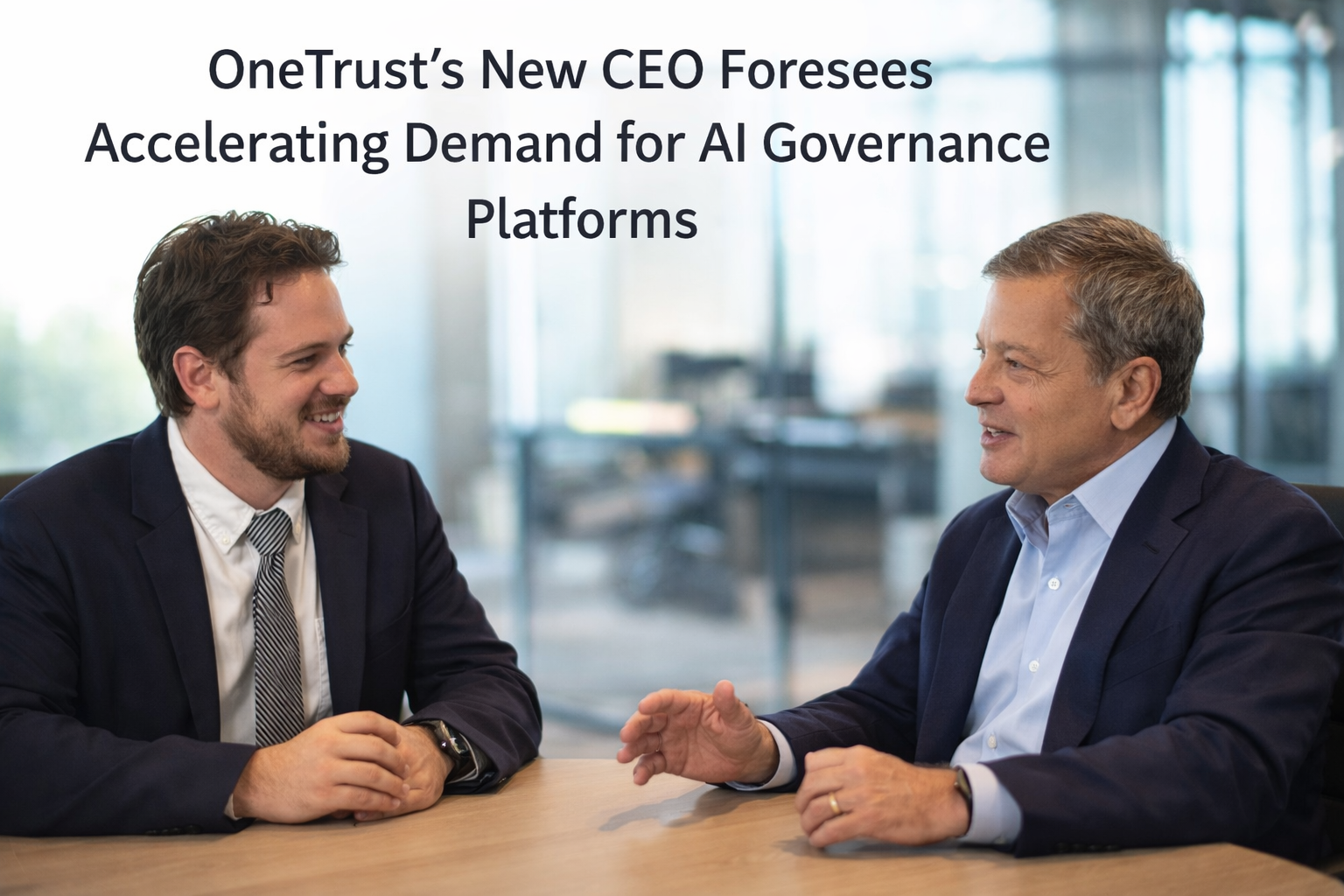
During a recent interview with Alexander LaCasse of the International Association of Privacy Professionals (IAPP), the company’s new chief executive discussed how OneTrust is positioning itself as the market for AI governance platforms begins to mature alongside enterprise adoption of artificial intelligence technologies.
The conversation touched on leadership continuity inside the company as well as the broader structural changes taking place across the governance market. As enterprises deploy AI systems into operational workflows, the need for oversight tools that manage risk, documentation, and accountability has begun expanding across multiple industries.
“It was really important to me that I feel like I could work really well with Kabir because he has so much market knowledge and is so respected by both the market but also our people.”
— John Heyman, Chief Executive Officer, OneTrust
The leadership transition arrives at a time when AI governance is moving from an emerging concept into a formal operational requirement for many enterprises. As organizations integrate AI systems into decision making, customer interactions, and internal workflows, the demand for platforms that help monitor and manage those systems is increasing rapidly.
The Rapid Expansion of AI Agents Is Creating New Governance Pressures
As enterprises move artificial intelligence from experimentation into daily operations, the number of systems interacting with enterprise data and infrastructure is increasing quickly. Many organizations are already deploying AI copilots, automated assistants, and internal agents that interact with databases, customer records, and operational software. These systems can improve productivity and accelerate decision making, but they also create new layers of exposure that security and governance teams must supervise.
The shift becomes more significant as organizations begin deploying multiple agents across departments rather than a single AI tool. Finance teams may use automation for forecasting and reporting, marketing teams deploy AI systems for content generation and analytics, and customer support teams rely on AI assistants connected directly to internal knowledge bases. As the number of systems grows, the challenge shifts from simply deploying AI to controlling how those systems interact with enterprise infrastructure.
Several structural pressures are now pushing organizations to adopt governance platforms more quickly.
Enterprises are deploying AI agents across multiple departments, increasing the number of systems that can access internal data and business workflows.
Security and compliance teams must understand how these systems retrieve information, generate outputs, and interact with enterprise infrastructure.
Regulators and internal audit teams increasingly expect organizations to document how AI systems are monitored and supervised.
As AI tools scale across an organization, even small errors or unintended actions can create operational or reputational risk.
"They're going to have hundreds and then thousands of agents working all the time, and that's going to create big opportunities, but also bigger risks than they've ever seen before."
— John Heyman, Chief Executive Officer, OneTrust
The scale Heyman describes reflects a broader shift taking place across the enterprise technology landscape. AI systems are no longer isolated tools used by small technical teams. They are becoming integrated components of business operations, interacting with internal systems and data sources across the organization. As that scale increases, the demand for platforms that help organizations monitor, document, and govern those systems is expanding alongside it.
How Enterprises Are Currently Building Governance Processes To Supervise AI Systems
As artificial intelligence systems move deeper into operational environments, organizations are beginning to establish internal processes that supervise how those systems are developed, deployed, and monitored. These governance structures are emerging across industries as companies realize that AI systems interacting with enterprise data and infrastructure require the same level of oversight that traditionally applied to financial systems or cybersecurity programs.
One of the first changes taking place inside organizations is the creation of formal review processes for AI deployments. Instead of allowing teams to implement AI tools independently, many companies now require approval workflows before models or agents can access internal data sources. These reviews often involve multiple departments, including security teams evaluating system access, legal teams reviewing regulatory exposure, and data governance teams confirming that the data being used meets internal policy requirements.
Monitoring has also become a central component of these governance programs. Once AI systems are deployed, organizations are beginning to track how models retrieve information, generate outputs, and interact with enterprise applications. This visibility allows companies to identify unexpected behavior, trace how certain outputs were produced, and determine whether a system accessed sensitive information during an interaction.
Another major shift is the documentation of AI activity. Enterprises increasingly maintain records describing how models were trained, what data sources they rely on, and how their outputs are monitored. These records allow organizations to explain system behavior to internal auditors, regulators, and security teams when questions arise about how an AI system reached a particular conclusion or action.
Platforms such as OneTrust are designed to help organizations manage these governance processes at scale. By providing tools that track data usage, document model behavior, and support policy enforcement across enterprise systems, governance platforms allow organizations to supervise AI systems in a more structured and transparent way as adoption continues to expand.
Leadership Transition Signals Acceleration in the AI Governance Market
As organizations begin treating AI governance as a core operational requirement, the market for platforms that manage data oversight, model accountability, and regulatory compliance is expanding quickly. Companies developing governance infrastructure are responding to this shift by strengthening their leadership teams and investing in capabilities designed to support large enterprise deployments.
For OneTrust, the leadership transition comes at a moment when organizations across industries are attempting to bring greater structure to how artificial intelligence systems are supervised. Enterprises deploying AI into customer operations, internal analytics, and automated decision making are increasingly searching for platforms that help track how data is used and how AI systems behave once deployed.
"Growing adoption of AI across organizations has led to massive demand for OneTrust solutions that help enable the responsible use of data and AI. This is a pivotal time to bring on a new CEO who can harness this momentum and drive OneTrust's next chapter of growth."
— Kabir Barday, Co-Founder and Executive Chairman, OneTrust
Barday’s remarks highlight how quickly the governance market is evolving alongside enterprise AI adoption. As organizations deploy larger numbers of AI systems across business operations, the need for infrastructure that supervises data usage, documents model activity, and supports regulatory oversight continues to expand. Governance platforms are increasingly becoming part of the technology stack that organizations rely on to manage risk while still allowing teams to deploy artificial intelligence across critical business processes.
Our Take
AI Governance Take
The conversation around OneTrust’s leadership transition highlights a broader shift taking place across the enterprise technology landscape. As organizations deploy artificial intelligence systems into operational environments, governance infrastructure is becoming a necessary layer of enterprise architecture rather than an optional capability. Companies introducing AI agents, automated decision systems, and data-driven assistants into business workflows must now supervise how those systems access data, generate outputs, and interact with internal infrastructure.
The growth described by OneTrust’s leadership reflects a larger market pattern. Enterprises are beginning to treat AI governance in the same way they historically approached cybersecurity and privacy compliance. When artificial intelligence systems influence financial decisions, customer interactions, or internal operations, organizations must be able to explain how those systems function, what data they rely on, and how risks are controlled. Governance platforms are emerging to support these responsibilities by helping organizations document AI activity, monitor model behavior, and enforce policies surrounding the use of enterprise data.
As the governance ecosystem expands, another challenge is emerging for enterprises attempting to deploy AI responsibly. The market now includes dozens of platforms focused on governance, security, monitoring, and compliance capabilities for artificial intelligence systems. Understanding how these platforms differ and which capabilities are necessary for a specific organization is becoming increasingly complex.
The role of GAIG is to analyze this rapidly growing ecosystem objectively. By examining governance platforms, explaining the structural differences between them, and translating industry developments like the OneTrust leadership transition into clear market insights, GAIG helps organizations understand how the AI governance landscape is evolving and how enterprises can navigate it effectively.