Picture the call. The demo runs perfectly. The case studies are compelling. The sales rep is sharp and the slide deck is polished. Three months after signing, the platform is live and nobody on your team can answer the question — who is responsible for acting on this monitoring signal by end of day. The capability that was demoed doesn't match what was delivered. The implementation took twice as long as promised. The compliance evidence package the platform was supposed to generate requires three hours of manual work per audit. The post-sale relationship is entirely reactive, never proactive. This happens. Often. And almost always because the buyer walked into the vendor call in the wrong position.
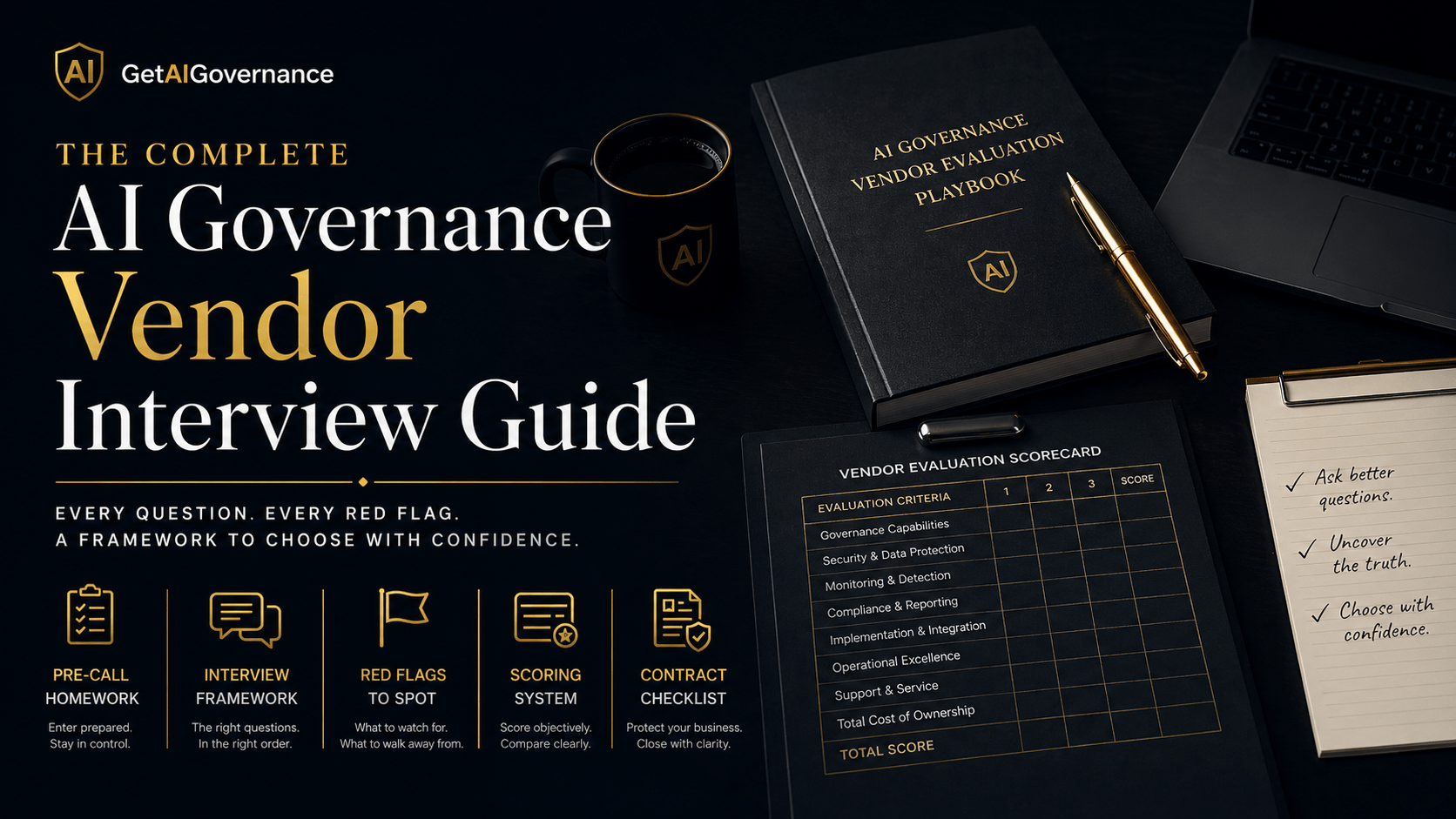
This guide exists to change that position before you get on the call. What you're reading is a complete vendor interview framework — from 20 minutes of pre-call homework through three distinct phases of interrogation, a behavioral red flag index, a category-specific deep dive for all four AI governance platform types, a post-call action sequence, and five contract provisions most buyers miss entirely.
The mindset that makes every page of this guide work is simple: the vendor is applying for a job. A six-figure, multi-year job with access to your most sensitive AI systems, your most consequential production workflows, and your organization's ability to demonstrate compliance to regulators and auditors. Treat the evaluation accordingly. You are the interviewer. You define what a good answer looks like. You decide whether to advance.
Three Rules Before You Join the Call
You are not here to be impressed. You are here to find out what breaks. Every vendor demo is built to show you the product at its best. Your job is to find the version that shows up six months into production when something goes wrong at 2am on a Sunday.
Silence is a tool. After you ask a hard question, stop talking. Vendors are trained to fill silence. What they say when they're filling silence — when the prepared answer is used up and they're reaching for the next sentence — is often more revealing than anything on the slide deck.
Every deflection is data. When a vendor can't answer a question directly, that non-answer tells you something specific about either the product or the culture. Note it. Return to it later in the call. Do not let it go.
Pre-Call Homework: 20 Minutes Before You Join
The buyers who get the most out of vendor calls are the ones who spent 20 minutes before joining doing specific research. This isn't about reading the vendor's marketing materials — they'll present all of that on the call. This is about building asymmetry before the meeting starts. You know something about them that they don't know you know.
Look up who you're meeting with on LinkedIn before the call. A sales rep answering "what do you not do well" is different from a solutions engineer answering it, which is different from a founder answering it. The role of the person across the table changes how you interpret every word they say.
Read their most recent case study. Then on the call, ask about a customer who isn't in it. Case studies are curated wins built for sales cycles. The customer story that didn't make the case study is the one you actually need to hear.
Check whether they've published anything substantive about EU AI Act compliance, agentic AI governance, or MCP security. These are the live topics in the category right now. A platform with no published thinking on any of them hasn't been doing the work. That's data before you join.
Look at their LinkedIn company page and check who they're actively hiring. A company with ten open sales roles and two open engineering roles is in a different place than a company with ten open engineering roles and two open sales roles. That hiring ratio tells you whether the product is being built or being sold right now.
Come to the call knowing who you're talking to, what their best story is, and what they haven't published, they will appreciate your effort.
Who Should Be on the Call
Most organizations send one person to vendor calls. That's a mistake that costs you signal. Different stakeholders hear different things and catch different gaps. Four roles should be represented in every serious vendor evaluation, and each needs to know what they're specifically listening for before they join.
CISO or Security Lead
Vagueness around enforcement versus documentation
Any claim about comprehensive security coverage without specifics
How they handle the question about what the platform doesn't cover
Whether behavioral monitoring is genuinely distinct from output monitoring
Compliance or Legal Lead
Regulatory framework specificity — can they name specific articles
What their contractual liability is if evidence generation fails
Whether they distinguish between documentation and enforcement
Data handling obligations and subprocessor disclosure
Engineering or ML Lead
Implementation reality versus sales reality on timeline
Integration complexity and what it actually requires from your team
Whether the platform understands production AI behavior, not just demo behavior
What recalibration looks like after a model update
Procurement Lead
Total cost of ownership beyond the license fee
What professional services are required versus optional
Contract flexibility on scope changes as your AI environment grows
Data portability provisions at contract end
If you can only send one person, brief them on all four listening modes before the call. The questions in Phase 3 are designed to surface gaps across all four dimensions simultaneously, but you catch significantly more when multiple perspectives are physically in the room.
Step 1 Read the Room
Before any product questions. Before the demo starts. Before any feature discussion. These five questions tell you who you are actually talking to and whether their understanding of the problem matches yours. A vendor who can't answer these well hasn't been in this space long enough or hasn't been paying attention to what their customers actually experience. Either way, that's information you need before Phase 3.
Score each answer 1 through 3 as you go. 1 means deflected or generic. 2 means answered but surface level. 3 means specific, honest, and referenced a real customer scenario.
Q1"Walk me through a typical customer you work with — what does their AI environment look like when they come to you, and what does it look like six months after deployment?"
Strong Answer
A specific customer profile with real detail — industry, team size, how many AI systems, what the governance gap was etc etc. A concrete before and after with specific outcomes or metrics. The vendor can tell this story quickly because they've told it many times.
Weak Answer
A generic enterprise customer with vague improvement language. No specific outcome. "Organizations come to us with governance challenges and we help them build a program" tells you almost nothing about the product or who it actually serves.
Q2 "What is the most common mistake organizations make before they find you?"
Strong Answer
A specific, honest description of the organizational failure pattern they've seen repeatedly. "Teams document their AI systems but never connect the documentation to runtime enforcement" is specific. It tells you the vendor understands the category at a deeper level than marketing language.
Weak Answer
"Not having a governance strategy" or any answer that sounds like a category pitch rather than a genuine observation about buyer behavior. If their answer could appear in a category explainer rather than a post-mortem, it isn't an honest answer.
Q3"What does your platform not do well — and what do you recommend customers use alongside you to fill that gap?"
Strong Answer
Specific honest gaps named without hedging. Specific complementary tools or capabilities recommended. A vendor who can tell you exactly where their product ends and where you need something else is a partner. That answer also tells you precisely where to probe harder in Phase 3.
Weak Answer
Deflection toward roadmap items. "We're building that now" applied to every gap you raise. A claim that the platform covers everything. Any vendor who says they cover everything is either not telling the truth or doesn't understand the breadth of the problem.
Q4"How long have you been working specifically in AI governance — AI governance specifically not the other categories (Security, Compliance, or Monitoring)?"
Strong Answer
A clear origin story with a specific year, a specific problem that drove the focus, and evidence of category-specific thinking that predates the current AI governance marketing wave. Founders who built this before it was a trend have different conviction than teams that pivoted here in 2023.
Weak Answer
Vagueness about timeline. Reframing AI governance as part of a broader security or compliance heritage without distinguishing the AI-specific work. Many security and compliance tools added "AI" to their positioning in 2023. The question is whether they have genuine AI governance DNA.
Q5 "Tell me about the last customer who had a difficult implementation — what happened and how did you handle it?"
Strong Answer
An honest, specific account of a real difficult experience — what went wrong, what the vendor did in response, what the outcome was. This answer demonstrates accountability culture and tells you how the vendor behaves when things aren't going well. That's the version of this company you'll eventually meet.
Weak Answer
"All our implementations go smoothly" or an immediate pivot to a success story. Every implementation has friction. A vendor with no difficult customer stories hasn't been honest with you or hasn't been building long enough to have them. Either way, file it.
"If you got vague answers to more than two of these questions, the next two phases will confirm what you're already sensing. Keep going — but keep score."
GAIG Buyer Help
Step 2 Map the Territory
You now know who you're talking to. These six questions build your map of how the platform actually works before you apply pressure in Phase 3. The goal is to understand the architecture, the coverage, the workflow, and the support model so clearly that when a Phase 3 answer contradicts something you heard in Phase 2, you notice the contradiction immediately and can call it out.
Q6"Walk me through the architecture — where does your platform sit in our environment and what does it actually touch?"
Strong Answer
A clear picture — verbal or drawn — of exactly where the product lives, what it reads, what it writes, what integrations are required on your side, and what data leaves your environment versus stays within it. You should be able to sketch the architecture yourself after hearing this answer.
Weak Answer
Hand-waving. "It integrates with everything." An inability to draw a clear boundary around what the product touches and what it doesn't. If the vendor can't tell you precisely where their product lives in your environment, that's a scope conversation you'll be having repeatedly after you sign.
Q7"What are the three core things your platform does — not features, functions. Give me three verbs."
Strong Answer
Three specific verbs that reveal whether the platform is passive or active. Monitor, enforce, document tells a different story than observe, alert, log. Enforce is the verb that separates governance platforms from governance documentation tools. Listen for it specifically.
Weak Answer
Immediately listing features instead of functions. An inability to reduce the platform to three verbs reveals that the product doesn't have a clear identity or the person on the call doesn't understand it well enough to abstract it. Ask again. Push for three verbs.
Q8"How does data flow through your system — what do you receive from our environment, what do you store, where does it go, and for how long?"
Strong Answer
A specific data flow description with clear retention periods, clear data handling obligations documented in the contract, and an explicit answer to whether your prompt content or AI system outputs are used to improve the vendor's own models or services.
Weak Answer
Vagueness that defers entirely to a legal team review. "We're SOC 2 compliant" as the complete answer to a data handling question. SOC 2 covers the vendor's infrastructure. It says nothing about what happens to your specific data inside their system.
Q9 "Who are your primary users inside a customer's organization — who logs in, who gets the alerts, who makes the configuration decisions?"
Strong Answer
A specific role mapping that demonstrates the vendor has thought carefully about org chart fit. If their primary user is a data scientist and your governance program is owned by legal, that's a workflow mismatch you need to solve before signing, not after.
Weak Answer
"Whoever owns AI governance" as the answer reveals the vendor hasn't mapped their product to specific job functions. That usually means the onboarding process will involve figuring out who in your organization is actually supposed to use the tool — which takes time you don't have.
Q10"What does a standard implementation look like — timeline, resources required from our side, and what does live actually mean versus fully deployed?"
Strong Answer
An honest timeline with distinct milestones. Specific resource requirements named — how many hours from your team, which roles are involved, what data access is required. A clear distinction between when the platform is technically live and when it's delivering full coverage of your AI environment.
Weak Answer
"We can be live in a week" without any qualification about what live actually covers at that stage. The most expensive thing in enterprise software is the gap between "live" and "doing what you bought it to do." Get that timeline in writing.
Q11"What does your support model look like — specifically, who do we talk to when something goes wrong at 2am on a Sunday?"
Strong Answer
A named support tier with a specific escalation path and an SLA stated in hours, not business days. A dedicated success manager who knows your deployment specifically. AI governance failures don't happen on business hours and the support model needs to reflect that.
Weak Answer
"We have a ticketing system" or "our team is very responsive" without a specific SLA attached. Ask what the contractual SLA is for a Severity 1 incident. If they don't have a Severity 1 definition, that's the answer you needed.
Step 3: The Real Test — The 12 Universal Hard Questions
We all know that in an interview there are a series of questions meant to stump you and get you to think. These are the stump questions. These questions apply to every AI governance vendor regardless of their category or positioning. They are organized across the four Control Layers — Governance, Security, Monitoring, and Compliance — because every platform that touches AI governance needs to account for all four. A platform that handles governance documentation beautifully but has nothing to say about monitoring signals is a half-answer to a whole problem.
Continue scoring 1 through 3 per question. Total across all 12 questions at the end of this section before moving to the category-specific deep dive.
Governance Specific Questions
G1"What does your platform enforce at runtime versus what does it only document after the fact?"
Strong Answer
A clear and specific distinction between runtime enforcement and post-hoc documentation, with the enforcement mechanism named concretely. The vendor can demonstrate runtime enforcement live in the demo — not describe it, show it. There is a significant capability gap between a platform that logs what happened and one that stops what shouldn't happen.
Weak Answer
Using "enforce" and "log" interchangeably. Pivoting entirely to documentation features when asked about enforcement. A platform that produces beautiful compliance documentation but cannot enforce a policy at the moment an AI system tries to violate it is a documentation tool, not a governance platform.
G2"How does your platform handle AI systems that weren't registered before deployment — shadow AI and shadow procurement entries?"
Strong Answer
A specific discovery capability described — how unregistered systems surface, what the detection mechanism is, what triggers an alert. The vendor understands that governance programs operate in messy real-world environments where not everything gets registered before it gets deployed. Their product accounts for that reality.
Weak Answer
"That's a process problem, not a platform problem." This is the most common deflection in the category and it reveals a fundamental misunderstanding of what enterprise AI governance actually looks like in practice. Shadow AI is not an exception — it is the default state in most large organizations.
G3"If our most governance-knowledgeable team member left tomorrow, what in your platform would stop working or require significant re-setup?"
Strong Answer
An honest account of what depends on institutional knowledge versus what is embedded in platform configuration. The vendor can tell you specifically which capabilities have single-point-of-failure dependencies and what they've built to mitigate that. Institutional resilience is a governance capability, not just a people problem.
Weak Answer
"The platform is fully self-sufficient." No governance platform is fully self-sufficient. If a vendor claims otherwise, they either haven't thought about this question seriously or they haven't had a customer whose key person left. Push harder.
Security Specific Questions
S1"Show me what happens in your platform when an agent attempts to access a data source it wasn't originally scoped for."
Strong Answer
They show it live. Not describe it — show it. You see exactly where the attempted access appears in the platform and what the automated response is. A vendor with genuine agent-level access control can demonstrate this in their demo environment. If they can't show it, the capability may not exist the way they described it.
Weak Answer
Describing it verbally without demonstrating it. "That would trigger an alert" with no ability to show what the alert looks like, where it appears, who receives it, and what happens next. Verbal descriptions of security capabilities that can't be demonstrated live deserve significant skepticism.
S2"How does your platform detect behavioral drift in AI agents — specifically tool invocation patterns and access patterns, not output quality?"
Strong Answer
A specific behavioral baseline methodology described — how baselines are established, how long they take to calibrate, what deviation threshold triggers a flag, and what the flag looks like in the platform. The vendor can show behavioral drift detection as a distinct capability from output monitoring.
Weak Answer
Conflating behavioral drift with output quality degradation. Pivoting to hallucination detection or accuracy monitoring as the answer to a behavioral security question. Output monitoring and behavioral monitoring are fundamentally different capabilities and a vendor who can't distinguish them hasn't built both.
S3"What does your platform capture when a prompt injection attempt fails — the attempt itself, or only successful exploits?"
Strong Answer
Precursor pattern capture confirmed. The vendor can show what a failed injection attempt looks like in their logs and explain how frequency escalation triggers a flag even when individual attempts are blocked. Prevention-oriented platforms capture attempt patterns. Detection-oriented platforms capture successful exploits.
Weak Answer
"We detect successful injection attempts." Successful attack detection is table stakes, not a differentiator. A platform that only captures successful exploits is missing the signal that precedes them — and that precursor pattern is where the prevention opportunity lives.
Monitoring Specific Questions
M1"Walk me through what happens when a signal crosses a threshold — who gets notified by name, not by role, and what automated action occurs?"
Strong Answer
A specific notification workflow that includes named ownership capability at the signal level. The platform can assign specific individuals as signal owners, not just route alerts to teams. Escalation paths are defined and automated, not manual. The vendor can show this workflow in the demo rather than describing it.
Weak Answer
"The relevant team gets notified." A team is not an owner. A signal that routes to a team creates diffusion of responsibility — everyone sees it, nobody owns it. An alert without a named individual accountable for responding within a defined timeframe is noise with a distribution list.
M2"What percentage of alert volume in a typical deployment requires human investigation — and how did you arrive at that number?"
Strong Answer
An honest estimate with a specific methodology for how they arrived at it. The vendor can talk about signal-to-noise ratios in real deployments, how alert fatigue manifests in the first months, and what they've built to improve actionability over time. They acknowledge that this is a real problem rather than claiming their platform eliminates it.
Weak Answer
"We minimize noise" with nothing specific attached to it. An inability to give any estimate for what percentage of alerts actually require action. Alert fatigue is real and documented across every monitoring category. A vendor who pretends their platform doesn't generate it has never had a customer long enough to see it develop.
M3"How does your monitoring recalibrate after a model update — automatically, manually, or not at all?"
Strong Answer
A specific recalibration mechanism described with a clear answer about automation level. The vendor understands that monitoring baselines established against one version of a model become miscalibrated after an update — and they've built something to address that rather than leaving it as a manual task for your team.
Weak Answer
"Your team would need to update the thresholds" as the complete answer. Fully manual recalibration means every model update creates a monitoring blindspot until your team gets around to it. In organizations running continuous deployment cycles, that blindspot is permanent.
Compliance Specific Questions
C1"If a regulator audited our AI systems tomorrow and asked for a timestamped trail of every human response to every monitoring signal in the last 90 days — could you produce that?"
Strong Answer
Yes — with the format described specifically and a demonstration of what the human response trail looks like as a distinct artifact from the system event log. The vendor understands that auditors need to see what the team did in response to signals, not just what the system generated. Those are separate records requiring separate capture mechanisms.
Weak Answer
"We have full audit logs" presented as the complete answer. System event logs show what the AI did. Auditors need the human response trail showing what your team did in response and when. A platform that conflates these two records is not audit-ready for agentic AI workflows.
C2"How does your platform specifically address EU AI Act Article 72 post-market monitoring requirements — not GDPR, not SOC 2, specifically Article 72?"
Strong Answer
Article 72 requirements named specifically — the obligation to actively collect, document, and analyse data, and demonstrate response to what that data shows. The vendor explains precisely how their platform satisfies the analysis and response obligations, not just the collection obligation. They understand the difference between logging and compliance.
Weak Answer
Pivoting to GDPR or general compliance language. Mentioning SOC 2 as the answer to a question about EU AI Act obligations. An inability to name Article 72 requirements specifically reveals that the regulatory depth on this platform is marketing language rather than genuine compliance architecture.
C3"What evidence does your platform produce that our control policies were technically enforced — not documented, enforced — during the last quarter?"
Strong Answer
A specific evidence artifact described and demonstrated — what enforcement evidence looks like in a real customer environment, how it's timestamped, how it's exportable, and what it proves to an auditor or regulator. The vendor can show you this in the demo rather than describing it hypothetically.
Weak Answer
Producing policy documentation in response to a question about enforcement evidence. Using "enforced" and "documented" interchangeably throughout the answer. A policy document showing that a rule existed is not evidence that the rule ran. Enforcement evidence is a technically distinct artifact from policy documentation.
The question I ask every organization evaluating a platform is not what the platform measures. It's whether the platform can tell you why the AI system made the specific decision it made — at the context level, with a timestamped trail of every human response in between. Most platforms can do one of those things. Very few can do both. That gap is where incidents live.
Nathaniel Niyazov
CEO, GetAIGovernance.net
The Red Flag Index
Beyond individual question scores, behavioral patterns across the call can override what any single good answer suggests. If you observe three or more of these patterns in a single vendor conversation, the score doesn't matter as much as the pattern.
When they answer a question you didn't ask
They're avoiding something specific. Circle back to your original question and ask it again with the explicit observation that you didn't get an answer to what you actually asked.
When every capability lives on the roadmap
Ask specifically what is live in production today versus what is planned. You are buying what exists, not what's coming. Roadmap commitments belong in the contract with milestone dates, not in the demo.
When they can name only one reference in your industry
One reference-able customer in your vertical is one lucky deal, not demonstrated traction. Ask how many customers in your industry have been on the platform for more than 12 months. That number is the honest answer.
When they say "we integrate with everything"
Ask them to name the three integrations that took the most engineering work to build. That answer reveals where their actual depth is. "Everything" is a sales claim. The hardest integrations are the honest capability map.
When the demo environment doesn't match your stack
Ask explicitly: "Is this demo data or our actual data, and does the interface or capability set change when we connect our real systems?" Every demo environment is clean. Production isn't.
When they defer to follow-up email more than once
Once is understandable. A pattern of it means the person on the call doesn't know their own product well enough to answer live questions about it. That's not a sales rep problem — it's a product depth problem.
When they reference a competitor unprompted more than twice
A vendor more focused on competitive positioning than on your specific problem is in selling mode. You want a partner thinking about your environment. Excessive competitor talk means they're not.
When they have no difficult customer story
Every implementation has friction. A vendor with no difficult customer stories hasn't been honest with you, hasn't been building long enough to have them, or isn't willing to be accountable about their failures. All three are problems.
The Scoring Framework
Score each of the 12 Phase 3 questions from 1 to 3. Add up your total after the call while your notes are fresh. Apply the framework consistently across every vendor you evaluate so comparisons hold up when you're reviewing three vendors three weeks apart.
Score | What It Means | Examples |
|---|---|---|
3 | Answered specifically, demonstrated live in the platform, referenced a real customer scenario. This is a capability you can rely on. | Showed runtime enforcement in the demo. Named a specific customer who used the capability. Gave a concrete mechanism for how it works. |
2 | Answered but surface level. Described the capability without demonstrating it. Or gave a general answer without customer evidence. | Said "yes we have that" without showing it. Described how it works in theory without a live example. Deferred a follow-up demo. |
1 | Deflected, gave a generic answer, or contradicted something said earlier in the call. This is a capability gap. | Pivoted to a different capability. Used the question's language without answering its substance. Said "that's on our roadmap." |
Score Interpretation — Out of 36
30–36
Strong candidate. Advance to category-specific deep dive and reference calls. This platform has demonstrated genuine capability across all four layers.
24–29
Conditional. Schedule a focused follow-up on the specific questions that scored 1 or 2 before advancing. Don't sign until those gaps are addressed in writing.
Below 24
The demo was better than the product. The gap between what was presented and what was demonstrated suggests the capability claims are aspirational rather than current.
Category-Specific Deep Dives
After the universal Phase 3 questions, go deeper in your specific category. These five questions per category are designed to surface the gaps that only appear when you understand the category well enough to ask precisely. Run the category questions that match your primary evaluation and use the others as supplemental probes where categories overlap — which in AI governance, they almost always do.
AI Governance Platforms
Five targeted questions beyond the universal stress test
GOV-1"Show me your model registry in a live environment — walk me through how a new AI system gets registered, classified, and what downstream controls that classification triggers automatically."
Strong Answer
A live walkthrough that shows registration, classification options, and the specific downstream actions that fire automatically based on risk tier. The registry is clearly a live operational system, not a form that feeds a spreadsheet with a UI layered on top.
Weak Answer
A static form demo that ends at registration without showing what happens next. Or a registry that requires manual steps to connect classification to controls. Manual connections between classification and enforcement are human failure points waiting to happen.
GOV-2"What happens in your platform when an AI system's operational scope expands beyond its original classification — is that automatically detected or manually reported?"
Strong Answer
Automatic detection capability described with the specific mechanism — behavioral signals, data access patterns, or output profile changes that trigger a reclassification flag. The vendor understands classification staleness as a real operational problem and has built something to surface it.
Weak Answer
"Teams are expected to review classifications on a regular basis." Manual-only reclassification processes fail when teams are busy — which is always. Under the EU AI Act, classification staleness creates legal exposure. A platform that leaves this entirely to human diligence is leaving a compliance gap open.
GOV-3"How does your platform handle third-party AI vendors in our supply chain — specifically tools our employees use that we didn't build and don't directly control?"
Strong Answer
A specific third-party AI governance capability — vendor assessment workflows, supply chain visibility, or shadow AI detection that surfaces tools not formally registered. The vendor understands that most enterprise AI governance failures happen at the third-party layer, not in internally built systems.
Weak Answer
Assuming all AI systems will be formally registered and internally managed. A governance platform built only for the AI systems you built yourself handles roughly half of your actual exposure. The other half is the third-party and employee-adopted tools your governance program can't currently see.
GOV-4"Walk me through your policy enforcement at the moment of execution — show me a policy being enforced in real time, not logged after the fact."
Strong Answer
A live demonstration of a policy rule running at the point an AI system attempts to take an action that violates it — with the violation blocked or flagged in real time rather than captured in a log reviewed later. This is the foundational governance capability distinction.
Weak Answer
Showing a log of past violations as the demonstration of enforcement capability. Logging a violation after it occurred is documentation. Stopping the violation before it completes is enforcement. These are different products with different risk profiles and different compliance implications.
GOV-5"If our board asked us to demonstrate that our AI systems are compliant with our internal governance policy right now — what can your platform produce in the next 60 minutes?"
Strong Answer
A specific set of reports or evidence packages described — what they contain, how they're generated, and what a board member or auditor would see. The vendor has thought about this scenario because their customers have asked for it. Audit readiness on demand is a real capability test, not a hypothetical.
Weak Answer
Describing a multi-day evidence compilation process. If producing a compliance snapshot requires more than an afternoon of manual work, the platform hasn't embedded governance into operational infrastructure — it's sitting alongside it. Boards don't wait for multi-day evidence pulls.
AI Security Platforms
Five targeted questions beyond the universal stress test
SEC-1"Show me what your platform captures when an AI agent makes a tool call it wasn't supposed to make — where does that appear and what happens next automatically?"
Strong Answer
A live demonstration showing exactly where an unauthorized tool call surfaces in the platform, what automated response fires, and what the investigation workflow looks like. The vendor distinguishes agent-level security from model-level security as distinct capability layers.
Weak Answer
Describing output filtering or prompt injection defense as the answer to an agent tool call question. These are separate attack surfaces. A platform built for LLM security that hasn't extended its model to agentic tool invocation patterns is behind where the threat landscape actually is.
SEC-2"How does your platform handle OAuth tokens issued to AI integrations that haven't been actively monitored for 90 days?"
Strong Answer
A specific orphaned token detection capability — how stale tokens surface, what the review workflow is, and whether the platform can enforce token expiration or flag tokens operating outside their original scope. The vendor understands that authorized access without active oversight is a security gap specific to AI integrations.
Weak Answer
Deferring to standard IAM token management practices that predate AI integration patterns. Orphaned AI tokens are a distinct security surface — they grant access to systems that are actively being used by AI agents operating autonomously. Standard IAM reviews weren't designed for that use pattern.
SEC-3"What is your platform's specific coverage for MCP-connected agents — agents that have access to internal data sources through a Model Context Protocol server?"
Strong Answer
Genuine MCP-specific security coverage described — how MCP server connections are inventoried, how data access through MCP is scoped and audited, and what the security model looks like for agents operating with broad MCP-granted access to internal systems. The vendor has built for the actual agentic attack surface.
Weak Answer
Conflating MCP security with general API security or LLM prompt filtering. MCP-connected agents can accumulate data access that exceeds any individual human developer on your team. A security platform that hasn't built specific coverage for MCP connections hasn't accounted for where enterprise agent exposure actually lives in 2026.
SEC-4"If an AI agent's behavior pattern changes significantly from its historical baseline — same permissions, different actions — how long before your platform surfaces that?"
Strong Answer
A specific detection latency named with the behavioral baseline methodology explained. The vendor can tell you how long it takes to establish a baseline, what deviation threshold triggers a flag, and whether detection is continuous or batch-based. Continuous behavioral monitoring is a materially different capability from periodic batch analysis.
Weak Answer
Vagueness about detection latency. An inability to distinguish behavioral baseline monitoring from output quality monitoring. If the vendor can't tell you how long it takes their platform to surface a behavioral anomaly, they haven't instrumented this capability in production environments.
SEC-5"What does your platform do with shadow AI that it detects — visibility only, or active enforcement that prevents data submission to unapproved tools?"
Strong Answer
A clear distinction between detection and enforcement capability, with the enforcement mechanism described specifically — at the endpoint, browser, or network layer. The vendor can show what happens when an employee attempts to submit sensitive data to an unsanctioned AI tool after the platform is deployed.
Weak Answer
Visibility-only framing presented as a complete answer to a shadow AI security question. Seeing that an employee used an unsanctioned tool after the fact is useful for reporting. Stopping the data submission before the sensitive content reaches an external model is security. These are not the same capability.
AI Monitoring Platforms
Five targeted questions beyond the universal stress test
MON-1"Show me what context-layer monitoring looks like in your platform — specifically retrieval quality, tool call correctness, and reasoning chain integrity for an agent session."
Strong Answer
A live walkthrough of a complete agent session trace — showing every retrieval call with relevance scoring, every tool invocation with correctness assessment, and the full reasoning chain from input to output. The vendor understands that output quality metrics measure the last mile. Context metrics measure where the decision was actually made.
Weak Answer
Showing hallucination rates and output accuracy as the demonstration of agent monitoring capability. These are output metrics. An agent can produce a plausible output while reasoning over bad retrieval, calling the wrong tool, and maintaining corrupted state. Output metrics don't surface any of that.
MON-2"How does your platform handle the period immediately after a model update — specifically, what happens to your monitoring baselines and thresholds?"
Strong Answer
A specific post-update workflow described — how the platform detects that a model update occurred, how it handles the recalibration period, and what visibility the team has into the fact that current baselines may not yet reflect the updated model's behavior profile. The vendor has seen this problem enough times to have built something for it.
Weak Answer
An assumption that model updates are always planned and coordinated with the monitoring team. In organizations running continuous deployment, models get updated independently of monitoring configuration changes. A platform that doesn't account for that creates an automatic blindspot after every model update — which is exactly when you need the sharpest visibility.
MON-3"Walk me through your alert ownership model — when a signal fires, what does your platform do to ensure a specific person is accountable, with a defined response window?"
Strong Answer
A named ownership system where specific individuals are assigned as owners of specific signal categories — with automated escalation when the response window is missed. The platform generates an audit trail of who received the alert, when they received it, and what action was taken and when.
Weak Answer
Team-level routing presented as signal ownership. Routing an alert to a team creates diffusion of responsibility. Everyone on the team sees the alert. Nobody is specifically accountable for acting on it within a defined window. That's how critical signals get missed while sitting visible in a shared channel.
MON-4"How does your platform distinguish between a threshold crossing that needs immediate escalation and one that needs investigation — what determines the difference?"
Strong Answer
A specific triage logic described — context-aware severity classification, anomaly scoring relative to historical baselines, or signal correlation that identifies when multiple indicators firing simultaneously indicate a different severity than any single signal alone. The vendor has thought about alert triage as a distinct engineering problem.
Weak Answer
A static threshold approach where every crossing of a defined number triggers the same alert at the same severity level. Binary threshold alerting is what produces the alert fatigue that makes teams stop responding to monitoring programs. Smart triage is what keeps monitoring programs operationally viable.
MON-5"What does your platform produce as evidence that monitoring was active and signals were responded to — specifically for a compliance audit covering the last quarter?"
Strong Answer
A specific compliance evidence artifact from the monitoring layer — a report that shows signals generated, signals investigated, response times, outcomes, and who was accountable for each. The vendor understands that under EU AI Act Article 72, demonstrating that post-market monitoring is active and generating human responses is a regulatory obligation, not an optional report.
Weak Answer
Raw alert logs presented as monitoring compliance evidence. A log of signals generated tells an auditor the platform was running. It doesn't tell them that signals were responded to by named individuals within defined timeframes with documented outcomes. Those are different records requiring different capture mechanisms.
AI Compliance Platforms
Five targeted questions beyond the universal stress test
COM-1"Show me the evidence package your platform would produce if a regulator requested proof of EU AI Act Article 72 compliance for a specific AI system over the last 90 days."
Strong Answer
A live demonstration of the evidence package — what it contains, how it's structured, how it demonstrates active monitoring and human response rather than just data collection. The vendor has customers who have already gone through regulatory examination processes and can describe what worked.
Weak Answer
A theoretical description of what the platform could produce without a live demonstration. Or an evidence package that shows data was collected without showing that it was analysed and responded to. Article 72 requires all three — collection, analysis, and response. A package that covers only collection is incomplete compliance documentation.
COM-2"How does your platform handle control mapping when a regulatory framework gets updated — is that update automatic, semi-automatic, or manual?"
Strong Answer
A specific update mechanism described — how the platform tracks regulatory framework versions, how it flags controls that may no longer satisfy updated requirements, and what the workflow is for customers to review and approve control mapping changes. The vendor treats regulatory alignment as a live connection, not a static document.
Weak Answer
Fully manual control mapping updates that depend on the customer's team noticing when a framework changed and updating their mappings accordingly. Regulatory frameworks update continuously. A compliance platform that leaves framework tracking entirely to human attention is a compliance gap waiting for the next framework revision.
COM-3"What is the difference between what your platform captures automatically and what requires human input to document — specifically for audit purposes?"
Strong Answer
A specific and honest accounting of what is automated versus what requires human input, with the rationale for each. The vendor can show you their audit evidence interface and walk through which fields populate automatically from live system connections versus which require manual entry. That ratio tells you your evidence reconstruction risk.
Weak Answer
"We automate compliance" presented as a complete answer to a question about documentation specifics. Ask again more specifically: for the last audit your customer ran, what percentage of evidence was pulled automatically versus manually compiled. That number is the honest answer to your question.
COM-4"How does your platform handle AI vendor assessments that have lapsed past their review date — does the system flag that automatically or does someone have to notice?"
Strong Answer
Automated lapse detection with a specific workflow — how approaching and past-due assessments surface, who gets notified, and what the escalation looks like if a lapsed assessment isn't addressed within a defined window. The vendor understands that vendor review lapses are one of the most common compliance gaps in practice.
Weak Answer
Calendar-based reminders to the team responsible for vendor assessments. Manual reminder systems fail under deadline pressure — which is when vendor assessments most commonly get deprioritized. Automated enforcement with escalation is the capability. A calendar reminder is the workaround teams use when the capability doesn't exist.
COM-5"When your customers go through a regulatory examination, what specific artifacts from your platform do examiners actually review — and have any of those examinations resulted in findings related to the platform's evidence?"
Strong Answer
Specific artifact types named from actual customer examinations — what regulators requested, what the platform produced, and whether any findings emerged related to evidence gaps. A vendor with customers who have been through regulatory examinations has real evidence of what works under scrutiny. That's different from theoretical compliance architecture.
Weak Answer
Describing what the platform should produce in a regulatory examination without evidence of it having happened. AI compliance platforms are relatively new and not all of them have customers who have faced regulatory examination using the platform's output. That's an acceptable answer. Claiming regulatory examination experience that doesn't exist is not.
Post-Call: The Next 48 Hours
What you do in the 48 hours after the call determines whether you get the information you need to decide or get managed by the vendor's sales process. The vendor is in follow-up mode after the call. Get there first.
Send the one question you deliberately held back
Choose the question from Phase 3 where the vendor was weakest and ask it in writing, by email, within 24 hours. Written answers reveal more than live answers — the vendor can't pivot mid-sentence and they have to commit to something specific. Their written response to a hard question tells you more about the product and the culture than anything they said on the call.
Ask for two specific references — not the ones they volunteered
Request one customer who had a difficult implementation and one who almost churned but didn't. A vendor who only offers smooth success stories is managing your perception. The customers who stayed through a difficult period tell you whether this is a partner worth buying from. The ones who left tell you whether the difficulty was resolvable or fundamental.
Request a sandbox in your actual stack before any contract discussion
Any vendor who will not provide a proof-of-concept or sandbox environment in your actual tech stack is asking you to buy on faith. In a category this consequential — with access to your most sensitive AI systems — faith is not due diligence. A vendor confident in their product should welcome the opportunity to demonstrate it in your environment. A vendor who resists is telling you something specific.
Contract Negotiation Flags
Five provisions that most buyers miss and most vendors won't volunteer. Run this list against the contract before you sign regardless of which platform category you're buying from. Getting these provisions right at signing costs nothing. Discovering they're absent after an incident costs significantly more.
Data Handling and Training Data Provisions
Get explicit written confirmation of three things: who owns the data your AI systems generate inside the platform, what happens to that data if you cancel or don't renew, and whether your prompt content or system outputs are used to train or improve the vendor's own models or services. The vendor's privacy policy is not a contract provision. Require contractual language that specifies your data rights explicitly.
Audit Evidence Availability SLA
Uptime SLAs are standard in every enterprise software contract. Audit evidence availability SLAs are not — and they're the SLA that matters most in regulated environments. If you need the platform to produce compliance evidence on demand for a regulator or auditor, that availability needs to be a contractual guarantee with a specific SLA and a specific remedy if it fails. "We will use reasonable efforts" is not an SLA.
Scope Change Flexibility
Your AI governance needs will change significantly over the contract term. New AI systems get deployed, new regulatory requirements come into force, new categories of risk emerge. A contract that locks you into the use cases and system scope you had at signing will create governance gaps as your environment evolves. Negotiate provisions that allow scope expansion without requiring a full contract renegotiation every time your AI environment grows.
Exit Data Portability
When you leave — and at some point, every vendor relationship ends — what do you get? Require contractual provisions for complete data portability at contract end: all historical audit trails, model registrations, evidence packages, monitoring configurations, and signal history in a portable format you can actually use elsewhere. Vendors who resist data portability provisions are counting on the migration cost keeping you on the platform regardless of whether it's still the right choice.
Liability Provisions for Missed Signals
Most AI governance platform contracts disclaim all liability for failures to surface alerts or monitoring signals that should have triggered governance action. In a category where missed signals create direct compliance exposure and potential regulatory liability, that disclaimer is worth negotiating explicitly. At minimum, understand what the vendor's liability position is before signing so it doesn't become a surprise during an incident response conversation when you need to know who owns what.
Our Take
The buyer who runs this guide through a vendor call will come out knowing more about that platform than most of the vendor's own customers do six months into their contract. That knowledge is not a negotiating advantage — it's a governance requirement. The platform you select for AI governance will sit at the intersection of your most sensitive systems, your most consequential regulatory obligations, and your organization's ability to demonstrate that its AI decisions are accountable, auditable, and controlled.
Most buyers select these platforms on the strength of a demo, a case study, and a reference call from a customer who was handpicked to say the right things. This guide is built to give you the tools to select on evidence rather than presentation. The difference between the two shows up six months into a deployment when the platform does or doesn't perform the way the demo suggested it would.
Two things determine whether you walk away from these calls with the right information. The first is asking the questions that the vendor hasn't been rehearsed on — the ones in Phase 3 and the category-specific deep dives that require live demonstration rather than verbal description. The second is knowing what a strong answer looks like before you hear an answer, so you're evaluating what you hear rather than reacting to it.
The platform is only as good as the evaluation that selected it. Run the guide. Keep the score. Get it in the contract.