Evaluating platforms that connect AI governance frameworks to technical compliance evidence? Browse AI Regulatory Compliance, AI Audit & Documentation, and AI Governance Platforms in the GAIG marketplace. Use the complete vendor interview guide to run structured evaluation before committing — or submit an inquiry and we'll match you to platforms based on your specific framework and compliance evidence requirements.
Submit an Inquiry
Every AI governance framework in existence has the same foundational problem. The EU AI Act tells you that high-risk AI systems must achieve appropriate levels of accuracy and be resilient against adversarial attacks. OWASP's Agentic Top 10 tells you that agents must have behavioral baselines and be monitored for goal drift. FINMA tells Swiss financial institutions that AI applications must be tested for robustness, stability, and bias before and during deployment. All of these frameworks describe what a compliant AI system should be able to demonstrate. None of them tell you how to actually generate that demonstration technically.
The result has been a governance market built overwhelmingly on documentation. Policy documents describe the controls. Risk assessments describe the classifications. Compliance reports describe the frameworks. Auditors review the documents and ask whether the documentation is complete. The AI system itself — what it is actually doing in production, whether it is actually accurate under adversarial conditions, whether it is actually drifting from its behavioral baseline — sits largely unexamined, because the connection between the framework requirement and the technical evaluation that would prove compliance has never been formally built.
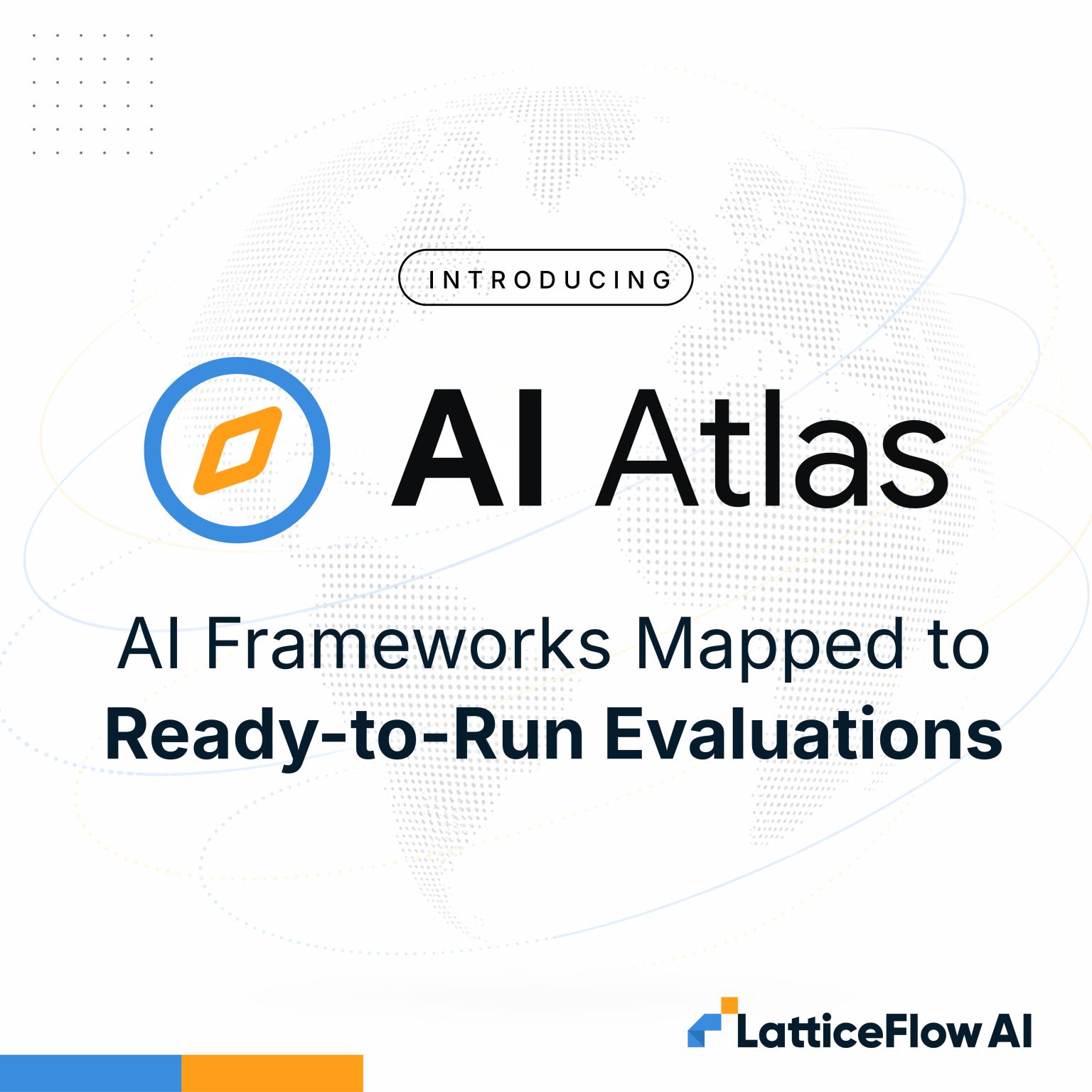
On April 30, 2026, LatticeFlow AI launched AI Atlas — the first public registry that builds that connection at scale. Atlas maps 20+ major AI governance, security, and risk frameworks directly to concrete, ready-to-run technical evaluations. Select a framework. See the specific risks and controls that framework identifies. See the specific evaluations that test whether those controls are passing or failing in your actual AI system. Run them. Get evidence. This is what turning compliance documentation into compliance proof looks like.
"Under the EU AI Act, we need technical proof of how our systems perform and how risk is controlled. LatticeFlow AI helped us to achieve that, through measurable evaluation and clear evidence."
— Patrick Schnyder, Co-founder & MD, PastaHR
That quote from Patrick Schnyder at PastaHR is the clearest single sentence description of what Atlas is solving. Regulatory bodies are moving from asking "do you have a governance framework?" to asking "can you prove technically that your AI systems comply with that framework?" Organizations that have been operating on documentation alone are discovering that the answer to the second question is frequently no — not because their systems are noncompliant, but because they never built the technical evaluation infrastructure to demonstrate compliance. Atlas is designed to eliminate that gap without requiring teams to build evaluation pipelines from scratch.
What AI Atlas Actually Is
Atlas is best understood as an evaluation index organized by governance framework. It is a structured registry where every major AI risk framework — regulatory, industry, or standards-body — is mapped to a set of specific risks, each risk mapped to a set of specific controls, and each control mapped to one or more concrete technical evaluations that assess whether the control is passing or failing in a real AI system. The structure is hierarchical and precise: Framework → Risks → Controls → Evaluations.
LatticeFlow AI describes it as providing "packaged evaluation solutions organized by governance framework, red-teaming category, or use case." The "ready-to-run" framing is specific: evaluations are not templates or guidelines for building your own test. They are executable assessments that can be run against an AI application through the LatticeFlow AI platform, producing pass or fail results with the documentation needed to demonstrate compliance alignment to regulators, auditors, and internal stakeholders.
The platform positions Atlas as the entry point to a broader governance workflow — the ./atlas module that "kickstarts your governance journey" before discovery (./discover), evaluation (./evaluate), security scanning (./secure), and continuous monitoring (./govern). In that architecture, Atlas is not just a registry. It is the governance translation layer that converts regulatory and framework requirements into technical action items with measurable outcomes.
100+ ready-to-run evaluations available at Atlas launch, mapped across 20+ governance frameworks.
LatticeFlow AI states teams can be "live in days" rather than spending weeks building evaluation infrastructure manually. The evaluation library covers cybersecurity, hallucination, robustness, safety, jailbreaking, privacy, and agentic skills.
Two frameworks are publicly accessible in full detail at launch — EU AI Act Article 15 and FINMA AI Governance and Risk Management — with complete risk definitions, control specifications, and linked evaluations available for review without requiring contact with the sales team. Eight additional frameworks are available immediately in the public Atlas directory, with the remainder available on demand through direct engagement. The publicly accessible frameworks give enough detail to understand the depth of the framework-to-evaluation mapping, which is the technically significant part of the announcement.
The Frameworks Atlas Covers
The framework coverage in Atlas spans regulatory mandates, industry standards, government requirements, and security-specific frameworks. This breadth matters because governance programs typically need to demonstrate alignment across multiple frameworks simultaneously — an EU-regulated financial services firm might need EU AI Act alignment, FINMA compliance, and OWASP security coverage all at once. Atlas provides a single registry for all of them rather than requiring separate evaluation infrastructure per framework.
Frameworks Currently Live in Atlas
Regulation — EU
EU AI Act / Article 15
Covers accuracy, robustness, cybersecurity, and consistent performance obligations for high-risk AI systems. 1 defined risk, 8 controls, with candidate screening evaluations linked. The compliance deadline pressure makes this the highest-priority framework for European organizations.
Regulation — Switzerland
FINMA / AI Governance and Risk Management
Swiss Financial Market Supervisory Authority guidance covering governance, accountability, inventory, data quality, testing, monitoring, documentation, explainability, and independent review for financial services AI. 13 risks, 35 controls, multiple evaluations linked. The most comprehensive regulatory framework in Atlas at launch.
Industry — OWASP
OWASP / Agentic Top 10 (2026)
The ten highest-impact security risks specific to AI agent systems. 10 risks, 41 controls covering agent goal hijack, tool misuse, identity and privilege abuse, supply chain vulnerabilities, unexpected code execution, memory poisoning, insecure inter-agent communication, cascading failures, human-agent trust exploitation, and rogue agents.
Industry — OWASP
OWASP / LLM Top 10 (2025.1)
The established security risk framework for large language model applications covering prompt injection, sensitive information disclosure, supply chain vulnerabilities, data and model poisoning, improper output handling, excessive agency, system prompt leakage, vector and embedding weaknesses, misinformation, and unbounded consumption.
Standard — 2026
AIUC-1 / AI Agent Standard
The new AI Unified Controls standard specifically for AI agent systems, version 2026-01. This is one of the newest frameworks in Atlas and addresses the specific control requirements for autonomous agents that earlier standards were not designed to cover.
Industry — OWASP
OWASP / Skills Top 10 (2026)
The agentic skills risk framework covering the capability failures specific to AI agents — the ten ways that agent skill execution goes wrong in ways that standard LLM security frameworks do not capture. Version 1.0 launched 2026.
Frameworks Available on Demand
Standard
ISO/IEC 42001:2023
The international standard for AI management systems. The most formally recognized standard for enterprise AI governance programs seeking third-party certification.
On Demand
Industry
MITRE / ATLAS
The adversarial threat landscape for AI systems — the MITRE framework specifically for machine learning security threats and attack patterns, updated through 2026.
On Demand
Industry
Microsoft / Responsible AI Standard v2
Microsoft's internal responsible AI standard, version 2022, covering accountability, transparency, fairness, reliability, safety, privacy, security, and inclusiveness.
On Demand
Industry
MLCommons / AILuminate (2025)
The safety evaluation benchmark from MLCommons, one of the most used standardized safety assessment frameworks for foundation models.
On Demand
Government — US
OMB M-24-10
The US Office of Management and Budget memorandum on advancing AI governance in federal agencies — the primary US government AI governance requirement for federal contractors and agencies.
On Demand
Standard
MIT / AI Risk Repository (2024/2025)
MIT's comprehensive taxonomy of AI risks — a research-based framework that catalogs the full landscape of AI failure modes and risk categories across deployment contexts.
On Demand
Industry
Meta / Frontier AI Framework (2025)
Meta's framework for evaluating and governing frontier AI systems — covering capability thresholds, risk assessment, and safety requirements for advanced AI models.
On Demand
Industry
OpenAI / Preparedness Framework v2 (2025)
OpenAI's internal framework for evaluating and managing catastrophic risks from frontier models — covering CBRN, cybersecurity, persuasion, and model autonomy risk categories.
On Demand
Government — Japan
Japan AI Guidelines for Business (2024/2025)
METI's AI governance guidelines for Japanese businesses — covering ten AI governance principles across safety, security, fairness, privacy, transparency, accountability, and appropriate use of AI systems.
On Demand
How the Framework-to-Evaluation Mapping Actually Works
The technical architecture of how Atlas maps frameworks to evaluations is the most important thing to understand about this launch, because it is what distinguishes Atlas from a document library. Most compliance registries are lists of frameworks with links to the original documents. Atlas is a structured mapping system where every element of a framework — every risk, every control — has a technical evaluation attached that produces a quantifiable pass or fail result.
Here is the precise mapping architecture, using EU AI Act Article 15 as the worked example because LatticeFlow AI has published the full framework details publicly:
EU AI Act Article 15 → Framework-to-Evaluation Mapping Architecture
Framework Level: EU AI Act Article 15
Article 15 covers obligations for high-risk AI systems to achieve appropriate levels of accuracy, robustness, and cybersecurity, including resilience against adversarial attacks. This is the regulatory text. Atlas ingests the regulatory requirements and structures them into the risk-control hierarchy below.
Type: Regulation · Region: EU · Domain: Cross-sector
Risk Level: Non-compliance with EU AI Act Article 15
The single defined risk under this framework: that the AI system fails to comply with Article 15's requirements. One risk, eight controls. Every control is a specific technical or organizational obligation that, if satisfied, demonstrates Article 15 compliance.
Risk ID: R.1 · 8 Controls attached
Control Level: Accuracy, Robustness, Cybersecurity, Consistent Performance, Accuracy Transparency, Resiliency, Biased Feedback Loops, Malicious Actors
Eight specific controls, each corresponding to a distinct technical obligation. Control C.1.1 (Accuracy) requires appropriate accuracy levels. Control C.1.2 (Robustness) requires resilience to input variations. Control C.1.3 (Cybersecurity) requires resistance to prompt injection attacks embedded in applicant documents.
Controls: C.1.1 through C.1.8
Evaluation Level: Candidate Screening Accuracy, Robustness, Cybersecurity, Bias, Resilience
Ready-to-run evaluations linked directly to controls. Control C.1.1 links to the Candidate Screening Accuracy evaluation — which measures whether the AI system correctly classifies job applicants, measuring both overall accuracy and the direction of misclassifications. Control C.1.3 links to Candidate Screening Cybersecurity — which evaluates whether the system resists prompt injection attacks embedded in applicant documents attempting to manipulate screening outcomes. Each evaluation produces a concrete pass or fail result with the documentation needed for regulatory evidence.
Evaluations: Runnable · Pass/Fail · Audit-ready documentation
Use-Case Mapping: Domain-Specific Application
Atlas applies use-case mapping on top of the framework structure. The EU AI Act framework in Atlas is demonstrated through a Candidate Screening mapping — showing how the framework requirements apply specifically to AI systems used in hiring contexts. The FINMA framework uses a Research Assistant mapping. This use-case layer means evaluations are generated for how an organization's specific AI application operates, not just against a generic framework definition.
Use-Case-Aware: Domain-specific metrics and generated datasets
The FINMA framework shows the same architecture at significantly greater depth. Thirteen risks across seven sections — governance and accountability, inventory and risk classification, data quality, testing and ongoing monitoring, documentation, explainability, and independent review — map to 35 controls, which map to multiple specific evaluations including Structured Data Completeness, Structured Data Accuracy, Structured Data Representativeness, Structured Data Bias, Data Poisoning, RAG Recall, RAG Hallucination, RAG Faithfulness, Text Robustness, and Data Drift evaluations. Every evaluation is linked to the specific control it tests, and every control is linked to the specific risk and regulatory requirement it addresses.
AI Governance Capabilities Explained: What Platforms Actually Do and How to Choose the Right One
The OWASP Agentic Top 10 The Most Technically Significant Framework in Atlas
The most important framework in Atlas from a 2026 enterprise AI perspective is the OWASP Agentic Top 10, because it addresses the fastest-growing and least-governed risk surface in enterprise AI: autonomous AI agents. While the EU AI Act framework covers high-risk AI systems broadly and FINMA covers financial services governance in depth, the OWASP Agentic Top 10 is specifically designed for AI systems that plan, decide, and act autonomously across multiple steps and systems — which is where most of the new production risk is actually accumulating.
The framework defines ten risks, 41 controls. Here is the complete risk structure as published in Atlas:
Risk ID | Risk Name | Controls | Core Governance Implication |
|---|---|---|---|
ASI01 | Agent Goal Hijack | 4 | Adversaries manipulate agent objectives through prompt injection, deceptive tool outputs, or poisoned data — redirecting autonomous multi-step behavior toward harmful outcomes. Requires behavioral baselines and continuous goal drift monitoring. |
ASI02 | Tool Misuse and Exploitation | 5 | Agents misuse legitimate tools due to prompt injection or misalignment, causing data exfiltration or workflow hijacking even within authorized privilege boundaries. Requires per-tool least-privilege profiles and immutable invocation logs. |
ASI03 | Identity and Privilege Abuse | 4 | Architectural mismatch between user-centric identity systems and agentic design enables privilege escalation through unscoped inheritance, memory-based credential retention, and cross-agent trust exploitation. Requires task-scoped time-bound credentials per agent. |
ASI04 | Agentic Supply Chain Vulnerabilities | 4 | Agents and tools from third parties — including MCP servers, agent registries, and inter-agent communication interfaces — can be malicious or compromised, cascading vulnerabilities across multi-agent systems. Requires SBOM and AIBOM with attestations. |
ASI05 | Unexpected Code Execution | 3 | Agents generating and executing code can be exploited through prompt injection or malicious package installation to achieve remote code execution or container escape. Requires hardened sandboxes and validation gates between code generation and execution. |
ASI06 | Memory and Context Poisoning | 4 | Adversaries corrupt stored context — conversation history, embeddings, RAG stores — causing persistent biased reasoning that propagates between agents and resists remediation. Requires memory segmentation by session and domain context. |
ASI07 | Insecure Inter-Agent Communication | 4 | Inter-agent messages without authentication or semantic validation enable spoofing, replay, or semantic manipulation across distributed agentic systems. Requires mutual authentication and digital signing for all inter-agent channels. |
ASI08 | Cascading Failures | 4 | A single fault propagates across agents and workflows, bypassing stepwise checks to cause system-wide harm that outpaces human intervention. Requires blast-radius guardrails between planner and executor components. |
ASI09 | Human-Agent Trust Exploitation | 4 | Adversaries exploit agent fluency and perceived expertise to manipulate users into disclosing information or approving harmful actions — with the agent's role invisible to forensic investigation. Requires multi-step human confirmation for sensitive or irreversible actions. |
ASI10 | Rogue Agents | 5 | Agents become malicious or compromised and deviate from authorized scope through goal drift, workflow hijacking, or reward hacking — with individually legitimate-appearing actions whose emergent behavior escapes detection. Requires cryptographic identity attestation per agent with behavioral integrity baselines. |
The governance significance of this framework being in Atlas — rather than just existing as an OWASP document — is specific and practical. The OWASP Agentic Top 10 currently shows no evaluation mapping in the publicly accessible Atlas view. The note reads "No evaluation mapping defined yet." This is the honest frontier of where Atlas is: the framework definition layer is complete, the controls are specified, and the evaluation mapping is still being built for the most complex agentic risk categories. For an organization that needs to demonstrate compliance with the Agentic Top 10 today, Atlas provides the risk and control framework in a structured form — the technical evaluations for the most advanced agentic scenarios are coming.
The CISO's Guide to AI Pre-Failure Signals: How to Read Your Governance Stack Before Control Breaks
What the FINMA Framework Reveals About Atlas's Depth
The FINMA AI Governance and Risk Management framework in Atlas is the most technically complete publicly accessible framework at launch, and it reveals how deep the evaluation mapping goes when LatticeFlow AI has had time to build it. FINMA covers seven governance domains with 13 risks and 35 controls — and several of those controls have multiple evaluations attached. Understanding what is mapped there shows what the EU AI Act and other regulatory frameworks will eventually look like in Atlas as the evaluation library expands.
The data quality section is particularly instructive. Under the risk "Poor or inappropriate data quality" (R.3.1), two controls are defined. The first control — defining internal rules for data completeness, correctness, integrity, availability, and access — links to Structured Data Completeness evaluation (measuring whether all required attributes and time periods are present in a dataset) and Structured Data Accuracy evaluation (measuring whether dataset attributes correctly represent the true value of the intended concept). The second control — assessing representativeness, timeliness, and bias of training data — links to Structured Data Representativeness and Structured Data Bias evaluations.
The testing and monitoring section is where the continuous compliance architecture becomes visible. Control G.4.1.2 (ensuring tests for AI model quality including accuracy, robustness, stability, and bias are scheduled) links to RAG Recall, Text Robustness, and RAG Hallucination evaluations. Control G.4.2.2 (monitoring data drift and adapting models to changes in input data) links to a Data Drift evaluation that "measures the degree to which each sample in a new dataset has drifted from the reference distribution." Control G.3.2.2 (managing risk of manipulation or poisoning of external data) links to a Data Poisoning evaluation that "detects poisoned samples in a dataset that could elicit backdoor behaviour when used for LLM training."
The second customer quote from the LatticeFlow AI platform page speaks directly to what this depth means for regulated industries:
"The blueprint we developed with LatticeFlow AI reflects our commitment to building AI that meets the expectations of Switzerland's highly regulated financial sector, and can be deployed with confidence in practice."
Dr. Sina Wulfmeyer
Chief Data Officer, Unique AI
The phrase "deployed with confidence in practice" is the key one. Confidence in practice is not the same as confidence in documentation. Documentation tells you the policy said the right things. Practice tells you the AI system actually performs within acceptable bounds under realistic conditions. The FINMA framework in Atlas is a blueprint for generating the technical evidence that grounds that confidence in something measurable rather than something asserted.
What This Means for Governance Teams — The Practical Implications
Reading Atlas through a governance lens surfaces several specific implications that the product announcement does not state directly but that follow clearly from the architecture. These are the things compliance leads, governance program managers, and CISOs need to be thinking about as they evaluate whether Atlas changes their current program.
Implication 1: The Framework Selection Problem Gets Easier
One of the most persistent governance challenges is that different regulators, different industry standards bodies, and different internal stakeholders point to different frameworks — and mapping between them to understand what any given AI system actually needs to demonstrate is manual, time-consuming, and error-prone. Atlas provides a single structured view of what each framework requires at the control level, which means compliance teams can see side-by-side what the EU AI Act and FINMA require for the same AI application and identify where controls overlap versus where they diverge. That cross-framework comparison currently requires weeks of manual analysis. Atlas makes it structural.
Implication 2: Pre-Deployment Evidence Generation Becomes Systematic
LatticeFlow AI's platform data shows teams can be "live in days" rather than weeks on evaluation setup. For governance programs that currently spend weeks or months building bespoke evaluation pipelines before a new AI system can be approved for production, this matters significantly. The bottleneck that delays AI deployment in regulated environments is usually not the regulatory review itself — it is the time to build the technical proof that the review requires. Atlas, accessed through the LatticeFlow AI evaluation engine, reduces that bottleneck by providing the evaluation pipeline ready-built for the specific framework in question.
Implication 3: Continuous Compliance Monitoring Becomes Framework-Anchored
The most common failure mode in AI compliance programs is that pre-deployment evaluation evidence becomes stale the moment the system goes live. Models drift. Data distributions shift. New attack patterns emerge. The compliance evidence generated during pre-deployment review is no longer accurate six months later, but re-running the full evaluation cycle is expensive enough that most organizations do not do it systematically. Atlas, connected to LatticeFlow AI's continuous monitoring module, makes framework-anchored continuous evaluation possible — the same FINMA-mapped evaluations that ran pre-deployment can run on a scheduled basis against the live system, generating ongoing evidence rather than a point-in-time snapshot.
"In a domain like energy infrastructure, a reliable AI is fundamental. LatticeFlow AI provides us the visibility and control to ensure our models are both high-performing and secure in daily business."
Kevin Geiger
Project Engineer Asset Analysis, Axpo
Implication 4: Audit Evidence Generation Changes Character
Under EU AI Act Article 72, post-market monitoring systems must actively collect, document, and analyse data — and the evidence they produce must demonstrate ongoing compliance, not just initial approval. An audit trail that shows a framework was reviewed at deployment and never tested against afterward is not Article 72 compliant. Atlas-linked evaluations, run continuously through the LatticeFlow AI platform, produce exactly the kind of timestamped, framework-anchored technical evidence that Article 72 requires. The audit trail stops being a documentation exercise and becomes a live technical record.
What Atlas Does Not Solve
Atlas AI Indeed is an impressive feature added to Latticeflow AI. However, its not God, it has its limitations so be aware of these limitations.
Limitation 1: The Agentic Evaluation Gap
The OWASP Agentic Top 10 framework shows "No evaluation mapping defined yet" in Atlas at launch. The ten risks and 41 controls are documented and structured — but the technical evaluations that would prove whether an agent is actually compliant with those controls are still being built. This is the honest frontier of the field: the risks are identified faster than the evaluation methodologies for testing them can be developed. For organizations that need to demonstrate OWASP Agentic Top 10 compliance today with runnable evaluations, that mapping is not yet available in Atlas.
Limitation 2: Platform Dependency
Atlas is a public registry — anyone can browse the framework-to-control mappings without an account. But running the evaluations requires the LatticeFlow AI platform, which is a commercial product. The framework intelligence in Atlas is open. The evaluation execution that makes that intelligence actionable is behind a platform relationship. Organizations evaluating Atlas should understand they are evaluating both the registry and the platform — the registry alone does not generate compliance evidence.
Limitation 3: The Accountability Layer Is Still Yours to Build
Atlas maps frameworks to evaluations and the LatticeFlow AI platform runs those evaluations and produces evidence. What Atlas and the platform do not provide is the organizational accountability layer that determines what happens when an evaluation fails. Who owns the failing control? What is the response SLA? Who reviews the evidence before it goes to a regulator? What is the escalation path when a production evaluation produces results outside the acceptable range? That layer — named owners, defined response procedures, documented escalation paths — must be built by the organization. Technical evaluation infrastructure without organizational accountability infrastructure still produces evidence that nobody acts on.
"Atlas solves the translation problem that has made AI compliance so expensive and so unreliable. The gap between what a framework says and what a technical team can actually test has always been wide enough to fill with documentation theater. A registry that closes that gap structurally — framework requirement mapped to specific control mapped to runnable evaluation producing audit-ready evidence — is the right architecture for the compliance problem. The honest limitation is that the agentic evaluation layer is still being built, which is where the most urgent production risk lives in 2026. That gap matters and it should be on every governance team's radar when evaluating Atlas."
Nathaniel Niyazov
CEO, GetAIGovernance.net
Submit an Inquiry
Our Take
AI Compliance Take
The AI Atlas launch is the most significant structural development in AI compliance tooling in 2026. Not because of the number of frameworks it covers — though 20+ is comprehensive — but because of the architectural decision it represents. Building a public registry that maps framework requirements to technical evaluations rather than to documentation checklists is a statement about what compliance is supposed to be: not a record of what you intended to do, but evidence that your system actually behaves within the bounds the framework requires.
The EU AI Act Article 15 implementation is the most immediately significant for European organizations facing the August 2026 high-risk system compliance deadline. The mapping from Article 15's accuracy, robustness, and cybersecurity requirements to specific candidate screening evaluations — with pass/fail results and audit-ready documentation — is exactly what compliance teams need and have been building manually at significant cost. Atlas systematizes that work.
The FINMA framework depth is the clearest demonstration of what Atlas becomes when fully built out. Thirteen risks, 35 controls, and multiple linked evaluations per control covering data quality, model robustness, hallucination rates, data drift, data poisoning, RAG faithfulness, and explainability — all structured and traceable from the regulatory requirement through the specific technical test. That is a serious compliance infrastructure, not a documentation framework with a different label.
The gap that deserves attention is the agentic evaluation layer. OWASP's Agentic Top 10 is in Atlas, structured and complete at the risk and control definition level. The ready-to-run evaluations for the ten agentic risk categories — including Agent Goal Hijack, Cascading Failures, and Rogue Agents — are not yet mapped. For organizations running production AI agents right now, that gap means Atlas can tell you what the OWASP Agentic Top 10 requires of your agent but cannot yet run the evaluation that proves your agent meets it. Watch that evaluation mapping closely. It is the next major development to track from LatticeFlow AI.