Type "AI governance platform" into a search bar and watch what happens. Every vendor promises oversight, risk control, compliance support, operational monitoring. The phrases blur together after the third page. Same diagrams, same reassuring language, same bold claims about comprehensive coverage. You keep scrolling, hoping something will clarify the differences. It doesn't.
Here's what you notice when you look closer. Some systems manage policy approvals and accountability chains. Others watch live models spitting out predictions in production environments. A few concentrate almost entirely on adversarial defense and prompt injection attacks. Several exist purely to generate audit documentation for regulators. Same vocabulary across every marketing page, completely different engines underneath. What's worse: buyers feel that gap fast, usually six weeks into evaluation when someone asks a technical question the vendor can't answer cleanly.
Consider what happened over the past three years. AI adoption outpaced market structure by a mile. Security firms acquired governance startups to fill visibility gaps. Governance platforms layered in monitoring features they built in four months. Observability vendors added lightweight policy modules to compete for budget. Compliance providers stretched toward lifecycle tooling they don't really understand yet. Each move made commercial sense for the vendor. Category boundaries softened anyway. And when boundaries soften, procurement turns into a swamp. Time burns, budgets stretch, internal credibility takes hits nobody talks about in retrospect.
Picture this scenario inside boardrooms everywhere. The question lands confidently: "Do we have AI governance?" Now watch what happens next. Answers splinter across the organization. Security teams think you mean runtime protection against attacks. Data science groups think you mean drift detection and performance degradation alerts. Legal assumes you're asking about regulatory documentation and compliance frameworks. Risk committees expect approval workflows and clear accountability trails for when models fail publicly. Four teams, same phrase, completely different mental models. The tension builds underneath every steering committee meeting after that.
Eventually someone schedules demos. Teams start comparing products that aren't even competing in the same category. Here's where it falls apart: pilots stall when integration requirements surface. Costs appear that nobody budgeted for. Confidence dips. Six months in, someone admits quietly that we still don't have governance and nobody's sure what went wrong. This happens more often than vendors will ever acknowledge publicly.
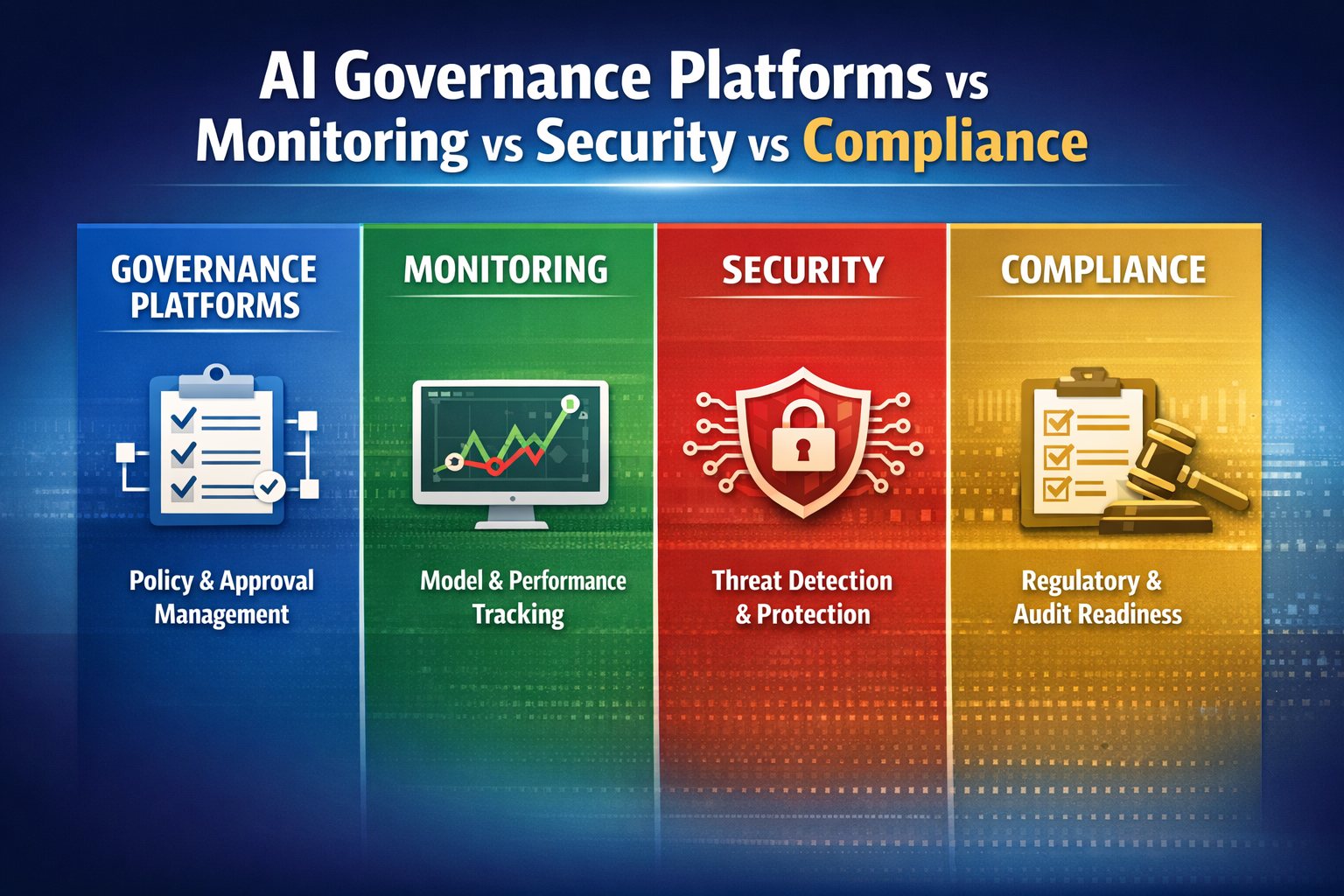
But clarity demands structure, whether procurement teams want to accept that or not. Four categories exist: Governance Platforms, Monitoring and Observability, Security and Risk, Compliance and Oversight. Each addresses distinct operational needs. Each lives under different organizational ownership. Each solves fundamentally different problems that happen to share vocabulary. Without taxonomy, "AI governance" degrades into marketing noise that sounds important but means nothing actionable. With structure, it becomes operational architecture. And here's what matters: architecture changes decisions. Decisions determine whether your governance actually functions or just produces documentation nobody reads.
Definitions
Governance Platforms
These systems manage the AI lifecycle inside a company from development through retirement. They track what models exist, assign risk tiers, document training data sources, manage approval workflows, and record who carries accountability when something fails. Think of governance platforms as answering the questions boards ask after an incident: Who approved this model? What data went into training? When was it last reviewed? Has anyone validated this thing since deployment? Governance platforms create structure and ownership around AI systems before they go live and while they operate. The focus sits on coordination and accountability across teams. Performance tracking happens elsewhere.
Monitoring and Observability
These tools watch models after deployment, when they're making real predictions with real consequences. They track prediction accuracy over time, detect drift when data patterns shift, monitor inference latency, and alert teams when performance starts degrading in ways that matter to the business. When a fraud detection model suddenly misclassifies legitimate transactions at twice the normal rate, monitoring tools catch that change. When a recommendation engine shifts behavior because underlying data distributions moved, observability platforms surface the drift before customer complaints pile up. These systems live in production environments. They measure and report what's happening right now. Policy creation and approval workflows? That lives somewhere else entirely.
Security and Risk
Security platforms protect AI systems from attacks, manipulation, and deliberate misuse. They defend against prompt injection attempts, adversarial inputs designed to fool models, model extraction attacks, and data leakage through clever prompting. Think about customer-facing chatbots: security tools block the user trying to jailbreak your LLM or exfiltrate training data through carefully crafted prompts. The job centers on protection and defense. Security platforms stop malicious behavior before damage spreads through your systems. Managing approval chains? Generating regulatory reports? Wrong category entirely.
Compliance and Oversight
These platforms map AI systems to regulatory requirements. They generate audit documentation, track evidence for regulatory examinations, and align internal policies with external frameworks like the EU AI Act or sector-specific banking regulations. Compliance tools satisfy regulators and internal audit teams who need proof that rules were followed. When examiners arrive asking for model validation documentation, compliance systems produce the evidence. Monitoring production drift? Stopping adversarial attacks? Those capabilities live in other categories.
Runtime AI
Runtime AI refers to AI systems while they are actively operating in production. That means models making predictions, chatbots responding to users, or agents executing tasks in real time. It does not refer to design or testing phases. Runtime is when the AI is live and interacting with real data.
Autonomous Agent
An autonomous agent is an AI system that can take actions on its own without needing human approval for every step. It can retrieve data, make decisions, and execute tasks within assigned boundaries. Think of it as AI with delegated authority.
Drift
Drift happens when a model’s performance changes over time because the data it sees has shifted. Customer behavior changes. Market conditions change. Input patterns change. When that happens, predictions degrade. Drift is performance instability caused by environmental change.
Asset Discovery
Asset discovery means identifying what AI systems exist inside an organization. That includes approved tools, shadow deployments, embedded AI features in SaaS platforms, internal models, and API integrations. You cannot govern what you cannot see.
Guardrails
Guardrails are enforcement controls placed around AI systems to prevent certain actions. They stop unauthorized data access, block sensitive outputs, or escalate decisions to humans when needed. Guardrails define behavioral boundaries.
API (Application Programming Interface)
An API is a connection method that allows one software system to communicate with another. In AI contexts, APIs allow applications to send data to external models or receive AI-generated responses. In simple terms: it’s the bridge that lets software talk to AI.
Why Category Confusion Exists In The First Place
AI governance did not start as a clean software category, It grew out of pressure. Originally, companies began deploying models across departments without a shared structure for oversight, and vendors rushed to fill gaps as quickly as possible. Eventually, security firms saw exposure risk and expanded into AI inspection. Governance platforms built policy workflows and added monitoring modules to stay competitive while Observability vendors layered in governance features because customers asked for more than performance metrics. Compliance providers stretched into lifecycle tooling once regulators began asking harder questions.
Then came Terminology. Words like governance, monitoring, risk, compliance, and oversight became interchangeable in marketing. The language had stayed consistent while the underlying capability shifted. One product might specialize in approval workflows and accountability tracking. Another might watch live models in production and alert on drift. A third might focus on adversarial defense and prompt injection. A fourth might exist primarily to generate regulatory documentation. From a distance, all claim “AI governance.” Operationally, they solve different problems.
Procurement problems emerge because organizations search for one concept while evaluating four separate categories. Teams assume they are comparing similar platforms. Six weeks later, someone realizes the tool under review does not actually monitor production models or does not generate audit artifacts required for regulators. Momentum stalls. Budget discussions restart. Confidence erodes inside steering committees, and frustration builds because nobody can clearly explain what went wrong.
Cant forget about market maturity. Established software sectors such as CRM or ERP evolved over decades, allowing boundaries to harden. AI governance formed in public view under rapid adoption pressure. Vendors expanded through acquisitions and feature additions before taxonomy stabilized. Buyers now face collapsed boundaries where categories blend, but responsibilities inside organizations remain distinct. Security teams think about threat prevention. Data science teams think about model performance. Legal teams think about documentation and regulatory mapping. Risk committees think about accountability and approval control. The phrase “AI governance” means something different to each group.
Confusion, then, is intended rather than accidental. Vendors speak across categories because growth incentives encourage breadth. Buyers approach the market expecting clarity because they assume software categories behave like older enterprise markets. When those expectations collide, evaluation becomes inefficient and costly. Until the categories are separated and defined, procurement teams will continue comparing tools that were never designed to solve the same problem in the first place.
Where Categories Overlap And Where Buyers Get Confused
Now that the four categories are clear, here’s where most people start mixing them up.
Overlap happens because vendors expand. A governance platform adds monitoring features because customers ask to see model performance after approval. A monitoring vendor adds policy templates because enterprise buyers want more structure. A security platform introduces governance language once it builds guardrails for LLMs or autonomous agents. A compliance tool stretches into lifecycle tracking because regulators demand clearer documentation. Each expansion makes business sense. It does not mean the product suddenly becomes all four categories at once.
Take Governance and Monitoring. A governance platform may show dashboards with model metrics, but that does not mean it provides deep production drift detection or real-time alerts that data scientists depend on. Monitoring tools may offer basic model inventory or tagging features, but that does not mean they manage approval workflows, accountability assignments, or executive reporting. Seeing a feature on a page is not the same as depth in that area. Buyers often assume coverage because they see familiar words. That assumption causes problems later.
Now look at Security and Governance. Security vendors test models for adversarial attacks and block malicious prompts. Governance platforms evaluate whether a model was approved correctly, assigned a risk tier, and documented for internal oversight. Both use the word validation. They are not doing the same job. Protection against attacks does not replace structured ownership and approval.
Compliance overlaps with Governance more than any other category. Governance platforms create documentation and accountability trails. Compliance tools take that documentation and map it to regulatory frameworks, then package it for auditors. Governance focuses on internal coordination. Compliance focuses on external proof.
Here’s the part buyers need to hear clearly: overlap does not mean interchangeability. Vendors may expand across categories, but their original design still shapes what they do best. If a company started as a monitoring tool, its strength will likely remain in production visibility. If it began as a compliance platform, documentation depth will probably be stronger than runtime enforcement.
Confusion grows when teams compare platforms as if they are solving the same problem. They are not. Each category solves a specific operational need. When you treat them as one interchangeable group, evaluation becomes messy, contracts get signed under wrong assumptions, and six months later someone realizes the tool does not do what the organization actually needed in the first place.
Common Procurement Mistakes
One of the most common mistakes happens when a team buys a Governance Platform thinking it will solve production instability. A company realizes models are behaving unpredictably in live environments, accuracy shifts without warning, and customers complain about inconsistent outputs. Leadership hears “AI governance problem” and approves a governance tool. The platform gets implemented, risk tiers get assigned, documentation improves, approval workflows become structured. Months later, the same performance problems continue because no one installed real-time monitoring. The organization bought structure when it needed visibility. The tools were working exactly as designed; they were just solving the wrong problem.
Another mistake runs in the opposite direction. Regulators start asking detailed questions about model validation history, approval authority, and risk classification. In response, the company doubles down on monitoring dashboards and performance metrics. Data science teams proudly present drift detection charts and latency reports during regulatory reviews. Examiners listen carefully and then ask for documented approval chains, formal risk assessments, and policy mapping to regulatory articles. Monitoring proves the model works today. Regulators want proof it was governed properly yesterday. Different requirement. Different category. The company assumed performance evidence equaled governance maturity, and the gap only surfaced during audit.
Security confusion creates a third failure pattern. An enterprise worries about prompt injection and data leakage through AI tools, so it implements runtime security controls. Guardrails are deployed, malicious inputs get blocked, and the CISO reports improved protection. Meanwhile, no centralized inventory exists of which AI systems are even active across departments. Shadow deployments continue growing quietly. When a board member asks for a full list of AI assets and their risk ratings, security logs cannot answer that question because protection tools were never built to manage lifecycle accountability. Defense improved, oversight remained fragmented.
There is also the assumption that one vendor claiming end-to-end coverage eliminates category thinking altogether. Teams select a platform marketed as comprehensive, expecting governance, monitoring, security, and compliance depth in one stack. Over time, they discover certain capabilities are mature while others feel lightweight or recently added. Integration across modules requires more coordination than expected. The issue is not deception. It is category origin. Every platform begins somewhere, and depth usually reflects that starting point.
Procurement mistakes rarely happen because teams are careless. They happen because organizations treat “AI governance” as one bucket instead of four operational functions. Once categories are separated clearly, these errors become predictable and avoidable. When they are blurred together, evaluation drifts, budgets stretch, and confidence erodes long before the real architectural gaps are addressed.
Vendor Landscape Map (By Category)
Now we place companies inside structure. No marketing blurbs. No feature hype. Just category alignment based on what they were built to do first and where their depth usually sits.
Start with Governance Platforms. These vendors focus on lifecycle control, risk tiering, approval workflows, accountability mapping, and structured documentation across teams. Their architecture centers on coordination and oversight.
Credo AI
Holistic AI
OneTrust AI Governance
TruEra
Arthur AI (governance + monitoring overlap)
Move to Monitoring and Observability. These companies were built to watch models in production, track drift, measure performance degradation, and provide operational visibility to ML teams.
Arize AI
Fiddler AI
WhyLabs
Aporia
Arthur AI (overlap with governance)
Then comes Security and Risk. These vendors concentrate on protecting AI systems from adversarial attacks, prompt injection, model extraction, and data leakage. Their strength is runtime enforcement and threat mitigation.
Robust Intelligence
HiddenLayer
Patronus AI
Finally, Compliance and Oversight. These platforms specialize in regulatory mapping, audit trail generation, and documentation structured for examiners and oversight bodies.
ValidMind
Monitaur
TrustArc
Securiti
OneTrust (compliance features)
Overlap exists because the market expanded quickly and vendors broadened scope through acquisitions or feature additions. What matters for buyers is not whether a vendor claims end-to-end coverage, but which category reflects its original design and deepest capability. Category clarity comes first. Vendor comparison comes second.
Our Take
AI GOVERNANCE TAKE
The AI governance market grew too fast. Tools started selling before anyone defined clear categories. Now buyers face a mess where every vendor uses the same words while solving different problems. Security vendors buy governance startups. Governance platforms add monitoring features. Monitoring tools build policy modules. Everyone claims they do everything. Categories blur, and buyers waste time figuring out what's real.
This creates real problems. Teams spend months evaluating "AI governance platforms," watch similar demos, then find out later that one does policy management, another does performance monitoring, and a third does compliance paperwork. Same language, different tools. The truth comes out six months after deployment when nothing connects properly.
GetAIGovernance fixes this. We organize vendors into four clear categories: Governance Platforms for managing AI lifecycles, Monitoring and Observability for tracking live performance, Security and Risk for stopping attacks, Compliance and Oversight for meeting regulations. Buyers see which vendors actually do what instead of guessing from marketing claims.
Clear categories change how people buy. Instead of comparing Credo AI to Arize like they're the same thing, buyers understand Credo builds policy systems and Arize tracks model performance. Both are useful. They just do different jobs. Knowing this upfront saves months and prevents nasty surprises during setup.
For vendors, being listed correctly on GetAIGovernance means better leads. Governance platforms get buyers who need policies. Monitoring vendors get buyers tracking performance. The right buyers find the right tools instead of everyone wasting time in meetings that go nowhere.
Category structure will happen whether vendors like it or not. Buyers always demand clarity once markets mature. The only question is whether you get positioned early or get lost in the noise while buyers go elsewhere for straight answers.