Why You Can Trust GetAIGovernance + Our Research
Every vendor on this page was evaluated against the same criteria using public documentation, funding disclosures, integration listings, customer evidence, and independent industry recognition. No vendor paid to be ranked. Rankings reflect our independent editorial assessment of each platform's fit, depth, and differentiation within the AI governance category. BE AWARE, THE NUMBER RANKINGS "#1, #2... DO NOT MEAN THE COMPANY IS BETTER THAT IS JUST HOW THEY WERE LISTED. ONE COMPANY IS NOT BETTER BECAUSE OF THE AMOUNT OF FUNDING OR THE TIME THEY'VE BEEN ACTIVE.
A CFO wants to know what the AI budget bought before approving the next one. A board member has read that a competitor is further along. A procurement lead is staring at a renewal for a tool that nobody can confirm anyone opened. Whatever the trigger, somebody senior asks what the AI spending returned, and the answer has to be a number.
The software built to produce that number has been grouped under one label, and the label is carrying more weight than it can bear. One platform in this category will tell you what your inference bill was last month, broken down by model and by team. Another will tell you which departments actually adopted the assistant you rolled out and which ones quietly stopped using it in week three. A third reads the conversations employees have with your agents and reports whether they finished the task they came to do. A fourth measures whether your people are any good at using AI in the first place. Those are four different products answering four different questions, and buyers routinely compare them as though they were substitutes.
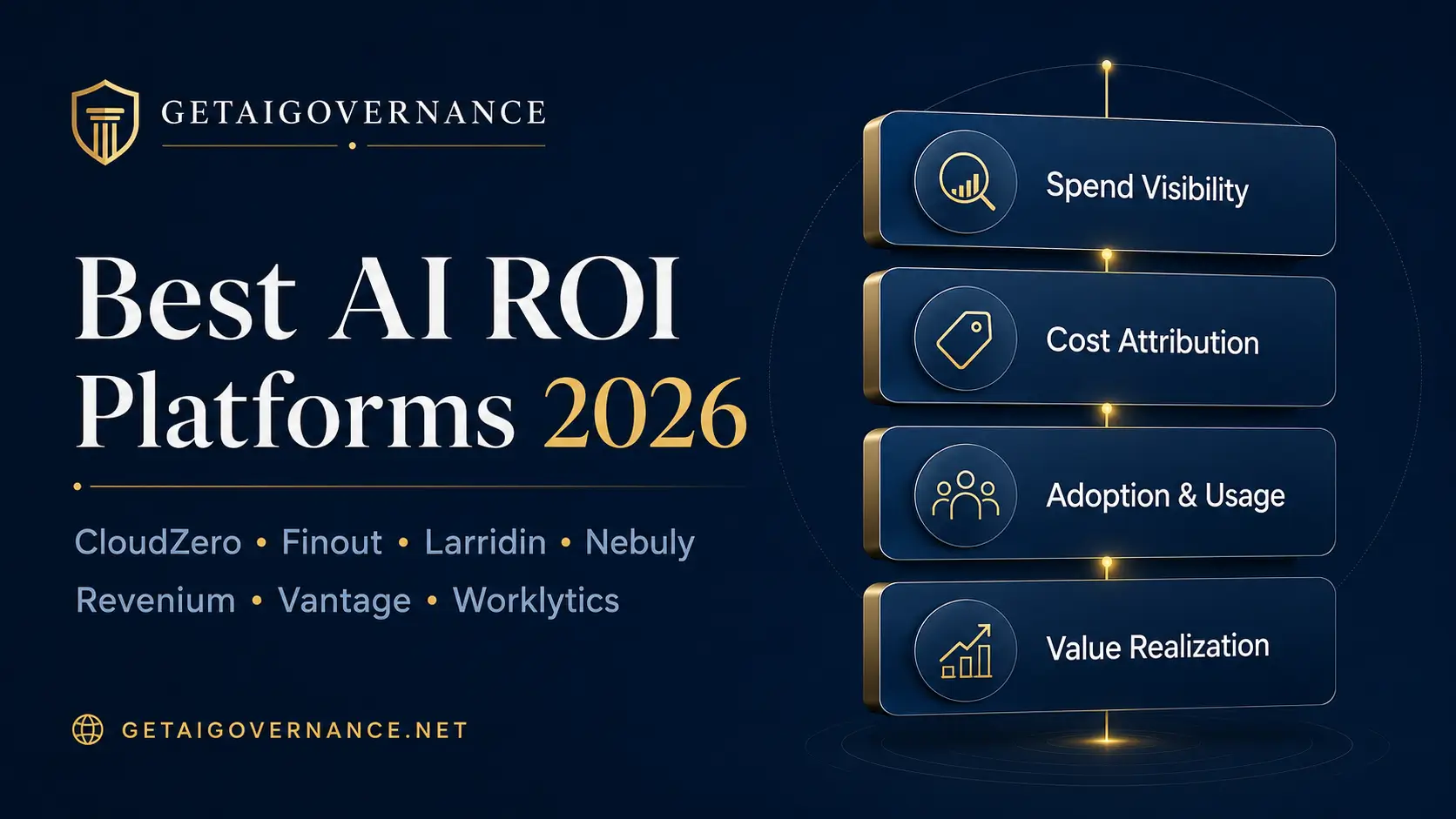
This guide compares seven AI ROI platforms organized around the measurement layer each one owns, drawing on the four-layer framework set out in our AI ROI metrics guide. Each platform anchors the one capability where its depth is most defensible. The goal is to clarify which system answers which question, rather than to rank companies by size or funding.
What AI ROI Platforms Actually Do
An AI ROI platform exists to answer one question: What did the AI spending actually return?
To answer it, the platform needs to connect three things that currently live in separate systems: what AI cost, who used it, and what the usage produced. Most organizations cannot do this today because the tools they already run were built before AI was doing meaningful work. Finance systems track budgets but not AI output. Monitoring tools track model behavior but not business value. Workforce tools track how people spend their time but rarely see the AI cost attached to it.
This creates constant confusion between three adjacent categories that buyers often treat as interchangeable:
FinOps platforms measure infrastructure cost. They can tell you what your cloud and API bills were last month and which team to charge. They stop there. Their job is cost control and forecasting, not proving whether the spending created value. Several platforms in this guide started in FinOps and expanded into AI, which gives them strong cost visibility but limits how far they can go into outcomes.
AI monitoring platforms measure whether models are behaving correctly. They track hallucination rates, drift, latency, and output quality. These are important signals, but they answer a different question. A monitoring tool can tell you that a model hallucinates in 3% of outputs. It cannot tell you whether deploying that model was worth the money. AI ROI platforms consume monitoring signals as an input when calculating return.
Workforce analytics platforms measure how people work. They analyze meetings, collaboration patterns, and productivity signals. They are useful, but they generally do not see the AI cost attached to that work. AI ROI sits at the intersection — where usage and cost are measured on the same page.
The category is still young, which is why many buyers end up comparing platforms that solve completely different problems. Understanding which layer a platform actually owns is the difference between buying something useful and buying an expensive dashboard that produces numbers nobody can defend.
How We Evaluated These Platforms
Layer depth. Does the platform deliver genuine operational depth in one measurement layer, or shallow coverage across several at once?
Data provenance. Does the platform produce observed data or self-reported data? This is the single most important question in this category, because a return figure built on a survey will not survive a finance director who asks how the number was measured.
Cost surface coverage. Does the platform see the costs that sit outside the token bill, including external API calls, tool invocations, and human review time?
Consumed versus built AI. Can the platform see the AI that employees use, or only the AI the organization instrumented itself? Most enterprise AI usage is now consumption of software built by somebody else.
Third-party validation. What independent analyst recognition, named customer evidence, or published results support the placement?
Buyer fit. What company size, industry, and internal buyer does the platform serve best?
The AI ROI Platforms: A Quick Overview
Platform | Pricing | Primary Capability | Best For |
|---|---|---|---|
Tiered subscription, not publicly listed | Cost Attribution and Unit Economics | Engineering and finance teams that need cost per customer and cost per feature to defend gross margin | |
Published tiers, free trial available | Spend Visibility and Consolidation | Enterprises folding AI spend into an established FinOps practice across cloud, Kubernetes, and SaaS | |
Custom enterprise pricing | AI Proficiency and Impact Intelligence | Organizations that need to know whether their people are actually skilled at using the AI they were given | |
Custom enterprise pricing | Agent Conversation Analytics and Outcome Measurement | Organizations with deployed AI agents that cannot tell whether users are succeeding with them | |
Usage-based, metered on transactions | Agent-Level Metering and Non-Token Cost Attribution | Organizations running agents where the real cost sits outside the token bill | |
Self-serve, free tier, scales with tracked spend | Developer-Level AI Cost and Self-Serve FinOps | Engineering teams without a dedicated FinOps function that need cloud and AI cost in one place | |
Published pricing, self-serve signup | Productivity Measurement and Value Realization | Leaders who have to defend an AI license renewal with productivity evidence that holds up |
The Best AI ROI Platforms
CloudZero Best for Cost Attribution and Unit Economics
The only platform in this guide that allocates AI cost without complete tagging
Choose CloudZero if: you need to know what an AI feature costs per customer, and your infrastructure is too shared, too multi-tenant, or too poorly tagged for conventional cost allocation to produce an answer you can defend.
Founded: 2016
HQ: Boston, MA
Company Size: Approximately 164 employees
Funding: $56M Series C (May 2025) led by BlueCrest Capital Management and Innovius Capital, with Matrix Partners, Threshold Ventures, Underscore VC, G20 Ventures, and a strategic investment from MongoDB
Recognition: Gartner Magic Quadrant for Cloud Financial Management Tools, Visionary; more than $15 billion in managed spend; customers include Coinbase, DraftKings, Expedia, Moody's, and Nubank
The product is the CloudZero platform, and two components do the work that puts it at the attribution layer. AnyCost is the ingestion API, pulling spend from any provider into one cost model, covering Anthropic, OpenAI, the major cloud platforms, Kubernetes, Snowflake, and Datadog. CostFormation is the allocation engine, and it is the reason CloudZero belongs here rather than in the spend visibility layer alongside Finout.
Most cost tools allocate spend by reading resource tags. In a real enterprise a large share of infrastructure is untagged, shared, or multi-tenant, which means tag-based allocation leaves a substantial fraction of the bill sitting in an unallocated bucket that nobody owns. The standard response to that problem is a tagging cleanup project, and the standard fate of a tagging cleanup project is that it never finishes. CostFormation assigns costs to products, features, teams, and customers without depending on complete tagging, which is what makes unit economics possible in an environment that was not built for them.
Unit economics is the thing a CFO is actually asking for. What does this feature cost per customer. What does an inference cost per query. What is the gross margin on the AI-powered tier of the product. A software company with AI features embedded in its product now has a cost of goods sold that moves with how heavily each customer uses those features, and without cost-per-customer visibility it can sign an enterprise deal that is unprofitable from the first day and not find out for two quarters.
The platform also computes the Cloud Efficiency Rate, which is revenue minus cloud cost divided by revenue, giving executives a single benchmark for the margin impact of AI and cloud spending. Machine learning models analyze hourly cost data to detect anomalies and attribute them to the team or the model that caused them, which turns a runaway inference loop from a monthly billing surprise into a same-day alert. A plugin surfaces cost data inside the development environment, putting the number in front of the engineer at the moment the spending decision is made rather than four weeks later.
What We Like
Allocation without complete tagging: CostFormation assigns cost to teams, features, and customers in environments where tag coverage is partial, which describes most enterprises honestly.
Real unit economics: Cost per customer, per feature, per inference, and per token are the figures that connect AI spending to gross margin rather than to an IT budget line.
Hourly anomaly detection with attribution: A cost spike arrives with the team that caused it already attached.
Cost data inside the IDE: Engineers see the cost consequence of a decision while they are still making it.
Gartner Visionary placement: Independent analyst recognition in the Cloud Financial Management Tools market.
What to Know
The platform measures cost and unit economics. It does not measure whether employees are using the AI licenses the company bought, and it does not measure what the work produced.
Pricing tiers are not published, so evaluation requires a sales conversation. Teams without a FinOps function may find the procurement process heavier than the problem warrants.
Third-party reviews consistently note that CloudZero's LLM-specific attribution is less mature than its cloud and Kubernetes allocation, which is where the platform's history lies.
Like every platform in this guide, it prices what vendors charge and does not price the cost of AI failures or the governance overhead the program consumes.
ROI Coverage
Best For
Software companies with AI in the product: Organizations whose cost of goods sold now moves with customer usage of AI features and who need to protect gross margin.
Engineering-led FinOps programs: Teams that want cost visibility embedded in the development workflow rather than delivered as a monthly finance report.
Enterprises with incomplete tagging: Organizations that have accumulated shared and multi-tenant infrastructure and cannot wait for a tagging project to finish before allocating cost.
Pricing: Tiered subscription. Not publicly listed. Enterprise sales conversation required.
Finout Best for Spend Visibility and Consolidation
The most established FinOps platform to extend properly into AI cost
Choose Finout if: you already run a FinOps practice and need AI spending folded into it rather than tracked in a separate tool that finance has to reconcile by hand.
Founded: 2021
HQ: Tel Aviv, Israel
Company Size: Approximately 113 employees
Funding: $85M total, including a $40M Series C (January 2025) led by Insight Partners, with Pitango, Team8, Red Dot Capital, and Maor Investments
Recognition: ISO 27001 and SOC 2 certified; honorable mention in the Gartner Magic Quadrant for Cloud Financial Management Tools; G2 Leader in cloud cost management; named Most Promising Startup of 2025 by Globes; customers include Lyft, Wiz, Tenable, SiriusXM, and The New York Times
The product is the Finout platform, and it is built on two components. MegaBill consolidates spend from every source into a single view. The patented Virtual Tags engine allocates both tagged and untagged spend to an owner without requiring a tagging cleanup project as a prerequisite. Finout ingests AI costs from OpenAI, Anthropic, and Cursor alongside AWS, Google Cloud, Azure, Oracle Cloud, Kubernetes, Snowflake, Databricks, and Datadog, and the company states that AI cost ingestion carries no additional charge.
Finout anchors the spend visibility layer because its center of gravity is completeness rather than attribution depth. The first problem it solves is the one where a company genuinely does not know what it is spending, because the spending is scattered across a cloud bill, a Kubernetes cluster, a dozen SaaS contracts, and a handful of AI vendors that each send their own invoice on their own schedule. MegaBill puts all of it in one place, and Virtual Tags then assigns the untagged remainder to owners, which is the step where most FinOps programs stall.
The published customer results are among the strongest in this comparison. Lyft has reported moving from 80% to 96% cost coverage across its infrastructure after deploying the platform, and cutting the time to detect a cost issue from weeks to days. Financial planning tools handle budgets and forecasts against plan. CostGuard connects to the native recommendation engines of the major cloud providers to surface waste. Anomaly detection flags unexpected movement with Slack alerting. Billy, an assistant built into the platform, answers FinOps questions in plain language.
What We Like
One bill across every source: MegaBill consolidates cloud, Kubernetes, SaaS, and AI spend, which is the first requirement of the visibility layer and the step most organizations have never completed.
Patented Virtual Tags: Allocation of untagged and shared spend removes the tagging cleanup project as a prerequisite to getting an answer.
AI ingestion at no additional charge: A genuine differentiator against competitors that price AI cost tracking as a paid add-on.
Named enterprise references with published results: The Lyft coverage improvement is a specific, checkable outcome rather than a testimonial.
ISO 27001 and SOC 2: Certification depth that enterprise procurement teams require before a security review will clear.
What to Know
Finout is a FinOps platform that has extended into AI. It measures what AI costs and leaves adoption, productivity, and outcome measurement to other tools.
It tracks the model and API spend that vendors invoice. In an agentic workflow, the external tool calls that dominate the real cost sit outside that picture unless they happen to arrive as a cloud or SaaS charge.
The platform assumes a FinOps function exists to operate it. Engineering teams without a dedicated FinOps hire will find the platform heavier than the problem requires.
ROI Coverage
Best For
Enterprises with an existing FinOps practice: Organizations that already manage cloud cost through a dedicated function and need AI folded into the same discipline.
Multi-cloud and Kubernetes environments: Companies whose spend is scattered across providers and whose tagging has never been complete.
Finance-led cost programs: Teams where the primary buyer is finance rather than engineering, and where showback and chargeback are the operating mechanism.
Pricing: Published tiers with a free trial available.
Larridin Best for AI Proficiency and Impact Intelligence
The only platform in this guide that measures whether your people are any good at using AI
Choose Larridin if: your adoption numbers look healthy and your productivity numbers have not moved, and you need to find out whether the problem is the tool, the workflow, or the fact that nobody knows how to use it properly.
Founded: 2024
HQ: South San Francisco, CA
Company Size: Approximately 26 employees
Funding: $17M seed led by Andreessen Horowitz, with Bloomberg Beta, Gradient, Haystack, and Homebrew participating
Recognition: SOC 2, GDPR, and HIPAA compliance; Omdia On the Radar coverage; founding team previously built comScore and Dynamic Signal
The product is the Larridin platform, and Scout is the component that starts the work, discovering every AI tool running across the organization including the ones individuals bought on a personal card. From there the platform measures adoption depth by team and role, scores AI fluency, maps the workflows AI is actually running, connects to GitHub and Jira to measure what AI-augmented engineers are shipping, and tracks every license, model call, and token.
The capability that earns Larridin its place in this guide, and that no other platform here provides, is proficiency measurement. The company's own framing of the problem is the sharpest articulation of it available. A sales team gets an AI research tool and hits 80% adoption. Users scratch the surface, miss the features that would drive real gains, and save minutes on a task where the tool could have saved hours, because nobody told them what it could do. Adoption looks like a success. Productivity has not moved. Every other platform in this comparison would report that rollout as a win.
The founding team matters here more than it usually does. Russ Fradin and Jim Larrison built comScore, which is to say they built the measurement layer for the early web, and they went on to build Dynamic Signal to roughly $50 million in annual recurring revenue before it was acquired. Ameya Kanitkar, the third co-founder, came from LinkedIn, Coinbase, and Groupon. The company they are describing is a third-party measurement business for enterprise AI, which is a coherent thesis from people who have run that playbook before in a different market.
Larridin is also the platform in this guide that takes the credibility problem most seriously, which is discussed in full at the end of this article. Its published framework insists on a pre-deployment baseline, warns buyers against accepting vendor-supplied metrics, and counts internal implementation, training, and change management on the investment side of the ROI equation rather than counting only what the software vendor charged.
What We Like
Proficiency and fluency scoring: The only platform in this comparison that measures capability rather than access, which is the gap between an adoption number and a productivity number.
Scout discovery: Surfaces every AI tool in use, including personal purchases that never went through procurement.
Developer intelligence: Connects to GitHub and Jira to measure what AI-augmented engineers actually ship, which is a harder and more useful number than seat count.
Workflow mapping: Shows where AI is already running, where it has stalled, and where the next automation opportunity sits.
Baseline discipline: The published framework states plainly that without a pre-deployment baseline, every ROI claim remains anecdotal. That is an unusual thing for a vendor to put in writing.
Founding team with a measurement track record: The comScore lineage is directly relevant to what the company is attempting.
What to Know
Founded in 2024 with $17M raised and roughly 26 employees. This is an early-stage company, and vendor stability is a legitimate procurement criterion for a multi-year measurement program.
Discovery depends on the access the platform is granted. The completeness of the AI inventory it produces is a function of which integrations are enabled.
The platform's breadth means it overlaps with Worklytics on adoption and productivity measurement. The two differ in method, and buyers evaluating both should press on how each collects its data.
Enterprise pricing is quoted on request rather than published.
ROI Coverage
Best For
Organizations with strong adoption and flat productivity: Companies where the rollout looks successful on paper and the business results have not appeared, which is the specific failure Larridin was built to diagnose.
Enterprises running AI across many functions: Organizations with tools scattered across product, engineering, customer success, and sales that need one view of what is working.
CIOs and CFOs preparing a budget defense: Leaders who need proficiency and impact data rather than a login count when the board asks what the money bought.
Pricing: Custom enterprise pricing, quoted on request.
Nebuly Best for Agent Conversation Analytics and Outcome Measurement
The only platform in this guide that reads the conversations your agents are actually having
Choose Nebuly if: you have deployed AI agents to employees or customers and you cannot tell whether anyone is actually accomplishing what they came to do.
Founded: 2022
HQ: New York, NY
Company Size: Approximately 15 employees
Funding: Seed stage, backed by EXOR Seeds, Endeavor Italy, Vento, and Club degli Investitori. Total raised is not publicly disclosed
Recognition: ISO 27001, ISO 42001, and SOC 2 certified; GDPR compliant; customers include Iveco and Oura
The product is the Nebuly user analytics platform, and it treats the conversations people have with an organization's AI agents as an enterprise data set. Every day, employees and customers ask questions of AI agents instead of clicking through software, and those conversations carry signals about adoption, unmet demand, and whether anyone is succeeding. No cost platform can see any of it, because none of that traffic appears on an invoice.
For internal agents, Nebuly tracks which departments, roles, and segments are engaging and which are not, so a program lead can see where a rollout landed and where it stalled. It scores AI fluency across functions and geographies. It surfaces the real tasks employees bring to AI, which routinely differ from what the rollout assumed, and that finding tends to change what a company deploys next. Most importantly for this framework, its success tracking measures whether users actually completed what they came to do, which is an outcome measure rather than a satisfaction survey, and outcome measures are what the credibility problem demands.
For customer-facing agents, the same conversation data surfaces churn signals, upsell signals, and topic discovery.
The technical approach matters for regulated buyers. Nebuly runs purpose-built small models trained specifically to extract signal from AI conversations rather than sending conversation data to general-purpose frontier models, which lowers both the cost per conversation and the exposure. The platform can run fully on-premise or in a private cloud so that conversation data never leaves the customer environment, and an anonymization module strips personally identifiable information before analysis. The ISO 42001 certification is uncommon in this market and directly relevant to buyers carrying AI-specific compliance obligations.
What We Like
Outcome measurement rather than a survey: Task completion tracked from the conversation itself is observed data, which is the standard a defensible ROI figure requires.
Use case discovery: Surfaces what employees actually bring to AI, which is one of the few findings in this category that changes what a company does next.
ISO 42001 certified: Rare in this market and directly relevant to buyers with AI governance obligations.
Full on-premise deployment: Conversation data never leaves the environment, which is the difference between a viable and an unviable purchase in a regulated industry.
Purpose-built small models: Lower cost per conversation and less exposure than routing conversation data to a frontier model.
What to Know
The platform needs deployed conversational agents to produce signal. An organization whose AI is mostly a coding assistant and a set of per-seat licenses will get limited value from it.
It measures adoption and outcomes and does not measure what any of it cost, which means it has to be paired with a cost platform before it can produce a return figure.
Named customer references are thinner than for the FinOps platforms in this guide, which reflects the company's stage rather than the quality of the product.
Enterprise pricing is quoted on request rather than published.
ROI Coverage
Best For
Organizations with deployed agents: Companies running internal or customer-facing AI agents that cannot say whether users are succeeding.
Regulated environments: Buyers who need conversation analytics without conversation data leaving the perimeter.
Product and CX leaders: Teams that need to know what users are asking their AI for and where it is failing them.
Pricing: Custom enterprise pricing, quoted on request.
Revenium Best for Agent-Level Metering and Non-Token Cost Attribution
The only platform in this guide that prices the credit report and not just the tokens
Choose Revenium if: you are running agents that call external tools, and you have worked out that the model tokens are the smallest thing on the bill.
Founded: 2020
HQ: Herndon, VA
Company Size: Approximately 18 employees
Funding: $13.5M seed round (November 2025) led by Two Bear Capital, with participation from WestWave Capital
Recognition: Joined the FinOps Foundation in June 2026; founding team previously built and exited RightScale, MuleSoft, and OpSource
The product is the Revenium metering platform, and the Tool Registry is the component that addresses the largest blind spot in AI cost measurement. The intuition that AI cost equals token cost was formed when AI meant a chat interface, and it has not survived contact with agents that call external services.
Consider a loan origination agent. The model reasoning across the workflow might consume thirty cents in tokens. Along the way the agent pulls a credit report, which costs somewhere between $35 and $75 depending on the bureau and the product. It runs an identity verification check. It queries a fraud score. It verifies a bank account through an aggregator. Each of those calls carries a per-transaction charge from a different vendor, and each arrives on a separate invoice at the end of the month with no field connecting it back to the agent decision that triggered it. The token cost, which is the only cost most teams are watching, represents well under one percent of what that workflow actually consumed.
The Tool Registry lets an organization register any cost source, including external REST APIs, MCP servers, SaaS platforms, internal compute functions, and human review time, and then meters every invocation back to the specific agent, workflow, trace, and customer that caused it. Human-in-the-loop activity is tracked inside the same trace, which means a team can measure whether automation is actually reducing human effort over time and by how much. That is a value question answered with cost instrumentation, and it is unusual.
Budget guardrails allow hard limits, threshold alerts, and automatic shutoff per agent, so a single experimental agent cannot drain a quarterly budget before anyone notices. The company draws a clear line between its work and observability tooling: observability platforms report what happened, while Revenium attributes cost to a business outcome and enforces a limit before the loss occurs, and the company states the two frequently run alongside each other rather than competing.
What We Like
The Tool Registry: The only mechanism in this comparison that captures external API, MCP, SaaS, and human review costs and ties them back to the agent decision that caused them.
Human review priced inside the trace: Makes it possible to measure whether automation is actually displacing human effort, which is the question most automation business cases assume rather than test.
Budget guardrails with automatic shutoff: Control rather than reporting. A runaway agent stops before the invoice arrives.
Usage-based monetization: Metered usage converts into billing, which matters for organizations selling AI features rather than only consuming them.
Founding team with relevant exits: RightScale, MuleSoft, and OpSource are all infrastructure metering and integration businesses.
What to Know
The strongest fit is organizations running agents. A company whose AI spend is mostly per-seat licensing will not need this depth and should look at the visibility layer instead.
It is a newer platform than the FinOps incumbents in this comparison, with a correspondingly shorter enterprise deployment history and thinner public customer evidence.
Registering cost sources in the Tool Registry is work that somebody has to do. The platform surfaces the non-token costs it has been told about, which means the completeness of the picture depends on the completeness of the registration.
ROI Coverage
Best For
Organizations running production agents: Companies whose agents call external metered services, where the token bill tells almost none of the cost story.
Teams testing an automation business case: Organizations that assumed automation would reduce human effort and need to find out whether it did.
Companies monetizing AI features: Businesses that need metered usage converted into billing rather than only into a cost report.
Pricing: Usage-based, metered on write transactions, billed monthly. Overages at $0.10 per 1,000 transactions.
Vantage Best for Developer-Level AI Cost and Self-Serve FinOps
The platform an engineering team without a FinOps hire can actually buy
Choose Vantage if: you need cloud and AI cost in one place, you want to see which developers are burning which tokens, and you do not have a FinOps function to run an enterprise platform.
Founded: 2020
HQ: New York, NY
Company Size: Approximately 107 employees
Funding: $25M total, including a $21M Series A (March 2023), backed by Andreessen Horowitz and Scale Venture Partners
Recognition: Redpoint InfraRed 100; co-founder and CEO Ben Schaechter sits on the FinOps Foundation governing board; founders came from AWS and DigitalOcean
The product is the Vantage platform, and its position in this guide rests on three things that separate it from the other cost platforms here. The first is native integration with OpenAI, Anthropic, and Cursor, giving token visibility at the developer, model, and project level. That developer-level view is genuinely distinct. The other platforms in this comparison will tell you what a team spent. Vantage will tell you which engineer spent it, which matters when a company is trying to work out why its coding assistant bill tripled.
The second is the MCP server, which lets engineers query cost data for OpenAI, Anthropic, and the cloud providers directly from inside their coding assistant. That places the cost conversation inside the development workflow rather than in a dashboard that engineers will not open. The third is automation. The FinOps Agent eliminates waste without waiting for a human to act on a recommendation, and Autopilot manages AWS savings plan purchasing.
Beyond AI, the platform connects to more than 20 services including AWS, Azure, Google Cloud, Kubernetes, Datadog, and Snowflake, with virtual tagging, unit costs tied to business metrics, hierarchical budgets, anomaly detection, a Terraform provider, and FOCUS-compatible cost uploads for custom sources.
The buyer distinction is what earns Vantage its place. Finout and CloudZero are both sales-led enterprise platforms that assume a FinOps function exists to operate them. Vantage has a free tier and a self-serve signup, which means a twelve-person engineering team can connect it in an afternoon and start seeing its AI bill without a procurement cycle. That is a real and underserved buyer.
What We Like
Developer-level token attribution: The only platform here that answers which engineer is generating which portion of the AI bill.
MCP server: Cost data queryable from inside a coding assistant, which puts the number where the spending decision happens.
Automated waste elimination: The FinOps Agent and Autopilot act rather than recommend, which is rare among visibility platforms.
Self-serve with a free tier: Accessible to teams that cannot buy an enterprise FinOps platform, which is most teams.
Broad native catalog: More than 20 providers, so AI spend is visible in the context of the full infrastructure footprint.
What to Know
Third-party reviews consistently note that Vantage's allocation depth is shallower than that of platforms built specifically for allocation, which is the tradeoff for its breadth.
Pricing scales with tracked spend, which means the platform becomes more expensive precisely as the bill it is monitoring grows. Teams optimizing for predictable cost should model this before committing.
Reviewers report that cost data updates run roughly a day behind, which matters for teams that want same-hour anomaly detection.
It is a cost platform. Adoption, proficiency, and outcome measurement sit outside its scope entirely.
ROI Coverage
Best For
Engineering teams without a FinOps function: Organizations that need cloud and AI cost visibility and cannot staff an enterprise FinOps platform.
Companies with heavy coding assistant spend: Teams trying to understand per-developer AI cost across Cursor, Claude, and the model APIs.
Startups and mid-market scaling AI spend: Organizations that want visibility now without an implementation project.
Pricing: Self-serve with a free tier. Paid tiers scale with tracked spend.
Worklytics Best for Productivity Measurement and Value Realization
The platform built to survive the question finance will ask
Choose Worklytics if: you have to defend an AI license renewal with a number, and you need that number to come from observed data rather than from a survey asking people how much time they think they saved.
Founded: 2015
HQ: New York, NY
Company Size: Approximately 14 employees
Funding: Seed round, backed by Y Combinator (W18 batch), Bowery Capital, Pioneer Fund, and FundersClub. Total raised is not publicly disclosed
Recognition: SOC 2 certified; Y Combinator company; customers include Uber, Nubank, Asana, Pinterest, Panasonic, Telefonica, Nutanix, WeWork, and Iberdrola
The product is the Worklytics platform, built on the DataStream work data pipeline, and it answers the question a CFO asks at renewal. Companies now spend six or seven figures across Copilot, Claude, ChatGPT, and a growing set of AI tools, often bought team by team with no single view of the total. Worklytics builds that view from data the organization already holds, then connects it to output.
The platform tracks AI spend across every tool, license, and agent, including the seats purchased outside IT's line of sight, and then ties that spend to time saved and output in dollar terms, per team and per tool, so cost and value appear on the same page. Teams can identify shelfware ahead of a renewal, which frequently pays for the platform on its own, and produce a brief with conservative, sourced numbers rather than a dashboard nobody acts on.
The measurement method is what makes the number survivable, and it is the reason Worklytics anchors the value realization layer. The platform analyzes metadata and log exhaust rather than the content of work, and the company states that it never stores or analyzes work content itself. There are no browser plugins and no endpoint monitoring agents. Employee data is anonymized through a pseudonymization proxy and aggregated to the group level. That design decision does two things at once. It produces observed data rather than survey data, which is the standard a defensible ROI figure requires. And it avoids the employee surveillance objection that stalls a great many workplace analytics deployments before they reach a security review.
Peer benchmarking answers a question internal metrics cannot, which is whether an adoption number that looks impressive in isolation is actually behind the market.
What We Like
Observed data rather than a survey: Time saved is derived from work metadata the company already holds, which is the difference between a number that survives finance and one that does not.
Shelfware identification before renewal: Frequently recovers more than the platform costs in the first cycle.
No browser plugins and no endpoint agents: Removes the employee privacy objection that kills comparable deployments during security review.
Peer benchmarking: Answers whether an internally impressive result is actually competitive.
Named enterprise customers at scale: Uber, Nubank, Pinterest, Panasonic, and Telefónica are specific and checkable reference points.
What to Know
The platform measures workforce productivity signals. It does not see infrastructure cost, per-agent inference cost, or the external tool calls that dominate an agentic workflow.
Value is highest where AI is deployed to knowledge workers through licensed tools. It is a weaker fit for organizations whose AI cost is dominated by production inference.
The time-saved figure is only as good as the baseline behind it. Buyers should ask directly how the platform establishes a pre-deployment comparison, because that is the weakest link in every productivity claim in this market.
It overlaps with Larridin on adoption and productivity. The two differ in method, and buyers evaluating both should press on how each collects its data.
ROI Coverage
Best For
Leaders facing a renewal decision: Organizations that have to justify continued AI spending with evidence a finance team will accept.
Companies with employee privacy constraints: Organizations where a browser plugin or endpoint agent would never clear a works council or a security review.
IT and people analytics teams: Functions accountable for AI tool spend across a large knowledge-worker population.
Pricing: Published pricing with self-serve signup available.
The Fifth Layer Most Platforms Miss
The four layers covered above represent what the current market actually sells. There is a fifth layer — risk-adjusted return — that almost no platform measures yet. This is the value AI created minus the real costs of its failures and oversight (rework from hallucinations, unauthorized agent actions, compliance overhead, and review cycles). Every number produced by the platforms in this guide is a gross return. The cost of things going wrong is rarely counted.
Among the platforms compared here, Larridin comes closest to addressing this gap. It is the only one whose framework explicitly calls for pre-deployment baselines, warns against vendor-supplied metrics, and includes internal implementation and governance costs in its ROI calculations. The rest of the market is still largely focused on the first four layers. As the category matures, expect risk-adjusted measurement to become a more important differentiator.
How to Choose the Right Platform
The wrong question is which AI ROI platform is best. That question has no answer without knowing which layer the organization is weakest in. Start by naming the two or three questions you cannot currently answer, and let those drive the evaluation.
If you cannot say what you are spending on AI in total, that is a spend visibility problem. Finout suits organizations that already run a FinOps practice and want AI folded into it. Vantage suits engineering teams that have no FinOps function and need to connect something this afternoon.
If you know the total and cannot say who caused it, that is an attribution problem, and it is the most common gap in organizations that have already done FinOps work on their cloud bill. CloudZero suits teams that need unit economics, meaning cost per customer and cost per feature, to protect gross margin. Revenium suits organizations running agents, where the token bill is a rounding error against the external tool calls nobody is tracking.
If you cannot say who is using what you bought, or how well, that is an adoption problem. Nebuly suits organizations with deployed conversational agents, because it reads the conversations directly. Larridin suits organizations whose adoption numbers look healthy while productivity has not moved, because proficiency is the variable it measures and nobody else does.
If you can say what you spent and who used it, and cannot say what it produced, that is a value realization problem, and it is the one a CFO will feel most acutely. Worklytics is the platform in this guide built specifically to produce a number that survives that conversation.
Two further questions are worth asking every vendor in this category, because the answers are revealing and the questions are rarely asked. The first is how the platform handles the AI the company consumes rather than builds, since most enterprise AI usage is now consumption of software built by somebody else, and a platform that only sees instrumented systems is showing a partial picture. The second is what the platform does about the cost of failure, and the honest answer today is nothing.
Sources
Every statistic in this guide traces to a named primary document. Vendor documentation is used for capability and product claims only and never as a source for market data.
Enterprise AI Investment and the Returns Gap
Accenture, "Pulse of Change" research, 2026. Survey of 3,650 executives. Source for the finding that 86% of C-suite leaders plan to increase AI investment while only 32% report sustained enterprise-wide impact. accenture.com/us-en/insights/pulse-of-change
Melody Brue, "Accenture Survey Finds AI Investment Surging, But Operating Models Lag," Forbes, June 24, 2026. forbes.com/sites/moorinsights
AI Labor Attribution and the Measurement Gap
Güney Yıldız, "Your Company Is Already Run Partly By AI. Your Accounts Don't Show It.," Forbes, June 24, 2026. Reporting on a Lanai study. Source for the findings that 90% of organizations have no dedicated AI return measurement function, that only 2% formally record even half of AI-generated work as a business outcome, and that 87% of AI-assisted output is credited to human employees alone. forbes.com/sites/guneyyildiz
Risk-Adjusted Return
"AI ROI: How to measure the true value of AI," CIO. Source for the Ilya Mikadze quote on reporting risk-adjusted ROI discounted by hallucination rate, guardrail intervention rate, override rate, data-leak incidents, and drift-forced retraining. cio.com
Company and Funding Records
Homebrew, "Larridin Raises $17 Million to Help Companies Rethink Productivity Management for a World of AI," March 31, 2025. Source for Larridin's seed round, investor list, and founding thesis. homebrew.co
Jim Larrison and Russ Fradin, "The AI ROI Measurement Framework: From Vibe-Based Spending to Measurable Business Value," Larridin, January 29, 2026. Source for the proficiency gap framing, the baseline requirement, the warning against vendor-supplied metrics, and the ROI formula that counts implementation and training as investment. larridin.com/blog/ai-roi-measurement
Vantage, "Vantage Named to Redpoint's InfraRed 100," June 2024. Source for Vantage's founding date, founders, funding total, and headquarters. vantage.sh/blog/vantage-redpoint-100
Vantage, "The Best AI Cost Management Tools," May 15, 2026. Source for Vantage's native OpenAI, Anthropic, and Cursor integrations, the MCP server, and the FinOps Agent. Vendor-authored, used for product capability claims only. vantage.sh/blog/best-ai-cost-management-tools
Related GetAIGovernance Frameworks
GetAIGovernance, "AI ROI Metrics Explained: What They Are, How They Work, and How to Evaluate AI ROI Platforms." The four-layer framework this guide is organized around. getaigovernance.net/blog/ai-roi-metrics-explained
GetAIGovernance, "AI Monitoring Signals Explained," June 18, 2026. The source framework for the quality signals that AI ROI measurement consumes as an input. getaigovernance.net/blog/ai-monitoring-signals-explained
Platform Documentation
CloudZero platform documentation, covering CostFormation, the AnyCost API, and the Cloud Efficiency Rate. cloudzero.com
Finout platform documentation, covering MegaBill, Virtual Tags, and CostGuard. finout.io
Nebuly platform documentation, covering conversation analytics, deployment models, and certifications. nebuly.com
Revenium platform documentation, covering the Tool Registry, real-time metering, and budget guardrails. revenium.ai
Worklytics platform documentation, covering DataStream, the pseudonymization proxy, and the measurement methodology. worklytics.co
Our Take
AI ROI Take
There is no single best AI ROI platform, because AI ROI is not a single problem. Spend visibility, cost attribution, adoption, proficiency, and value realization are separate measurement layers, and a platform that owns one of them well rarely owns the rest. The organizations that end up with expensive dashboards nobody acts on are the ones that bought a platform first and worked out what they needed to measure afterward.
The deeper issue is that most companies are trying to prove a return on AI before building the instrumentation a credible number requires. The figure gets assembled from a survey, compared against a baseline nobody measured, and divided by a cost that counted the tokens and missed the credit report. It falls apart the moment somebody in finance asks a second question, and everybody in the room knows it will.
The practical sequence is the one the four layers describe. Find every dollar, including the tools nobody registered. Attribute each dollar to the team, the feature, the customer, or the agent decision that caused it, and make sure the attribution captures the external tool calls that a token bill will never show. Establish who is actually using what was bought, and how capably. Then convert the usage into a value figure, and subtract what the failures and the oversight cost before calling the result a return.
That last subtraction is the one nobody in this market is doing yet. Browse the AI ROI category to compare platforms by the layer they actually own, and start with the question your organization cannot currently answer.