Most teams buy an AI monitoring platform and assume the problem is solved. They end up with dashboards full of data they never act on, because they bought tooling before they understood what they needed to observe. This guide is the map that should come first.
Monitoring platforms were built around different priorities, and those priorities determine which signals they track well. A platform that came out of the machine learning operations world will have deep drift detection and feature distribution analysis. One that grew out of the LLM evaluation space will score hallucinations and output relevance. One built for enterprise cost management will give you token-level breakdowns by team and feature. These are measuring different things about an AI system, and treating them as interchangeable leads directly to expensive tools running in parallel while real problems go undetected.
The April 2026 version of this article covered twelve signal categories. Two things have happened since then that required a significant update. First, autonomous agents went from an experimental deployment pattern to a production reality across enterprise environments, and they fail in ways that the original twelve categories were not built to detect. Second, the regulatory environment hardened. The EU AI Act's Article 50 transparency obligations, SR 26-2's model governance requirements, and the first TRAIGA enforcement actions all created demand for a class of monitoring output that the original article treated as an afterthought: governance evidence. The records that prove a system behaved as intended need their own signal category, because they serve a different audience and require different instrumentation than operational monitoring.
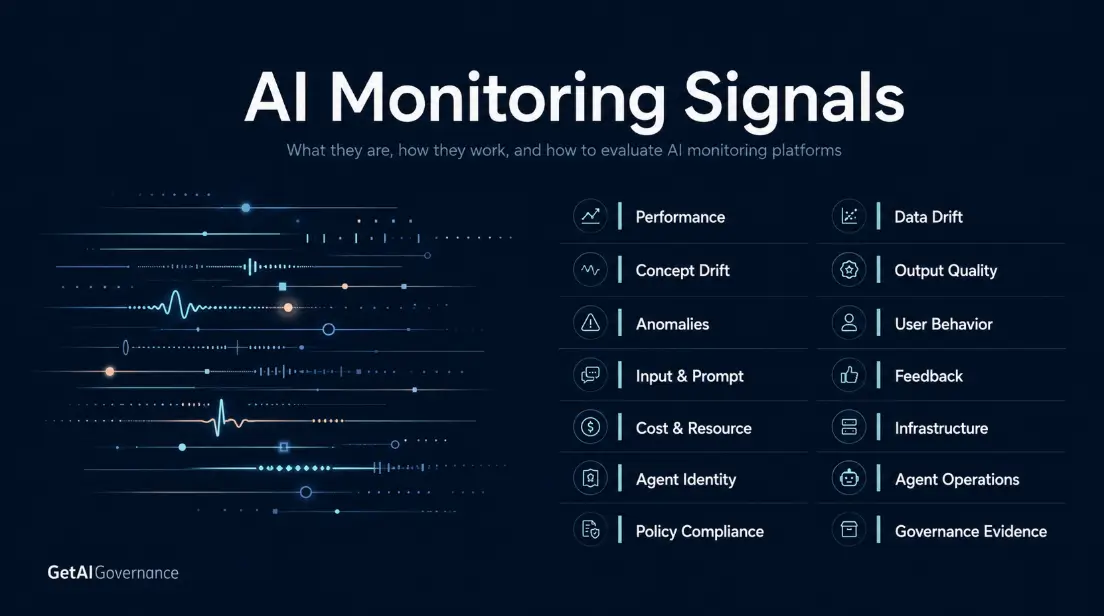
This updated guide covers all fourteen signal categories. The first ten are updated and in some cases consolidated from the April version. The last four are genuinely new. The structure of the article follows the structure a team should use when evaluating platforms: understand what each category measures, understand which failure modes it catches, and then map your specific environment to the categories where you actually need depth.
What changed from April 2026: Data Drift and Concept Drift were merged into a single Model Behavioral Drift section. System Health and Pipeline were merged into Infrastructure and Pipeline Observability. Cost and Resource Telemetry was expanded with LLM-specific signals including cache hit rate, tool call frequency, and per-agent cost allocation. Four new sections were added: Agent Identity and Authorization, Agent Operational Monitoring, Intent and Policy Compliance, and Governance Evidence Signals.
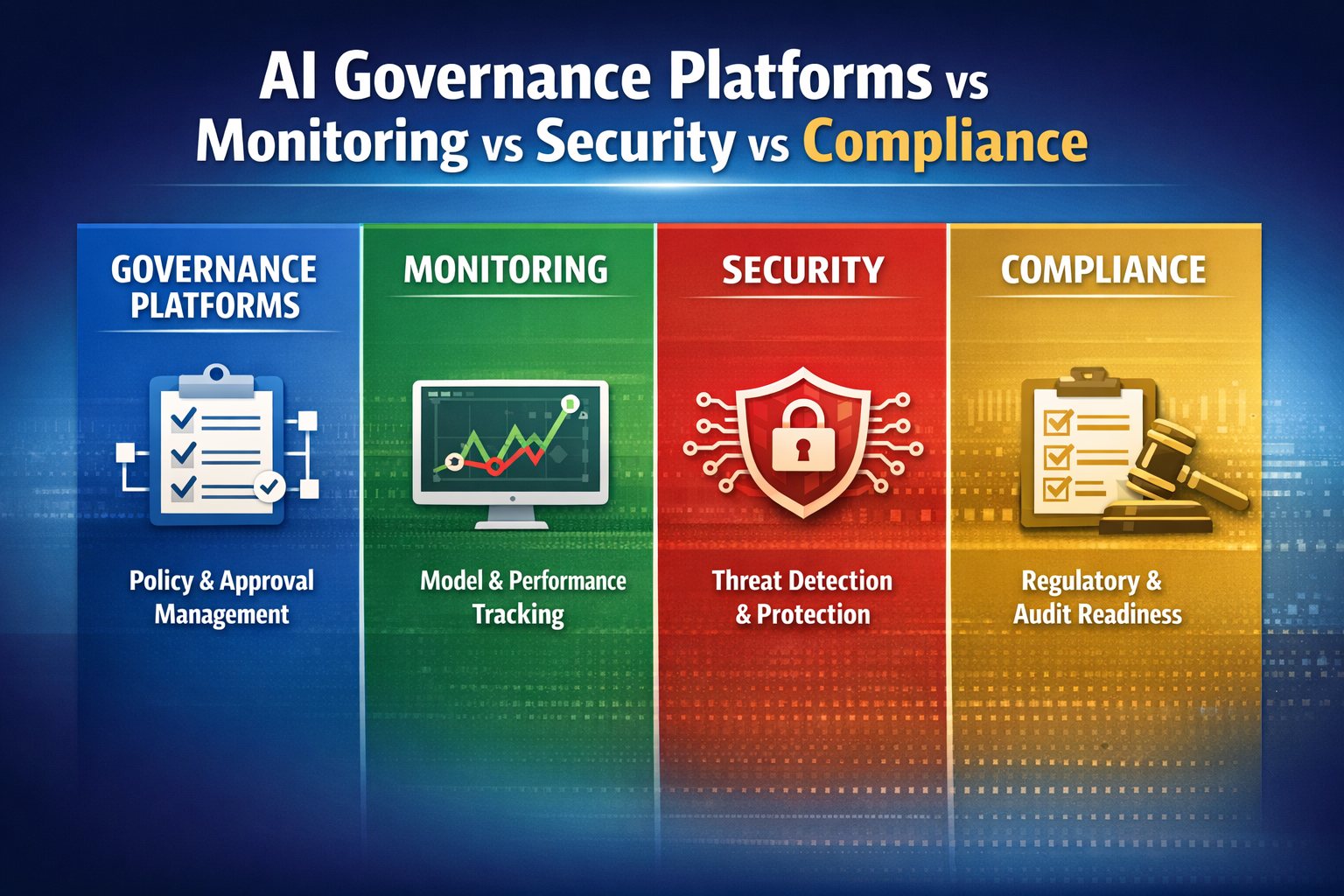
One clarification before getting into the categories themselves. Monitoring platforms observe behavior and surface patterns. They do not enforce controls, generate compliance documentation, or define who is accountable for what. Those jobs belong to security platforms, compliance platforms, and governance programs respectively. What monitoring does is feed those functions with the raw signal data they require to operate. A governance program with no monitoring is a policy document. A monitoring program with no governance is a dashboard nobody acts on.This guide covers what monitoring signals actually are, where they come from, why they matter, and how to evaluate platforms based on which signal groups they cover well.
Why AI Monitoring Signals Exist
Models behave differently in production than they did during development. That gap is not a failure of engineering; it is the nature of deploying systems that respond to inputs that cannot be fully controlled or predicted in advance. Users behave differently than testers. Real data drifts from training data. Downstream systems change. The world changes. And a model that was performing well at deployment can quietly degrade across any of these dimensions without producing an obvious error that triggers an alert.
Signals exist because teams need a way to see those changes before they become incidents. A model drifting on a key feature distribution looks like nothing on a conventional dashboard until it starts producing wrong outputs at scale. Hallucination rates creeping up in a generative system look like normal traffic patterns until a customer surfaces a factual error that creates a compliance problem. API costs rising 40 percent month over month look like normal growth until someone looks at the token-level breakdown and realizes a workflow change is sending five times as many tokens per request as intended.
None of those problems announce themselves loudly. They accumulate quietly, and without a monitoring layer that tracks the right signals, they stay invisible until they become expensive. That is the operational logic behind every signal category covered in this article: continuous visibility into how a system is behaving over time, measured at the dimensions that actually change.
The inputs coming into AI systems also change in ways that matter. User query patterns shift as products evolve. New prompt structures appear. Data distributions in connected pipelines update when upstream sources change. A monitoring layer that only watches outputs misses the input-side changes that usually precede output-side problems. Signals that track what is going into a model give teams the ability to catch that upstream drift before it works its way through to visible quality problems.
Cost is another dimension that monitoring exists to surface. Language model inference has a different cost structure than traditional software. Token usage, API call volume, compute consumption, and model version mix all contribute to a cost picture that changes with usage patterns. Teams that do not monitor these signals at the granular level tend to discover cost problems in billing statements rather than operational dashboards, at which point the damage is already done.
System health signals exist because AI systems sit inside larger technical environments that fail in ways specific to AI workloads. Latency spikes in inference pipelines behave differently from latency spikes in conventional APIs. Ingestion failures in RAG pipelines create silent quality problems that look like model issues until the pipeline is inspected. Monitoring at the infrastructure layer for AI-specific failure modes requires different signals than conventional application performance monitoring provides.
Teams that define what they need to observe before selecting tooling consistently get more value from monitoring than teams that buy platforms first and figure out the signals later.
AI Monitoring Signals Framework
Monitoring platforms are built around signals. Signals are the measurable indicators that show how AI systems behave, change, and perform over time. A signal is not a report and it is not an alert; it is a continuous measurement against a defined dimension of system behavior. Teams that understand which signals they need understand what monitoring platforms are actually selling.
The twelve categories below cover the full surface of what AI monitoring can observe. No platform covers all of them equally. Map your environment to the categories where you need the most depth.
Performance Signals — "Is It Working Well?"
Performance signals are the most fundamental category in AI monitoring. They measure whether a model is producing correct outputs, doing it fast enough, and doing it without breaking. Every monitoring conversation starts here because degradation in core performance is what eventually shows up in product metrics, customer complaints, and regulatory examination — performance signals just catch it earlier.
The persistent challenge with performance monitoring is that degradation rarely announces itself. A model that was 94 percent accurate at deployment can drift to 88 percent over several months and produce no error messages, no infrastructure alerts, nothing that looks wrong in a conventional operations dashboard. The only way to catch it is to track accuracy continuously against a held-out validation set or human-labeled ground truth.
Accuracy
Continuous measurement of whether model outputs match expected correct answers over time. The monitoring question is not whether the model is accurate in aggregate but whether its accuracy on a defined validation set has changed since the last time you checked. A credit scoring model that was hitting 94 percent accuracy at deployment and is now at 88 percent deserves investigation. The model did not change, but something about the inputs did, and tracking accuracy over time is how teams find out before the business impact surfaces in portfolio review.
Latency
Measurement of inference time from request to response, tracked at the p50, p95, and p99 levels. The p99 number is the one that matters most for user-facing applications, because a 500ms median that hides a 4.5 second p99 means that roughly one in a hundred users is waiting long enough to abandon the interaction. Latency problems in AI-powered workflows compound quickly when AI components sit inside larger systems where downstream calls are waiting on the model response. After model version updates, p99 latency is the first number to check.
Error Rates
Tracking of failed inference requests, timeout rates, and model exceptions as a percentage of total requests over time. Sudden spikes in error rates usually point to infrastructure problems or model instability. Gradual creep in error rates is harder to catch and more damaging, because it builds slowly below the threshold of conventional alerting while affecting a growing percentage of users.
Consistency
Measurement of how much model outputs vary for the same or semantically equivalent inputs over time. A model that gives noticeably different answers to the same question on different days is exhibiting instability that performance averages will not surface. In legal, financial, or regulated contexts, inconsistency creates audit exposure even when individual outputs are technically acceptable.
Model Behavioral Drift — "Did the world change in ways that made the model's learned behavior wrong?"
Drift is the most common reason that AI systems that worked well at deployment stop working well six months later. It does not produce errors. It produces quietly wrong outputs at a rate that grows gradually enough to escape notice until someone checks, which is precisely why monitoring is necessary.
Feature Drift
Statistical measurement of how the distribution of input features changes over time compared to the training distribution. Feature drift is usually the earliest observable signal that model performance is about to degrade. The model itself has not changed; the data it is receiving has moved outside the range of what it was trained on. Teams that catch feature drift early can retrain proactively rather than waiting for accuracy to drop enough to trigger a performance alert.
Embedding Drift
Measurement of how the semantic distribution of text embeddings changes over time in systems using vector representations. Feature-level drift statistics can miss meaning-level shifts in language. Embedding drift catches those shifts specifically in LLM-powered systems and retrieval-augmented generation pipelines, where a seasonal product catalog update or an industry terminology shift can change the embedding space enough to degrade retrieval quality without moving any conventional feature distribution metric.
Schema Drift
Detection of changes to input data structure, field names, data types, or required fields that differ from the expected schema at training or deployment time. Schema drift causes a particularly frustrating class of silent failure: the model continues processing changed data without errors, but its accuracy drops because the inputs no longer match what it was trained on. Upstream data sources change their output format regularly, and without schema drift monitoring, the downstream AI system has no way to detect the mismatch.
Relationship Shift
Detection of changes in the statistical relationship between input features and correct output labels over time, separate from changes in the input distribution itself. A logistics pricing model trained during a period of stable fuel costs will have learned a specific relationship between inputs and optimal prices. When fuel prices become volatile, that learned relationship no longer reflects reality even if the input features themselves look statistically similar to training data. Relationship shift monitoring catches this class of problem, where the model's assumptions about the world have become outdated.
Semantic Drift
Monitoring for changes in the meaning or interpretation of language inputs over time. Industry terminology evolves, new jargon appears, and acronyms change meaning. A model trained on data from eighteen months ago may interpret current language usage in ways that were correct at training time but produce wrong or irrelevant outputs now. Technical support chatbots and domain-specific language applications are particularly vulnerable to this because their users operate in fast-moving professional vocabularies.
Output Relevance Decay
Tracking of how well model outputs remain relevant to user queries over time, particularly in generative and retrieval-augmented systems. Relevance decay is slow and invisible in conventional metrics because the model is technically functioning correctly; it has just become less useful as the world it was trained on has diverged from the world its users are asking about. Teams that measure relevance over time catch this before users begin abandoning the tool.
Output Quality Signals Expanded –– Is what the model produces actually correct, safe, and fair?
For generative AI systems, performance signals alone tell an incomplete story. A model can respond quickly, maintain stable accuracy on held-out benchmarks, and operate without infrastructure errors while producing outputs that are factually fabricated, demographically biased, or inappropriate for the context. Output quality signals measure the content of what the model produces, not just whether it produced something in time.
This section has been expanded from the April version to include model confidence scores and outlier detection. Regulatory pressure from the EU AI Act, state AI laws in California and Illinois, and SR 26-2 has made fairness and bias monitoring a compliance requirement in several industries, which means these signals now need to be tracked with documentation rather than treated as optional quality checks.
Hallucination Rate
Tracking of how frequently a generative model produces factually incorrect, fabricated, or unsupported claims relative to total outputs, measured against ground truth or reference documents. Hallucination is the defining output quality risk for large language models because it produces no errors, no latency spikes, nothing operationally unusual. The model generates confident-sounding wrong answers at whatever rate its architecture and training produce, and without automated fact-checking against a reference corpus or held-out ground truth, the rate is invisible. In legal, medical, financial, and technical contexts, even a low hallucination rate creates liability if the errors are in high-stakes outputs that users act on.
Toxicity
Continuous scoring of model outputs for harmful, offensive, or policy-violating content, tracked as a rate over time and broken down by output category. Toxicity can emerge after fine-tuning runs intended to improve response naturalness, after prompt template changes that shift the model's conversational register, or under specific input conditions that were not covered in safety testing. Tracking toxicity continuously means catching those changes within hours of a deployment rather than days, when the exposure is still contained.
Bias and Fairness Indicators
Measurement of whether model outputs show systematic differences in quality, tone, accuracy, or content across demographic or categorical groups. Bias often changes after model updates, data changes, or shifts in the user population, and it rarely announces itself clearly. A hiring support tool that begins producing candidate summaries with systematically different language patterns based on name-implied demographics will not produce errors or performance alerts. Bias indicator monitoring — measuring output characteristics across defined demographic dimensions on a continuous basis — is what catches those patterns before they appear in litigation. Under Illinois HB 3773 and the Workday lawsuit precedent, this category has moved from an optional ethical consideration to a documented operational requirement for any organization using AI in employment contexts.
Relevance
Scoring of how well model outputs address the actual intent of the input, tracked over time. Relevance scores surface when a model begins generating technically coherent but contextually unhelpful outputs. This quality degradation tends to be invisible in accuracy and performance metrics because the model is answering the literal question while missing the underlying intent. Customer support applications are particularly susceptible to this after knowledge base updates change how topics are indexed in retrieval systems.
Model Confidence Scores New
Tracking of how certain the model is about its predictions or outputs over time, surfaced through probability scores or self-reported uncertainty. Low-confidence outputs in high-stakes use cases should trigger human review rather than automated delivery. Monitoring confidence distributions over time surfaces when a model is operating in territory where its training data was sparse or where distribution shift has moved inputs outside the range the model was calibrated on. A model whose average confidence drops significantly after a data pipeline change is telling you something about the mismatch between its training and its current inputs even before accuracy metrics move.
Outlier Detection New
Identification of rare or anomalous outputs that fall far outside the statistical distribution of normal model responses in terms of content, structure, or semantic characteristics. Outlier detection complements general anomaly monitoring by focusing specifically on the tail of the output distribution, where adversarial inputs, data corruption, and model instability tend to produce their most visible artifacts. In high-stakes regulated contexts, outlier outputs warrant investigation before they are delivered or acted upon.
Anomaly Signals –– Does something look wrong that no predefined rule was written to catch?
Anomaly signals catch behavior that deviates from established patterns without requiring anyone to have anticipated the specific deviation in advance. They are the monitoring category that surfaces the things teams did not know to look for, which makes them particularly valuable in the first months after a new deployment when the normal pattern of behavior has not yet been fully characterized.
Unusual Outputs
Detection of model outputs that fall outside the statistical distribution of normal responses in terms of length, structure, content patterns, or semantic characteristics. Unusual outputs are often the first visible sign of model instability, prompt manipulation, or input distribution shift. A content generation system that occasionally produces outputs with formatting patterns that never appeared in normal operation is telling you something has changed upstream, even if the specific cause is not yet clear.
Abnormal Inputs
Detection of input patterns that deviate significantly from the normal distribution of queries the system receives. Abnormal inputs are early indicators of misuse, coordinated abuse, automated probing, or upstream data problems. Catching them early gives security and operations teams the opportunity to investigate before the pattern scales to a volume that creates real impact.
Usage Spikes
Detection of sudden increases in request volume, user counts, or resource consumption that deviate from historical baselines. Usage spikes can mean legitimate viral adoption or abuse patterns. The monitoring value is in catching the spike quickly enough to investigate and distinguish between the two before costs compound or infrastructure degrades under unexpected load.
User Behavior Signals –– How are people actually using the system, and how has that changed?
User behavior signals track how humans interact with AI systems over time. They surface patterns that the model layer cannot see: how users phrase queries, which features they abandon, which interaction sequences precede quality problems, and how usage evolves as a user base becomes more sophisticated with a tool. These are often the leading indicators that precede model-layer problems, because user behavior usually changes before output quality metrics move.
Prompt Patterns
Analysis of how users structure their inputs over time, including query length distributions, topic concentrations, phrasing patterns, and changes in how users engage with the system. Prompt patterns reveal the gap between how a system was designed to be used and how it is actually being used. A coding assistant whose users shift toward longer, more complex multi-step requests over three months is heading toward context window and quality challenges that can be addressed proactively if the trend is visible.
Usage Trends
Tracking of how frequently specific features, workflows, or AI capabilities are used over time across user segments. Usage trends connect operational monitoring to product decisions. A 60 percent decline in use of a specific AI-powered feature over six weeks is a signal worth investigating, because it usually traces to a specific quality or performance problem rather than user preference change.
Interaction Anomalies
Detection of unusual interaction patterns including abnormal session lengths, rapid query repetition, structured probing behavior, or other deviations from normal usage. Interaction anomalies often indicate attempted misuse, users hitting system limitations in frustrating ways, or automated abuse. Financial services chatbots that see sessions where users send semantically similar queries with slight variations in quick succession are usually dealing with users testing policy filter boundaries, and catching that pattern early informs how those filters should be adjusted.
Input and Prompt Signals –– What is going into the model, and does any of it look dangerous?
Input and prompt signals monitor what enters the model before it generates a response. They are separate from output signals because they catch problems at the source rather than after the model has processed potentially problematic content. Input-side monitoring also provides leading indicators of output-side quality changes, because input distribution changes usually precede output quality changes by days or weeks.
Prompt Structure
Analysis of the structural characteristics of incoming prompts including length distributions, instruction formatting, context window usage, and token composition. Prompt structure changes often precede quality changes. If average prompt length increases 240 percent over two months because users began pasting full data tables into queries, context window overflow issues and quality degradation will follow unless the trend is caught early enough to address in the serving infrastructure or the user interface.
Risky Inputs
Detection of input content that falls into policy-defined risk categories, including sensitive data types, off-topic content, or content that violates use case boundaries. Risky input monitoring provides a leading view of where output quality or safety issues are likely to emerge. Healthcare AI assistants that receive inputs containing patient-identifiable information pasted directly into prompts need to surface that pattern through input monitoring before any PII appears in system logs or model outputs.
Injection Indicators
Monitoring for input patterns associated with prompt injection attempts, including instruction override syntax, role manipulation attempts, and encoded payloads. This is a flagging signal rather than an enforcement control. Its value is in the visibility it provides into how frequently and in what form injection attempts are occurring, even when security controls are blocking them. That data informs how filtering thresholds should be tuned and surfaces new attack patterns as they emerge — injection attempt frequency routinely spikes after public disclosure of specific vulnerability patterns, and tracking that correlation helps security teams respond to what the threat landscape is actually doing.
Feedback Signals –– What are humans telling you about what the model produced?
Feedback signals incorporate human judgment into the monitoring picture. They are the category where monitoring intersects most directly with product quality, because they capture dimensions of usefulness and correctness that automated metrics approximate but cannot fully measure. The most useful thing about feedback signals is that they often diverge from automated quality scores in informative ways, and that divergence is where the real signal lives.
Human Ratings
Collection and tracking of explicit user ratings on model outputs, tracked as distributions over time and broken down by output type, user segment, and model version. When human ratings decline while automated quality scores stay stable, the automated scoring is missing something users care about. An AI writing assistant whose outputs score well on coherence and grammaticality but whose human ratings are falling is probably drifting in tone or formality in ways the automated metrics cannot capture.
Corrections
Tracking of how frequently users edit, reject, or override model outputs, and what categories of content tend to require correction. Rising correction rates are a direct measure of how much manual work AI outputs are creating rather than eliminating. They indicate quality degradation even when automated metrics look stable, because users adapt their behavior before automated scoring catches up. A legal document drafting tool whose correction rate on one clause type rises from 12 percent to 31 percent over eight weeks is telling you something specific has changed about that category, even if overall quality scores have not moved.
Reinforcement Signals
Tracking of downstream behavioral signals that indicate whether AI outputs led to successful outcomes, including task completion rates, follow-up query patterns, and workflow advancement signals. Reinforcement signals connect AI output quality to what users were actually trying to accomplish, rather than measuring the output in isolation. A sales enablement tool may produce objectively well-formed email drafts that consistently fail to advance deals in late-stage negotiation contexts, and that failure will not appear in output quality scores but will appear in deal advancement rates if reinforcement signals are being tracked.
Cost and Resource Signals — "What Is This Costing?"
Cost and resource signals track the economic and computational footprint of AI systems. For most organizations, AI inference costs are a new budget line with different behavior from conventional software costs. They scale with usage in ways that are not linear and that can produce surprise billing events without monitoring.
Token Usage
Tracking of input and output token consumption per request, per workflow, per user segment, and in aggregate over time, broken down by model version. Token usage is the primary driver of LLM inference costs, and it changes with prompt structure changes, model version changes, and user behavior changes in ways that compound quickly at scale. A customer service platform that sees monthly API costs increase 180 percent over a quarter usually finds, when token usage monitoring is examined by workflow, that one feature change caused token counts per request to be several times higher than intended.
API Cost Allocation
Monitoring of actual API spend in real time, allocated to teams, features, workflows, and model versions with cost anomaly detection. Cost allocation is what makes monitoring data actionable for engineering and product decisions. Without it, the total spend is visible but the cause is not, and optimization decisions lack the data they need. A 400 percent cost overrun caught within the first 24 hours of a production deployment is a budget line. The same overrun discovered in a monthly billing review is a budget crisis.
Compute Consumption
Tracking of GPU and CPU utilization, memory usage, and infrastructure costs for organizations running self-hosted models or managing inference infrastructure. Self-hosted model deployments have direct, variable infrastructure costs that respond immediately to configuration decisions. A misconfigured warm-up setting that keeps a model consuming 60 percent of GPU capacity during off-peak hours is the kind of waste that compute monitoring surfaces within days of deployment rather than weeks.
Cache Hit Rate
Tracking of what fraction of tokens are served from cache rather than being generated fresh on each request. Low cache hit rates may reflect poor prompt design, insufficient caching configuration, or a workload type that is inherently difficult to cache. High cache hit rates reduce inference costs directly. Most LLM serving platforms now expose this metric, and monitoring it over time reveals whether prompt design changes or caching policy changes are improving or degrading cache utilization. OpenLLMetry and similar OpenTelemetry extensions for LLMs expose cache hit rate as a standard telemetry dimension, making it straightforward to track alongside the other cost signals.
Tool Call Frequency and Cost
Tracking of how many external tool calls an LLM or agent makes per task, the token cost of those calls, and the trend in both over time. Rising tool call frequency per task is a reliable signal that prompts are becoming less efficient or that agent orchestration logic is creating unnecessary external calls. An agent workflow that averaged three tool calls per task at deployment and is now averaging seven is doing more work for the same output, which compounds cost and latency simultaneously. Monitoring this at the agent level, not just in aggregate, is the practice that makes the pattern visible.
Per-Agent Cost Attribution
Allocation of token usage and API costs to specific agents in multi-agent deployments, tracked daily and weekly with budget burn rate monitoring. Multi-agent systems make cost attribution difficult without dedicated instrumentation because costs aggregate across the pipeline rather than being visible at the agent level. Per-agent cost attribution is what allows teams to identify which agent in a five-agent workflow is responsible for a cost spike, rather than investigating the entire pipeline. Budget burn rate monitoring at the agent level also provides the data for daily and weekly cost-per-task calculations that justify or challenge individual agent deployments.
Infrastructure and Pipeline Observability — "Is the System Stable?"
System health signals monitor the operational stability of the AI infrastructure layer. AI systems have health failure modes that conventional application monitoring does not fully cover: inference service instability, model loading issues, and pipeline failures that produce silent quality problems rather than obvious errors.
Uptime and Availability
Tracking of inference service availability, broken down by model endpoint, geographic region, and deployment environment. Partial availability issues — where a model is technically responding but producing degraded outputs due to infrastructure instability — are more common and harder to detect than complete outages, and average availability metrics mask them. Granular availability tracking at the endpoint level is what surfaces intermittent degradation patterns before they affect a large enough percentage of users to produce complaint volume.
Failure Tracking
Tracking of inference failures, model loading errors, dependency failures, and other error types broken down by failure type and component. Aggregate error rates can mask pipeline-specific problems. A document processing system running three models in sequence whose second stage fails at a rate that is small relative to overall request volume may look fine in aggregate metrics while affecting every user who needs that specific pipeline component. Failure monitoring broken down by component is what makes those patterns visible.
Latency Spikes
Detection of sudden increases in inference latency that exceed defined thresholds, tracked at the component and request-type level. AI system latency spikes cascade into downstream systems quickly when AI components are embedded in user-facing workflows. They also serve as early warning signals for infrastructure problems that have not yet escalated to full outages. Tracking latency at the request-type level rather than in aggregate is what allows teams to identify that a specific query category is producing lookup overhead rather than treating the spike as a general system problem.
Ingestion Failures
Tracking of failures in data ingestion pipelines that feed models, including failed document ingestion, embedding generation failures, and index update errors in retrieval systems. Ingestion failures create silent quality problems that standard monitoring misses. A knowledge management AI tool that has been failing to ingest three weeks of policy updates will produce confident answers based on outdated information, and nothing in the model layer will look wrong. Ingestion health monitoring is what catches this class of problem before users or regulators surface it.
Model Update Tracking
Tracking of model version changes, fine-tuning deployments, and prompt template changes with before-and-after performance comparisons automatically triggered on deployment. Model updates are the most common source of unexpected behavior changes in production AI systems. Without pipeline monitoring that records what changed and when, connecting a performance change to a specific deployment requires manual investigation that can take days. Automated performance comparison on deployment compresses that investigation significantly.
Deployment Issues
Detection of problems in the model deployment process including failed deployments, partial rollouts, configuration errors, and version mismatches between components. A model update that deploys successfully to 60 percent of inference nodes before a network partition stalls the rollout leaves the system running two different model versions simultaneously without any explicit error signal. Deployment state monitoring catches this within minutes rather than waiting for the divergent behavior to surface in output quality metrics.
Business Impact Signals –– Is this actually helping, and can you prove it?
Pipeline signals monitor the operational health and integrity of the data and model pipelines that feed AI systems. They surface changes and failures in the infrastructure layer that affect model behavior without being visible in the model's outputs directly.
Ingestion Failures
Definition: Tracking of failures in data ingestion pipelines that feed models, including failed document ingestion, embedding generation failures, and index update errors in retrieval systems.
Why it matters: Ingestion failures create silent quality problems. A RAG system that is failing to ingest 15 percent of new documents does not produce errors; it produces responses that lack current information. Teams that do not monitor ingestion health tend to discover these problems through user feedback rather than operational monitoring.
Real-world example: A knowledge management AI tool began producing outdated answers about company policies three weeks after a new HR system was deployed. Pipeline monitoring surfaced that the integration between the HR system and the document ingestion pipeline had been silently failing for the entire period, meaning three weeks of policy updates had not been indexed.
Model Updates
Definition: Tracking of model version changes, fine-tuning deployments, and prompt template changes with before-and-after performance comparisons automatically triggered on deployment.
Why it matters: Model updates are the most common source of unexpected behavior changes in production AI systems. Without pipeline monitoring that tracks what changed and when, attributing behavior changes to specific updates is difficult and slow.
Real-world example: A content moderation system saw a 12 percent increase in false positive rates over a two-day period. Pipeline monitoring connected the timing to a fine-tuning deployment that had happened 18 hours before the change appeared in production metrics, which accelerated root cause analysis from days to hours.
Deployment Issues
Definition: Detection of problems in the model deployment process including failed deployments, partial rollouts, configuration errors, and version mismatches between components.
Why it matters: Deployment issues in AI systems can be subtle. A version mismatch between a model and its serving configuration can produce degraded outputs without clear error signals. Pipeline monitoring that tracks deployment state provides the visibility needed to catch these issues quickly.
Real-world example: A model update was deployed successfully to 60 percent of inference nodes before a network partition caused the deployment to stall. The system was running two different model versions simultaneously without any explicit error. Pipeline deployment monitoring surfaced the partial rollout state within minutes.
Agent Identity and Authorization –– Which agent did what, under whose authorization, with what credentials?
Every other agent monitoring capability in this article — liveness, output quality, coordination, intent compliance — requires that you already know which agent is doing what. If agents are not individually identified, tracked, and tied to accountable principals, there is no foundation to monitor against. You cannot investigate an output from "the agent" any more than you can investigate a database change made by "a user."
The Singapore IMDA Agentic AI Governance Framework, released in January 2026 and updated in May, specifies that organizations should implement unique identities for each agent tied to a supervising user or another agent accountable principal. SR 26-2's model inventory requirements establish the same principle for the financial services context. HiddenLayer's 2026 AI Threat Landscape Report found that 73 percent of organizations report internal conflict over who owns AI security controls — a finding that traces directly back to the absence of the agent identity layer that would make accountability unambiguous.
Why this matters for compliance teams specifically: When a regulator asks which agent made a specific consequential decision on a specific date, the answer requires an agent identity system that was logging that information at the time. You cannot reconstruct agent identity after the fact from aggregate outputs. The identity layer must be operational before the question is asked.
Agent Inventory and Version Tracking
Maintaining a current inventory of all deployed agents, including their version, deployment date, capability scope, and configuration. An agent inventory is to agent governance what a model registry is to model governance. Teams that are deploying agents across departments without central visibility have no way to know whether an outdated agent version is still running somewhere in production, or whether an agent with broader permissions than necessary has accumulated access that was never reviewed after the initial deployment.
Permission Scope Per Agent
Continuous tracking of the specific tools, APIs, data stores, and external services each agent is authorized to access, compared against what it is actually accessing. Permission scope monitoring applies the principle of least privilege to agents. An agent granted write access to a CRM system, a document management platform, and an internal communication tool represents a threat surface that was not part of any pre-agent security architecture. Tracking the gap between authorized scope and actual access patterns is how security teams detect when an agent is operating outside its intended boundaries.
Authorization Boundary Logging
Recording every access decision an agent makes against its defined authorization boundaries, including successful accesses, access attempts outside scope, and any escalation events. Authorization boundary logs are the raw evidence that incident response and regulatory examination both require. When a multi-agent pipeline produces an outcome that requires investigation, authorization boundary logs are what allow a team to reconstruct which agent accessed which system and whether each access was within scope.
Principal-to-Agent Accountability Mapping
Maintaining a current mapping between each deployed agent and the human or organizational principal accountable for its behavior. This is the governance record that regulators, auditors, and legal teams ask for first. It does not require sophisticated tooling, but it does require that the question "who is responsible for this agent's behavior?" has a documented answer that is updated when ownership changes. The absence of this mapping is what produced the governance gap that the Workday AI hiring lawsuit exposed — not a lack of monitoring data, but a lack of documented accountability for what the monitoring data described.
Non-Human Identity Credential Monitoring
Tracking of the credentials, API keys, and service account tokens that agents use to authenticate to external systems, including rotation schedules, scope audits, and anomalous usage detection. Non-human identity management for AI agents is an emerging practice that vendors including Opal Security and Defakto are building products around specifically. Agent credentials that are not rotated, that have broader scope than the agent's defined tasks require, or that show unusual access patterns represent a persistent security exposure that conventional identity management programs were not designed to catch.
Agent Operational Monitoring –– Is each agent running, producing acceptable work, and coordinating correctly with other agents?
Traditional infrastructure monitoring tracks uptime, latency, and error rates for services that receive a request and return a response. Autonomous agents do not work that way. An agent maintains state across many tool calls, makes decisions about what to do next, and may be waiting on other agents, external APIs, or user input at any given moment. Monitoring agent health requires instrumentation that reflects how agents actually operate, not how conventional services operate.
The five monitoring dimensions in this section are drawn from agent-native monitoring research and platform development work in 2026. They describe what continuous agent health monitoring looks like in practice when it is built for the way agents fail rather than borrowed from conventional application monitoring frameworks.
Liveness and Heartbeat Monitoring
Tracking whether each agent is running and responsive through continuous heartbeat signals that distinguish between active, idle, stuck, sleeping, and unresponsive states. The key metrics are time since the last heartbeat, duration spent in the current state, and measurable progress on the current task. Agents fail silently in ways that conventional uptime monitoring does not catch — an agent can be technically running while making no progress on its assigned task, and without heartbeat monitoring that tracks task progress, that failure mode is invisible until a downstream process times out waiting for the agent's output.
Per-Agent Output Quality
Measuring the acceptability of what each agent produces, tracked through completion rate, first-pass approval rate, rejection patterns, output length and structure consistency, and time to completion. When agent output quality monitoring is built into the workflow, automated signals provide continuous feedback that complements human-in-the-loop review at scale. Rising rejection rates for a specific agent are a signal worth investigating before the problem propagates through downstream agents that depend on that output.
Task Cycle Time and Throughput
Monitoring how long each agent takes to complete tasks, tracked at the p50, p90, and p99 percentiles, alongside queue depth and agent utilization rate. Rising task cycle times are often the first operational signal that an agent is encountering a problem that has not yet produced explicit errors — the agent is still running but taking significantly longer than its historical baseline to complete work of the same type. Alerting on cycle time percentile shifts catches those situations before they create downstream bottlenecks.
Handoff Success Rate
Tracking of how successfully agents complete handoffs to other agents or human reviewers in multi-agent workflows, including handoff latency, blocked tasks, and failed handoffs that require retry or escalation. Handoff failures in multi-agent pipelines are a class of coordination failure that single-agent monitoring cannot see. An agent that successfully completes its own task but consistently fails to deliver that output to the next agent in a recognizable or usable format is creating a bottleneck that aggregate throughput metrics will eventually reflect but handoff monitoring catches immediately.
Multi-Agent Coordination Signals
Observing how agents interact in collaborative workflows, including cross-agent communication patterns, dependency bottlenecks, duplicate work detection, and end-to-end pipeline throughput. Multi-agent coordination failures tend to produce cascading problems where one agent's delay or error propagates through a pipeline in ways that make root cause attribution difficult after the fact. Monitoring coordination patterns in real time — which agent is waiting on which, where handoff latency is highest, whether multiple agents are performing redundant work — gives operations teams the information needed to intervene before a single coordination failure becomes a pipeline stall.
Intent and Policy Compliance Signals –– Is the agent staying on task and operating within its defined authorization boundaries?
The monitoring categories above measure whether agents are running, producing acceptable output, and coordinating correctly. Intent and policy compliance signals measure something different: whether agents are doing what they are supposed to be doing, within the boundaries they were authorized to operate within. An agent that is running perfectly, producing high-quality outputs, and handing off smoothly to downstream agents while accessing systems outside its permission scope and pursuing goals that have drifted from the original task is failing in a way that operational monitoring will not catch.
Apiiro's 2026 agent security research, the Singapore IMDA Agentic AI Governance Framework, and practical enterprise deployment experience all point to the same conclusion: agent monitoring must combine operational health signals with runtime policy enforcement and intent verification. The signals in this section are the monitoring layer that supports that enforcement rather than replacing it.
Intent and Goal Alignment
Tracking whether an agent's actions over the course of a task remain consistent with the goal it was assigned, rather than drifting toward unintended objectives. Intent alignment is difficult to measure with a single metric, but it can be tracked through the combination of task completion verification (did the agent accomplish the stated objective?), action coherence analysis (are the individual actions the agent took consistent with a plausible path to that objective?), and out-of-scope action detection (did the agent attempt actions that have no clear relationship to the assigned task?). An agent that begins a task by summarizing a document and ends up attempting to send emails to external recipients has exhibited goal drift that intent monitoring should surface.
Tool and API Usage Against Permission Model
Tracking which external tools and APIs an agent calls during task execution, compared against the tool access its permission model defines. The gap between authorized tool access and actual tool access is the clearest operational indicator of an agent operating outside its intended boundaries. Tracking this at the per-agent, per-task level — which tools were called, how many times, and whether each call was within the authorized scope — provides the data that security teams need to investigate anomalies and that governance teams need to demonstrate that agents are operating within defined boundaries.
Outcome Validation
Checking that an agent's outputs meet the success criteria and accuracy thresholds defined for the task before those outputs are delivered to downstream agents or human recipients. Outcome validation is the quality gate that sits between an agent completing a task and that completion being treated as a valid input to the next stage. In regulated contexts, outcome validation records are part of the governance evidence that demonstrates human oversight is embedded in the workflow rather than limited to reviewing final outputs after the fact.
Prompt Integrity and Data Access Policy
Monitoring whether sensitive inputs, internal system instructions, or confidential data are being passed to external endpoints in ways that violate data access policies. Prompt integrity monitoring tracks what is going into external API calls from agents — not just what the agent produces, but what the agent sends outward. An agent that includes internal system prompts, proprietary data, or personally identifiable information in requests to external model providers or APIs is creating a data exposure that may violate policies and regulations regardless of what the agent intended to accomplish.
Unauthorized Action Rate
Tracking the frequency with which agents attempt actions outside their authorized scope, whether those attempts succeed or are blocked by enforcement controls. A low unauthorized action rate that is trending upward is a signal worth investigating before it reaches a threshold that creates real exposure. An agent that is attempting more out-of-scope actions over time is exhibiting a pattern that may reflect prompt injection, goal drift, or a permissions configuration that has not kept pace with how the agent's task definition has evolved.
Governance Evidence Signals –– What does the monitoring record show to a regulator, auditor, or lawyer after the fact?
It does not make sense in a world where the EU AI Act's Article 50 obligations, SR 26-2's model documentation requirements, the TRAIGA enforcement action, and the Workday lawsuit have all created demand for monitoring outputs that are specifically designed to answer questions from compliance teams, legal counsel, and regulators rather than from infrastructure engineers.
Governance evidence signals are monitoring outputs produced with the second-use audience in mind. An infrastructure engineer looking at a dashboard wants to know what is wrong right now. A compliance officer asked to respond to a regulatory examination wants to know what the system was doing on a specific date, who was accountable for it, and whether it was operating within documented policy boundaries. The Workday case illustrated this distinction clearly: the monitoring data existed. What was missing was the governance evidence layer that could have answered specific accountability questions about specific decisions on specific dates.
The gap the Workday case exposed: The monitoring infrastructure documented 1.1 billion AI-assisted hiring decisions. What it could not answer, in a form useful to counsel and regulators, was who owned accountability for each decision domain, what the documented oversight obligation was, and what specific decisions were made on specific dates. Monitoring data and governance evidence are produced by the same systems but serve different audiences and require different levels of specificity.
Decision and Action Audit Trails
Logs of every consequential decision or action taken by an AI system or agent, recorded in a format that allows reconstruction of what happened, when, and under what conditions. Audit trails need to be complete enough to answer specific questions about specific events, not just to produce aggregate statistics. An audit trail that shows overall decision rates by category is useful for operational monitoring. An audit trail that can show what decision was made for a specific input on a specific date, and what the model's state was at that time, is what governance and legal review require.
Policy Compliance Records
Documentation of how AI system behavior compared to defined policy requirements over time, structured for regulatory examination rather than operational review. Policy compliance records answer the question "was the system operating within its defined boundaries?" at whatever time period a regulator or auditor specifies. They need to be structured with that question in mind from the start, which means defining what "compliance" means for each policy before the record is generated rather than trying to reconstruct compliance status from raw logs after the fact.
Human Oversight Records
Documentation of every instance where human review, override, or approval was required under the system's governance design, including whether that review occurred and what its outcome was. The EU AI Act's requirements for human oversight of high-risk AI systems, SR 26-2's model validation documentation requirements, and Colorado SB 26-189's human review obligations for automated decision-making all require organizations to demonstrate that human oversight is embedded in AI workflows rather than theoretically available. Human oversight records are the evidence that demonstrates this. Without them, the oversight requirement exists only on paper.
Intervention and Override Logs
Records of every instance where a human operator or automated control intervened to modify, stop, or override an AI system's output or action, including the reason for the intervention and its outcome. Intervention logs serve two purposes: they are operational feedback that informs how models and agents should be adjusted, and they are governance evidence that shows a functioning oversight mechanism. An AI system that runs for six months with zero logged interventions in a context where human oversight is required is not demonstrating that the system was perfect; it is demonstrating that the oversight mechanism was not being used, which creates a different kind of compliance exposure.
Evidence Packaging for Regulatory Examination
Structured outputs that aggregate monitoring data, audit trails, policy compliance records, and oversight logs into packages designed to respond to specific regulatory inquiry formats. Evidence packaging is the final step that converts monitoring data into governance-ready documentation. It requires knowing in advance what questions different regulatory frameworks ask — what SR 26-2 examiners want to see is different from what an EU AI Act conformity assessment requires, which is different from what a TRAIGA enforcement inquiry demands — and structuring the output accordingly. Organizations that build evidence packaging into their monitoring programs before examination avoid the scramble of reconstructing months of operational history under time pressure.
How to Evaluate AI Monitoring Platforms Using Signals
The wrong question in AI monitoring is "which platform is best?" That question has no useful answer without knowing which signals actually matter for a given environment. A platform with exceptional drift detection may have basic output quality scoring. A platform built for LLM evaluation may have limited cost visibility. Match the platform to the signal gap, not to the marketing positioning.
Start by identifying the two or three monitoring questions that are currently unanswerable in your environment. If the answer to "is our model still accurate?" is "we don't know," that is a performance signal gap. If "are outputs hallucinating more than they were last month?" cannot be answered, that is an output quality signal gap. If "what are we spending on inference by feature?" is unclear, that is a cost signal gap. Those specific gaps should drive platform evaluation before anything else.
Matching Signal Gaps to Monitoring Priorities
Primary risk: Model accuracy degrading over time — Prioritize Performance Signals and Data Drift Signals. These are the categories that catch the slow degradation that conventional alerting misses. Platforms built for ML observability tend to be strongest here.
Primary risk: Generative outputs hallucinating or drifting off-policy — Prioritize Output Quality Signals. Hallucination rate, relevance, and toxicity monitoring are the core signals for generative AI quality. LLM evaluation platforms were built specifically for this signal group.
Primary risk: Costs rising faster than usage — Prioritize Cost and Resource Signals. Token-level usage tracking and API cost allocation are the signals that explain cost anomalies before they show up in billing. Cost monitoring tends to be a secondary capability in most observability platforms and a primary capability in dedicated AI cost management tools.
Primary risk: User behavior changing in ways that affect quality — Prioritize User Behavior Signals and Feedback Signals. These signal groups surface the leading indicators of quality problems that originate in how users interact with the system rather than in model behavior itself.
Primary risk: Pipeline and infrastructure instability — Prioritize System Health Signals and Pipeline Signals. These are the categories that catch infrastructure-layer problems that produce quality symptoms without obvious operational errors.
Primary risk: Unable to explain AI system performance to stakeholders — Prioritize Business Impact Signals. Without task success rate, conversion impact, and ROI tracking, monitoring data stays inside the technical team. Business impact signals connect operational monitoring to the language executives and product teams use to make investment decisions.
Evaluating platforms against priority signal groups means asking how those signals are measured, at what granularity, with what frequency, and what the alert and investigation workflow looks like when a signal moves. A platform that mentions output quality scoring in its documentation but implements it as a monthly batch job is not the same as one that scores outputs continuously at inference time. That difference only becomes visible when you ask specifically how the signal is generated.
Sources
All claims in this article trace to primary documents or named research publications. Vendor marketing materials are not used as primary sources for monitoring methodology claims.
Agent Monitoring — Operational Signals
AgentCenter — AI Agent Monitoring Best Practices: The Complete Guide — March 2026. Primary source for the five-pillar agent monitoring framework: liveness, output quality, performance, cost, and coordination signals.
Sentry — AI Monitoring — Agent-native monitoring platform documentation covering heartbeat and task progress instrumentation.
Agent Intent and Policy Compliance
Apiiro — AI Agent Security and Monitoring: 2026 Guide — 2026. Source for intent alignment, tool and API usage monitoring, outcome validation, and prompt integrity signals.
LLM-Specific Telemetry and OpenTelemetry Extensions
Traceloop — OpenLLMetry Documentation — OpenTelemetry extension for LLMs. Source for token usage breakdowns, cache hit rate, tool call frequency, and cost attribution telemetry standards.
OpenTelemetry — Semantic Conventions for Generative AI Systems — Official OpenTelemetry specification covering GenAI observability metrics including token usage, model parameters, and error categories.
Ethical and Trust Signals
UptimeRobot — AI Monitoring: The Complete 2026 Guide — 2026. Source for fairness metrics, toxicity detection, model confidence scores, and outlier detection as core observability requirements.
Predictive Observability and Unified Platforms
Rootly — AI Observability Trends 2026 — Source for unified platform development, predictive insights, AI-assisted root cause analysis, and the shift from reactive to predictive monitoring posture.
Singapore IMDA Agentic AI Governance Framework
IMDA Singapore — New Model AI Governance Framework for Agentic AI — January 22, 2026. Source for agent identity requirements, principal accountability mapping, and the four governance dimensions for agentic deployments.
IMDA — Agentic AI Governance Framework Full Document (PDF) — Full technical specification including unique agent identity and least-privilege tool access requirements.
Agent Identity and Non-Human Identity Management
Opal Security — AI Agent Identity and Access Management — Q1 2026. Source for non-human identity management for autonomous agent deployments and credential monitoring practices.
Defakto — Machine Identity Governance for AI Agents — 2026. Non-human identity and machine identity governance for AI agent deployments.
AI Security and Ownership Gap Data
HiddenLayer — 2026 AI Threat Landscape Report — March 18, 2026. Source for the finding that 73% of organizations report internal conflict over AI security control ownership, and that one in eight AI breaches involves agentic systems. 250 IT and security leaders surveyed.
SR 26-2 — Model Risk Management and Documentation Requirements
Federal Reserve — SR 26-2 Supervisory Letter — April 17, 2026. Official guidance superseding SR 11-7. Source for model inventory, validation documentation, and ongoing performance monitoring requirements in US banking organizations.
EU AI Act — Audit Trail and Oversight Requirements
EUR-Lex — EU AI Act Full Text (Regulation EU 2024/1689) — Official text. Source for Article 50 transparency obligations, Article 12 record-keeping requirements for high-risk AI systems, and human oversight requirements under Article 14.
Governance Evidence and Liability Precedents
GetAIGovernance — Workday AI Hiring Lawsuit: The Governance Failure Nobody Wants to Talk About — GAIG analysis of the accountability gap that monitoring data alone could not close. Source for the distinction between monitoring data and governance evidence.
GetAIGovernance — The State of AI Governance H1 2026 — June 2026. Source for TRAIGA enforcement timing, EU AI Act Omnibus changes, and the regulatory environment that elevated governance evidence monitoring to a first-class requirement.
AI Observability Platform Research
Arize AI — AI Observability: What It Is and Why It Matters — Platform documentation on production AI monitoring including agentic system observability with self-improvement loops.
Fiddler AI — LLM Monitoring in Production — Platform documentation on output quality monitoring, hallucination detection, and production agent oversight.
Coralogix and Observability Infrastructure
Coralogix — AI-Native Observability Platform — Q1 2026. Source for unified log, metric, and trace infrastructure as the base layer for AI monitoring programs.
Model Drift and Behavioral Monitoring
Zero Drift — Model Performance Monitoring and Behavioral Drift Detection — H1 2026. Source for the gap between deployment-time model behavior and production behavior over time, and continuous drift detection methodology.
Superwise — What Is Model Monitoring? — Platform documentation covering feature drift, concept drift, and output quality monitoring methodology.
Our Take
AI Monitoring Take
Monitoring platforms reflect the priorities of the teams that built them. The ones that came out of the machine learning operations world are strongest on performance, drift, and infrastructure signals. The ones that emerged from the LLM and generative AI wave are strongest on output quality and evaluation signals. The ones built around enterprise AI cost management are strongest on resource and token visibility. Knowing which lineage a platform comes from tells you a lot about where its depth actually lives versus where its coverage is thin.
No platform captures all twelve signal categories with equal depth. The ones that claim to tend to have strong coverage in four or five categories, adequate coverage in three or four more, and light or placeholder coverage in the rest. That spread is visible when you move past the demo and start asking how specific signals are generated, at what frequency, and at what level of granularity.
The teams that get genuine value from monitoring are the ones that defined what they needed to observe before they started evaluating platforms. They identified specific signal gaps, mapped those gaps to business risks, and evaluated platforms against the signal categories that mattered most for their environment. The teams that end up with expensive dashboards full of data they do not act on are the ones that bought a platform first and assumed the monitoring problem was solved.
Signals are only as useful as the questions they answer. A hallucination rate signal that nobody checks is not monitoring; it is data storage. Teams that match signals to real operational questions get real visibility into what their AI systems are doing. Browse the AI Monitoring category at GetAIGovernance.net to compare platforms by the signal groups they cover and find the right fit for the questions your environment actually needs to answer.