The Best AI Governance Tools for 2026

Written by Nathaniel Niyazov
Updated June 4, 2026

Compare AI governance platforms side-by-side and find the right solution for your organization’s AI systems

When You Need AI Governance

Most organizations begin serious AI governance only after an informal arrangement breaks. A compliance question goes unanswered, litigation arises over an unapproved model decision, an auditor requests documentation for an uncatalogued system, or risk teams discover overlapping models operating on shared data without coordination. The root issue is companies have deployed more AI than they can account for, and accountability demands now carry real consequences. Regulatory deadlines intensify the pressure, with the EU AI Act’s high-risk obligations effective August 2026, multiple U.S. state AI laws active, and financial regulators (SR 26-02, PRA SS1/23, OSFI E-23) actively examining governance programs. Scale is the other driver — informal oversight works for one model but collapses at fifty models across ten business functions making real-time decisions.

What Are The 4 Types of AI Governance

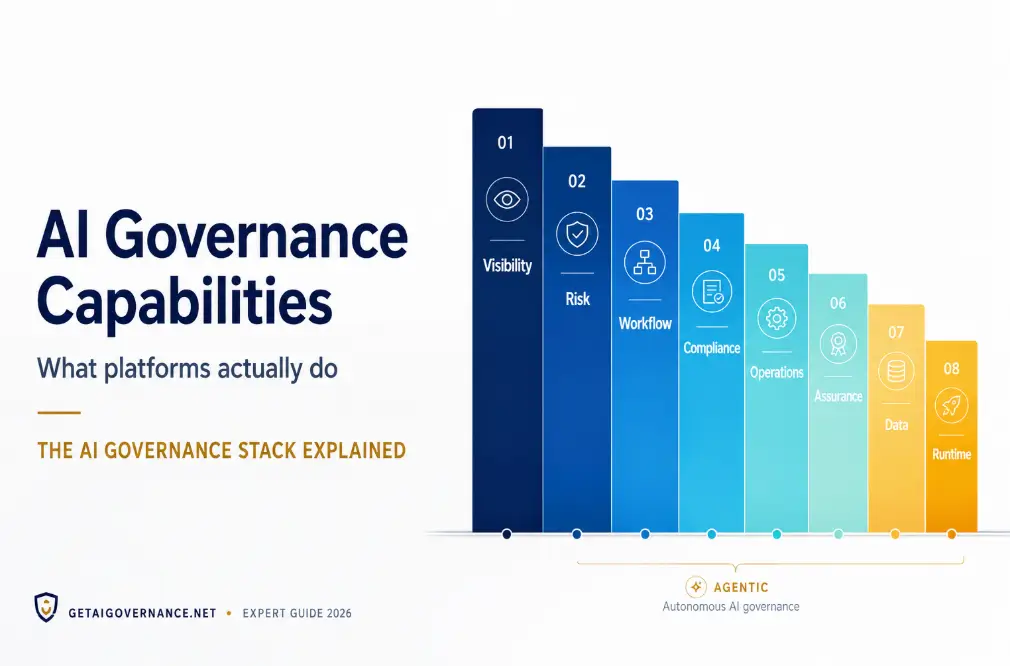
1. Policy & Inventory Cataloguing every AI system the organization operates, assigning ownership, classifying each system by risk tier, and documenting the policies that govern its use. This is the foundation layer — you can't govern what you haven't inventoried. 2. Risk Assessment Structured evaluation of each AI system against defined risk criteria: bias exposure, fairness in decision outcomes, data quality, explainability, and potential for harm. This layer produces the risk classification that determines how much oversight each system requires. 3. Audit & Documentation Generating and maintaining the evidence trail that regulators, auditors, and legal teams need to verify that governance obligations were met. Model cards, validation records, approval workflows, change logs, and regulatory reporting artifacts all live here. 4. Runtime Enforcement Policy controls applied to AI systems while they're running in production — not after a periodic review. Behavioral monitoring, drift detection, output validation, and continuous compliance checks that catch problems between audit cycles.

Compare Governance Platforms

Provider Best For Primary Governance Layer Key Strengths Key Limitation Deployment Model
Credo AI Large enterprises with regulatory exposure Audit & Documentation Regulatory compliance mapping and audit readiness Lack of real-time runtime security guardrails SaaS
ModelOp Cross-functional enterprise AI teams Policy & Inventory AI system-of-record across business and IT Requires strong internal coordination Hybrid
Holistic AI Risk and audit-focused organizations Risk + Runtime Strong model evaluation and risk analysis Less execution-layer enforcement SaaS
Monitaur Production AI governance and continuous oversight Runtime Enforcement Post-deployment monitoring and evidence tracking Less pre-deployment policy structuring SaaS
ValidMind Financial institutions with model risk management and SR 11-7 / SR 26-02 obligations Audit & Documentation Strong validation and regulatory alignment Narrow focus on model risk vs full governance SaaS
Trustible Governance professionals managing intake workflows, risk scoring, and vendor evaluations Risk Assessment Purpose-built, legal-and-compliance-first workflow Designed for governance practitioners — less suited for MLOps or data science teams as primary users SaaS / Single-tenant
Saidot EU-based or EU-exposed organizations building AI Act compliance programs Policy & Inventory developer-centric, agentic governance model EU-native focus; U.S. regulatory depth is thinner than EU coverage SaaS
Solytics Partners Regulated financial institutions needing full-lifecycle governance across models, LLMs, and agents TOTAL COVERAGE Unified governance, assurance, validation, monitoring, and agentic AI oversight across the entire AI lifecycle within a single enterprise control plane. Platform depth requires implementation investment; less suited for organizations starting from zero governance SaaS / On-premise / Hybrid
OneTrust AI Governance Organizations that need AI governance integrated with an existing privacy and GRC program Audit & Documentation Privacy + AI governance integration Primary platform focus is privacy and GRC — AI governance depth is lower than purpose-built platforms SaaS
Enzai Organizations building EU AI Act compliance programs and responsible AI documentation Audit & Documentation Operational AI governance infrastructure that transforms AI intake, inventory, compliance, and oversight into a unified enterprise system of record. Newer platform with a narrower track record at enterprise scale SaaS
VerifyWise Organizations needing AI governance and compliance tracking with open-source flexibility Risk Assessment Open, self-hostable AI governance that helps teams manage AI inventory, risks, evidence, policies, and framework alignment with full control over their own infrastructure. Open-source foundation requires internal technical capacity to deploy and maintain Open-source / SaaS
Adeptiv AI Organizations that need automated AI inventory and shadow AI discovery as a starting point Policy & Inventory Continuous AI governance that combines inventory, risk assessment, monitoring, evidence, and regulatory compliance in a single platform. Founded 2024 — limited track record at large enterprise scale SaaS

How to Choose the Right Platform

Choosing the right platform depends on how your organization actually uses AI. Some platforms are built for compliance and audit workflows, while others focus on controlling AI systems in production. The key distinction is whether the platform can enforce policies at the point of execution. Start by identifying your primary need. If you’re under regulatory pressure, prioritize compliance depth. If you’re running AI in production, focus on visibility and control. The best platform is the one that fits how your systems operate today, not the one with the longest feature list.

Top AI Governance Providers

Relyance AI

Relyance AI

AI and data governance platform focused on real-time data flow visibility, privacy compliance, and control across AI systems and modern cloud architectures.

Learn more
Enzai

Enzai

Enzai is an AI governance platform that operationalizes compliance, risk, and oversight across the full AI lifecycle through structured intake, centralized registries, and automated regulatory mapping.

Learn more
SolasAI

SolasAI

SolasAI operates as an AI fairness and bias detection platform focused on identifying, explaining, and reducing discrimination in predictive models.

Learn more
VerifyWise

VerifyWise

Self-hosted AI governance platform focused on risk management, compliance workflows, and full control over data and deployment environments.

Learn more
Saidot

Saidot

AI governance platform focused on EU regulatory compliance, using a graph-based system to manage risk, policies, and AI system relationships.

Learn more
WeRAI AI Integration Inc.

WeRAI AI Integration Inc.

Pre-execution AI governance platform using a patented human authorization protocol to control AI actions before they occur.

Learn more

Related Articles