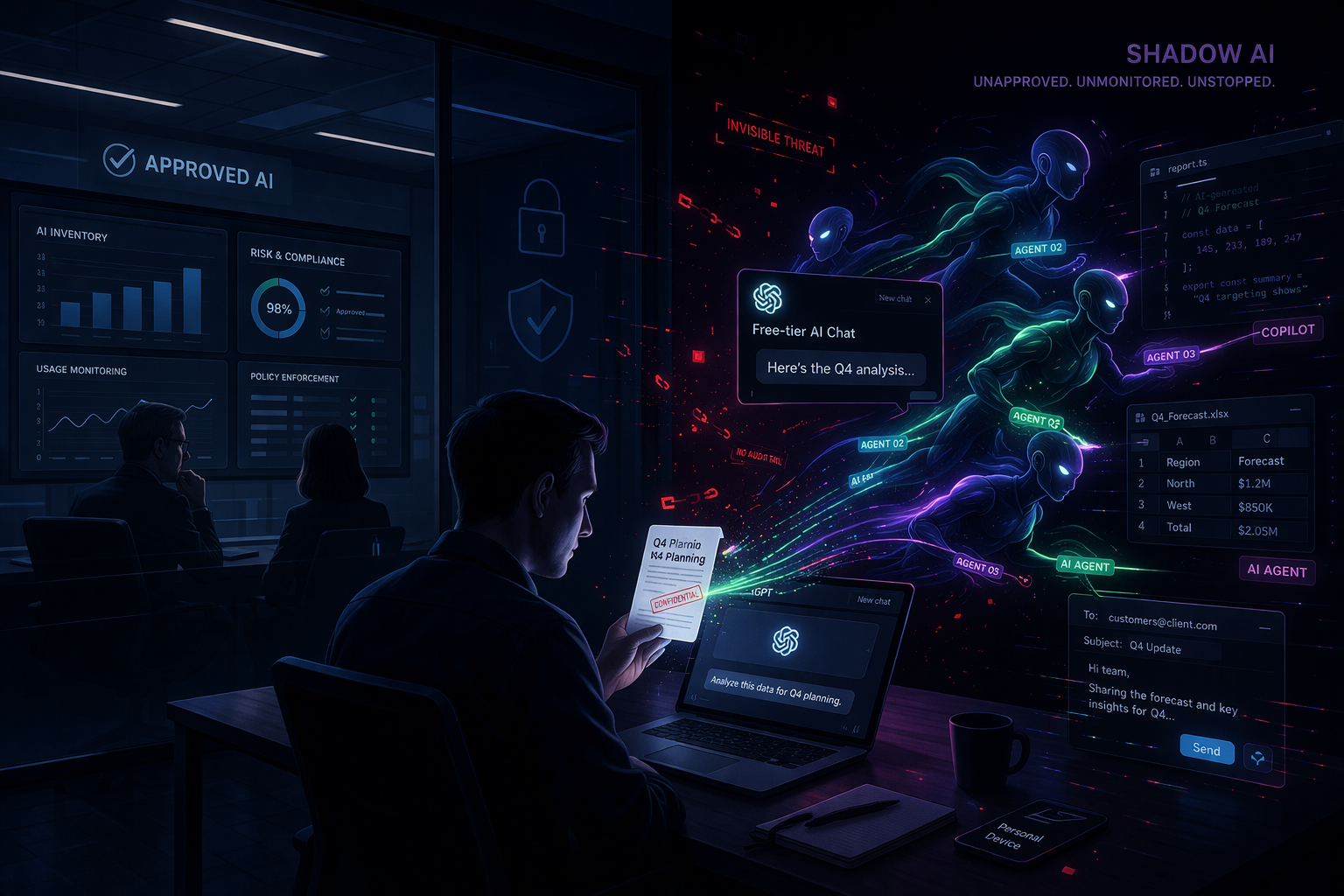
An employee finds a useful AI tool on a Monday, signs up on a free tier, and is using it on work documents by Tuesday. The enterprise procurement and security review cycle for that same tool takes three to six months. The math does not work in governance's favor and it never will as long as consumer AI tools continue improving faster than enterprise approval processes can respond.
According to HiddenLayer’s 2026 AI Threat Landscape Report, three out of four organizations now cite shadow AI as a confirmed or probable problem — 76% overall, up from 61% in 2025. That 15-point year-over-year jump is one of the largest single-year shifts in the entire dataset.
What makes shadow AI structurally different from shadow IT is that shadow IT was slow-moving and bounded — an unapproved Dropbox account, an unauthorized SaaS subscription, something you could eventually find through an invoice or a security scan and address through a defined conversation. Shadow AI is fast-moving and unbounded. The tools are free or nearly free, they are improving every few months, and they produce outputs that get embedded directly into business processes — documents, code, decisions, customer communications — in ways that are invisible after the fact. An employee who used ChatGPT to draft an analysis last month left no trace of that in any system your governance team monitors.
Why Governance Cannot Keep Pace
The structural mismatch between how AI tools spread and how governance programs are designed is clear. Governance programs were built around procurement events — something gets bought, approved, onboarded, and monitored. Shadow AI does not create a procurement event. It creates a usage event that happens entirely outside the systems governance is watching.
Only 37% of organizations have AI governance policies in place according to IBM's global study. That means 63% of enterprises are operating without any formal framework to evaluate, track, or respond to AI tool usage by employees. IBM's same study found shadow AI added an average of $670,000 to breach costs in the organizations that experienced incidents.
The agentic escalation makes this more urgent than most teams realize. Traditional shadow AI was a human pasting company data into a chatbot for a single interaction. Agentic shadow AI is an autonomous agent with API access that chains actions across multiple services, runs continuously, and makes decisions without human review. An employee who deploys an AI agent to automate a workflow has introduced something that operates independently around the clock, accesses connected systems, and produces no easily auditable record of what it decided or why. That is a fundamentally different risk category than someone using ChatGPT to clean up a document.
What the Visibility Gap Actually Looks Like in Practice
The specific surfaces where shadow AI is accumulating fastest include developer teams using unsanctioned code assistants, with many developers admitting to relying on unapproved coding tools. Business teams using consumer AI through personal accounts — nearly 47% of generative AI usage in enterprises happens through personal accounts that completely bypass enterprise controls per Netskope's 2026 data. Finance teams analyzing spreadsheets with AI tools that were never evaluated for data handling. Customer service teams summarizing client interactions with tools that send that data to third-party servers. None of these activities generate a compliance event. They generate a visibility gap that accumulates silently.
What the governance team is looking at while this is happening is the AI systems that went through formal approval — the ones that were procured, onboarded, and documented. They are producing audit trails for those systems, maintaining policy frameworks around them, and reporting on control effectiveness for the systems they can see. The systems they cannot see are the ones doing the most damage when something goes wrong, because they were never in the inventory, never had a control applied, and never generated a record that allows anyone to reconstruct what happened after the fact.
What Actually Works
The organizations that manage shadow AI well do three things differently. They provide enterprise-grade approved alternatives that are actually competitive with what employees find on their own — the research on this is consistent, when approved tools are provided unauthorized use drops significantly. They deploy usage monitoring that creates visibility into AI tool interactions at the network or endpoint level rather than relying on self-reporting. And they treat AI governance as a continuous detection and response function rather than a policy that gets written once. The HackerOne 2026 AI Security report found that organizations testing 91% or more of their AI systems report 16% lower attack rates and $730,000 less in annual remediation costs — the same logic applies to shadow AI. Visibility reduces exposure regardless of whether the risk comes from outside or from inside the organization's own workforce.
Our Take
AI Governance Take
Shadow AI is the clearest real-world evidence that the governance gap described throughout GAIG's coverage is not abstract. Every enterprise running AI governance through documentation and approval workflows has a shadow AI problem they cannot see because their governance infrastructure was never designed to observe what happens outside the approval process. The 15-point jump in shadow AI concern between 2025 and 2026 in the HiddenLayer data is not a trend, it is a measurement of how fast the gap between deployment and governance is widening. The obligation to track AI system performance after deployment under the EU AI Act Article 61 applies to approved systems. It does not reach shadow AI because shadow AI was never in scope to begin with. That jurisdictional gap is itself a regulatory exposure.
No platform currently solves the shadow AI visibility problem at the point where it originates — the employee decision to use an unapproved tool. Detection happens after usage has already occurred, which means exposure is always retrospective. The agentic escalation makes this significantly harder because autonomous agents do not behave like human users and current monitoring approaches were not built to track agent-initiated actions across external services. The market is producing tools that address parts of this problem but comprehensive shadow AI governance remains an unsolved engineering and organizational challenge. GAIG tracks the vendors building visibility and usage tracking capabilities for AI systems in production. The marketplace at GetAIGovernance.net includes platforms in the Usage Tracking and Model Observability categories designed specifically for the visibility gap this article describes — enterprise teams evaluating these capabilities can use the marketplace to compare what each platform actually observes and how.