At the Gartner Security & Risk Management Summit this week, VP Analyst John Watts presented the firm's 2026–2027 ThreatScape — a structured assessment of where the balance of power between attackers and defenders currently stands. The finding that got the most attention: four threats exist where attackers have a meaningful structural advantage over the organizations being targeted, and most enterprises are not set up to close those gaps with the approaches they're currently running.
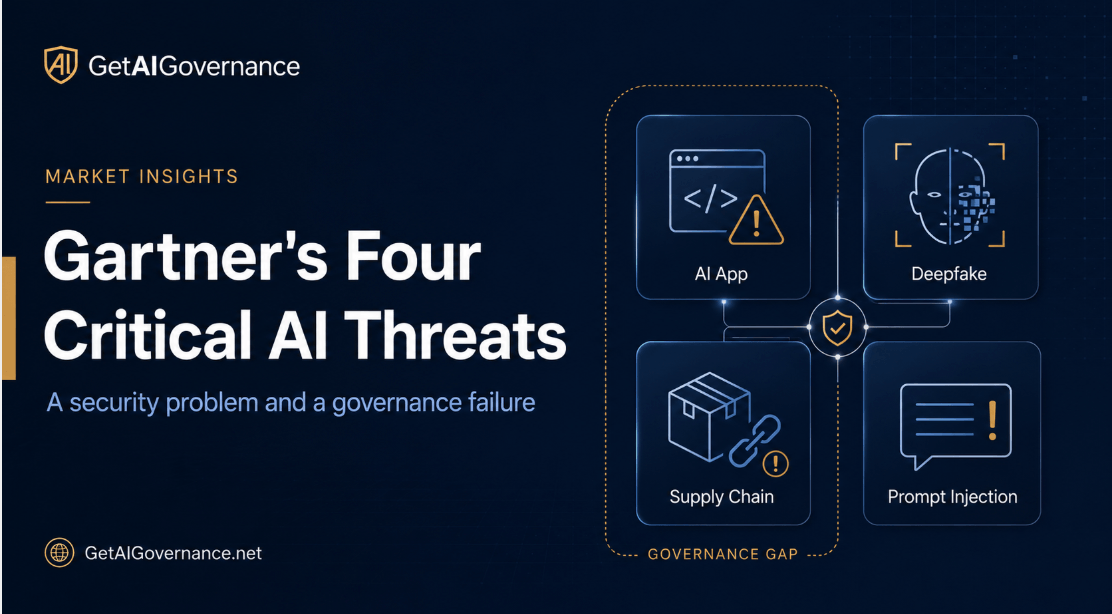
The four threats Watts named are AI application compromise, deepfake identity impersonation, software supply chain attacks, and prompt injection. Gartner's framing is that these threats are qualitatively different from the categories security teams have been defending against for the past decade — they exploit how AI systems are built and connected to enterprise infrastructure, how identity verification works under AI-generated media conditions, and how software dependencies are trusted inside modern deployment pipelines.
"There are four critical and unpredictable threats where attackers hold a significant advantage to successfully exploit weaknesses in targeted organizations."
John Watts, VP Analyst — Gartner Security & Risk Management Summit, June 2, 2026
The summit drew CISOs and security leaders from across enterprise sectors. Watts also addressed MCP security — the Model Context Protocol that governs how AI agents connect to external tools and data sources — calling out indirect prompt injection through MCP as one of the most immediate attack vectors for organizations running agentic systems. That framing matters for understanding the broader argument: this isn't a warning about future risks. It's a warning about systems that are already in production.
The Four Threats
Each of the four threats Gartner named has a security dimension — the attack vector, the detection challenge, the technical mitigation. Gartner's recommendations in the press release address those dimensions: input validation and sanitization for prompt injection, behavioral integrity testing for AI application compromise, supply chain visibility tooling for dependency attacks, multi-factor identity verification for deepfake impersonation.
What the security framing leaves implicit is that three of the four threats also have a governance dimension — and the governance dimension is where most enterprises are currently unequipped. Detecting a prompt injection event in a production agent is a security capability. Knowing who owns the accountability for that agent's behavior, what their documented response obligation is, and what the audit trail of their action looks like — that's the governance layer. Both have to be present for the detection to translate into accountability.
The Governance Gap Across the Four Threats
AI Application Compromise: Security tools detect anomalous model behavior and unauthorized data access. Governance determines who is accountable for every production AI application, what their behavioral boundaries are, and what happens when those boundaries are violated.
Prompt Injection: Security testing identifies injection vulnerabilities before and after deployment. Governance defines who owns the AI system's instruction set, who reviews it when it changes, and who is responsible when an injection succeeds in redirecting the system's behavior.
Software Supply Chain: Security tooling monitors dependency integrity and behavioral drift. Governance establishes who is named as accountable for every AI component in the stack, what their validation obligations are, and what the response protocol looks like when a dependency is compromised.
Deepfakes: Detection systems and multi-factor verification reduce the success rate of impersonation attacks. Governance defines the verification protocols for sensitive requests, the authorization structure for high-risk actions, and the accountability trail for decisions made under impersonation conditions.
Gartner's MCP security observation at the summit makes the governance gap concrete. An AI agent connected to external tools through MCP has a defined permission scope — what it can read, what it can write, what external services it can call. Securing that agent against indirect prompt injection is a security problem. Documenting who authorized the permission scope, who reviews changes to it, and who is accountable when an injection succeeds in exceeding those permissions — that's a governance problem. Security controls without that accountability layer generate detection events that nobody is named to respond to.
The Workday hiring lawsuit is the clearest documented example: system logs existed, a bias audit was conducted, outputs were monitored across 1.1 billion screening decisions. What was missing was the accountability infrastructure — named owners, human response trails, independent audit methodology. The monitoring didn't prevent the liability, but the absence of governance did.
The observability-versus-governance distinction we laid out in May applies directly here. As we wrote then: a dashboard that captures model outputs tells you what the system produced. Governance tells you who was accountable for reviewing it, what they decided, and what evidence exists that they acted. Gartner's four threats push that distinction from an architectural observation to an operational requirement.
Conditions Driving This Change
Enterprise AI deployment has moved significantly faster than the security architecture, governance frameworks, and operational controls required to support it safely, creating a structural gap that multiple threat categories have exploited simultaneously.
AI application compromise emerged as a major threat surface because production AI systems are now deeply integrated with enterprise data stores, external APIs, third-party tools, and internal workflows in ways the underlying models were never architected to secure. The real attack surface is not the model itself, but every connection point between the model and the rest of the enterprise stack.
These connection points multiplied far more rapidly than the governance, access controls, and runtime security measures needed to govern them, leaving organizations exposed as AI systems gained broad access to sensitive resources and actions.
Prompt injection became a critical and distinct threat because AI systems process natural language instructions in a fundamentally different way from traditional software. Unlike SQL injection, which exploits a gap between code and data handling, prompt injection exploits the model’s inability to reliably distinguish between legitimate instructions and malicious instructions embedded in content the system is asked to process.
Indirect prompt injection has extended this risk into agentic systems by allowing attackers to embed malicious instructions inside documents, emails, web pages, or other data sources that an AI agent reads and acts upon as part of legitimate tasks, often with real enterprise permissions and access.
Software supply chain attacks targeting AI components became a foreseeable consequence of organizations rapidly adopting third-party AI packages, libraries, and SDKs without extending traditional software supply chain security practices to cover them. The AI package ecosystem expanded faster than security review processes and provenance validation could keep up.
The May 2026 Mini Shai-Hulud worm incident demonstrated this gap in practice when it compromised over 170 packages — including Guardrails AI and Mistral AI’s official SDKs — by compromising legitimate CI/CD pipelines and generating valid provenance attestations that passed all existing automated checks.
Deepfake identity impersonation scaled rapidly because the cost and technical barrier to creating convincing synthetic audio and video dropped faster than organizations updated their identity verification, authentication, and fraud detection processes to account for fabricated media. This has enabled executive impersonation fraud, recruitment scams, and attacks against biometric systems throughout 2026.
Identity verification systems built on the assumption that voice and video are reliable signals of human identity are now operating in an environment where those signals can be fabricated at high quality and low cost, creating a fundamental mismatch between legacy controls and current threat capabilities.
Across all four threat categories, the common structural driver is the same: organizations prioritized speed of AI adoption and capability deployment over the parallel development of security architecture, runtime controls, supply chain validation, and identity assurance mechanisms needed to operate those systems safely.
What AI Security Looked Like Before These Threats Crystallized
Before agentic AI systems entered production at scale, enterprise AI security was primarily a model security question. Organizations assessed the models they deployed for data leakage, output reliability, and acceptable use policy compliance. Penetration testing covered the interfaces through which humans interacted with AI outputs. Governance frameworks focused on who could deploy a model, what data it could access, and what outputs required human review before acting on them.
That architecture worked reasonably well when AI systems were tools that humans operated. A language model that generates a draft for a human to review has a bounded risk surface — the human is the decision point, and governance accountability flows through the human's action. The AI system's output is an input to a human decision, not an action in itself.
2023–2024 Enterprise AI Security
AI systems were primarily advisory tools. Humans reviewed outputs before any action was taken. Security focus was on model access control, data exposure during inference, and acceptable use policies for generative tools.
Supply chain risk for AI packages was addressed under existing software security frameworks, which assumed dependency authors were trustworthy unless proven otherwise. Provenance attestations were treated as reliable signals.
Identity verification relied on behavioral and biometric signals that were considered difficult to spoof at scale. Deepfake tooling existed but required significant technical capability to produce results convincing enough to deceive enterprise security controls.
2026 Threat Conditions
AI agents operate autonomously with real enterprise permissions. Prompt injection can redirect agent behavior through content the agent reads during normal operation. The human review gate that bounded earlier AI risk no longer applies to agentic systems.
AI package ecosystems grew faster than supply chain security practices. Attackers can compromise legitimate CI/CD pipelines and publish malicious packages with valid provenance records. Traditional supply chain signals can no longer be fully trusted.
Synthetic audio and video generation is accessible at a cost and quality level that makes deepfake-based impersonation viable for a much wider range of attackers than it was two years ago. Biometric verification and voice-based identity systems face a more difficult threat environment than they were designed for.
What Threat Landscape Looks Like Now
The practical implication of Gartner's ThreatScape is that enterprise AI security programs need to extend their scope to the governance layer — and that governance teams need to get serious about the security surface their programs are supposed to cover. These functions have historically operated independently, with security owning detection and response and governance owning policy and accountability. The four threats Gartner named sit at the boundary between those functions and require both to work.
For prompt injection specifically, Gartner's recommendation to integrate testing into the AI development lifecycle rather than treating it as a single-safeguard problem is the right technical direction. The governance corollary is that someone has to own the agent's instruction set as a governed artifact — reviewed, versioned, and accountable to a named owner who responds when the system behaves outside its defined parameters. Testing tells you where the vulnerabilities are. Ownership tells you who fixes them and by when.
For AI application compromise, the attack surface expansion Gartner describes — custom-built agents, third-party integrations, employee-only applications, each potentially exposing sensitive data or enabling unauthorized actions — maps directly to the agentic governance problem we've been covering. The Gartner finding from May on uniform agent governance is the companion piece to this one: applying the same controls to every AI agent regardless of its actual access scope produces the same mismatch Gartner is now calling a security vulnerability. An orchestrating agent with multi-system write access needs a fundamentally different accountability structure than a read-only summarization tool. The security controls should reflect that. So should the governance framework.
For supply chain, visibility into what is running in the environment and where it came from is the foundation Gartner identifies correctly. Organizations that haven't extended their software supply chain security practices to cover AI packages are operating with a blind spot that attackers are already exploiting. Behavioral verification — continuous monitoring of whether installed components operate within expected bounds — is the layer that provenance attestations alone can't provide. The Shai-Hulud worm passed every provenance check. Behavioral monitoring would have caught the divergence.
Sources
Gartner — "Gartner Identifies Four Critical Threats Requiring Urgent Improvements from Cybersecurity Leaders." Press release, June 2, 2026. Analyst: John Watts, VP Analyst, Gartner. Presented at the Gartner Security & Risk Management Summit, National Harbor, MD. gartner.com
Gartner Security & Risk Management Summit 2026 — Day 1 Highlights. Coverage includes John Watts on ThreatScape and Dennis Xu on MCP security and AI agent risk. National Harbor, MD, June 1, 2026. gartner.com
National CIO Review — "LIVE From Gartner: The Four Threats Security Leaders Should Be Prioritizing Right Now." Emily Hill, June 2, 2026. nationalcioreview.com
GetAIGovernance.net — "Mini Shai-Hulud Worm Compromises TanStack, Mistral AI, Guardrails AI, and Dozens of Other Packages." May 2026.
GetAIGovernance.net — "Gartner Says 40% of Organizations Will Have AI Observability by 2028." Nathaniel Niyazov, May 14, 2026.
GetAIGovernance.net — "Uniform AI Agent Governance Will Cause Enterprise Failures by 2027 — Gartner." Nathaniel Niyazov, May 29, 2026.
GetAIGovernance.net — "Workday's AI Hiring Lawsuit Exposed the Governance Failure Nobody Wants to Talk About." GetAIGovernance.net, 2026.
Our Take
AI Security Take
Gartner is correct that these four threats represent a category shift. Attackers are exploiting how AI systems are built, connected, and trusted — and the security industry is building detection tooling to match. That tooling is necessary. The organizations that stop there will find themselves in the position Workday found itself in: monitoring data that documents the exposure rather than governing it.
Three of the four threats Gartner named — AI application compromise, prompt injection, and supply chain attacks on AI components — exist precisely at the boundary between what a security tool detects and what a governance program is supposed to prevent. Closing that boundary requires both functions to operate on the same threat model. Security teams need to understand the accountability structure behind the systems they're protecting. Governance teams need to understand the attack surface of the systems they're supposed to be accountable for.
The organizations that close that gap before a production incident — that build named ownership, behavioral boundaries, and response protocols into their AI programs alongside the detection tooling — are the ones that can answer a regulator's questions or a plaintiff's discovery request when something goes wrong. The window to build that infrastructure deliberately is still open. It won't stay open indefinitely, and Gartner's ThreatScape is telling you how the clock works.