Gartner published a press release on May 26, 2026 with a finding that governance teams should read carefully: applying the same governance controls to all AI agents — regardless of autonomy level or what those agents can actually reach and affect — is the setup for failure at a significant share of enterprises, and that failure is likely to show up in the next two years.
The specific prediction is that by 2027, 40% of enterprises will demote or decommission autonomous AI agents due to governance gaps that were only identified after something went wrong in production. What does that mean though? The failure pattern Gartner describes is organizations treating agent governance as a binary question — either lock everything down or trust it fully — without differentiating between agents whose worst-case outcome is a mildly inaccurate summary and agents whose worst-case outcome is a multi-system action taken under a service account with broad access.
"Enterprises are treating AI agent governance as binary, either locked down or fully trusted, and that is the root cause of failure."
Shiva Varma
Senior Director Analyst, Gartner — May 26, 2026
Varma elaborated that when the same controls are applied to all agents without distinguishing their scope of access, two common failure patterns emerge. Over-restriction of simple agents slows delivery and drives shadow development — teams find workarounds rather than working inside a governance framework that treats a document summarizer the same as an agent with write access to production systems. Under-restriction of complex agents leaves real exposure unaddressed because the controls applied weren't calibrated to the actual risk. Both failures produce the same outcome: governance that doesn't match the environment it was supposed to govern.
40% of enterprises will demote or decommission autonomous AI agents by 2027 due to governance gaps found only after production incidents.
Gartner, May 26, 2026
13% of firms feel prepared for the governance challenges autonomous AI agents introduce, per an earlier Gartner advisory from April 2026.
Gartner, April 28, 2026
What drove this finding
Enterprise AI agent deployment has moved fast enough in 2025 and 2026 that most governance frameworks haven't kept pace. The challenge is that agents are genuinely different from the AI systems that most enterprise governance programs were designed to handle. A language model that generates text or recommendations for a human to review has a bounded risk surface — the human is the decision-maker, the AI is a drafting or analysis tool. An autonomous agent that can read a database, reason about what it finds, and then write to another system or trigger an external API has a fundamentally different risk profile. The same governance controls don't translate directly.
Most organizations deploying agents in 2025 did what organizations typically do when a new technology category arrives faster than the policy process can respond: they applied whatever framework was closest to hand. In practice, that meant extending existing AI governance policies to cover agents, or applying security controls built for service accounts and APIs to systems that behave very differently from either. The result is the mismatch Gartner is describing — controls that were calibrated for one kind of system applied to a different kind of system without adjustment.
There's also a volume problem building in the background. A separate Gartner projection estimates that Fortune 500 companies will operate more than 150,000 AI agents each by 2028. At that scale, manually reviewing and classifying each agent against a uniform policy becomes operationally impossible — which is exactly the point where uniform governance breaks down in practice even for organizations that found it adequate at smaller deployment volumes.
How agent governance has typically been approached
Before the Gartner finding, the modal enterprise approach to AI agent governance treated agents as an extension of existing AI risk management policy. An organization with a policy covering LLM use for internal tools would add a clause or addendum covering agents, apply the same acceptable-use rules, require the same documentation before deployment, and run agents under the same access review processes they'd apply to any other automated system. That approach made sense as a starting position when agent deployments were small, experimental, and mostly confined to low-stakes workflows.
The problem is that most of those policies were written assuming a static model producing outputs for human review. Agents produce outputs and then act on them. An agent with read access to financial data, reasoning capability over that data, and the ability to send external communications doesn't fit neatly into a risk classification built for a text generation tool. Organizations that mapped agents to existing risk tiers often ended up under-classifying the risk — because the tiers were built around output harm rather than action harm — and over-applying restriction to lower-risk agents because the policy didn't have a way to distinguish between them.
Shadow development is one documented consequence of this. When governance frameworks are too blunt to distinguish between a low-risk agent and a high-risk one, teams building legitimate low-risk agents find the overhead disproportionate to the actual risk and route around it. That produces the exact problem the governance policy was trying to prevent: agents deployed without governance review, running in production, with no documented accountability for what they do.
What Gartner recommends instead
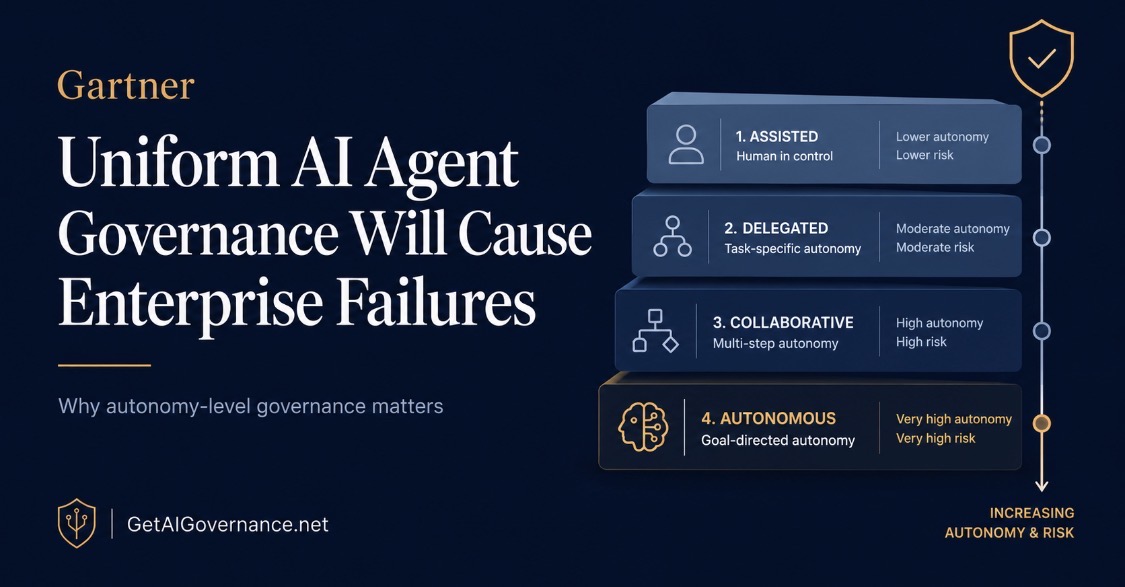
Gartner's recommendation is a proportional governance model built on four autonomy levels. Each level carries a different trust boundary and a different set of governance requirements calibrated to what an agent at that level can actually do.
Level | Agent Type | Access Scope | Governance Focus |
|---|---|---|---|
Level 1 | Observe | Read-only access to defined data sources; outputs visible only to the requesting user | Scoped data access, user authentication, usage logging, basic functional and security testing |
Level 2 | Assist | Can draft outputs or suggest actions, but a human approves before anything executes | Human-in-the-loop approval gates, output review requirements, escalation protocols |
Level 3 | Act | Can execute defined actions autonomously within a constrained, predefined scope | Constrained action boundaries, real-time behavioral monitoring, audit trails for every action taken |
Level 4 | Orchestrate | Can direct other agents, allocate resources, and operate across multiple systems with broad permissions | Full accountability infrastructure — named owners, response SLAs, multi-layer behavioral monitoring, executive oversight sign-off |
Varma specifically called out Level 1 agents as a case where existing governance frameworks cause unnecessary friction. A read-only agent that summarizes documents and shows results only to the user who asked has a risk surface limited primarily to data exposure and output accuracy. Treating it with the same review burden as an orchestrating agent with multi-system write access is governance calibrated to the wrong threat model, and the operational consequence is teams finding workarounds rather than working within the framework.
At the other end, Level 4 orchestrating agents require governance infrastructure that goes well beyond what most organizations have built for any AI system. An agent that can direct other agents, allocate resources across systems, and operate with broad permissions under a service account is a fundamentally different accountability problem. Gartner's framework treats this level as requiring named ownership, defined behavioral boundaries, continuous monitoring, and executive-level oversight — the full accountability stack.
Sources
Gartner — "Gartner Says Applying Uniform Governance Across AI Agents Will Lead to Enterprise AI Agent Failure," May 26, 2026. Analyst: Shiva Varma, Senior Director Analyst. gartner.com
Gartner — "Avoid Governance Mismatch: Classify AI Agents by Autonomy Level" (client research referenced in press release). Gartner, Inc., May 2026.
Gartner — April 28, 2026 advisory on enterprise AI agent preparedness: 13% of firms feel prepared for autonomous agent governance challenges. Referenced in AI CERTs News coverage, May 27, 2026. aicerts.ai
Gartner — Fortune 500 agent volume projection: 150,000+ agents per enterprise by 2028. Referenced in AI CERTs News coverage, May 27, 2026. aicerts.ai
AI Monitoring Signals Explained — GetAIGovernance.net. getaigovernance.net
Best AI Governance Platforms 2026 — GetAIGovernance.net. getaigovernance.net
Our Take
AI GOVERNANCE TAKE
Gartner's finding is correct, and the 40% decommissioning prediction is probably conservative given where most enterprise governance programs actually are. The binary governance problem Varma describes — locked down or fully trusted — is exactly what GAIG has been calling the accountability gap applied to agent identity. A uniform policy doesn't distinguish between agents by what they can do, so it can't assign accountability proportionally either. The result is governance that either blocks low-risk work unnecessarily or leaves high-risk agents without the oversight structure their actual scope of action requires.
The autonomy level framework Gartner recommends is a useful starting structure, but the accountability layer underneath it is what makes the framework operational rather than theoretical. Knowing that an agent is Level 3 — autonomous within a constrained scope — tells you what controls to apply. It doesn't tell you who is named as responsible for reviewing behavioral drift when the agent starts operating outside those constraints, what their response timeframe is, or where the audit trail of that review goes. Those questions are the difference between a classification framework and a governance program.
Organizations that haven't started classifying their deployed agents by autonomy level should treat the 2027 deadline in Gartner's prediction as a real operational target, not an analyst forecast to file away. Agents that fail without governance infrastructure in place don't fail quietly. Browse the AI Governance category in the marketplace for platforms built around agentic governance and accountability infrastructure, or submit an inquiry to get matched with the right tool for your current deployment scope and classification requirements.