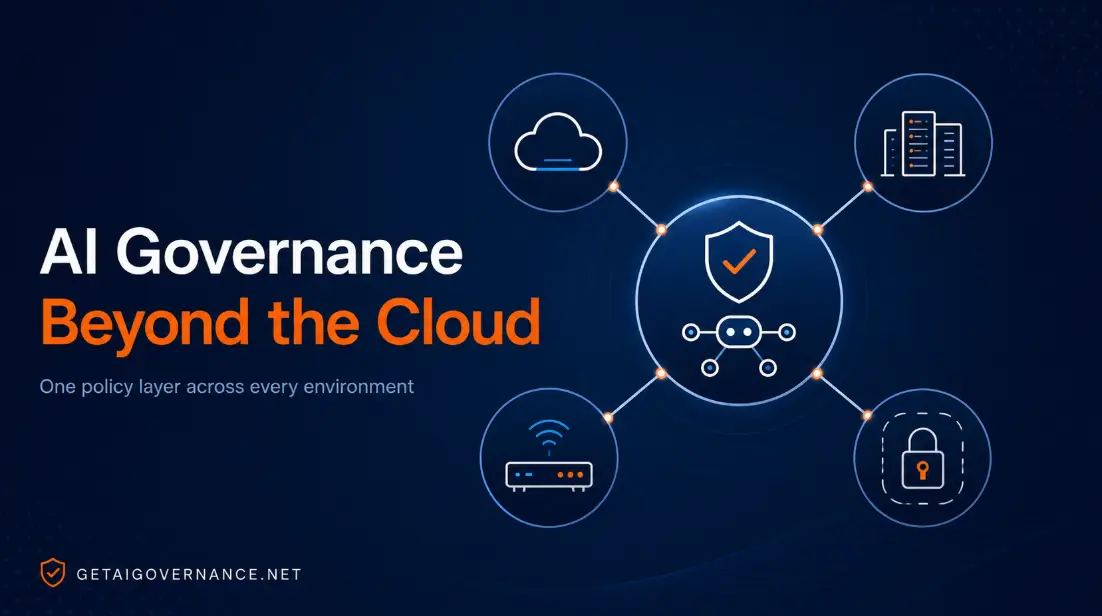
DataRobot announced on July 2 that it is extending its AI governance into environments the public cloud does not reach. The company wants to enforce one set of policies on an agent whether it runs in a public cloud, a private data center, at the edge, or inside an air-gapped or sovereign system where cloud-native governance stops working. The release, dated from Boston, frames the target as a fragmentation problem: platform vendors govern inside their platform, cloud providers govern inside their cloud, and application vendors govern inside their application. The moment an agent crosses one of those lines, DataRobot argues, both the visibility and the governance drop away.
The company puts the stakes in a regulated setting. When an agent makes a lending decision that touches several clouds and a few internal systems, a tool that sees only one of those environments will miss a pattern that tracks with a protected characteristic, arrive too late to step in, and come up short on the paperwork a regulator will ask for. DataRobot calls siloed governance an audit liability that grows heavier as agent deployments multiply.
Governance can't be an afterthought bolted onto a platform that was never designed for it. Enterprises need one consistent mechanism for defining, enforcing, and proving policy compliance across every agent, every environment, and every workflow. That's what DataRobot delivers.
Venky Veeraraghavan, Chief Product Officer, DataRobot
Conditions driving the event
DataRobot did not pick this fight at random. A few pressures came together in the first half of 2026 that turned governance across every environment into a selling point rather than a footnote.
Agents stopped living inside one platform. Enterprises now run them across public clouds, private data centers, and increasingly at the edge and inside air-gapped or sovereign systems for defense, energy, and government work. A governance tool tied to one cloud lost sight of the agent the moment it crossed into another, which turned cross-environment coverage into a real buying question.
Regulators raised the bar on proof. The EU AI Act's obligations for high-risk systems and the NIST AI Risk Management Framework both expect an enterprise to show what an agent did and who was accountable, and DataRobot ties its release to continuous alignment with both. An organization that cannot generate that record across every environment its agents touch carries an exposure it often has not measured.
DataRobot's own research gave it a number to sell against. The company's 2026 Unmet AI Needs Survey, cited in its Gartner announcement a week earlier, reported that 94 percent of organizations hit operational failures after deploying agentic AI, with the average project still taking 7.3 months to reach production. Those figures come from a vendor with an interest in the answer, so read them as a marketing frame, though they do point at a real gap between agent ambition and agent control.
The analyst field got crowded fast. Gartner named DataRobot a Leader in its June 2026 Magic Quadrant for data science and machine learning platforms for the third year running, and it named IBM, Databricks, and Dataiku Leaders in the same report. DataRobot needed a claim that set it apart from the other leaders, and governance that works outside any single hyperscaler is the line it chose to draw.
What AI governance looked like before
Before this release, most enterprise AI governance stopped at a boundary. A platform vendor governed the agents built on its platform, a cloud provider governed the workloads inside its cloud, and a compliance tool governed the models it could see. Each of those tools did its job well enough inside its own walls. The trouble started when an agent reached across walls, because the governance did not travel with it.
That gap is the one GAIG has written about as the deployer problem. An enterprise can hold a model provider's documentation and still keep no record of what its own agent did once it started calling tools, writing to databases, and moving between systems that no single vendor watches end to end. When a regulator or a plaintiff asked who owned a decision and what evidence backed it, the honest answer was often that the monitoring data existed in pieces and the accountability record did not. The Workday hiring case turned that gap into a concrete legal exposure across more than a billion screening decisions.
The fix most organizations reached for made the problem worse. They bought a separate governance tool for each environment, so a company running agents in two clouds and a data center ended up with three governance regimes that shared no policy, no log format, and no owner. Proving compliance then meant stitching three partial records into one story after the fact, usually while an auditor waited. An enterprise could describe what happened in each environment on its own, yet it could not show one continuous account of an agent's behavior from the moment it shipped to the moment it acted.
What AI governance looks like now
DataRobot's answer is a single governance layer that it says runs the same way in every environment, split into three parts. The company describes the first as AI and agentic governance. Before an agent ships, a central registry with role-based access, approval workflows, and version control is meant to keep anything noncompliant out of production.
Once an agent is live, DataRobot says real-time moderation checks every input and output against policy and blocks unsafe responses, watching for bias, hallucinations, prompt injection, toxicity, and leaked personal data as they happen. The company ties this layer to continuous alignment with the NIST AI Risk Management Framework and the EU AI Act. Whether that enforcement behaves the same way in an air-gapped system as it does in a public cloud is the question a buyer should press on.
The second layer covers IT governance, and it holds the most interesting idea in the release. DataRobot gives each agent its own identity and permissions rather than letting it borrow a human employee's credentials, then attaches granular entitlements that control which data and which APIs the agent can reach. The company pairs that with end-to-end lineage that tracks an agent's actions across the tools and applications it touches. An agent with its own scoped identity and a continuous log is the accountability structure the Workday gap was missing.
The third layer, infrastructure governance, handles cost and hosting. DataRobot points to gateways, fair-use policies, and model hosting that it says keep agentic AI spending predictable whether the work runs in public cloud, private cloud, hybrid, edge, air-gapped, or sovereign environments. The platform behind all three layers, the DataRobot Agent Workforce Platform, is co-engineered with NVIDIA and validated on hardware from Dell and Nebius, which is how the company argues it can promise the same governance on infrastructure it does not own. Every part of this comes from DataRobot's own account of the product, so the claims wait on independent testing.
Our Take
AI Governance Take
I will say the part I do not usually get to say about a launch like this. DataRobot has the diagnosis right. Governance that stops at the edge of one platform is a real audit liability, and the company is describing the same failure GAIG has tracked through the deployer gap and the Workday case. The agent-identity design, where each agent carries its own scoped credentials and a continuous log, is the accountability infrastructure most programs still lack.
The diagnosis being right does not make the product proven. This is a press release, and a press release exists to sell. The company frames the launch as advancing an industry standard with one consistent mechanism across every environment, and it offers no independent test of the harder promise, that identical policy enforcement really runs in an air-gapped or sovereign system the way it runs in a public cloud. The Gartner recognition DataRobot cites covers its data science platform in a quadrant it shares with IBM, Databricks, and Dataiku, and that award does not validate the beyond-the-cloud governance the release is built around.
The move worth watching sits underneath the pitch. An enterprise that adopts one vendor's governance layer across every environment fixes fragmentation and takes on a fresh dependence, because the mechanism that defines, enforces, and proves compliance everywhere now belongs to a single supplier. That trade can be worth making, though the buyer should make it with the questions written down: whether moderation really catches bias and leaked data in the air-gapped deployment, who owns the agent identity and the lineage record when an auditor calls, and what the exit looks like if the one governance layer becomes the single point of failure. Those are governance questions, and the release does not answer them.
DataRobot named the problem more honestly than most vendors do, and the architecture it described is the right shape. The proof that the same governance holds where the cloud does not reach has to come from somewhere other than the company selling it.