Coupang is South Korea's largest e-commerce platform, a company the PIPC described as operating "AI-powered logistics" across tens of millions of customer relationships. The scale of its data processing operation — order histories, payment records, delivery addresses, behavioral profiles — is the kind of scope that demands identity governance infrastructure operating well below the threshold of what regulators have to specifically request. It was not in place.
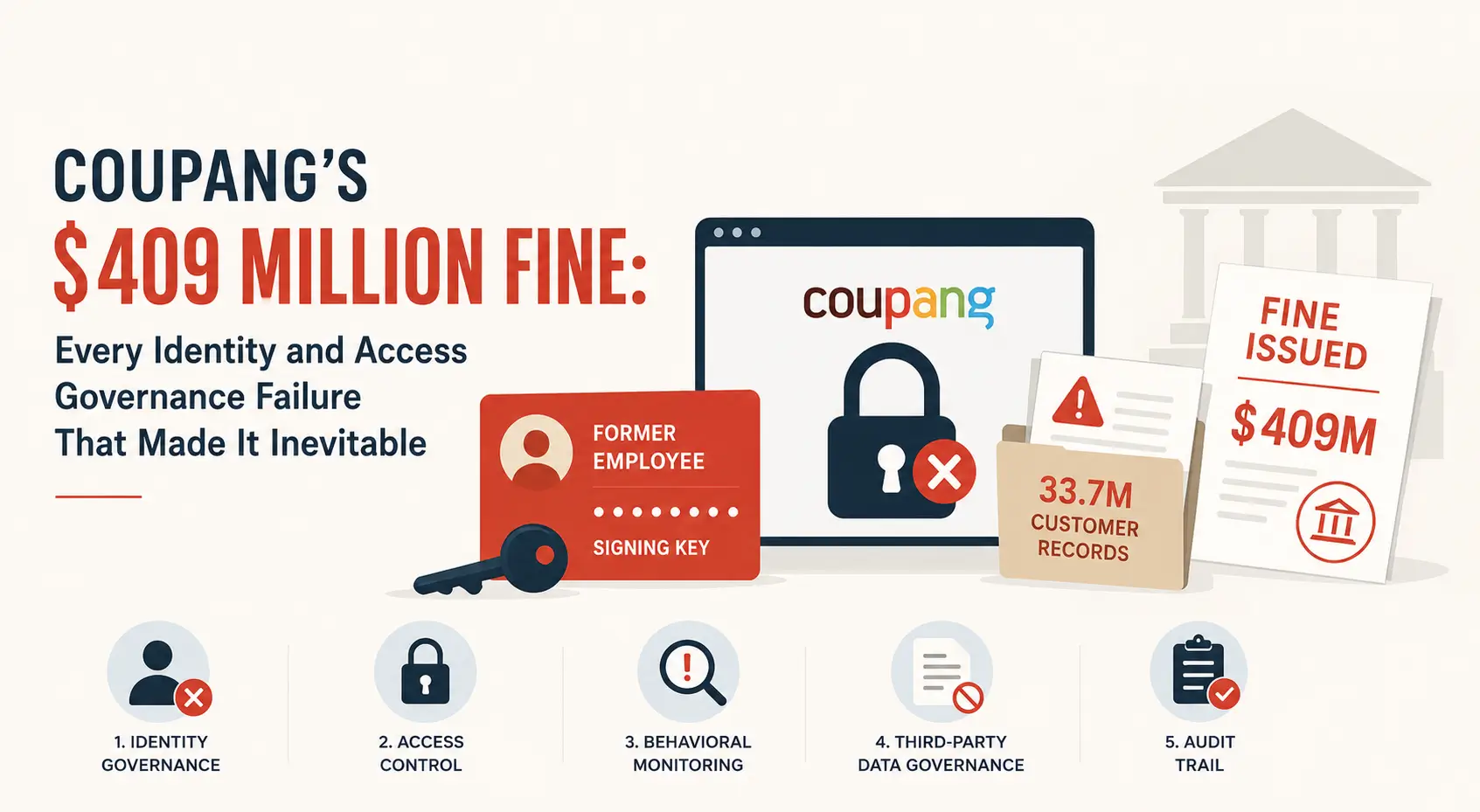
AI tool adoption among enterprise practitioners is accelerating faster than the governance frameworks designed to oversee it. Research across the industry consistently finds that fewer than half of organizations operate under a formal AI governance program. Last week, one arrived. South Korean regulators fined Coupang 624.9 billion won — approximately $409 million — after inadequate data access controls allowed a former employee to retain a stolen cryptographic signing key, exposing approximately 33 million customer records.
The breach didn't start with an outside attacker probing network perimeters or exploiting a zero-day vulnerability. It started with a former employee who left with a cryptographic signing key they should never have been able to keep. That key provided ongoing authentication to Coupang's systems. According to the PIPC's findings, Coupang failed to establish basic security management systems for authentication signing key management and access controls. A signing key with no revocation process, held by someone who no longer worked at the company, is not a sophisticated attack surface. It's a missing lifecycle management control.
The PIPC's assessment was unsparing: the breach stemmed from deficiencies in basic safety management. That language matters because it tells you this wasn't an advanced persistent threat that evaded Coupang's defenses. Coupang's access governance infrastructure didn't catch the problem because the infrastructure to catch it didn't exist. Everything downstream from that — the scope of exposure, the regulatory response, the $1.2 billion compensation program — follows directly from one missing category of control.
"The breach stemmed not from sophisticated hacking but from deficiencies in basic safety management."
South Korea Personal Information Protection Commission (PIPC)
June 11, 2026
What Actually Happened
Coupang's data breach involved a former employee retaining a cryptographic signing key after leaving the company. That key continued to provide authentication access to Coupang's systems. The PIPC investigation found that Coupang had inadequate controls over both the issuance and the revocation of authentication credentials. When the employee left, the credential went with them — and Coupang had no system in place to detect that a former employee was using it to access production systems.
Separately, the PIPC found that Coupang had collected online activity records for approximately 11.17 million users across third-party websites and apps without their consent. Coupang argued this marketing data didn't constitute personal information and deleted the records in April 2026 after investigators confronted the company. The commission added a further 201.1 billion won — about $132 million — specifically for this violation. The total fine of 624.7 billion won covered both the breach itself and the unlawful data collection.
Incident A — Former Employee Retains Stolen Cryptographic Signing Key
A former Coupang employee left the company with a cryptographic signing key that provided authentication access to production systems. Coupang had no credential lifecycle management process that automatically revoked or rotated credentials on employee departure. The key remained active and was used to access systems containing tens of millions of customer records. This is the primary basis for the PIPC's 423.6 billion won penalty — the largest component of the total fine.
Incident B — Unlawful Collection of 11.17 Million Users' Activity Data
Coupang collected behavioral tracking data from third-party websites and apps for approximately 11.17 million users without obtaining proper consent. The data was retained until April 2026, when Coupang deleted it after regulators confronted the company during the investigation. The PIPC treated this as a separate violation from the breach — the absence of consent governance for third-party data collection produced a distinct 201.1 billion won component of the fine.
Confirmed Timeline
2025 Former employee leaves Coupang. Authentication signing key is not revoked. Key continues to provide access to Coupang production systems containing customer records.
2025 Breach occurs. Personal information tied to approximately 33.7 million customer accounts is exposed. Coupang does not detect the unauthorized access through any automated monitoring system.
April 2026 After being confronted by PIPC investigators, Coupang deletes approximately 11.17 million third-party behavioral records it had collected without consent.
Jun 11, 2026 PIPC votes at a plenary session to impose a record 624.7 billion won ($409 million) fine on Coupang and its logistics subsidiary Coupang Fulfillment Services. Largest data protection penalty in South Korean history.
Jun 11, 2026 Coupang shares fall approximately 5% in the session following the announcement. The company, which reported a $266 million net loss in Q1 2026, signals plans to challenge the ruling.
Jun 2026 Coupang operates a separate $1.2 billion customer compensation program connected to the same incident. Total incident cost exceeds $1.6 billion before legal costs and operational remediation.
Five Missing Controls That Made the Breach Possible
The PIPC's determination — that the breach resulted from deficiencies in basic safety management — describes an organizational reality that predates any individual decision made during the incident. The following controls were each independently capable of stopping the breach. None of them were in place.
Failure 01 — Identity Governance
No Credential Lifecycle Management on Employee Departure
When an employee leaves an organization, every credential that employee held — passwords, API keys, session tokens, cryptographic signing keys — should be revoked as part of a documented, automated offboarding process. Coupang had no such process for authentication signing keys. A former employee left the company with a key that provided direct authentication access to production systems, and that key remained active indefinitely because nothing in Coupang's environment was tracking whether credentials issued to departed employees had been revoked.
The AI Governance Capabilities framework treats identity governance for AI systems as a distinct capability precisely because the credential lifecycle problem that caused the Coupang breach is now occurring at a different scale with AI agents. An agent provisioned with broad system access during deployment and never reviewed afterward is the same failure pattern — credentials that should have been scoped or revoked, sitting open indefinitely, because no process was tracking them.
What right looks like:Automated offboarding workflows that flag every active credential held by a departing employee and require explicit confirmation of revocation before the offboarding is marked complete. Cryptographic signing keys specifically tracked in a credential inventory with defined expiration dates and rotation schedules, independent of employment status.
Failure 02 — Access Control
No Minimum-Privilege Scoping on Authentication Credentials
A cryptographic signing key that provides authentication access to systems containing 33.7 million customer records is operating without any scoping constraint if a single key can expose records at that scale. Least-privilege access control requires that every credential be scoped to the minimum access required for the specific function it supports. A key used for one workflow should provide access to the systems that workflow requires — not to an organization's entire customer record environment.
The AI Security Controls framework describes this under the Identity and Access layer: agent permission scoping enforces hard limits on what systems a credential can reach, so that the blast radius of a compromised or misused credential is bounded by the scope of the access it was issued for, not by the scope of everything the organization owns.
What right looks like:Every authentication credential scoped to the minimum system access required by its associated function. Signing keys that authenticate to a payment processing subsystem should not, by design, be capable of authenticating to customer record stores in a different business domain. Scope limits enforced at the infrastructure level, not through policy documentation.
Failure 03 — Behavioral Monitoring
No Detection of Credential Use After Employee Departure
Even if a credential was not revoked on departure, monitoring for anomalous authentication events — specifically, credentials authenticating to production systems from accounts whose employment status has changed — would have detected the unauthorized access. Coupang had no monitoring system that surfaced the former employee's use of the retained signing key. The breach was not detected through any automated security or governance system. It was discovered through the PIPC's regulatory investigation, which is the least favorable possible detection mechanism for an incident of this scope.
IBM's X-Force 2026 threat research found that credential abuse and third-party compromises are expanding attackers' reach faster than defenders can revoke access. The Coupang case illustrates exactly that dynamic — the credential was in active use without any detection for long enough to expose tens of millions of records before anyone at Coupang knew it was happening.
What right looks like:Continuous behavioral monitoring that establishes authentication baselines for active users and flags any authentication event from a credential associated with a departed employee as an immediate priority alert. Just-in-time credential issuance for sensitive system access, so that credentials are not persistent between sessions and a retained key from a departed employee expires within hours of their last legitimate use.
Failure 04 — Third-Party Data Governance
No Consent Framework for Third-Party Behavioral Data Collection
The 201.1 billion won component of the fine addresses a separate but related failure: Coupang was collecting online activity records from 11.17 million users across third-party websites and apps without their consent. This is a data governance failure at the collection layer — the organization was processing personal data under a legal basis that didn't exist. When regulators confronted Coupang with evidence of the collection, the company deleted the records and disputed whether the data constituted personal information, which is not a governance posture. It is a response to being caught without one.
The AI Governance Capabilities guide covers data governance as a distinct capability layer precisely because AI systems create new data processing contexts that existing consent frameworks were not designed to handle. An AI system that ingests user behavioral signals from third-party sources to train recommendation models is processing personal data in ways the underlying consent never covered — and most organizations have no process for auditing whether their AI data pipelines stay within the scope of the consent they obtained.
What right looks like:A documented inventory of every data source feeding AI-adjacent systems, with explicit consent basis documented for each processing activity. Automated comparison of data flows against consent records, generating alerts when data collection activities operate outside documented consent scope. Periodic consent audits as AI systems are updated or expanded.
Failure 05 — Audit Trail
No Tamper-Resistant Log of Authentication Events Sufficient for Forensic Reconstruction
After the breach was confirmed, Coupang's ability to understand the scope of what was accessed, when, and through which credential path depended entirely on whatever logs existed from the authentication systems involved. An organization with 33.7 million records at risk and no comprehensive tamper-resistant authentication audit trail cannot fully reconstruct the incident, cannot determine with confidence what was accessed, and cannot produce the evidence a regulator expects when responding to an investigation. The absence of this infrastructure doesn't make the breach worse — it makes the regulatory exposure worse, because the organization cannot demonstrate the scope of the problem or the adequacy of its response.
What right looks like:Tamper-resistant logs capturing every authentication event with full context: credential identifier, target system, timestamp, session duration, and associated user or account status at the time of authentication. Retention periods sufficient to support forensic reconstruction of incidents discovered months after occurrence. Audit log architecture that is separate from the systems being audited, so that a compromised production system cannot modify its own authentication record.
This Is the Reference Number
The Coupang fine lands at a specific moment in the global AI governance conversation. In the week of June 11, the PIPC issued its ruling, the US government issued AI export controls, and Palo Alto Networks reported demand metrics from its security pipeline that reflected the same underlying pressure — organizations are being forced to price the cost of ungoverned AI systems and ungoverned access infrastructure. The Coupang number is the most specific answer available.
"The week of June 11, 2026 did not create AI governance risk. It priced it. That is the difference between an IT decision and a board decision."
Tim Freestone
Chief Strategy Officer, Kiteworks
TechRepublic, June 23, 2026
The fine surpassed South Korea's previous record — 134.8 billion won imposed on SK Telecom earlier in 2026 for its own breach — by a factor of more than four. It also landed alongside a $1.2 billion customer compensation program that Coupang was already running for the same incident, bringing the total identifiable cost above $1.6 billion before legal costs, operational remediation, and the reputational effects on a company that was simultaneously trying to expand into Taiwan and international markets. Coupang shares fell 32% year-to-date before the fine was announced.
Every general counsel presenting AI risk to a board now has a number. Every CISO defending identity governance investment now has a reference case. Every regulator examining an organization's access controls now operates with the knowledge that a $409 million benchmark exists for inadequate credential management affecting tens of millions of records. The Coupang case didn't create the risk. It made the risk visible as a dollar amount that organizational decision-makers can price into governance investment decisions.
The PIPC's jurisdiction is South Korea, but the precedent is not jurisdictionally contained. The fine dwarfs previous Asian data protection penalties and will inform how other regulators in the region set enforcement thresholds. The principle that credential lifecycle failures constitute "deficiencies in basic safety management" — not sophisticated attack scenarios that regulators should accommodate — is now documented in a formal enforcement action from a major economy's data protection authority.
Our Take
AI Governance Take
The Samsung breach required engineers who didn't fully understand that consumer ChatGPT retained their prompts. The Coupang breach required even less from the attacker — a former employee kept a credential that should have been revoked on their last day of employment, and Coupang had no system in place to detect that the credential was still active or to catch it when it was used to access production systems.
That's the governance failure. Not a zero-day. Not a nation-state actor. Not an AI system behaving unpredictably. A person left the company with a key that still worked, used it to access systems they were no longer authorized to access, and Coupang found out through a regulatory investigation rather than through any internal security or monitoring system.
The identity governance capability that GAIG covers in the AI Governance Capabilities guide — treating every system identity, including AI agents, as a first-class identity requiring lifecycle management, scoped access, and revocation on departure — exists specifically because this failure pattern is not unique to Coupang. Every organization that provisions credentials to systems and doesn't have an automated revocation process is carrying the same exposure at some scale. Coupang had 33.7 million customer records behind theirs. The number attached to your organization's version of the same gap depends on what's behind yours.
The fine is $409 million. The credential revocation process costs considerably less than that.