Trustible has launched AI Controls, a new set of capabilities within its platform designed to give organizations more direct oversight and policy enforcement over their AI systems. The release comes as enterprises increasingly look for practical ways to manage the growing number of AI models and agents operating across their environments.
As companies scale their use of AI, many governance teams have struggled to move beyond high-level policies and manual processes. While frameworks and documentation requirements have become more established, translating those into consistent, enforceable controls at the system level has remained a challenge for many organizations.
AI Controls introduces functionality aimed at bridging this gap by allowing teams to define and apply governance rules more directly within their AI workflows. The features focus on areas such as policy enforcement, behavioral monitoring, and structured oversight, giving compliance and risk teams additional tools to manage AI usage beyond initial approval stages.
The launch reflects a broader trend in the AI governance market, where platforms are expanding beyond documentation and risk assessment to include more active control and monitoring capabilities. As regulatory expectations continue to rise, organizations are seeking solutions that can help demonstrate not only that policies exist, but that they are being consistently applied across AI systems in production.
Trustible positions AI Controls as a way for enterprises to strengthen day-to-day governance without requiring entirely new infrastructure or processes.
Conditions Driving the Launch of AI Controls
Organizations are deploying AI systems at a much faster pace than their governance processes can effectively oversee, creating a growing gap between approved use cases and actual usage in production.
Many enterprises have established AI policies and risk frameworks on paper, but struggle to translate these into consistent, enforceable controls once AI systems are live and interacting with real data and workflows.
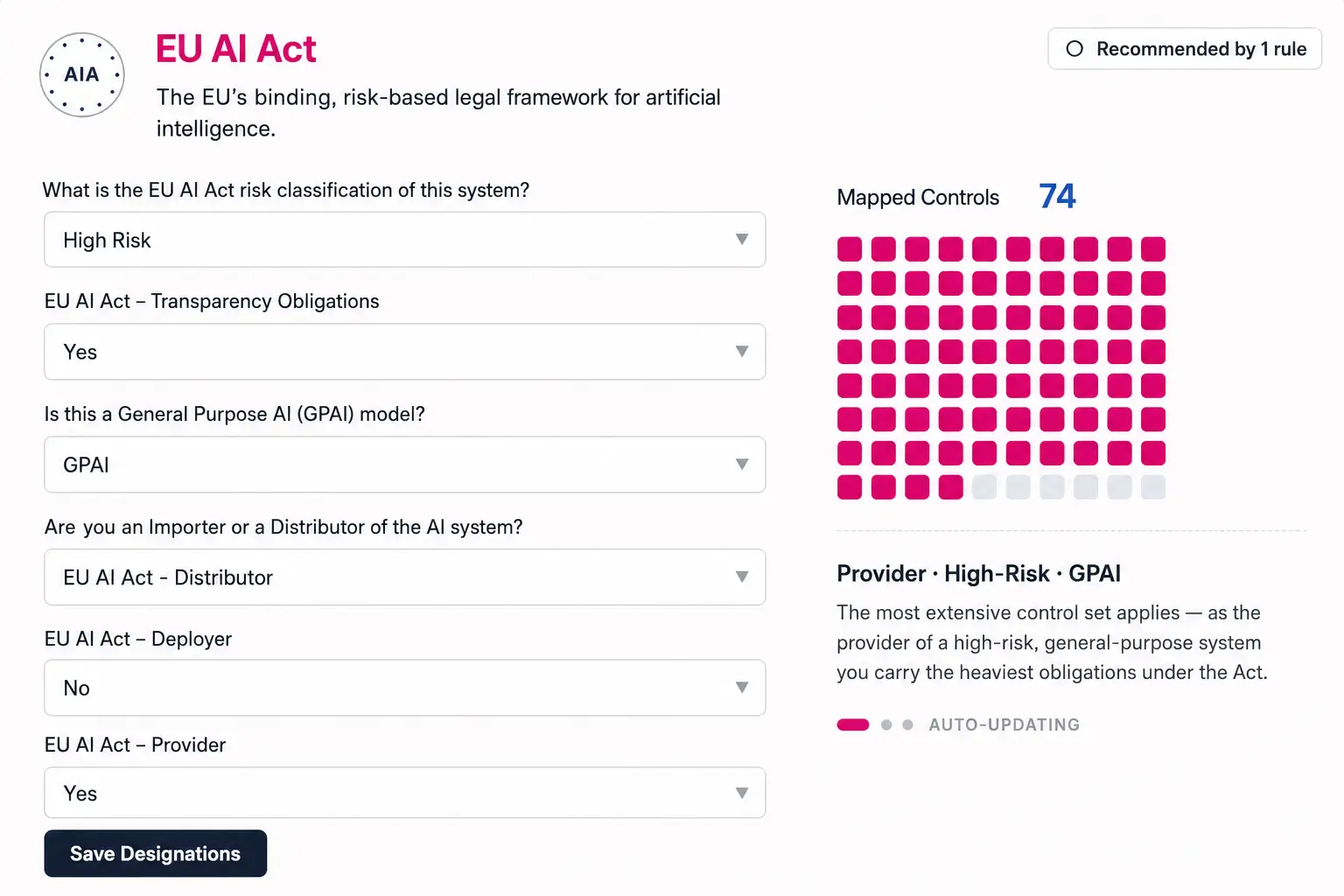
Regulatory expectations are increasing, with frameworks such as the EU AI Act requiring organizations to not only assess risk but also demonstrate ongoing oversight and control over high-risk AI systems.
Governance and compliance teams are facing significant scalability challenges, as the number of AI models, agents, and use cases continues to grow across different business units and functions.
Traditional governance approaches that rely heavily on manual reviews, spreadsheets, and periodic audits are becoming insufficient for managing the volume and speed of modern AI deployments.
There is rising concern around shadow AI, where employees and teams adopt AI tools without proper oversight, increasing both operational and compliance risks across the organization.
Security and risk leaders are under pressure to move beyond initial approval processes and establish mechanisms that can monitor AI behavior and enforce policies on an ongoing basis.
Many organizations lack clear visibility into how their AI systems are actually performing and making decisions after deployment, making it difficult to detect drift, misuse, or policy violations in real time.
As AI becomes more embedded in core business processes, the consequences of poor governance — including regulatory fines, reputational damage, and operational failures — are becoming more significant and harder to ignore.
Governance teams are increasingly being asked to provide evidence of control, not just documentation of policies, creating demand for tools that can operationalize oversight across AI systems.
The growing use of autonomous and agentic AI systems has added complexity, as these tools can take actions independently and interact with multiple internal systems without constant human supervision.
Existing governance platforms have largely focused on intake, risk assessment, and documentation, leaving a gap in the market for capabilities that support active policy enforcement and continuous monitoring of AI in production.
What AI Governance Looked Like Before
Before tools began offering more operational control features, AI governance in most organizations was largely a front-loaded and documentation-heavy process. Teams would typically conduct risk assessments, classify use cases, define high-level policies, and go through approval workflows before an AI system was allowed to move forward. Once a system was approved and deployed, however, ongoing governance often became inconsistent or minimal.
Oversight relied heavily on periodic reviews, manual audits, and self-attestation from the teams managing the AI systems. While this approach could work when companies had only a handful of AI use cases, it quickly became unsustainable as AI adoption spread across different departments. Many organizations ended up with dozens or even hundreds of AI tools and models running in production, yet lacked reliable ways to ensure those systems continued to operate within the boundaries that were originally approved.
Governance remained mostly reactive. Issues such as policy drift, unauthorized changes, or unexpected model behavior were often discovered late — sometimes only after problems had already surfaced in business operations or during an audit. There were few practical mechanisms to enforce rules in real time or at scale. As a result, governance functions spent a disproportionate amount of time on intake and initial approval processes, while struggling to maintain meaningful visibility and control once AI systems were live.
What AI Governance Looks Like Now
The introduction of capabilities like Trustible’s AI Controls represents a shift toward more operational and enforceable governance. Instead of treating governance as something that happens mainly before deployment, organizations are now looking for ways to actively manage and control AI systems throughout their lifecycle. This includes the ability to define rules and ensure those rules are consistently applied as AI systems interact with data and make decisions in production environments.
AI Controls aims to give governance and compliance teams more direct ways to enforce policies and maintain oversight after systems are deployed. This moves governance beyond documentation and periodic reviews toward something closer to ongoing management and control. It allows teams to set boundaries and have better visibility into whether those boundaries are being respected as AI usage evolves.
This change is driven by both scale and regulatory pressure. As the number of AI systems grows and expectations around accountability increase, organizations need governance approaches that can actually keep up with how AI is being used day to day. While tools like Trustible’s are still maturing, they reflect a broader movement in the market toward governance that is more active, enforceable, and integrated into how AI systems actually operate.
Our Take
AI Governance Take
Trustible’s launch of AI Controls reflects a necessary evolution in how enterprises approach AI governance. For years, most governance efforts have centered on upfront processes — risk assessments, policy documentation, and approval workflows. While these steps remain important, they have proven insufficient on their own as organizations scale their use of AI across more systems and business functions.
The real challenge many companies are now facing is not creating governance frameworks, but actually enforcing them once AI systems are live. As the number of models and agents grows, organizations need more than visibility — they need mechanisms to actively manage behavior and ensure policies are followed in practice. Tools that help bridge the gap between documented governance and operational control will become increasingly relevant.
That said, the market is still early in this transition. Many governance platforms are only beginning to move beyond documentation and assessment into more active enforcement capabilities. Organizations evaluating these tools should be clear about what level of control they actually need versus what is currently being offered. Features that sound powerful in theory can sometimes deliver limited practical impact if they remain heavily dependent on manual oversight or lack deep integration with existing AI systems.
For governance and compliance teams, the priority should be identifying where their current processes break down at scale and seeking solutions that address those specific gaps, rather than adopting new tools simply because they expand the governance feature set. Trustible’s AI Controls is part of a broader shift toward more operational governance, but success will ultimately depend on how well these capabilities integrate into how organizations actually build and run AI.