Download The Report
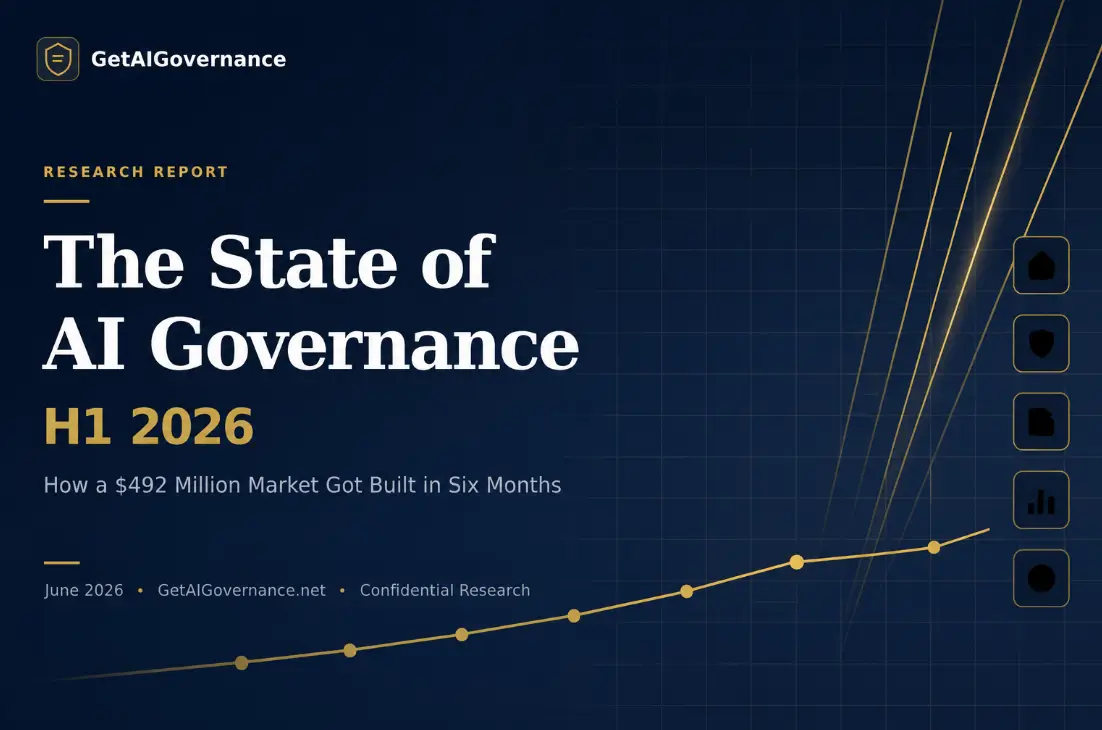
Download The State of AI Governance H1 2026 to explore:
70 pages of analysis
28 external sources
Regulatory breakdowns
Security incident analysis
Vendor landscape mapping
Acquisition and funding trends
H2 2026 outlook and predictions
Between January and June 2026, AI governance moved from a planning discussion to an operational requirement.
New regulations took effect across multiple jurisdictions. Security incidents exposed governance failures inside enterprise AI programs. More than $2 billion in acquisitions reshaped the vendor landscape. Liability cases established new accountability expectations. At the same time, Gartner projected AI governance platform spending would reach $492 million in 2026 and exceed $1 billion by 2030.
The State of AI Governance H1 2026 examines the events, regulations, security developments, acquisitions, liability cases, and market signals that transformed AI governance into one of the fastest-growing categories in enterprise technology.
What You'll Learn
This report covers:
The Gartner forecast that projected a $492 million AI governance market in 2026 and more than $1 billion by 2030.
The regulatory developments that reshaped enterprise compliance requirements across the United States, Europe, and Asia.
The security incidents and research findings that turned governance from a compliance discussion into a business risk conversation.
The acquisition wave that brought more than $2 billion into AI governance and security infrastructure.
The liability events that established accountability expectations for AI developers, deployers, and enterprise buyers.
The vendor landscape across AI Governance, AI Security, AI Compliance, and AI Monitoring.
Key Findings From The Report
AI Governance Became a Recognized Enterprise Software Market
In February 2026, Gartner projected that AI governance platform spending would reach $492 million this year and exceed $1 billion before the end of the decade. The forecast was driven by expanding AI regulation, increasing compliance obligations, and growing enterprise demand for accountability infrastructure around AI systems.
Regulatory Pressure Accelerated Faster Than Most Organizations Expected
Within six months, organizations faced new AI obligations from California, Texas, Singapore, the European Union, and U.S. federal regulators. What had previously been voluntary governance guidance evolved into enforceable compliance requirements with real legal and operational consequences.
Security Became the Catalyst for Governance Investment
The report documents a series of events that forced governance discussions into boardrooms and security teams. Stanford recorded 362 AI incidents during 2025, HiddenLayer found that one in eight AI breaches involved agentic systems, and Palo Alto Networks reported a surge in customer demand related to AI security concerns.
Enterprise Readiness Remains Critically Low
While AI adoption continues to accelerate, preparedness has not kept pace. The report highlights research showing that only a small percentage of organizations believe they are prepared for emerging AI regulatory requirements, creating a widening governance gap as deployments expand.
Liability Is Becoming a Governance Driver
Cases involving OpenAI, Workday, EY Canada, and early enforcement actions under state AI laws demonstrated that governance failures increasingly carry legal and financial consequences. The question is no longer whether accountability matters, but whether organizations can prove it when challenged.
Governance and Security Are Converging
One of the strongest conclusions from the report is that governance and security are no longer separate conversations. The acquisitions, regulatory developments, and security incidents examined throughout H1 2026 consistently point toward a future where authorization, accountability, monitoring, and enforcement operate as a unified control system.
Capital Is Accelerating the Problem Faster Than Governance Can Catch Up
AI attracted approximately $242 billion in investment during Q1 2026 alone. That capital is accelerating AI deployment across industries, creating downstream demand for governance, security, compliance, and monitoring infrastructure capable of managing the risks that accompany large-scale adoption.