Picture a governance program manager who has spent twelve months building an AI program. Models are in production. Dashboards are configured and running. Compliance documentation has been filed. The program looks like it works. Then something goes wrong — an output that was accurate six weeks ago and isn't anymore, a retrieval result that's technically correct but built on data that hasn't been reviewed in four months, an evaluation test that passed in staging and failed silently in production for three weeks before anyone noticed.
Nobody knows why. Nobody owns the layer where it broke.
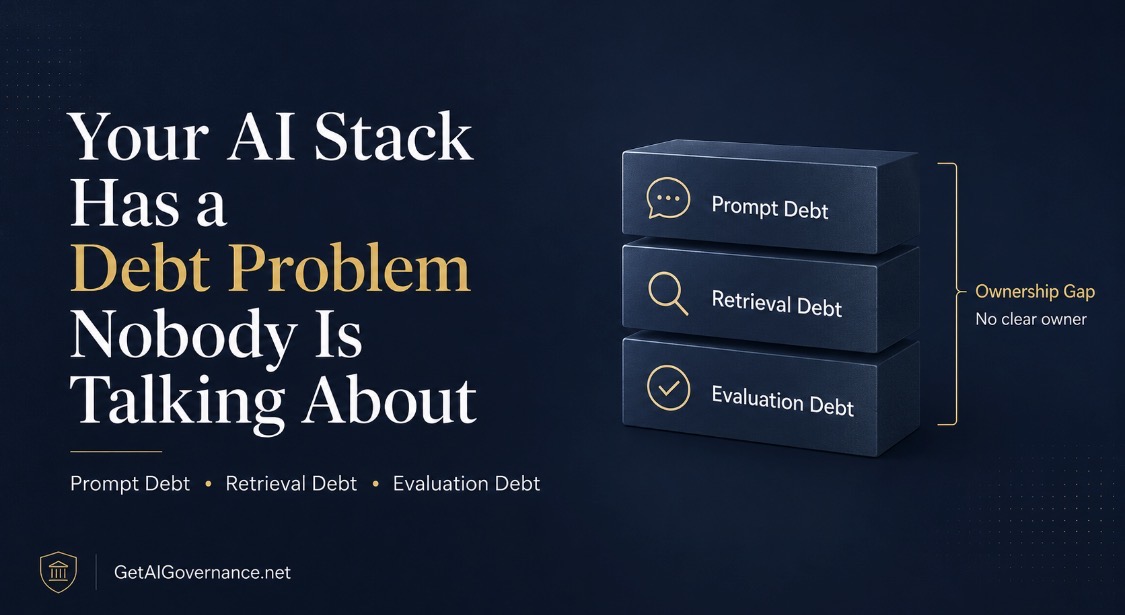
A VentureBeat analysis published this week put a name to what's been accumulating inside enterprise AI programs: prompt debt, retrieval debt, and evaluation debt. Three failure modes building quietly at the layers most organizations have the least governance infrastructure for. The framing is useful. But I think the diagnosis behind it is wrong, and that gap between the symptom and the cause is where organizations are going to keep getting stuck.
The industry is calling this a technical problem. The evidence says it's an ownership problem.
95% of enterprise AI initiatives fail to deliver measurable P&L impact. Only 5% of custom AI pilots reach production with real value creation.
MIT Project NANDA, "The GenAI Divide: State of AI in Business 2025," July 2025
42% of businesses scrapped multiple AI initiatives in 2025 — up sharply from 17% the year before.
S&P Global Market Intelligence, 2025
Those numbers generate a lot of commentary about AI complexity, about the gap between proof-of-concept and production, about organizational readiness. What they generate less of is an honest conversation about why the same failure pattern keeps repeating across different organizations, different industries, and different AI stacks. MIT's own framing in the GenAI Divide report gets close to it. The lead researcher described the core problem as a "learning gap" — the inability to integrate AI into workflows, structures, and cultures. Not the technology. The organizational infrastructure around it.
Prompt debt, retrieval debt, and evaluation debt are three expressions of that same organizational gap.
What the three debt types actually describe
Prompt debt is what happens when prompts spread through an organization without governance. Someone finds a prompt that works. They copy it into a production workflow. Someone else modifies it slightly for a different use case. A third version gets embedded in a customer-facing product. Nobody documented why specific decisions were made. Business rules, tone guidelines, risk tolerances, edge case handling — all of it exists as invisible logic inside prompt text with no version history, no owner, and no review process.
When the underlying model updates, something in that prompt stops working. Nobody knows which version is the canonical one, what it was supposed to do in the edge cases, or who approved the language that's now producing outputs nobody intended. The technical fix people reach for is version control tooling. That helps. But version control without an assigned owner just means you have a documented trail of unmanaged prompts rather than an undocumented one. The governance problem is identical.
Retrieval debt is the same ownership failure one layer down. Most enterprise AI deployments use retrieval-augmented generation — the model pulls context from enterprise data repositories before generating a response. Those repositories contain outdated documents, duplicate records, and information that was accurate at some point and has since been superseded by something that hasn't been indexed yet. The AI returns answers that are technically correct based on what it retrieved and dangerously wrong based on what actually applies today.
Here's what makes retrieval debt harder to catch than a hallucination: a hallucination is wrong in a way that looks wrong. Retrieval debt produces answers that were right until recently and still read as plausible. A tester checking outputs doesn't flag it because the answer is internally consistent with the source material. The source material just hasn't been maintained. Nobody was watching the freshness of the retrieval pipeline because nobody was assigned to.
Evaluation debt is what forms when testing frameworks are built once and then left to age. A benchmark captures model behavior at a point in time. The model updates. The data underneath the evaluation changes. The production environment shifts. Nobody updates the evaluation logic to track with those changes, so the evaluation gradually stops measuring what it was designed to measure. It keeps passing tests that have quietly become irrelevant while the behavior that actually matters in production goes unmeasured.
A 2025 MIT study from Project NANDA found that 95% of enterprise AI initiatives fail to deliver measurable impact, attributing the failures to brittle workflows, weak contextual learning, and misalignment with day-to-day operations. S&P Global Market Intelligence found 42% of businesses scrapped multiple AI initiatives in 2025, up from 17% the year before. Both sets of researchers point to organizational failure rather than technical failure as the primary driver. The technical debt framing captures what the failure looks like. The ownership diagnosis explains why it keeps happening.
The technical framing is understandable but wrong
The reason organizations reach for technical solutions to these problems is that the failures present as technical failures. An output degrades and it looks like a model problem. A retrieval result is stale and it looks like a data quality problem. An evaluation passes while production behavior drifts and it looks like a testing problem. When failures look technical, the response is to buy a tool, upgrade a framework, or add a new platform layer.
That response addresses the symptom without touching the cause.
I've watched organizations invest in evaluation platforms, retrieval optimization tools, and prompt management software without seeing any sustained improvement in AI program reliability. The reason is consistent: the tooling was purchased without assigning anyone to run it. A prompt management platform with no named owner for each prompt is still an unmanaged prompt library — it just has better interface design. A retrieval quality tool with no defined freshness SLA and no one accountable for enforcing it is a dashboard nobody looks at. An evaluation framework with no one responsible for updating it when the model changes is a test suite that hasn't been maintained.
The structural reason this keeps happening is that AI systems introduce accountability gaps at exactly the layers where ownership is hardest to assign. Code has developers. Infrastructure has engineers. Models have data scientists. But prompts live between the product team and the AI team. Retrieval pipelines live between the data team and the AI team. Evaluation programs live between the quality team, the AI team, and the compliance team. The interfaces between organizational functions are where ownership goes to die, and that's precisely where AI's new layers of technical logic have settled.
Nobody designed their governance program for a world where prompt text is load-bearing business logic with no compiler to surface errors. Most accountability frameworks were built before that was a real problem. The debt isn't accumulating because people are careless — it's accumulating because the frameworks that should catch it were built for a different kind of system.
The Ownership Test Everyone Should Make
There's a straightforward way to assess where your program stands on each debt type. Ask these questions and see how far you get before the answer becomes unclear.
For prompt debt: pick any prompt currently running in a production system. Who is the named person responsible for that prompt's accuracy, behavior, and compliance with current policy? What happens when the underlying model updates — who reviews whether the prompt still produces intended outputs, and within what timeframe? If the prompt is producing outputs that violate a business rule that changed last month, who finds out and how?
For retrieval debt: pick any data source feeding a retrieval pipeline. When was it last reviewed for currency? Who is responsible for that review? What's the defined threshold for how outdated retrieval content can become before it triggers a review cycle? If a document in the index was superseded by a policy update three weeks ago, who knows, and how did they find out?
For evaluation debt: when did someone last update the evaluation framework to account for a model update? Who owns that update process? Is there a documented baseline that gets revised each time the model or the underlying data changes? If the evaluation is passing but production behavior has drifted from what the evaluation measures, who is responsible for catching that discrepancy?
If you can't answer those questions with a name and a timeline, the debt is already there. The tool you're using to manage each layer is irrelevant until those questions have answers.
"MIT called the core problem a 'learning gap' — the inability to integrate AI into workflows, structures, and cultures. The technology wasn't the failure. The organizational infrastructure around it was. Prompt debt, retrieval debt, and evaluation debt are three more expressions of that same gap."
What having it right actually looks like
The organizations that are in the 5% — the ones producing measurable returns from AI programs — have something in common that shows up in the MIT research and in what GAIG hears directly from practitioners who've built programs that held up under regulatory scrutiny. They assigned owners before they built infrastructure, not after. The governance framework preceded the tooling investment rather than following it.
For prompt governance, that means every prompt running in production has a named owner with a documented review responsibility. When a model updates, that owner reviews the prompt's behavior against a defined standard before the update reaches production users. When business rules change, the owner is in the loop because they're on the distribution for policy updates. The review doesn't happen because a platform flagged a drift — it happens because a human was assigned to own that outcome and has a calendar reminder and an SLA to close.
For retrieval pipeline governance, each data source feeding a retrieval system has a defined freshness standard and a named person responsible for enforcing it. The standard isn't ambitious — even a quarterly review cycle is a significant improvement over no cycle. The named person doesn't have to do the work themselves, but they're accountable for knowing whether it's been done and escalating when it hasn't. The signal framework GAIG uses for monitoring programs applies here: a pipeline without a named signal owner is noise, and outdated retrieval content is a signal nobody is watching.
For evaluation governance, the evaluation program is treated as a living document rather than a completed artifact. Version control is applied to evaluation logic the same way it's applied to code — when the model changes, when the data changes, or when the use case requirements change, the evaluation is updated alongside them. The person responsible for evaluation quality has documented baselines and a defined process for verifying that the evaluation is still measuring what it was designed to measure. Point-in-time benchmarks get replaced by continuous evaluation cadences that scale with deployment.
None of this requires new technology. All of it requires named humans with defined responsibilities and response timeframes.
The table below maps each debt type to the ownership failure underneath it and to what a governed version of that layer actually looks like. The tooling column is secondary. The owner and the SLA columns are what make the difference.
Debt Type | What It Looks Like | The Actual Gap | What Governance Requires |
|---|---|---|---|
Prompt Debt | Unversioned prompts embedded in production with no review history and no policy linkage | No named owner; no review process tied to model updates or policy changes | Named owner per prompt, documented review SLA, policy change distribution list |
Retrieval Debt | Data sources feeding retrieval pipelines that haven't been reviewed for currency in months | No freshness standard; no named person responsible for data source review | Freshness SLA per data source, named owner, escalation path when review lapses |
Evaluation Debt | Evaluation frameworks that pass tests while production behavior drifts from what's being measured | Evaluation logic treated as completed artifact rather than a maintained program | Versioned evaluation logic, update cadence tied to model/data changes, named owner for evaluation currency |
The reason this matters beyond program hygiene is regulatory. EU AI Act high-risk system requirements, which are fully enforceable as of August 2026, include post-market monitoring obligations that require organizations to demonstrate ongoing oversight of AI system behavior in production. An organization with prompt debt, retrieval debt, and evaluation debt in a high-risk AI system doesn't just have a reliability problem — it has an audit problem. The evidence that a monitoring program is actually running and producing governed outcomes is exactly what regulators will ask for. A dashboard full of signals with no named owners and no documented response history is not that evidence.
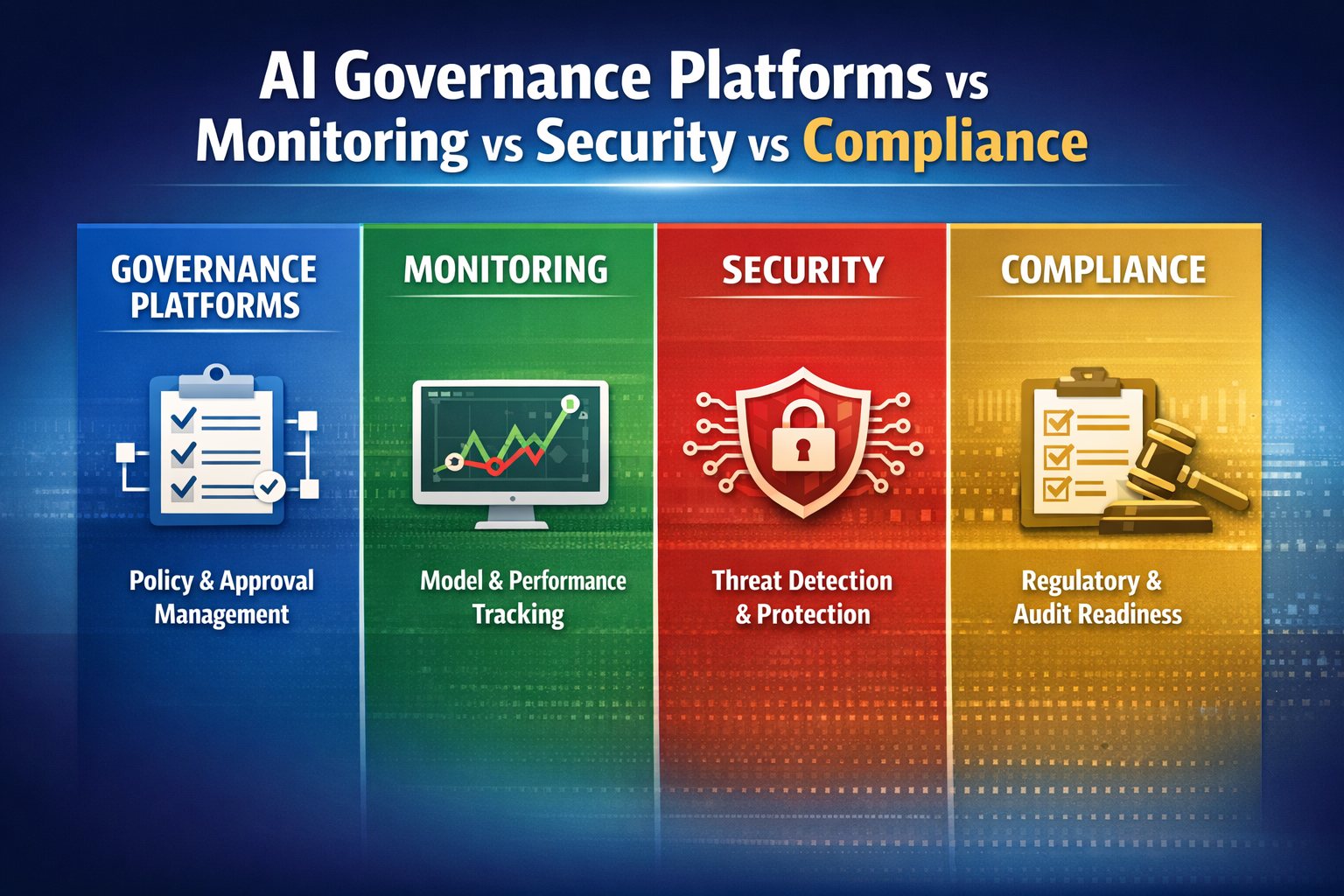
The AI Monitoring Signals frameworkdocuments what these signals look like across governance, security, monitoring, and compliance layers. The Best AI Governance Platforms guide covers the tooling that helps organizations build ownership infrastructure around their AI stack. Both are worth reading before the August deadline, because the ownership gaps that produce prompt debt and retrieval debt are the same gaps that produce regulatory exposure when an examiner asks who was watching your AI systems and what they did about what they saw.
The 95% failure rate in the MIT data isn't a mystery. Organizations are building AI programs on top of accountability frameworks that were designed for a different kind of system, and the layers where accountability is missing are exactly where the debt accumulates. The technical framing of the problem points toward platforms. The ownership framing points toward people. Both matter, but only one of them is actually the problem.
Sources
VentureBeat — "Why prompt debt, retrieval debt, and evaluation debt are quietly reshaping enterprise AI risk," May 25, 2026. venturebeat.com
MIT Project NANDA — "The GenAI Divide: State of AI in Business 2025," July 2025. Lead researcher: Aditya Challapally. Methodology: 150 executive interviews, 350 employee surveys, 300 public AI deployment cases. Reported in Fortune, August 18, 2025. fortune.com
MIT Project NANDA report findings — additional coverage by Virtualization Review, August 19, 2025. virtualizationreview.com
S&P Global Market Intelligence — 42% of businesses scrapped multiple AI initiatives in 2025, up from 17% in 2024. Cited in VentureBeat, May 2026.
Simon Willison — blog post on prompt brittleness and reuse patterns, March 2023. simonwillison.net
Wipro Tech Blogs — "Managing Prompt Technical Debt in Enterprise AI," Medium, April 2026. medium.com
European Commission — EU AI Act high-risk system obligations enforcement date: August 2, 2026. European Commission
AI Monitoring Signals Explained — GetAIGovernance.net. getaigovernance.net
Best AI Governance Platforms 2026 — GetAIGovernance.net. getaigovernance.net
Our Take
VentureBeat named the debt types correctly. The framing of prompt debt, retrieval debt, and evaluation debt as distinct failure modes is useful and gives practitioners language for problems that have been hard to name. What the framing misses is the single cause underneath all three: nobody owns these layers with the same clarity that code has developers, infrastructure has engineers, and compliance documentation has compliance officers.
Buying a prompt management platform doesn't solve prompt debt if no one is assigned to the prompts it manages. Deploying a retrieval quality tool doesn't solve retrieval debt if no one has a defined review SLA for the data sources it monitors. Adding an evaluation framework doesn't solve evaluation debt if no one updates the evaluation logic when the model changes. The tooling is fine. The missing piece is a named human with a defined responsibility and a response timeframe, for each layer, every time something changes.
That's what the 5% in the MIT data have that the 95% don't. Build the ownership infrastructure first. The tooling question comes after you know who's responsible for what.
Browse the AI Risk and Controlscategory for related analysis, or submit an inquiry to get matched with governance platforms built around the accountability layer your current program is missing.