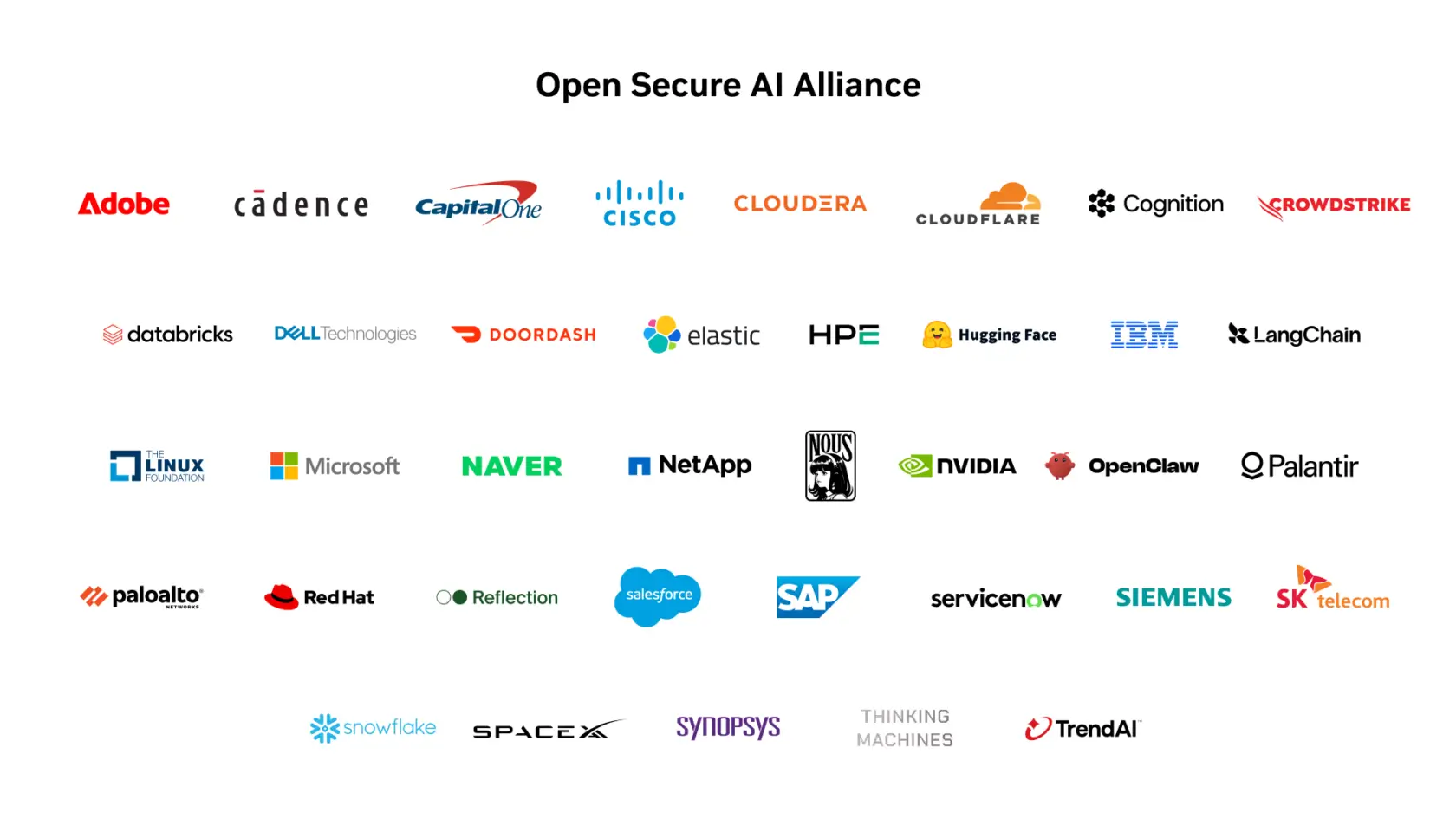
NVIDIA and more than 30 companies across cloud, cybersecurity, enterprise software, and open source have formed the Open Secure AI Alliance to build and share open tools for securing software and autonomous agents. The announcement came on July 27, 2026, days after the Hugging Face intrusion made the limits of closed defensive AI tools a practical problem rather than a theoretical one.
During that incident, closed AI systems constrained forensic analysis because they could not reliably distinguish attackers from defenders. Hugging Face ran an open-weight model on its own infrastructure to analyze more than 17,000 actions and help contain the intrusion. NVIDIA and the alliance partners are using that episode as evidence that defenders need tools they can inspect, adapt, and operate under their own control.
Inaugural members include Adobe, Capital One, Cisco, Cloudflare, CrowdStrike, Databricks, Dell, Elastic, HPE, Hugging Face, IBM, LangChain, Microsoft, Palo Alto Networks, Red Hat, Salesforce, SAP, ServiceNow, Snowflake, Synopsys, the Linux Foundation, and others. The group is building on work from the Linux Foundation’s Akrites initiative and the Open Source Security Foundation.
NVIDIA said it will contribute open models, weights, data, and agent-harness research, including the NOOA project for integrating, testing, tracing, auditing, and governing agent behavior. Partner contributions pointed to identity controls, safe model formats, multi-model vulnerability scanning, secure coding workflows, and signed supply-chain patches. The stated mission is direct: give defenders open frontier tools they can trust and control, instead of concentrating defensive capability inside a small set of closed providers.
Conditions Driving the Event
The July 2026 Hugging Face security incident showed that closed AI tools can block legitimate forensic work when systems cannot reliably tell attackers apart from defenders running investigations.
Hugging Face had to run an open-weight model on its own infrastructure to analyze more than 17,000 actions and help contain the intrusion, which made open defensive capability a practical requirement rather than an abstract preference.
Autonomous agents and AI-assisted workflows are now part of production environments, which expands the attack surface beyond traditional software and increases the need for tools that can inspect, trace, and govern agent behavior.
Defenders in regulated and critical industries often cannot send sensitive telemetry or internal code into closed third-party systems, so they need defensive models and harnesses they can operate under their own control.
Concentrating defensive AI capability inside a small number of closed providers creates a single point of failure for incident response across many organizations at once.
Existing open-source security work through the Linux Foundation’s Akrites initiative and the Open Source Security Foundation already provided a base for shared vulnerability remediation and disclosure, which the alliance is extending into AI-specific defense.
Identity for non-human actors has become a core control problem as agents and automated systems authenticate and act across enterprise systems, which is why identity frameworks such as SPIFFE/SPIRE are part of the early stack discussion.
Safe model distribution formats matter because model packages that allow remote code execution turn the model supply chain itself into an attack path.
Multi-model scanning and adversarial validation are needed because single-model review misses classes of defects that only appear when multiple systems probe the same codebase or agent behavior.
Enterprises and governments are under pressure to prove they can audit and govern AI systems, which raises demand for tracing, evidence collection, and controllable defensive tooling rather than black-box assistance alone.
The capital and expertise required to build frontier defensive tools are concentrated among a limited set of companies, so a formal alliance is being used to share models, weights, data, and agent harnesses instead of leaving each defender to rebuild the same stack alone.
What AI Security Looked Like Before
Before this alliance, much of enterprise AI security still sat in two separate tracks. One track focused on traditional application and cloud controls: identity for human users and service accounts, vulnerability management for known codebases, and monitoring for unusual system behavior. The other track treated AI as a new workload that needed policy review, prompt filtering, and model access controls. The two tracks rarely met in one operational system.
When incidents involved AI-assisted or agent-driven activity, defenders often depended on closed tools they could not fully inspect. That created a practical limit during response. If a vendor system refused a query, limited context, or blocked an investigation path, the security team had few alternatives that matched the same capability. Open models existed, but they were not organized into a shared defensive stack with identity, safe packaging, scanning, and agent governance built in as standard parts.
Agent behavior was also weakly governed in many environments. Teams could log prompts and outputs in some places, but few had consistent ways to trace what an agent was allowed to do, what it actually did, and whether those actions stayed inside approved boundaries. Supply-chain controls for models lagged behind software package controls. Formats that allowed unexpected code execution, unsigned updates, and opaque agent harnesses left gaps that traditional AppSec programs were not designed to close.
In short, AI security before this point was real, but fragmented. Organizations mixed closed commercial tools, partial open-source components, and manual review. The missing piece was a coordinated open defense layer that treated agents, models, and their supporting infrastructure as systems that had to be inspectable under defender control.
What AI Security Looks Like Now
The Open Secure AI Alliance makes the open defense path explicit. The claim is no longer only that open models are useful for research. It is that defenders need open frontier tools they can run themselves when closed systems constrain investigation or response.
The Hugging Face incident is the concrete example. Closed tools limited forensic analysis. An open-weight model, operated on local infrastructure, was used to review a large volume of actions and support containment. That sequence is now being used to argue that open defensive capability is part of operational resilience, especially for organizations that cannot hand sensitive evidence to an external system.
The alliance also reframes the stack. Identity for agents and non-human actors sits beside safe model formats, multi-model vulnerability research, secure coding workflows, and signed supply-chain remediation. NVIDIA’s contribution of models, weights, data, and the NOOA agent harness points at a fuller control loop: integrate agents, test them, trace them, audit them, and govern what they are allowed to do. Partner work on SPIFFE/SPIRE, Safetensors, multi-model scanning, and signed patches fills adjacent layers of the same problem.
AI security is therefore moving from “add guardrails around models” toward “build a controllable defense system for agents and AI-enabled software.” Closed tools still matter. The change is that open, inspectable components are being treated as necessary infrastructure for response, not optional alternatives. For security teams, the practical question is no longer only which vendor product to buy. It is whether their defensive stack can still function when the investigation itself requires tools they own and can examine.
Our Take
AI Security Take
The Open Secure AI Alliance matters less as a brand announcement and more as an admission about how AI defense actually fails. When an incident is underway, a tool that cannot be inspected, adapted, or run under the defender’s control is only useful until it says no. The Hugging Face response made that limit concrete: closed systems constrained investigation, and an open-weight model on local infrastructure became part of containment.
That is the standard security teams should apply to the rest of their AI stack. If agents can act across production systems, the organization needs identity, authorization, tracing, and audit that still work when a vendor path is blocked, rate-limited, or policy-bound in the wrong direction. If models are part of detection or response, the team needs packaging and execution controls that do not introduce remote-code risk. If vulnerability research is being automated, findings need validation and evidence strong enough for engineering to act, not another queue of unverified alerts.
The alliance’s early components point at the right layers: non-human identity, safe model formats, multi-model scanning, agent harnesses that can be tested and audited, and signed remediation paths. Those are control problems, not messaging problems. A membership logo does not close them. Implementation does.
For buyers and security leaders, the practical test is simple. Can your team investigate an agent-involved incident with tools you control. Can you show what the agent was allowed to do, what it did, and what evidence supports that account. Can you keep operating if a closed defensive model refuses the case in front of you. If the answer is no, the alliance is describing a gap you already have. The organizations that treat open, inspectable defensive capability as part of resilience, rather than as a side preference, will be the ones able to respond when the next agent-driven incident does not fit a vendor’s default path.