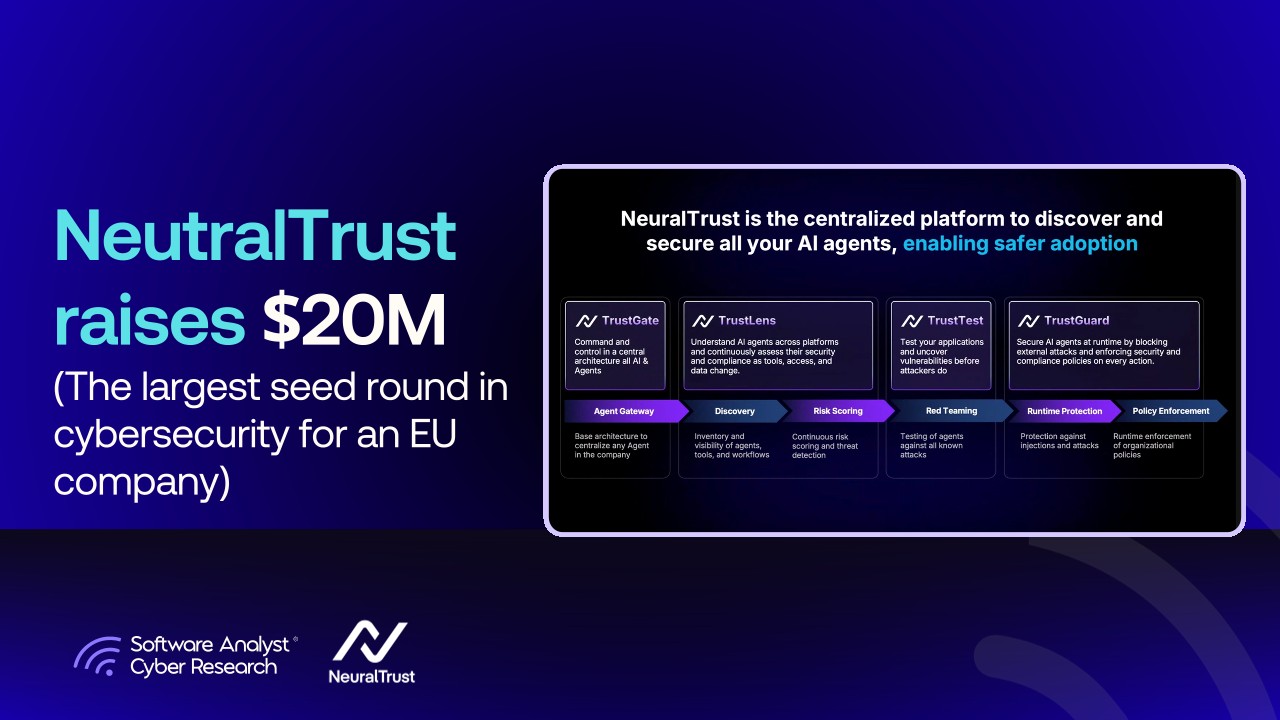
NeuralTrust has raised €17.2 million in a Seed funding round to accelerate the development of its platform for securing and governing AI agents in enterprise environments. The round was led by Alstin Capital, with participation from several European investors, and marks one of the largest cybersecurity Seed financings raised by a company in the European Union.
The company, founded in 2022 and based in Barcelona, has built a platform designed to help organizations manage the security and governance challenges that come with deploying autonomous AI agents. As enterprises begin moving AI agents into production systems that interact with real data and infrastructure, many are discovering that traditional security tools are not equipped to handle this new class of technology.
NeuralTrust’s platform focuses on providing visibility, policy enforcement, and control over AI agents throughout their lifecycle. This includes capabilities for discovery, monitoring, access control, and runtime governance — areas that have become increasingly important as organizations experiment with more autonomous systems.
“AI agents are now part of enterprise operations, but the controls protecting them are still catching up. This round allows us to keep building the infrastructure layer that makes AI adoption measurable, governable, and safe. Our mission has not changed since day one: turn AI security into a strategic advantage for the enterprises that will define the next decade,”
Joan Vendrell
co-founder and CEO of NeuralTrust.
The funding will be used to expand product development, grow the engineering team, and support go-to-market efforts as demand for AI agent security solutions continues to rise across regulated industries.
Conditions Driving the Change
Several converging trends are driving increased investment in AI agent security platforms:
Enterprises are rapidly moving AI agents from experimental pilots into production environments where they interact with live systems and sensitive data.
Traditional cybersecurity tools were not designed to govern autonomous systems that can plan, reason, and execute actions independently.
The attack surface for AI agents is expanding quickly, including risks such as prompt injection, tool misuse, data exfiltration, and unauthorized actions.
Security and compliance teams are struggling to maintain visibility and control over AI agents once they are deployed, creating significant governance gaps.
Regulatory pressure around AI is increasing, with frameworks like the EU AI Act requiring greater accountability and risk management for high-impact AI systems.
Many organizations lack the infrastructure to enforce consistent policies across different AI models, frameworks, and deployment environments.
The speed at which agentic systems can operate makes manual oversight impractical, creating demand for automated control layers.
Investors are recognizing that AI security is becoming a distinct and high-growth category within cybersecurity, separate from traditional application or infrastructure security.
Enterprises in regulated industries (banking, insurance, healthcare, and government) are particularly focused on building secure and auditable AI deployments.
There is a growing consensus that securing AI agents requires purpose-built infrastructure rather than retrofitting existing security tools.
These conditions have created strong momentum for specialized platforms focused on AI agent security and governance.
What AI Security Looked Like Before
Before dedicated AI agent security platforms gained traction, organizations attempting to secure AI systems largely relied on existing cybersecurity tools and processes. These included traditional application security measures, API gateways, and general monitoring solutions. While these tools provided some baseline protection, they were not designed to address the unique risks introduced by autonomous AI agents.
Most security programs treated AI models and agents similarly to regular applications or services. This meant that issues such as prompt injection, unauthorized tool use, or agents taking unexpected actions were difficult to detect and prevent in real time. Visibility into what agents were actually doing was often limited, and enforcing consistent policies across different models and frameworks was challenging.
Governance was also fragmented. Many organizations had separate processes for model risk management, data governance, and application security, with little integration between them. As a result, it was difficult to maintain a unified view of risk or to apply consistent controls as AI usage scaled.
Overall, AI security before this wave of specialized platforms was largely reactive and relied on tools that were not purpose-built for autonomous, decision-making systems.
What AI Security Looks Like Now
AI security is evolving to include dedicated control layers specifically designed for AI agents. Platforms like NeuralTrust are part of a growing category focused on providing visibility, policy enforcement, and runtime governance for autonomous systems.
This shift allows organizations to treat AI agents as distinct entities that require their own identity, access controls, and monitoring. Instead of relying solely on general application security tools, companies can now implement controls that understand the behavior and decision-making patterns of agents.
A key development is the focus on runtime governance. Rather than only evaluating models before deployment, organizations are increasingly looking for solutions that can monitor and intervene while agents are actively operating. This includes capabilities such as tool access governance, policy enforcement at runtime, and the ability to pause or redirect agent behavior when necessary.
“AI agents are entering enterprise infrastructure faster than security teams can adapt, so the window to establish control is now. What convinced us to lead this round was not just an exceptional product, but also the team’s clarity on where the real problem sits. They’ve built a genuine control layer, not another point solution, and enterprises can operationalise it today. We believe securing AI agents in enterprise infrastructure is becoming one of the defining problems in cybersecurity and NeuralTrust is best placed to own it,”
Alexander Meyer-Scharenberg
Partner at Alstin Capital.
This evolution reflects a broader recognition that securing AI requires infrastructure built specifically for the unique risks and operational patterns of agentic systems.
Our Take
AI Security Take
The €17.2 million raised by NeuralTrust underscores that securing and governing AI agents is becoming a priority for both enterprises and investors. As organizations deploy more autonomous systems that can interact with critical infrastructure and data, the limitations of traditional security approaches are becoming increasingly clear.
For security leaders, this means expanding their focus beyond model evaluation and traditional application security. Building controls that can operate at runtime, enforce policies dynamically, and provide clear visibility into agent behavior is becoming essential. The ability to govern agents in production — not just before deployment — is emerging as a key requirement.
At the same time, the market is still early. Many organizations are still figuring out how to integrate these new control layers into their existing security and governance programs. Success will depend not only on technology but also on clear ownership, defined processes, and the ability to balance security with operational flexibility.
Teams evaluating solutions in this space should assess how well any platform integrates with their current infrastructure and whether it provides practical, enforceable controls rather than just additional visibility. As agentic AI adoption accelerates, organizations that establish strong governance foundations early will be better positioned to scale safely and responsibly.
The funding round also signals that investors see long-term value in platforms that can address one of the most complex emerging challenges in cybersecurity: making autonomous AI systems secure, accountable, and production-ready at scale.