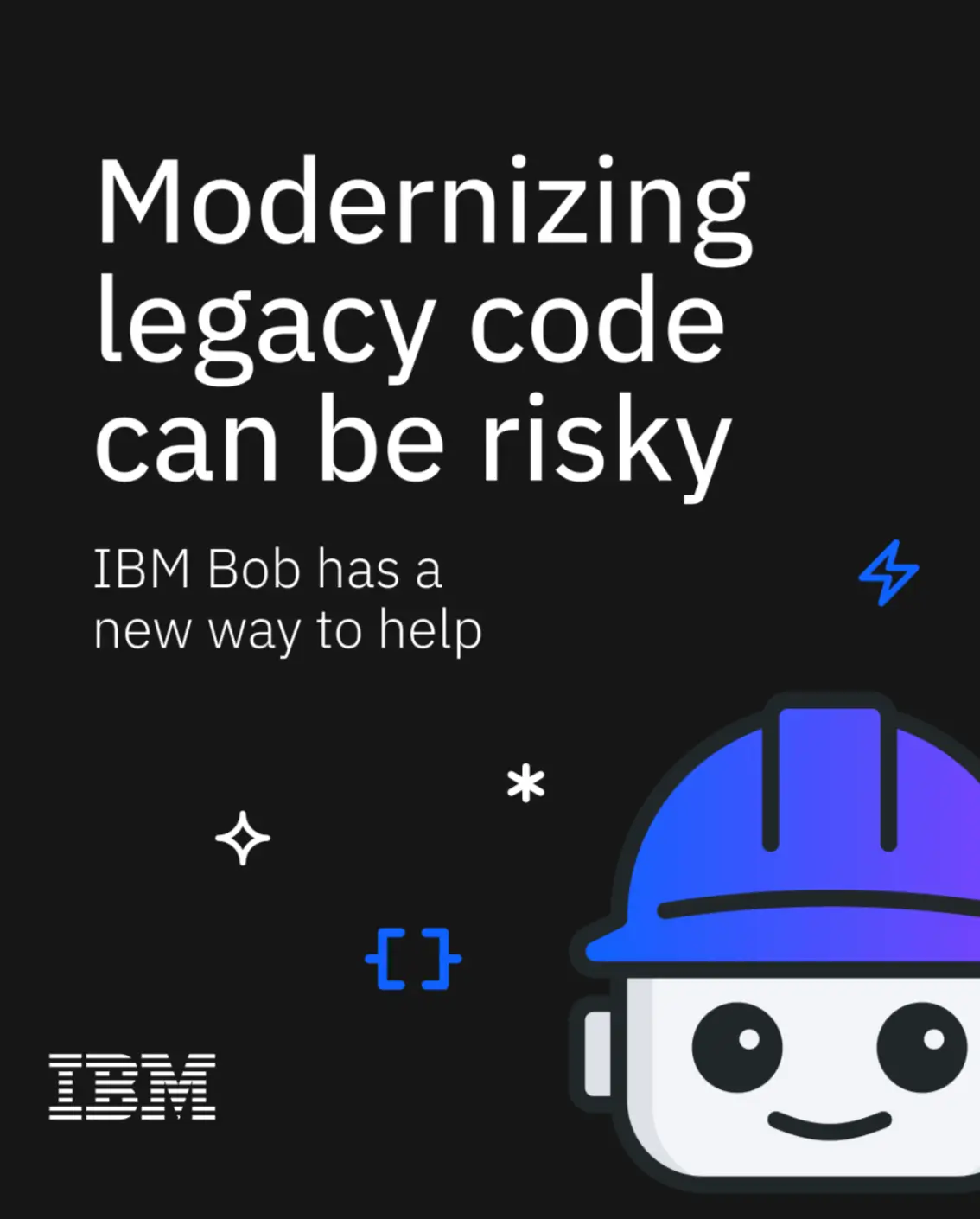
IBM announced a set of updates to Bob, its agentic coding platform, on July 9. The announcement leads with Premium Packages that bring platform-specific modernization support for Java, IBM i, and mainframe Z systems, along with a rebuilt agent architecture and new deployment regions in Japan and Europe. Underneath the modernization headline sits the part that changes the governance picture. The release adds enterprise administration controls for managing teams and monitoring consumption, a shared workflow engine that folds human approvals into multi-step agent execution, and an analytics system called Bobalytics that reports on how the agent is used and what it produces.
Read together, those additions move the oversight of what an agent is allowed to do, who can run it, and what record exists of its work into the platform running the agent. IBM describes the workflow engine in its own announcement as a way to build:
reusable, governed, multi-step engineering workflows that combine AI agents, enterprise tools, and human approvals into repeatable software delivery processes designed to scale across teams.
IBM announcement, authored by Neel Sundaresan and Michael Kwok, July 9, 2026
The Conditions Driving The Change
Several forces converged to make agent oversight a product requirement rather than a nice-to-have, and each one shows up directly in what IBM chose to build.
Agents now act, rather than suggest. Enterprise coding tools have moved past autocomplete inside an editor toward software that plans a change, edits many files, runs tests, and carries the work through delivery, often taking several steps in sequence without a person reviewing each one.
Autonomy created an accountability gap. When an agent holds real permissions in a production codebase and acts on its own between checkpoints, the organization struggles to say who authorized a given action, what approval stood between the plan and the change, and what record explains the decision after the fact.
The work moved outside the IDE. Agent activity now spans planning, testing, continuous integration, and operations, so oversight confined to a single development interface no longer covers the places where the risky actions actually happen.
Modernization raised the stakes. Long-lived Java, IBM i, and mainframe systems carry undocumented dependencies and business logic accumulated over years, and letting an agent change that code without guardrails risks breaking rules the company can no longer see or explain.
Consumption pricing turned usage into a budget problem. Agents that run continuously and bill by the token make cost and usage visibility a live financial concern for engineering leaders, not a report they can review once a quarter.
Regulated buyers need data to stay in place. Organizations in regions with data residency and sovereignty rules cannot adopt an agent that sends their code and activity across borders, which turns deployment location into a governance requirement.
Scale broke informal control. One developer using an assistant can be managed by hand, while hundreds of developers running agents across many teams need administration, allocation, and monitoring that no manual process can keep up with.
Leaders are now personally answerable for agent behavior. The people signing off on enterprise AI adoption are being asked to demonstrate control over what their agents do, which creates demand for approvals and evidence built into the tool rather than reconstructed afterward.
IBM frames the change in the same terms. The company writes that the problem has moved beyond writing code toward controlling systems that act, and it positions Bob as a partner that, in its words:
What AI Governance Looked Like Before
Until recently, the controls that governed AI coding agents mostly sat apart from the agents themselves. Policy, permissions, and audit came from separate governance and security posture tools. Visibility into how much a team used a given assistant came from adoption and analytics vendors that pulled data across many tools at once. Approval steps were wired in around the agent through existing code review and change management, rather than built into how the agent ran. The arrangement had a clear logic. Oversight that watches from the outside stays independent of any single tool, and it can cover a mix of agents from different vendors in one place.
The weakness of that arrangement is the gap between what the agent does and what the outside layer can see. An external tool infers agent behavior from logs, commits, and metadata after the work is done. It does not sit inside the execution path where the agent decides and acts. For a fleet of agents running continuously, that gap is where accountability tends to go missing, because the record of why an agent did something is reconstructed later rather than captured as it happens.
What It looks like Now
The Bob update closes that gap by putting the controls in the tool. The workflow engine builds human approvals directly into agent execution, so a person signs off inside the process rather than catching problems in a later review. The administration layer governs who can use the agent, how much they consume, and how resources are allocated across deployments. Bobalytics reports on productivity, quality, governance, usage, and cost for the work Bob does, giving engineering leaders a direct read rather than an inference from outside data. IBM states the purpose plainly, writing that development leaders need visibility into usage, governance, optimization, and cost as adoption grows, and describing Bobalytics as a way to deliver that visibility for enterprise AI adoption.
The expansion into Japan and Europe belongs in the same picture. New regional deployment options let organizations keep agent activity within borders that satisfy data residency and sovereignty rules, which is a governance concern for regulated buyers as much as a convenience.
The tradeoff deserves a clear eye. Native oversight sees the agent directly, captures approvals as they happen, and asks less setup from teams already standardized on Bob. It is also scoped to one vendor's agent, and it asks the buyer to accept oversight that is built, measured, and reported by the same company selling the agent. That is a reasonable arrangement for a shop that runs Bob and little else, and a real limitation for an enterprise trying to govern agents from several vendors at once.
Our Take
AI Governance Take
The oversight of AI agents is consolidating into the platforms that run them, and IBM will not be the last incumbent to fold the layer into its own product. For a team standardized on a single agent, built-in approvals and administration are a genuine improvement over controls bolted on from the outside, and they are worth turning on. The limitation is structural rather than a matter of quality. An enterprise running agents from several vendors cannot govern its whole estate through controls that only see one of them, and oversight supplied by the vendor being overseen answers to the wrong party the moment an auditor or a regulator asks who was accountable for a given action.
The practical course is to use the native controls and still keep the accountability record in a place the tool vendor does not own. A buyer should be able to say who owns each agent, what it is authorized to do, and what it actually did, across every agent in the building, without depending on any single vendor's dashboard to answer. Treat built-in governance as the floor it is, and keep an independent record above it.