Disclosure: Some Platforms mentioned are listed vendors in the GetAIGovernance marketplace and is named in this article. All analysis of Gartner's placements reflects Gartner's published research and GAIG's independent editorial assessment.
Download First Gartner Magic Quadrant for AI Governance Platforms Here
On June 16, Gartner published the inaugural Magic Quadrant for AI Governance Platforms. This is the first time the firm has formally defined AI governance platforms as their own recognized market category, published structured vendor evaluations with named placements, and put a compound annual growth rate on record — 67.5%, from $65 million in 2024 to a projected $1.4 billion by 2030.
Before this report, AI governance coverage in the Gartner research catalog was scattered across hype cycles, market guides, and commentary inside adjacent reports on GRC and data governance. This is the first time Gartner has said, in the clearest possible way, that AI governance platforms are a distinct market with distinct players and distinct criteria for what separates the good ones from the rest.
That matters for how enterprises and procurement teams will approach this space going forward. A Gartner Magic Quadrant creates an organizational shortcut. Boards and procurement committees recognize the format. Vendors without an entry need to explain their absence; vendors with an entry — in any quadrant — have a form of market legitimacy that didn't exist a week ago. The inaugural edition is also the most consequential one, because it establishes the baseline that every subsequent edition will be compared against.
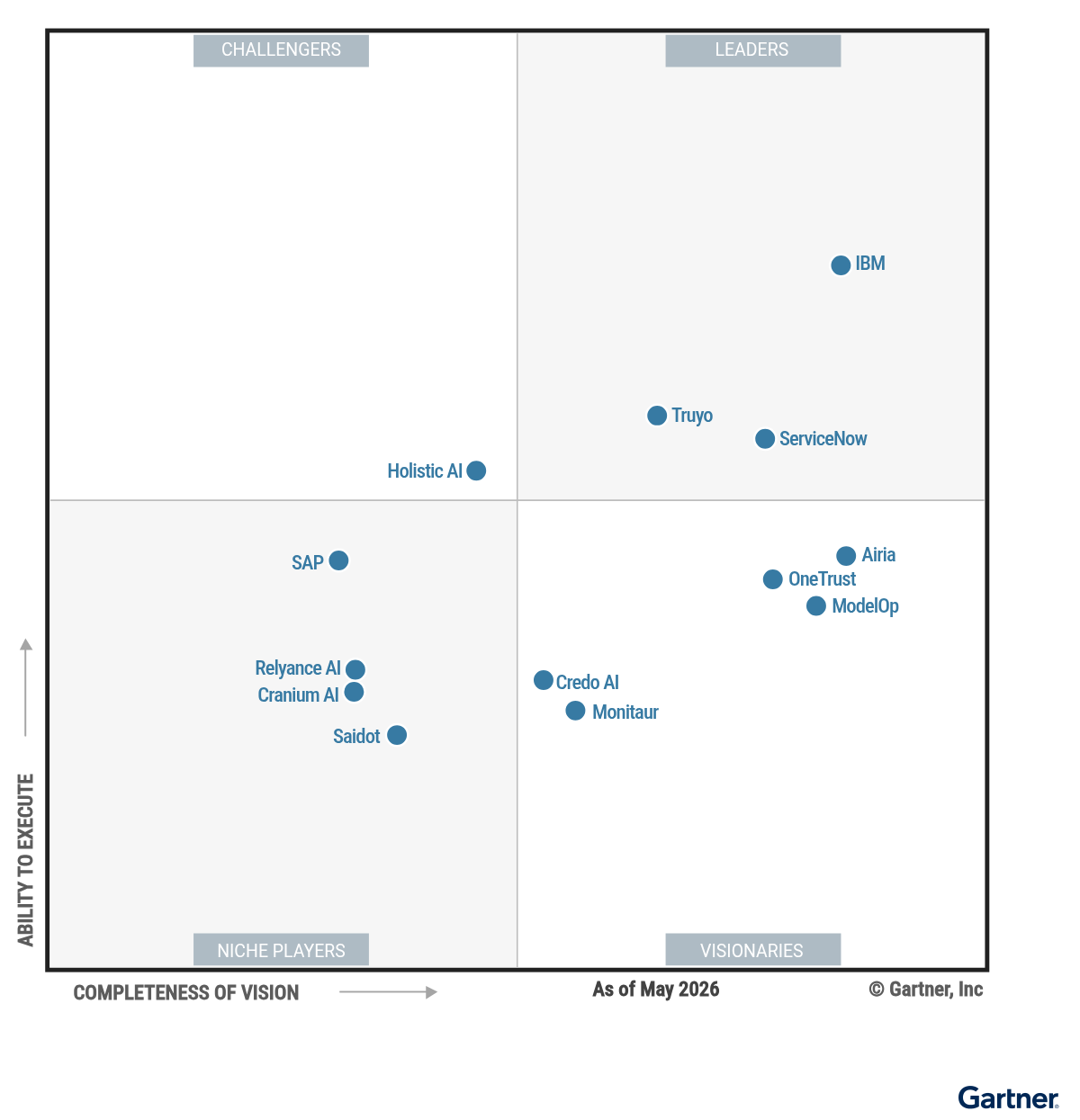
The quadrant named 13 vendors across four placements. IBM and ServiceNow in Leaders will not surprise anyone who follows enterprise software. The third placement in Leaders is the one worth paying attention to.
67.5% CAGR through 2030. AI governance platform market growing from $65M in 2024 to $1.4B by 2030. Source: Gartner, June 2026.
100+ Vendors Gartner identified marketing AI governance capabilities. Only 13 qualified for inclusion in the inaugural MQ.
13 Vendors evaluated in the inaugural report. More than 100 were considered before Gartner applied its mandatory inclusion criteria.
How to Read This Quadrant
Every Magic Quadrant has a methodology, and reading placements without understanding the methodology produces the wrong conclusions. This particular report has two features that separate it from a standard MQ and directly explain several of the placements that might otherwise seem counterintuitive.
The first is that Gartner rated "Market Responsiveness and Record" and "Operations" as not evaluated in this edition. Those two criteria are how Gartner typically measures whether a vendor has a history of consistent execution — sustained growth, renewals, long-term customer relationships. In the inaugural edition, there is no history to measure. Every vendor in this quadrant is operating in a market that didn't exist as a formal Gartner category 18 months ago. Gartner acknowledged this directly in the report, noting that historical performance is "anticipated to gain importance in future iterations." What this means practically is that the 2027 edition of this MQ will be considerably more revealing than the 2026 edition, because by then there will be 12 months of observable execution history that analysts can score against. The 2026 placements are a snapshot, not a verdict.
The second is that among the criteria Gartner did evaluate, product and overall viability both received a "high" weighting on the Ability to Execute axis, while sales execution and pricing received "low." On the Completeness of Vision axis, market understanding, product strategy, innovation, and geographic strategy all received "high" weightings, while vertical strategy received "low." The practical consequence of those weightings is that a vendor with a strong product operating in a relatively small number of regulated industries can outscore a vendor with a weaker product that sells more broadly. Geographic reach mattered — Gartner required products deployed in more than two regions to qualify at all — but sales volume and go-to-market sophistication were explicitly deprioritized in this first edition.
Truyo –– Unexpectadly –– Landed in Leaders Next to IBM and ServiceNow
Truyo is an AI governance platform focused on centralized risk and compliance management — enterprise AI inventory, impact assessments, audit-ready evidence generation, and regulatory change tracking. Its clients are primarily in healthcare, financial services, and government. Its operations are mostly focused in North America.
Most buyers evaluating AI governance platforms haven't encountered Truyo in a competitive deal. The company runs heavily on channel sales — 70% in North America, and 100% in several other regions. Its direct sales team consists of four people. By the conventional measures of enterprise software market presence, Truyo is a small company with a constrained go-to-market operation.
Despite all of that, Gartner placed Truyo in the Leaders quadrant alongside IBM and ServiceNow. But how? Why?
Gartner's own vendor description explains how. Truyo's three listed strengths in the report are native shadow AI and agent discovery that links discovered agents directly to governance workflows, configurable role-based workflows that let buyers adapt intake and approval processes to specific industry rules without custom code, and a development cadence — quarterly major releases — that lets the company address emerging risks faster than slower-moving competitors. On the last point, Gartner added something worth noting specifically:
"Truyo added agent discovery in 2026 and actively incorporates customer feedback into its roadmap. It ships quarterly major releases, enabling customers to address emerging risks faster and benefit from frequent releases."— Gartner, Magic Quadrant for AI Governance Platforms, June 2026
The cautions Gartner flagged are real. Runtime enforcement is governance-centric and does not perform in-line blocking or autonomous model intervention, which matters for organizations that need hard stops rather than policy tracking. Executive-level reporting is limited, which matters for boards and governance committees that need structured summary views. And the channel-heavy sales model creates a legitimate question about whether direct account engagement will hold up as the platform scales.
What Gartner's methodology essentially revealed is this: in an inaugural evaluation where product quality and viability were weighted heavily and sales execution was weighted low, Truyo's product was strong enough to place in Leaders despite a go-to-market model that would typically suppress that outcome. That is worth understanding before dismissing or over-crediting the placement. It doesn't mean Truyo is a better product than IBM's watsonx.governance or ServiceNow's AI Control Tower. It means Gartner found the product credible enough to clear a bar that most of the 100+ vendors Gartner initially identified couldn't clear at all.
The 2027 edition will add the execution history criteria that this one couldn't evaluate. That's when the Truyo placement becomes either a confirmed trajectory or a first-edition anomaly that the methodology couldn't fully catch.
The Rest of the Quadrant
Here is the full vendor list across all four quadrants, followed by what each group means for different buying situations.
Leaders
IBM — watsonx.governance
ServiceNow — AI Control Tower
Truyo — Truyo AIGP
Visionaries
Airia
OneTrust
ModelOp
Credo AI
Monitaur
Challengers
Holistic AI
Niche Players
Cranium AI
Relyance AI
Saidot
SAP — AI Agent Hub
Leaders: IBM, ServiceNow, and Truyo
IBM and ServiceNow are in Leaders for straightforward reasons. Both have global enterprise sales operations, established customer bases in regulated industries, and the organizational viability that large buyers look for before committing to a platform. IBM's watsonx.governance integrates with IBM OpenPages GRC, which matters for organizations already running IBM infrastructure. ServiceNow's AI Control Tower sits inside the ServiceNow platform that much of the enterprise world already runs for ITSM — governance workflows that connect directly to existing enterprise processes are easier to adopt than standalone tools that require separate integrations.
The meaningful cautions for both are also real. IBM's implementation requires significant effort, which tends to exclude organizations with early-stage governance maturity. ServiceNow's AI governance is chargeable for use cases outside the ServiceNow environment, which means the cost scales with how broadly you want to govern. Neither caveat is disqualifying, but both affect whether these are the right platforms for a specific organization's current state.
Visionaries: Five Platforms With Strong Product Thinking and Execution Still Catching Up
The Visionaries quadrant in this MQ contains more genuine buying interest than the description might suggest. This is where several of the most purpose-built platforms in the market landed — platforms that were designed specifically for AI governance from day one rather than extended from existing GRC or privacy tooling.
Airia is worth specific attention in this group. Its embedded active AI governance control plane enforces policy at runtime rather than through point-in-time assessments — which addresses a gap that several other vendors in this quadrant still have on their roadmaps. ModelOp has the most detailed AI documentation approach in the entire quadrant, including risk tiering and prompt templates that create model inventory visibility well beyond standard compliance audit requirements. Both are worth evaluating for organizations that want to work closely with a platform still scaling but with demonstrably strong product depth.
Monitaur is also in the Visionaries quadrant. This will be surprising to readers who are familiar with GAIG's recent analysis of the Chartis AI Governance Quadrant, where Monitaur placed in the Category Leaders group — the highest tier in Chartis's evaluation. The two placements aren't contradictory, but they require explanation. Chartis evaluates vendors against financial services model risk management criteria specifically, and Monitaur's depth in that domain is what produced its Chartis placement. Gartner's MQ evaluated breadth of AI governance coverage across all enterprise use cases, and Gartner specifically called out that Monitaur's product focus on high-risk use cases "could be construed as too limited a view for enterprises looking for solutions with broad AI usage control and operational governance requirements." Depending on what a buyer actually needs — regulated-industry depth or broad enterprise coverage — those two assessments point in the same direction or pull in different ones.
"Monitaur's product plan is focused on delivering governance for high-risk use cases. This could be construed as too limited a view for enterprises looking for solutions with broad AI usage control and operational governance requirements."
Gartner
Magic Quadrant for AI Governance Platforms, June 2026
Challengers: Holistic AI
Holistic AI is the only vendor in the Challengers quadrant, which puts it in an unusual position. Challengers have demonstrated execution but have not fully established thought leadership or innovation at the level Gartner expects of Leaders. Holistic AI's specific strengths in Gartner's assessment are fast implementation — average six weeks — and workflow and auditability that Gartner called "unique" for its immutable, tamper-proof audit trail. The cautions center on risk quantification methodology and vision gaps around AgentOps integration. For organizations that prioritize getting a governance program operational quickly over having the most expansive product vision, Holistic AI's Challenger placement reflects a real tradeoff that some buyers will find attractive.
Niche Players: Four Different Reasons for the Same Quadrant
Cranium AI, Relyance AI, Saidot, and SAP are all in the Niche Players quadrant, but for very different reasons and with very different implications for buyers.
Cranium AI
Niche Player
Cranium is positioned for CISOs who are co-owning AI governance and want a platform optimized for the security buyer rather than the compliance or governance buyer. Its AI inventory discovery, SIEM integration, and five-layer runtime risk framework are genuinely strong for that persona. The Niche placement reflects that Cranium's messaging and capabilities are still maturing for governance personas beyond cybersecurity. Worth evaluating if the buyer's primary driver is the AI security and governance convergence rather than policy-first governance.
Relyance AI
Niche Player
Relyance is the most data-focused platform in the quadrant, with strong native discovery, automated metadata and lineage capture, and continuous audit-ready evidence generation. Its Niche placement reflects specific runtime governance gaps — Gartner noted unsupported controls including bias monitoring, prompt injection prevention, and model observability — and limited end-to-end intake and deployment workflows. Organizations with deep data governance requirements and lighter runtime enforcement needs will find Relyance more relevant than its quadrant placement suggests.
Saidot
Niche Player
Saidot's knowledge graph architecture — where information entered once propagates automatically across connected risks, controls, evidence, and policies — is a genuinely different technical approach from the other platforms in the quadrant. Its geographic focus is Europe, and its EU AI Act coverage is strong. Organizations outside Europe and outside financial services or public sector will find limited fit with where Saidot is currently built. Gartner noted that its policy runtime enforcement consists of observability-ingestion and webhook-based actions, with fuller enforcement on the roadmap rather than in production.
SAP — AI Agent Hub
Niche Player
SAP's AI Agent Hub is useful almost exclusively for organizations running deep SAP environments. Gartner's caution was direct: SAP lacks automated enforcement for non-SAP solutions, and the platform does not continuously monitor AI risk in real time, requiring manual updates or static risk calculations. For SAP-centric enterprises, the bundle with LeanIX, Joule Studio, and SAP Signavio makes it a coherent extension of existing infrastructure. For anyone else, the governance gaps outside the SAP ecosystem are too significant to treat it as a general-purpose AIGP.
The Vendors That Didn’t Make the List But Are Great Runner-Ups
Several platforms that GAIG covers regularly — including ValidMind, Solytics Partners, Trustible, and others — are not in this Magic Quadrant. That absence requires an explanation rather than an assumption.
Gartner's inclusion criteria for this inaugural edition required that vendors have standalone products with more than 10 paid deployments, with all mandatory features generally available before April 1, 2026, and with products deployed in more than two of the following regions: the US, Canada, LATAM, the UK, Europe, the Middle East and Africa, and APAC. Vendors whose AIGP capabilities are embedded in a broader GRC, data management, or AI security platform without a standalone commercial offering were excluded. Vendors focused primarily on governing AI within their own platforms were excluded.
The geographic distribution requirement in particular is the likely explanation for several absences. Platforms that have strong deployment records in financial services in North America but limited deployments outside that region may not have cleared the multi-region threshold as of February 2026 — which was the evaluation date Gartner used for the 10-deployment criterion.
On ValidMind and Solytics Partners specifically: Both platforms received Category Leader placement in the Chartis AI Governance Quadrant, and ValidMind was named the number one AI Governance Platform in the Chartis RiskTech100 2026. Their absence from this Gartner MQ most likely reflects the geographic distribution requirement rather than a product quality determination. Chartis and Gartner measure different things using different criteria; a platform can place at the top of one evaluation and not appear in the other without either assessment being wrong.
Gartner also published six honorable mentions for vendors that didn't qualify for the formal evaluation but which analysts found relevant: Enzai, LatticeFlow AI, Modulos, Singulr, Trustible, and WitnessAI. These are worth looking at. Gartner named them specifically, and the exclusion criteria that kept them out of the formal quadrant don't necessarily reflect anything about product quality.
What To Actually Do With This Report
The most useful buying opportunities in this quadrant are probably in the Visionaries group, and the reason is specific. Gartner's methodology deprioritized sales execution in this first edition, which means several of the Visionaries landed where they did on product strength despite not having the enterprise sales infrastructure that Leaders do. For an organization with internal resources to work with a platform that's still building its delivery ecosystem and partner network, those platforms offer the chance to build a relationship with a product that's still early enough to be influenced by customer feedback — and at pricing that will look favorable against where this market is heading.
Gartner itself made the pricing point directly in the report's buying recommendations:
"If procuring at this early stage, negotiate and lock in multiyear preferential pricing. Vendors are likely to significantly increase prices as they grow and demonstrate a consistent ability to sell into large, complex enterprises with big budget centers."
Gartner
Magic Quadrant for AI Governance Platforms, June 2026
For organizations that need a governance platform to be operationally stable from day one, with established partner networks and deployment support, the Leaders group — particularly IBM for regulated multinationals and ServiceNow for organizations already running ServiceNow infrastructure — provides the assurance that comes with scale. Truyo is the Leaders placement worth evaluating independently if the budget is there, because the product earned that placement against criteria weighted heavily toward product quality.
Vendors not in this Magic Quadrant deserve evaluation on Gartner's own mandatory criteria applied directly to your environment. The inclusion bar was high. Platforms that didn't clear it aren't necessarily weaker; they may just be earlier-stage on geographic distribution or deployment count than this first edition required.
Our Take
Before June 16, there was no Gartner Magic Quadrant for AI Governance Platforms. There were market guides, hype cycles, and analyst commentary — useful, but not the same thing. A Magic Quadrant is Gartner's formal signal that a market is real, that the vendors in it are distinguishable from each other in ways buyers need to understand, and that the category warrants a structured annual evaluation.
The 2026 edition is an inaugural snapshot with a methodology that explicitly deferred some of the most important execution criteria to future editions. Truyo's Leaders placement is the finding that will generate the most debate, and that debate is legitimate — a company with four direct salespeople and 100% channel dependency in several regions is not operating like a conventional Leaders quadrant vendor, and the 2027 edition will either confirm the trajectory or reflect a correction. The Visionaries group contains several of the most technically interesting platforms in the market. The Niche Players group contains several platforms that are excellent fits for specific use cases and wrong fits for others.
What the report establishes definitively is that AI governance platforms are now a recognized enterprise technology category with documented criteria, named players, and an analyst framework that enterprise procurement teams will use. For buyers who have been deferring the governance platform decision, this report changes the calculus. The category is formal now.