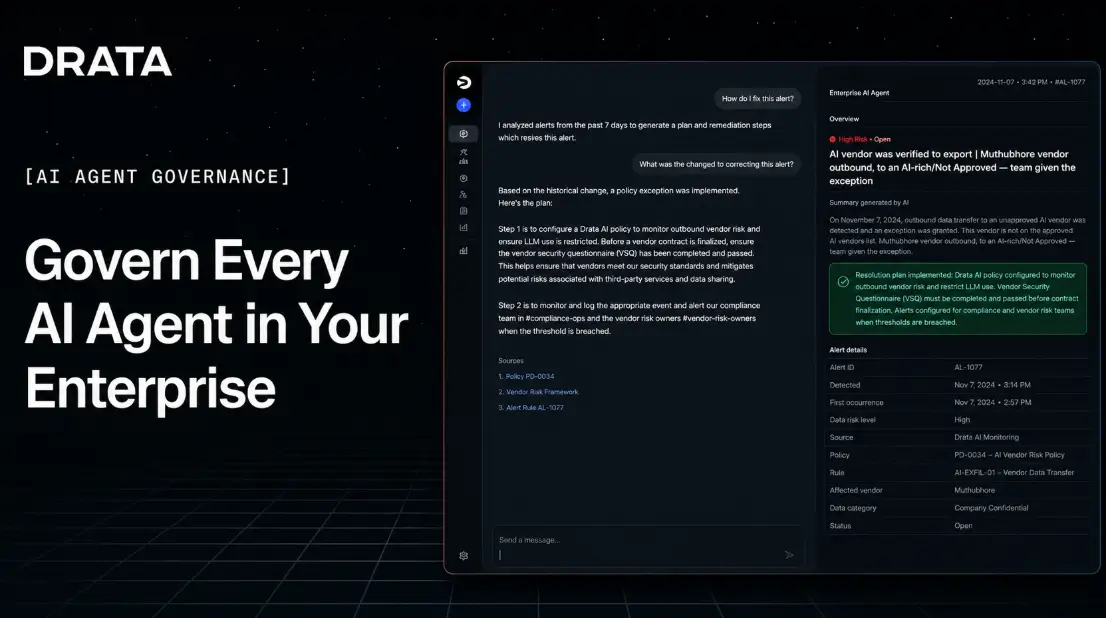
Drata has launched AI Agent Governance, positioning it as the solution to what the company calls the “Fourth Dimension of Trust” in enterprise relationships — the need to govern autonomous AI agents that are already operating inside corporate environments with real permissions and data access.
The new offering combines continuous discovery, pre-execution policy enforcement, and tamper-evident audit trails in one platform. It directly targets the visibility and control gaps that have emerged as organizations move from AI pilots to production agent fleets. According to Drata, 89% of companies currently leave security questions about AI agents unanswered, and only 11% of vendors can prove an audit trail for agent decisions.
“Today, the Fourth Dimension of Trust is no longer theoretical. It runs as agentic software. It deploys inline with the AI platforms your company already uses. It produces evidence your auditor already accepts.”
Adam Markowitz
CEO and Founder Drata
The platform includes the Drata Sensor, which registers every agent at creation and maps its owner, identity, permissions, and scope in real time. Mission Control evaluates actions against plain-English policies before execution, functioning, in Markowitz’s words, “more like a fire suppression system.” A staged Trust Ladder lets teams move policies from observation to full enforcement at their own pace, while Drift Detection and Chain of Custody provide ongoing monitoring and immutable records for auditors and customers.
"Over the past few months, we’ve seen an entire new category emerge around which AI agents are running and how we are governing them, and answering those questions with 100% confidence is impossible with today’s technology.”
Nils Puhlmann,
co-founder of Cloud Security Alliance and former chief security officer of Twilio, Navan and Zynga
The announcement comes as governance questions about agents are moving from theoretical to procurement-critical, with Drata claiming the new capabilities will help organizations respond confidently to the growing wave of AI-related security and compliance inquiries.
Conditions Driving the Change
Enterprise organizations have rapidly moved AI agents from experimental pilots into live production environments, where autonomous systems now routinely access sensitive data, execute business processes, and make decisions without human intervention at every step.
Most existing security and governance tools were originally designed for human users or static service accounts, leaving organizations without the visibility or control mechanisms needed to manage large fleets of dynamic, autonomous agents.
Security and compliance teams currently lack real-time visibility into the majority of AI agents running across their environments, as many agents are spawned through SaaS connectors, internal tools, or vendor platforms without any formal registration or ownership tracking.
Traditional monitoring solutions only detect issues after an agent has already taken action, which creates unacceptable risk when agents operate at machine speed and can chain multiple actions across systems in seconds.
Agent permissions and behavior frequently drift over time due to changes in OAuth scopes, vendor API updates, or evolving prompts, rendering one-time approvals and static policies ineffective for ongoing governance.
Procurement and security questionnaire processes have become significantly more difficult, with 89% of companies currently unable to provide confident answers about which AI agents are running and how they are governed.
Only 11% of vendors can currently produce a verifiable, tamper-evident audit trail for AI agent decisions, creating a major gap in the evidence required by auditors, customers, and regulators.
Regulatory frameworks such as ISO 42001 and the EU AI Act are increasingly requiring organizations to demonstrate continuous accountability and control over AI systems, rather than relying on point-in-time assessments.
Boards and CISOs are becoming more cautious about scaling agentic AI due to rising concerns around data exposure, unauthorized actions, and the lack of clear ownership and oversight for autonomous systems.
The gap between AI capability and governance control is widening quickly, as organizations continue deploying more agents while still depending on reactive monitoring and manual review processes that cannot keep pace with agent activity.
Enterprises are facing growing pressure to treat AI agents as a distinct and high-risk category that requires real-time policy enforcement, drift detection, and audit-ready evidence rather than traditional visibility-only approaches.
Without new governance infrastructure capable of discovering agents at creation, enforcing policy before execution, and maintaining continuous oversight, organizations risk accumulating unmanageable operational, compliance, and security exposure as agent adoption accelerates.
What AI Governance Looked Like Before
Before the emergence of dedicated real-time agent governance platforms, organizations largely relied on traditional visibility and monitoring tools to manage AI systems. These tools were designed primarily to log what had already happened rather than prevent issues from occurring in the first place. Security and governance teams typically received alerts after an agent had accessed data, executed a workflow, or made a decision, leaving them in a reactive position where damage could already be done.
Policy enforcement was mostly manual or based on point-in-time approvals. When an agent was first deployed, teams would review its intended permissions and scope, but there was little ongoing oversight once the agent went live. As a result, permissions frequently expanded over time through API changes, updated prompts, or increased OAuth scopes without anyone noticing until an incident or audit surfaced the problem.
Governance efforts were also heavily dependent on security questionnaires and manual evidence gathering. Most organizations struggled to answer even basic questions about which AI agents were running in their environment, who owned them, and what data they could access. In many cases, these questions went unanswered because there was no reliable way to maintain an accurate, up-to-date inventory of agents or produce verifiable records of their behavior.
Compliance and risk teams often treated AI agents the same as traditional applications or service accounts. This approach worked reasonably well when AI usage was limited and mostly human-supervised. However, as autonomous agents began operating independently at scale, the old model of periodic reviews, static policies, and after-the-fact monitoring proved too slow and incomplete to keep up with the speed and complexity of agentic workflows.
What AI Governance Looks Like Now
AI governance has shifted from reactive visibility to proactive, real-time control. Organizations are now moving toward platforms that can discover agents the moment they are created, map their identity and permissions instantly, and enforce policy before any action is executed. This represents a fundamental change from logging what already happened to stopping unauthorized behavior in the moment.
Modern agent governance includes continuous, live inventory capabilities that register every agent at inception rather than relying on periodic scans or manual tracking. Policies can now be written in plain language and enforced inline across all agents, with systems evaluating each action against approved rules before it is allowed to proceed. This pre-execution enforcement layer significantly reduces the window for risky or unauthorized behavior.
Drift detection has also become a core part of governance. Instead of discovering policy violations months later during an audit, organizations can now receive immediate alerts the moment an agent operates outside its approved scope, changes its permissions, or attempts to access new systems. Combined with tamper-evident audit trails, this creates a much stronger chain of custody for decisions and actions.
Governance is also becoming more operational and less purely compliance-driven. Teams can now stage policy rollout through controlled phases — starting with observation only, moving to recommendations, and only then activating full enforcement. This reduces the risk of breaking critical workflows while still allowing organizations to strengthen controls over time. Overall, AI governance has evolved from a documentation and review exercise into an active, embedded control layer that operates at the same speed as the agents it is meant to govern.
Our Take
AI Governance Take
The launch of real-time AI agent governance capabilities marks a clear turning point. For years, most organizations treated AI governance as a documentation and monitoring exercise — something handled through periodic reviews, static policies, and after-the-fact logging. That model is no longer sufficient now that autonomous agents are actively making decisions and taking actions inside enterprise systems at machine speed.
Governance teams must stop relying primarily on visibility tools and post-action alerts. These approaches create the illusion of control while leaving organizations exposed to policy drift, unauthorized access, and untraceable decisions. The organizations that will manage agentic AI effectively are those that treat governance as an active, inline control layer rather than a reporting function.
This means prioritizing three things immediately. First, establish continuous, real-time discovery of every AI agent in the environment — not through periodic scans, but through systems that register agents at the moment of creation. Second, move from reactive monitoring to pre-execution policy enforcement. Agents should be evaluated against clear rules before they are allowed to act, not after the fact. Third, build tamper-evident audit trails that can actually satisfy auditors, customers, and regulators, rather than depending on logs that are difficult to verify or reconstruct during an audit.
The gap between what agents can do and what governance teams can currently control is widening quickly. Continuing to manage this through questionnaires that 89% of companies cannot answer confidently, or through monitoring tools that only surface problems after damage occurs, is no longer a viable strategy. Governance must now operate at the same speed and level of automation as the agents themselves.
The companies that embed real-time policy enforcement, drift detection, and verifiable evidence into their agent operations will gain a meaningful advantage — not just in risk reduction, but in their ability to scale agentic AI responsibly and answer the increasingly difficult questions coming from procurement, compliance, and the board.