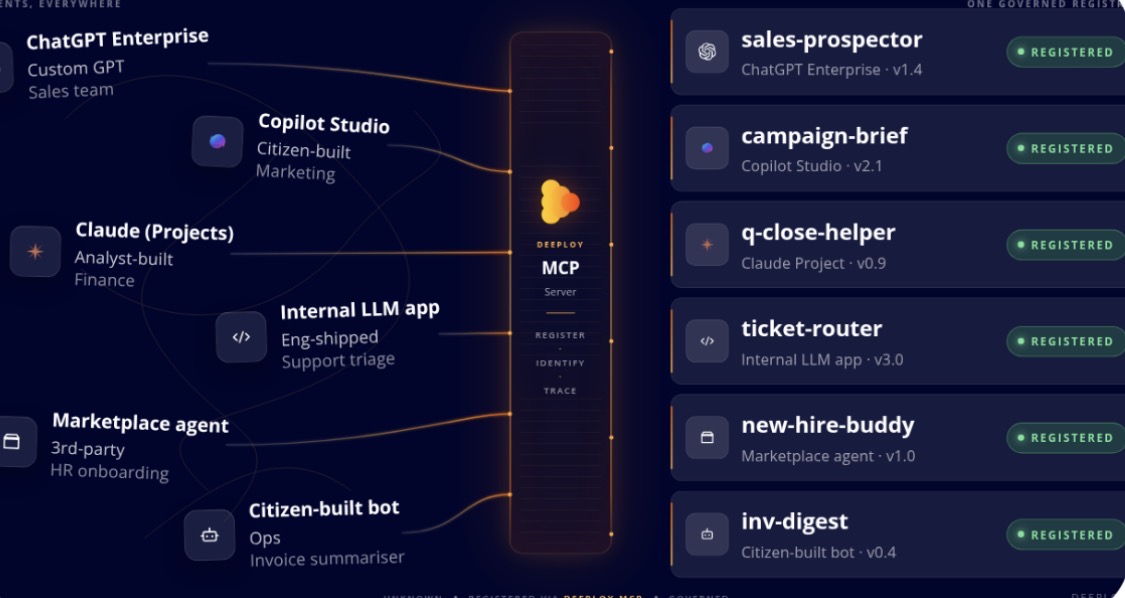
Deeploy, a leading platform for secure and governed AI deployments, has launched a new MCP Server specifically built to address the growing governance and control challenges of agentic AI systems.
The Model Context Protocol (MCP) Server enables organizations to better manage how AI agents discover tools, interact with systems, and maintain consistent behavior across complex workflows. As enterprises increasingly move from simple copilots to autonomous agents capable of planning, reasoning, and taking actions, the need for standardized, secure, and observable communication between agents and tools has become critical.
Deeploy’s new offering focuses on providing centralized governance over agent-tool interactions, improved visibility into agent behavior, and stronger runtime controls. This is particularly relevant as organizations face rising concerns around agent sprawl, unauthorized actions, data exfiltration risks, and maintaining human accountability in multi-agent environments.
The launch reflects a broader industry shift toward building dedicated infrastructure layers for agentic AI governance. Rather than treating agents as isolated applications, Deeploy is positioning the MCP Server as a control plane that helps enforce policies, monitor interactions, and maintain auditability across the entire agent ecosystem.
Key Terms
MCP Server (Model Context Protocol Server): A dedicated server that standardizes and governs how AI agents discover, authenticate, and interact with tools and external systems in a secure, observable manner.
Agentic AI: Autonomous AI systems that can plan, reason, use tools, and execute multi-step tasks with minimal human intervention.
Runtime Governance: Continuous oversight and control mechanisms that operate while agents are active, rather than only during pre-deployment reviews.
Agent-Tool Interaction: The process by which AI agents call and use external tools, APIs, or systems to complete tasks.
Policy Enforcement Layer: Technical controls that ensure agents only perform actions that comply with predefined organizational policies and boundaries.
These terms reflect the growing need for dedicated infrastructure to manage the complexity and risk of deploying autonomous agents at enterprise scale.
Conditions Driving This Change
Enterprises are rapidly moving beyond simple chat-based copilots to deploying autonomous AI agents capable of planning, reasoning, and executing complex, multi-step workflows across internal systems and external tools, dramatically increasing both capability and risk.
The rise of multi-agent systems has created new challenges around visibility, as agents interact with each other and with hundreds of tools, making it difficult for traditional governance approaches to maintain effective oversight and control.
Organizations are struggling with agent sprawl — the uncontrolled proliferation of agents — leading to unclear ownership, inconsistent policy application, and growing security and compliance exposure.
Current methods of agent governance, often limited to prompt-level guardrails or basic API access controls, have proven insufficient against sophisticated attacks such as prompt injection, tool misuse, and unauthorized data exfiltration.
Procurement and security teams are demanding standardized, secure protocols for agent-tool communication, as the lack of common standards has resulted in fragmented, insecure, and difficult-to-audit implementations across different vendors and platforms.
Regulatory and board-level expectations around AI accountability are rising, requiring organizations to demonstrate clear visibility, policy enforcement, and auditability over agent behavior in production environments.
The industry is seeing increased adoption of the Model Context Protocol (MCP) as a emerging standard for secure agent-tool interactions, creating demand for robust, enterprise-grade MCP Server infrastructure that can enforce governance policies at scale.
Companies need better runtime observability and intervention capabilities as agents become more autonomous, because relying solely on pre-deployment testing or post-incident reviews is no longer adequate for high-stakes operational use cases.
What It Looked Like Before
Before dedicated MCP Servers and standardized agent communication protocols, organizations managing AI agents faced significant governance and security challenges. Most companies relied on ad-hoc approaches — typically basic API keys, prompt-level guardrails, or simple allow/deny lists for tool access. These methods provided minimal visibility into how agents actually interacted with tools and external systems.
Security teams often struggled with fragmented implementations. Different agents used different authentication methods, logging was inconsistent, and there was little centralized policy enforcement. When an agent needed to call multiple tools, developers would hardcode connections or use custom scripts, making it extremely difficult to audit behavior or enforce consistent rules across the environment.
Runtime oversight was particularly weak. Once an agent was deployed, monitoring its tool usage in real time was limited. Teams had little ability to detect anomalous behavior, unauthorized tool calls, or policy violations as they happened. This created blind spots around data exfiltration risks, privilege escalation, and unintended actions — especially problematic in multi-agent setups where agents could call other agents or chain multiple tools together.
Governance was largely static and pre-deployment focused. Organizations would review agent designs during approval stages but had limited ongoing control once agents were live. This gap between design intent and actual runtime behavior became a major Pre-Failure Signal as agentic AI scaled.
What It Looks Like Now
With Deeploy’s MCP Server, organizations now have a dedicated, centralized layer for governing agent-tool interactions. The server standardizes how agents discover, authenticate, and communicate with tools while enforcing organizational policies in real time.
Instead of fragmented, custom integrations, teams can now manage agent-tool access through a unified control plane. Policies can be defined centrally and applied consistently across all agents, with fine-grained controls over which tools each agent can access and under what conditions. The server provides improved visibility into agent behavior, logging interactions, and enabling real-time monitoring and intervention when needed.
This represents a shift toward true runtime governance. Security and governance teams can now observe agent activity as it happens, detect anomalies, enforce boundaries, and maintain audit trails that are much more comprehensive than before. For multi-agent systems, the MCP Server helps manage complex interactions while maintaining clear accountability and policy compliance.
The overall approach moves from reactive, manual oversight to proactive, architectural control. Organizations can define clear boundaries for agent autonomy, enforce least-privilege principles more effectively, and maintain better control as they scale agent deployments across the enterprise.
Our Take
AI Governance Take
Deeploy’s launch of the MCP Server represents a meaningful step forward in addressing one of the most pressing challenges in the agentic era: how to create standardized, enforceable governance over how AI agents interact with tools and external systems.
By providing a dedicated control plane for agent-tool communication, the solution helps organizations move beyond fragmented, custom implementations toward centralized policy enforcement, better visibility, and stronger runtime controls. This is particularly important as enterprises scale from single agents to complex multi-agent workflows.
The real value lies in shifting governance from being mostly pre-deployment and prompt-based to something more architectural and continuous. Features like standardized authentication, policy enforcement at the interaction layer, and improved auditability directly support better human accountability and risk management.
For governance, compliance, and security teams, solutions like this highlight the growing need for dedicated infrastructure layers specifically designed for agentic AI. While no single tool solves every problem, centralized MCP Servers are becoming an important building block for maintaining control as autonomous agents become more common in enterprise environments.