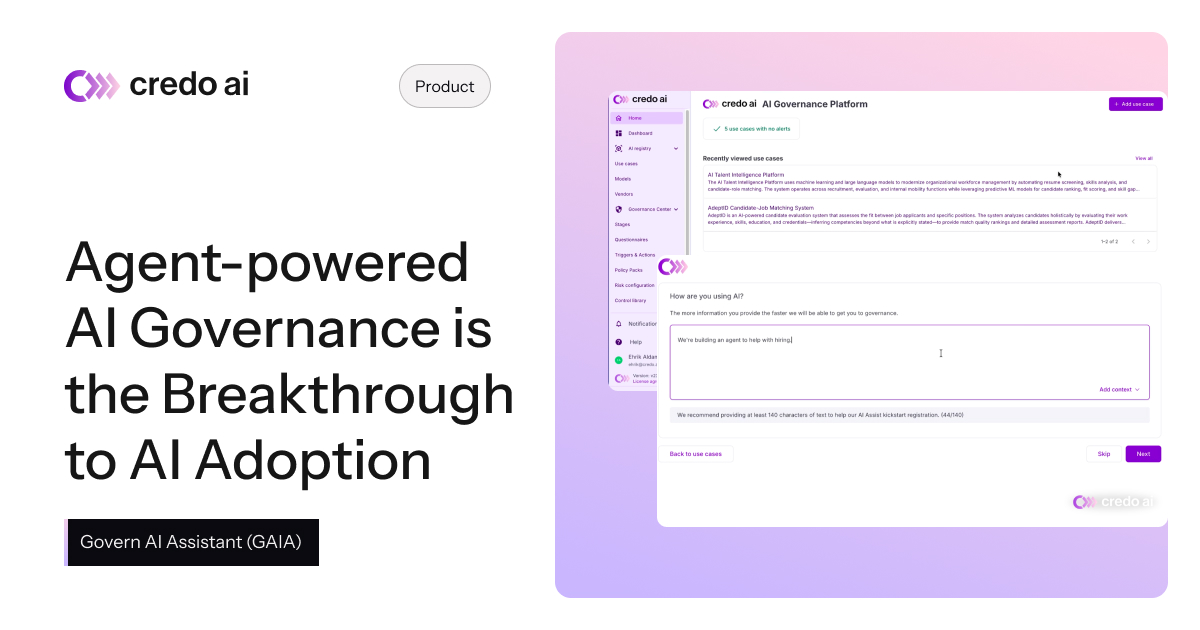
Credo AI today announced the general availability of GAIA (Govern AI Assistant) (not GAIG, thats GetAIGovernance), an AI-powered governance agent built directly into the Credo AI platform. GAIA is designed to handle the high-volume, repetitive work of AI use case intake, documentation, risk identification, and initial control recommendations.
The timing is strategic. According to Credo AI’s own State of AI Governance Survey, 60% of organizations now deploy AI across multiple departments or company-wide. At the same time, only 4% say they are governing AI at scale. Governance teams are overwhelmed — one director reported reviewing just six out of more than 100 AI requests.
GAIA aims to close this gap by acting as an intelligent assistant that works alongside human governance teams. Users can submit a text description or upload documents such as product briefs or project plans, and GAIA suggests structured descriptions, domain classifications, questionnaire responses, relevant risks, and mapped controls.
This is not a fully autonomous governance system. GAIA provides strong starting points and suggestions that humans review, edit, or reject. Every recommendation includes reasoning, preserving human oversight and accountability
Key Terms
GAIA (Govern AI Assistant): Credo AI’s governance agent that automates intake, documentation, and initial risk/control workflows.
Use Case Intake: The process of documenting and evaluating new AI projects before approval or deployment.
Context-Aware Questionnaire Assistance: GAIA reads provided materials and drafts responses to governance questionnaires.
Risk-Matched Controls: Recommendations drawn from Credo AI’s control library and tied to specific identified risks.
Agentic Governance: Using AI agents themselves to help govern other AI systems at scale.
Conditions Driving This Change
AI adoption has moved from centralized pilots managed by a small innovation team to widespread, decentralized deployment across departments and business units. Business teams are now launching their own AI initiatives with minimal central oversight.
Governance teams face growing backlogs as the number of AI use cases increases faster than headcount. Many organizations report reviewing only a small fraction of total AI projects.
Manual intake and documentation processes consume 11–20 hours per week for many governance professionals, pulling them away from higher-value risk analysis and strategic work.
Organizations struggle to maintain consistent risk assessment quality when volume is high. Rushed reviews lead to either overly conservative blocking of good projects or approval of higher-risk use cases.
The rise of agentic AI increases both the pace of new use cases and the complexity of risks that need evaluation. Agents that can act across systems introduce new categories of operational, compliance, and security risk.
Regulatory expectations continue to demand documented evidence of review and decision-making. Auditors and regulators are asking for clear records of how each use case was assessed.
Governance teams are among the most AI-literate groups in enterprises and are now turning to AI assistance to keep up with the volume they helped create.
Traditional governance platforms rely heavily on human-driven workflows that no longer match the speed of AI development. Static questionnaires and manual routing create friction that slows down the business.
These pressures have created a clear need for tools that can handle volume while preserving human judgment on the most important decisions.
What It Looked Like Before
Before tools like GAIA, AI governance intake was almost entirely manual. Governance teams sent lengthy questionnaires via email or shared spreadsheets to project owners. Responses came back incomplete or vague, requiring multiple follow-up rounds just to understand basic details about the use case.
Risk identification depended almost entirely on the experience and available time of the reviewer. A stretched team might apply generic risk templates instead of context-specific analysis. Edge cases were frequently missed. Documentation quality varied dramatically — some use cases received thorough review while others received minimal scrutiny due to backlog pressure.
The entire process created painful bottlenecks. Valuable AI projects sat waiting for weeks or months for governance approval. Business teams grew frustrated and sometimes bypassed the process entirely, creating shadow AI. Meanwhile, governance professionals spent most of their time chasing information and filling out forms rather than doing deep risk analysis or strategic work.
Accountability existed on paper through approval workflows, but the operational reality was inconsistent and slow. When issues later surfaced, it was difficult to reconstruct exactly what was known at the time of approval. This created both compliance risk and real operational friction.
What It Looks Like Now
With GAIA, the intake process has changed significantly. Users can submit a short text description, upload documents such as product briefs or project plans, or even point the agent to existing resources. GAIA then generates structured suggestions for use case metadata, domain classification, and detailed questionnaire responses based on the provided context.
Reviewers no longer start from a blank page. They receive intelligent drafts they can accept, reject, or edit line by line, with full visibility into why GAIA made each suggestion. This dramatically reduces the back-and-forth and allows governance teams to focus their time on judgment calls rather than data entry.
GAIA also proactively surfaces relevant risks drawn from Credo AI’s enterprise risk library and recommends matched controls tailored to the specific use case. The agent learns from four years of deployment data across Credo AI customers, improving its recommendations over time.
Importantly, human reviewers retain full final authority. Every suggestion, edit, and decision remains fully auditable. Credo AI is also previewing a public MCP server that will let organizations connect their own custom agents into the platform for even more tailored workflows.
GAIA is now generally available to all Credo AI customers.
Our Take
AI Governance Take
Credo AI’s GAIA represents a practical step toward solving one of the biggest operational problems in enterprise AI governance today: scaling oversight without losing quality or burning out teams.
By automating the repetitive parts of intake and initial risk flagging, GAIA allows governance professionals to spend more time on the work that actually matters — nuanced risk judgment, cross-functional coordination, and strategic guidance. This is the right direction. Governance at scale requires tools that augment human capability rather than attempting to replace it.
The bigger question is execution. Organizations that treat GAIA (or similar agents) as a way to rubber-stamp more use cases faster will simply move risk around. The ones that will succeed will combine this kind of automation with strong human ownership, clear escalation paths, and ongoing runtime validation of approved systems.
This launch reflects a broader industry shift: agentic tools are increasingly being used to govern other agentic systems. Done right, this can help close the gap between AI adoption speed and governance capability. Done poorly, it risks creating new layers of sophisticated documentation without real enforcement.
For governance program managers feeling overwhelmed by volume, tools like GAIA are worth evaluating seriously.