Why You Can Trust GetAIGovernance + Our Research
Every vendor on this page was evaluated against the same criteria using public documentation, funding disclosures, integration listings, customer evidence, and independent industry recognition. No vendor paid to be ranked. Rankings reflect our independent editorial assessment of each platform's fit, depth, and differentiation within the AI security category.
BE AWARE: THE NUMBER RANKINGS "#1, #2..." DO NOT MEAN ONE COMPANY IS BETTER. THAT IS JUST HOW THEY WERE LISTED. ONE COMPANY IS NOT BETTER BECAUSE OF THE AMOUNT OF FUNDING OR THE TIME THEY'VE BEEN ACTIVE. COMPANIES ARE RANKED IN ALPHABETICAL ORDER
Most organizations trying to secure enterprise AI are solving several different problems under a single label. Some need to protect deployed models from adversarial manipulation. Others need to govern how agents access enterprise systems. Some need to secure the pipelines where models are trained and stored. And others need to detect threats that use AI as a weapon against their infrastructure. These aren't variations of the same problem, they're completely different problems that require completely different platforms. They require AI Security platforms
The result is a fragmented market where vendors use overlapping language to describe capabilities that operate at entirely different layers of the AI stack. Buyers end up comparing platforms that don't compete, missing the gaps in their actual coverage, and building security programs that appear complete while leaving specific layers exposed.
This guide organizes the leading AI security platforms by the specific control layer they address. The goal isn't to rank companies against each other. It's to clarify which platform addresses which problem, so procurement decisions are made based on actual coverage rather than marketing positioning from the companies.
What AI Security Platforms Actually Do
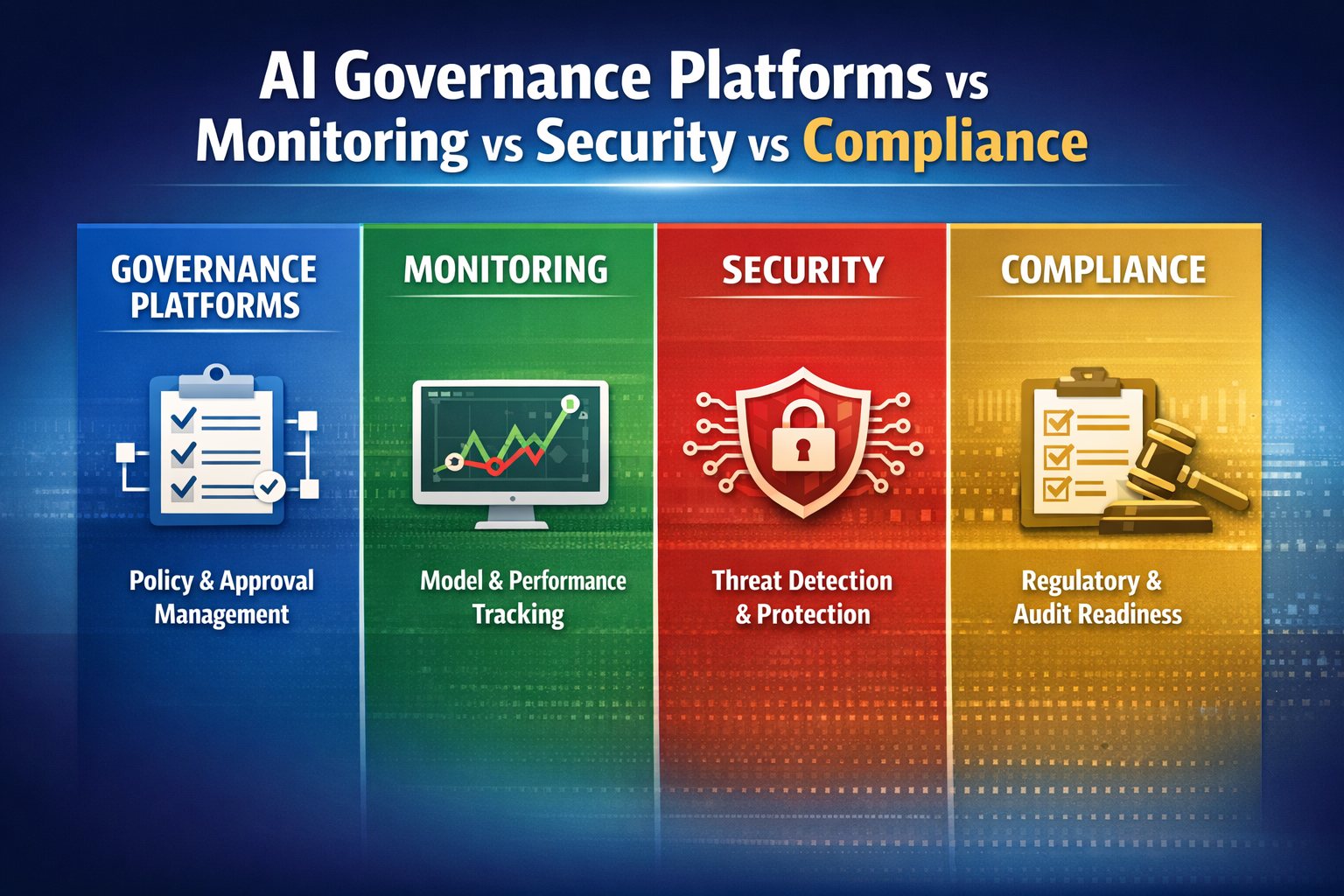
AI security platforms enforce, intercept, scan, or log the behavior of AI systems in real time or near real time. That is the line that separates this category from AI governance, which writes the policies and runs the approval workflows, and from AI monitoring, which watches model performance and surfaces drift. A governance platform can tell you that a use case was approved under a specific risk classification. A security platform is the thing standing between an attacker's prompt injection attempt and the model actually processing it. Both functions matter. They are not the same function, and a team that buys one expecting it to cover the other usually finds that out during an incident rather than during the sales call.
The seven layers in this guide split into two functional groups. Three layers enforce directly: Threat and Vulnerability controls block attacks before they reach the model, Runtime and Execution controls decide what an agent is allowed to do at the moment it tries to do it, and LLM Interaction controls sanitize what enters and leaves a model at the conversation boundary. The other four layers create the conditions enforcement depends on. Asset and Discovery establishes what exists. Identity and Access defines who or what can touch which resources. Model and Pipeline Security protects the foundation a model was built on before it ever reaches production. Audit and Evidence produces the record that proves any of the above actually happened the way it was supposed to.
How We Evaluated These Platforms
Control Layer Depth: Does the platform's core product actually perform the function the layer requires, or is the capability a secondary feature bolted onto a different primary business?
Enforcement vs. Observation: Does the platform block or stop a harmful action, or does it only detect and alert after the fact? Both have value. They are not interchangeable, and a buyer who needs enforcement should not accept an alerting tool as a substitute.
Independent Validation: What named enterprise customers, analyst recognition, or third-party research validates the platform's claims?
Deployment Maturity: Has the specific capability being evaluated shipped and been used in production, or was it announced recently with limited evidence of real-world deployment?
Regulatory and Framework Alignment: Which specific compliance obligations, such as EU AI Act Article 12 or SR 26-2, does the platform's output actually satisfy?
Buyer Fit: What size organization, industry, and internal team is this platform actually built to serve?
The AI Security Platforms: A Quick Overview
Platform | Control Layer | Pricing | Best For |
|---|---|---|---|
Model and Pipeline Security | Custom enterprise quote | Organizations needing AIBOM generation and supply chain integrity verification across both AI-generated and human-written code | |
Threat and Vulnerability | Custom enterprise quote | Enterprises needing validated, expert-confirmed vulnerability discovery at the scale AI-driven attack surfaces now demand | |
Runtime and Execution | Custom enterprise quote | Organizations running models and agents in production that need real-time inference-loop defense against adversarial attacks | |
Threat and Vulnerability | Custom enterprise quote | Teams needing continuous, CI/CD-integrated automated red teaming against production AI systems | |
Asset and Discovery | Custom enterprise quote | Organizations with little or no current visibility into shadow AI tools, OAuth grants, and AI-embedded SaaS integrations | |
Identity and Access | Custom enterprise quote | Enterprises that need purpose-built, just-in-time access governance for AI agents and other non-human identities | |
Audit and Evidence | Custom enterprise quote | Organizations needing tamper-evident logging of AI-to-API and agentic interactions mapped to EU AI Act Article 12 | |
Identity and Access | Custom enterprise quote | Large enterprises wanting AI agent identity governance unified with existing human and service account IAM infrastructure | |
LLM Interaction | Custom enterprise quote | Organizations that want AI interaction governance embedded inside an integration platform they already run at scale | |
LLM Interaction | Custom enterprise quote | Security-first teams wanting a standalone, intent-based control plane for every AI interaction across the enterprise |
Cycode — Best for AI Bill of Materials and Software Supply Chain Integrity
The Most Independently Validated Pipeline Security Platform in This Guide
Choose Cycode if: your organization needs to know exactly what components, models, and dependencies make up an AI system before it reaches production, and you need that inventory to survive a supply chain attack that forges provenance attestations the way the May 2026 Shai-Hulud campaign did.
Founded: 2019
HQ: Tel Aviv, Israel and New York, NY
Funding: $80M raised (Insight Partners, YL Ventures)
Recognition: Ranked #1 for Software Supply Chain Security in Gartner Critical Capabilities for Application Security Testing; Leader in the IDC MarketScape for Application Security Posture Management; Leader and Outperformer in the GigaOm Radar for Software Supply Chain Security; entered the 2025 Gartner Magic Quadrant for AST
Cycode's AI-Native Application Security Platform runs on what the company calls the Context Intelligence Graph, a single correlated model that connects findings across application security testing, software supply chain security, and application security posture management rather than treating each as a separate scanning exercise. The ADLC Security suite, which reached general availability in May 2026, extends that graph specifically to AI development: it generates an AI Bill of Materials for every model, dataset, and dependency in a system, scans for the kind of forged provenance attestations that let the Shai-Hulud attackers slip 172 compromised packages past standard supply chain checks, and maps the resulting inventory to SSDF, NIST, SOC 2, and ISO 27001 requirements automatically.
The reason Cycode anchors this layer alone, with no second platform alongside it, comes down to the density of independent validation behind the placement. A number one ranking in Gartner's Critical Capabilities for Software Supply Chain Security is a specific, defensible claim, not a marketing summary of a broader category. The IDC MarketScape Leader designation and the GigaOm Radar recognition for both Innovation and Growth come from two more analyst firms working independently of each other and of Gartner, which is the kind of convergent third-party signal that's rare anywhere in the AI security market right now. Multiple Fortune 100 companies use the platform, according to Cycode's own published customer data, and Gartner Peer Insights reviews from enterprise security teams describe the product holding up specifically in shift-left workflows where findings need to surface before code merges rather than after deployment.
What makes the AIBOM capability matter beyond the compliance checkbox is what it answers during an actual incident. When a security team needs to determine which version of which model, dataset, or dependency was running at the exact moment something went wrong, an AIBOM that updates on every build gives an immediate answer. Without one, that same question turns into manual archaeology across build logs and deployment records that may not even agree with each other. Cycode's research found that 48 percent of AI-generated code contains vulnerabilities, a figure that makes the case for pipeline-level scrutiny on its own, but the supply chain problem the company is really built to solve goes past code quality and into the question of whether the components feeding a build pipeline can be trusted at all.
Organizations evaluating Cycode should know the platform's primary audience is application security and DevSecOps teams working inside CI/CD pipelines, not compliance or governance functions looking for a standalone audit tool. The capability set assumes a team that already has, or is building, a shift-left security practice and wants AI-specific risk folded into that existing workflow rather than run as a separate program.
✓ What We Like
Convergent third-party validation: A number one Gartner ranking, IDC Leader, and GigaOm Leader status from three separate analyst firms working independently is the strongest combined credential in this entire guide.
Real AIBOM generation, not just inventory: The ADLC Security suite produces provenance documentation and integrity hashes that update on every build, directly answering the question the Shai-Hulud attack exposed as unanswerable for most organizations.
Context Intelligence Graph architecture: Correlates findings across application security testing, supply chain security, and posture management instead of producing three disconnected reports.
Framework mapping built in: SSDF, NIST, SOC 2, and ISO 27001 alignment ships as part of the platform rather than requiring a separate compliance layer.
Fortune 100 deployment evidence: Multiple large enterprise customers and consistent Gartner Peer Insights reviews from working security teams back the analyst recognition.
⚠ What to Know
Built for application security and DevSecOps teams operating inside CI/CD pipelines, not for compliance teams looking for a standalone documentation tool.
The ADLC Security suite reached general availability in May 2026, so production deployment evidence specifically for the AIBOM capability is still accumulating relative to Cycode's longer-standing application security testing functions.
Gartner Peer Insights reviews note occasional reliability issues with external pipeline stage integrations, worth raising directly during a proof of concept.
Pricing is fully custom and requires an enterprise sales conversation; nothing is published for self-service evaluation.
Security Control Coverage
AI Bill of Materials
Model Supply Chain Security
Artifact Scanning
Version Integrity Verification
Regulatory Frameworks
Best For
DevSecOps and application security teams: Organizations with an existing or developing shift-left security practice who want AI-specific supply chain risk handled inside that same pipeline.
Enterprises with heavy AI-generated code volume: Companies where a meaningful share of code now originates from AI coding tools and need scanning built for that reality.
Regulated industries facing audit requirements: Organizations that need AIBOM documentation mapped automatically to SSDF, NIST, SOC 2, or ISO 27001 rather than assembled manually before an audit.
Pricing: Not publicly listed. Enterprise sales conversations required. Contact Cycode directly or request a match through GetAIGovernance.net..
HackerOne — Best for Validated Vulnerability Discovery at Enterprise Scale
The Platform Behind the Industry's Largest Researcher-Verified Security Program
Choose HackerOne if: AI-driven scanning tools are surfacing more vulnerabilities than your team can confirm are actually exploitable, and you need a system that combines autonomous agent execution with expert human verification to tell the difference between real risk and noise before it reaches a developer's queue.
Founded: 2012
HQ: San Francisco, CA
Funding: $159M raised
Recognition: Recognized in Gartner's Emerging Tech Impact Radar for AI Cybersecurity Ecosystem for leadership in AI Security Testing; named customers include Anthropic, Crypto.com, General Motors, Goldman Sachs, Lufthansa, Uber, the UK Ministry of Defence, and the US Department of Defense
HackerOne's core offering is now the H1 Platform, launched in June 2026 and powered by an agentic AI orchestrator the company calls Hai. The platform unites autonomous AI agents with what HackerOne describes as the world's largest community of independent security researchers to continuously discover, validate, prioritize, and remediate vulnerabilities across code, cloud, and AI systems. Two capabilities inside that platform speak directly to the threat and vulnerability layer this guide is evaluating: h1 Validation, introduced in April 2026 specifically to handle the surge in vulnerabilities that AI-powered scanning tools are now finding faster than security teams can confirm them, and Agentic PTaaS, a continuous penetration testing service that combines automated agent execution with human expert verification rather than relying on either one alone.
The numbers behind why h1 Validation exists are worth sitting with. HackerOne's own data shows vulnerability submissions grew 76 percent year over year, hitting a record high in March 2026, while the time between a vulnerability's public disclosure and its first exploitation attempt has shrunk to hours. Remediation speed, meanwhile, improved only 19 percent over the same period, which means the backlog between discovery and fix keeps growing even as discovery accelerates. About a quarter of findings turn out to be genuinely exploitable, a rate that has held steady through the volume surge, meaning the absolute count of real, actionable vulnerabilities keeps climbing even as the noise around them grows louder. h1 Validation exists to sort the real findings from the rest before a developer ever has to look at the report.
Agentic PTaaS, which launched in January 2026, takes a position the company is explicit about in its own marketing: fully autonomous testing tools promise speed but tend to deliver shallow, unverified findings that generate more noise than insight, while traditional human-only pentesting delivers trust and depth but cannot keep pace with how quickly modern environments change. HackerOne's answer combines both, scaling the reconnaissance, setup, and exploitation phases of testing through agentic execution while routing actual exploitability verification through the company's vetted researcher community. The agents driving this are trained on proprietary exploit intelligence built from years of testing real enterprise systems rather than synthetic environments, which the company points to as the reason its results hold up under production conditions where scope is ambiguous and assets change constantly.
The scale of HackerOne's customer base is one of the more concrete pieces of evidence in this guide. The H1 Platform supports 1,300 organizations including 20 percent of the Fortune 500, and the company reports having helped customers mitigate more than $32 billion in exposure risk while cutting mean time to remediate by roughly 80 percent. Named customers spanning a defense ministry, a global investment bank, and a frontier AI lab is not a credential many platforms in this category can match, and it reflects a company that has been doing security validation work since well before the current AI wave made the category fashionable.
✓ What We Like
Genuine human-AI hybrid validation: Agentic PTaaS pairs autonomous execution with expert researcher verification rather than asking buyers to trust either approach alone.
Scale of customer evidence: 1,300 organizations, 20 percent of the Fortune 500, and named customers including the US Department of Defense and Goldman Sachs.
Built for the actual volume problem: h1 Validation responds directly to a documented 76 percent year-over-year surge in vulnerability submissions, not a hypothetical future need.
Real-world trained exploit intelligence: Agents are trained on patterns from actual enterprise testing rather than synthetic benchmark environments alone.
Gartner Emerging Tech Impact Radar recognition: Independent analyst acknowledgment specifically for AI security testing leadership.
⚠ What to Know
The H1 Platform rebrand and Hai orchestrator launched in June 2026, so the unified platform experience is newer than the individual capabilities like h1 Validation and Agentic PTaaS that it now houses.
Value depends heavily on integration with existing developer workflows like Jira, GitHub, and ServiceNow; teams without mature remediation pipelines will see less benefit from the validation speed.
The researcher community model means quality and response time can vary by program configuration and budget tier.
Pricing is fully custom and scoped to program size; smaller organizations should expect a meaningful procurement conversation before getting a number.
Security Control Coverage
Adversarial Testing
Prompt Injection Defense (Testing)
MAESTRO Threat Modeling Integration
Continuous Validated Pentesting
Regulatory Frameworks
NIST AI RMF
OWASP Top 10 for LLM Applications
OWASP Top 10 for Agentic Applications
Best For
Large enterprises with high vulnerability volume: Organizations whose AI-powered scanning tools are surfacing more findings than internal teams can validate manually.
Government and defense-adjacent organizations: Buyers needing the credibility of researcher-verified findings backed by a platform with existing defense and intelligence community trust.
Engineering teams with mature remediation pipelines: Companies with Jira, GitHub, or ServiceNow workflows already in place that can absorb validated findings quickly.
Pricing: Not publicly listed. Enterprise sales conversations required. Contact HackerOne directly or request a match through GetAIGovernance.net.
HiddenLayer — Best for Real-Time Defense Inside the Inference Loop
The Clearest Fit for Runtime Enforcement in This Entire Guide
Choose HiddenLayer if: you need a control that actually sits inside the model's inference process and stops an adversarial attack, a prompt injection attempt, or model evasion before it completes, rather than a system that logs the event and tells you about it after the fact.
Founded: 2022
HQ: Austin, TX
Recognition: Active partnerships with Cohere and Databricks announced June 29, 2026; integration into the Databricks Unity AI Gateway ecosystem; described across multiple independent industry reports as a leading dedicated AI security company
HiddenLayer's AISec Platform protects agentic, generative, and predictive AI applications across the full lifecycle, but the capability that anchors this specific layer is the AI Runtime Security module, which sits directly inside the inference loop rather than upstream as a filter or downstream as an alerting system. That placement is the entire reason it qualifies for the runtime and execution layer in the way that this guide defines it: a control here either interrupts execution when a model's reasoning or output matches a defined risk pattern, or it is performing a different function entirely. HiddenLayer's runtime module does the former, watching model behavior as it happens and intervening before a damaging output reaches a user or a downstream system.
The company expanded that runtime capability into agentic territory in March 2026, adding process isolation and behavioral anomaly detection specifically at the agent level rather than only at the single-model level. That distinction matters because an autonomous agent process can spawn sub-agents, maintain state across sessions, and take actions across multiple connected systems simultaneously, which means the threat surface is the agent's full operational footprint rather than a single inference call. HiddenLayer's instrumentation tracks behavior across that entire footprint, which is the architecture Palo Alto formally recognized when it defined Agentic Endpoint Security as a distinct product category following its own Koi acquisition in April 2026.
The two partnerships HiddenLayer announced on June 29, 2026, the day before this article was published, are the freshest evidence available anywhere in this guide. The collaboration with Cohere pairs HiddenLayer's runtime protections with Cohere's North enterprise AI platform, and notably, HiddenLayer evaluated Cohere's own platform against its security standards before deploying it for internal employee use, which is a level of dogfooding most security vendors do not publicly document. The Databricks Unity AI Gateway integration extends the same runtime defense into one of the more widely deployed enterprise AI infrastructure stacks, giving organizations already standardized on Databricks a path to runtime protection without standing up a separate system.
HiddenLayer's broader platform also includes Model Scanner, which has disclosed more than 48 vulnerabilities in commonly used machine learning frameworks, and AIBOM and Model Genealogy capabilities introduced as a direct response to supply chain attack patterns like the Shai-Hulud campaign. Those functions sit closer to the pipeline security layer than the runtime layer this entry is anchored on, and the company's breadth across both is real, but it is the AI Runtime Security module specifically that gives HiddenLayer the strongest, most defensible claim to this particular layer among every platform researched for this guide.
✓ What We Like
True inference-loop enforcement: The AI Runtime Security module interrupts execution in real time rather than alerting after a harmful output has already been delivered.
Agentic-specific runtime defense: Process isolation and behavioral anomaly detection built for the multi-step, multi-system footprint that autonomous agents actually create.
Current, active partnership momentum: The Cohere and Databricks integrations announced June 29, 2026 are the freshest verified developments anywhere in this article.
Documented internal validation practice: HiddenLayer tested Cohere's North platform against its own security standards before deploying it internally, a transparency move not common among competitors.
Disclosed vulnerability research record: More than 48 disclosed CVEs in commonly used ML frameworks demonstrates active, credible security research rather than only product marketing.
⚠ What to Know
HiddenLayer's broader platform spans model scanning, AIBOM generation, and runtime defense; this entry evaluates the runtime module specifically, and the company's other capabilities should be evaluated separately based on what a buyer actually needs.
The agentic runtime expansion is comparatively recent, dating to March 2026, so production deployment history for the agent-specific behavioral detection is shorter than for the company's core model runtime protections.
Effective deployment requires genuine integration into the inference pipeline, which means engineering involvement rather than a configuration-only setup.
Funding details and total capital raised were not located in public sources at the time of this research.
Security Control Coverage
Real-Time Enforcement
Agent Restriction and Action Bounding
Agentic Endpoint Security
Adversarial Testing
Regulatory Frameworks
EU AI Act
NIST AI RMF
OWASP Top 10 for Agentic Applications
Best For
Organizations running production agentic systems: Teams that need runtime defense built specifically for multi-step, multi-system agent behavior rather than single-inference model protection.
Databricks and Cohere environments: Enterprises already standardized on either platform's infrastructure who want runtime security integrated natively rather than bolted on separately.
Security engineering teams: Organizations with the technical capacity to integrate runtime instrumentation directly into the inference pipeline rather than seeking a configuration-only tool.
Pricing: Not publicly listed. Enterprise sales conversations required. Contact HiddenLayer directly or request a match through GetAIGovernance.net.
Mindgard — Best for Continuous Automated Red Teaming Against Production AI
An Academic Research Foundation Turned Into a CI/CD-Native Testing Platform
Choose Mindgard if: you need adversarial testing that runs continuously against your live AI systems rather than as a periodic engagement, and you want that testing built on a research foundation specific to AI vulnerabilities rather than adapted from conventional application security tooling.
Founded: 2022, as a spinout from Lancaster University
HQ: London, UK and Boston, MA
Funding: $11.9M raised (.406 Ventures, Atlantic Bridge, WillowTree Investments, IQ Capital, Lakestar)
Recognition: Featured in the OWASP LLM and Generative AI Security Solutions Landscape Guide; won the 2025 Cybersecurity Excellence Award for Best AI Security Solution; SOC 2 Type II certified
Mindgard grew directly out of more than a decade of AI security research conducted at Lancaster University's School of Computing and Communications, a designated UK Academic Centre of Excellence in cyber security. The company was founded by Dr. Peter Garraghan, who leads distributed systems research at the university and remains CEO and CTO, alongside Dr. Neeraj Suri as Chief Security Officer and Steve Street running revenue and operations. That academic lineage shows up directly in the product: the platform currently employs 11 PhDs and runs what it calls Dynamic Application Security Testing for AI, simulating thousands of adversarial attack scenarios against deployed models, agents, and multimodal systems and mapping the results against MITRE ATLAS and OWASP frameworks.
What separates Mindgard from a pre-deployment red-teaming engagement is the continuous part. The platform integrates through a GitHub Action and command-line interface that pulls the latest attack techniques on every run, requiring only an inference or API endpoint to test rather than access to model internals. That matters because models and the systems around them keep changing after launch through new prompt templates, new data sources, and new tool integrations, and each of those changes can quietly introduce vulnerabilities that were never present at the original security review. A reconnaissance module added in March 2026 extended the platform further, automatically discovering guardrails, system prompts, tools, and integrations to map the actual production attack surface of a deployed system rather than relying on a static inventory someone configured months earlier.
Mindgard's funding is modest next to several other companies in this guide, sitting at $11.9 million raised across two rounds, with the most recent $8 million Series A led by .406 Ventures in December 2024 explicitly intended to fund US expansion. The platform is already in use by the intelligence community according to the company's own public statements, and the founding team's academic credibility, backed by NVIDIA's Inception Programme and Microsoft's Founders Hub, gives it a research-grounded story that few competitors at this funding stage can match.
The honest comparison point worth naming directly is HiddenLayer, which also appears in this guide for a different layer. Mindgard sits purely at the testing layer, proactively attacking systems to find vulnerabilities before adversaries do, while HiddenLayer's runtime module intervenes during live inference. Mindgard does not claim to do what HiddenLayer does, and the two are not substitutes for each other; an organization running both continuous offensive testing and real-time runtime defense is covering two genuinely different parts of the threat and vulnerability problem rather than paying twice for the same function.
✓ What We Like
Academic research foundation: Built on a decade of dedicated AI security research from a UK Academic Centre of Excellence, with 11 PhDs currently on staff.
True continuous testing: GitHub Action and CLI integration means adversarial testing runs as part of the development cycle, not as a periodic engagement scheduled months apart.
No model internals required: Tests run against an inference or API endpoint, meaning the platform works across third-party and proprietary models alike.
MITRE ATLAS and OWASP alignment: Findings map directly to recognized frameworks rather than a proprietary scoring system buyers have to learn from scratch.
SOC 2 Type II certified: Meets a baseline security assurance standard that matters for enterprise procurement.
⚠ What to Know
Smallest funding total in this guide at $11.9 million, which is a relevant consideration for organizations weighing vendor financial stability over a multi-year engagement.
30-person team as of early 2026, meaning support and feature velocity should be evaluated directly during procurement rather than assumed at enterprise scale.
The platform finds vulnerabilities; it does not enforce runtime controls, so organizations need a separate platform for the actual blocking function once Mindgard identifies a weakness.
Custom enterprise pricing scoped to deployment size and number of AI systems under test, with no public pricing tiers.
Security Control Coverage
Adversarial TestingMAESTRO Threat Modeling IntegrationPrompt Injection Defense (Testing)
Regulatory Frameworks
NIST AI RMFOWASP Top 10 for LLM ApplicationsGDPR
Best For
Engineering teams running active CI/CD pipelines: Organizations that want adversarial testing embedded directly into the development cycle rather than scheduled as a separate event.
Multimodal and agentic deployments: Teams testing systems more complex than a single chatbot interface, where attack surface mapping needs to account for tools, integrations, and connected systems.
Organizations wanting research-grounded methodology: Buyers who value a testing approach built on published academic security research rather than proprietary heuristics alone.
Pricing: Not publicly listed. Contact Mindgard directly or request a match through GetAIGovernance.net.
Nudge Security — Best for Shadow AI Discovery Across the Workforce
The Clearest Single Answer to "What AI Is Actually Running Here?"
Choose Nudge Security if: you cannot currently produce a reliable answer to what AI tools your employees are using, what data those tools can access, and what OAuth integrations connect them to your other systems, and you want that visibility within hours rather than after a multi-week audit.
Founded: 2021
HQ: Austin, TX
Funding: $39M raised (Cerberus Ventures, Ballistic Ventures, Forgepoint Capital, Squadra Ventures)
Recognition: Named customers include Reddit and Notion; reported 3x ARR growth for two consecutive years; nearly 200 customers across software, financial services, biotechnology, healthcare, and entertainment
Nudge Security's discovery engine is the strongest single-platform answer to the asset and discovery layer in this guide, and the mechanism behind that strength is what makes it worth understanding before anything else. The platform deploys without agents or network proxies, integrating instead through read-only access to an organization's email provider, which lets it discover and inventory every SaaS and AI account ever created across the organization, including ones created years before Nudge Security was ever installed. Layered on top of that baseline discovery, a browser extension delivers real-time visibility into AI conversation activity, file uploads, and the OAuth grants employees hand out to AI tools without realizing the access scope they are creating.
The OAuth grant problem specifically is where the platform's value becomes concrete rather than abstract. According to the company's own usage data, the average employee accumulates 70 OAuth grants over time, many of which persist long after anyone remembers approving them, and a single one of those grants can give an AI vendor continuous, standing access to an organization's most sensitive data. Nudge Security surfaces those grants with risk scores attached, attributes them to specific users and devices, and connects each one to a security profile covering the vendor's breach history, data training policies, and compliance attestations, drawn from a database the company maintains on more than 175,000 AI and SaaS providers.
Reddit's CISO has gone on record describing the deployment experience directly: within hours of turning the platform on, the security team had complete visibility into its SaaS footprint, a result that matches the broader pattern in the company's published research, which has tracked more than 1,500 unique AI tools discovered across its customer base, with an average of 39 distinct AI services running inside a typical enterprise. That gap between what security teams assume they have and what is actually running is the exact problem this layer of the control framework exists to close, and Nudge Security's email-first, agentless approach to surfacing it is what gives the company the strongest claim to the layer among every discovery-focused platform researched for this guide.
One distinction worth being direct about: Nudge Security markets itself heavily under the banner of "AI security governance," and a meaningful share of the platform's broader feature set, including acceptable use policy delivery and automated guardrail playbooks, extends past pure discovery into policy enforcement territory that overlaps with what a governance platform does. That overlap does not weaken the discovery capability itself, which stands on its own merits, but buyers evaluating Nudge Security specifically for this layer should understand that the company's full product surface reaches further than asset discovery alone.
✓ What We Like
Agentless, near-instant deployment: Read-only email integration delivers a full historical AI and SaaS inventory within hours, without endpoint agents or network changes.
OAuth grant visibility: Surfaces the specific access pathways, often invisible to security teams, that give AI vendors standing access to sensitive data.
Vendor risk database depth: Security profiles covering more than 175,000 AI and SaaS providers give context on breach history and data training practices without manual research.
Verified customer results: Named, on-record testimony from Reddit's CISO and consistent reporting of hours-not-weeks deployment timelines.
Strong commercial trajectory: 3x ARR growth for two consecutive years signals real market traction rather than early-stage hype.
⚠ What to Know
The platform's branding and feature set extend well past pure discovery into policy enforcement and governance workflow territory, which buyers should account for when scoping exactly what they are purchasing.
Deepest behavioral visibility, including AI conversation monitoring, requires browser extension deployment on top of the baseline email integration.
At $39 million raised and roughly 35 to 44 employees depending on the source, this is a smaller company than several others in this guide, worth weighing for long-term vendor stability.
Pricing is custom and not published; expect a sales conversation rather than self-service signup for enterprise deployment.
Security Control Coverage
Shadow AI Detection
AI Inventory and Registry
Data Provenance Tracking
Regulatory Frameworks
Best For
Organizations starting from zero visibility: Security teams that genuinely do not know what AI tools exist across their environment and need a fast, low-friction starting point.
IT and security teams without dedicated AI security headcount: Lean teams that need automated discovery and risk scoring rather than a tool requiring constant manual configuration.
Compliance and GRC functions: Teams needing audit-ready documentation of AI tool usage, data handling practices, and access patterns across the SaaS ecosystem.
Pricing: Not publicly listed. Contact Nudge Security directly or request a match through GetAIGovernance.net.
Oasis Security — Best for Purpose-Built Non-Human Identity Governance
Built From the Ground Up for Agents, Not Retrofitted Onto Human IAM
Choose Oasis Security if: you need access governance designed specifically for AI agents and other machine identities from the architecture up, with permissions granted dynamically based on what a system is trying to do at the moment it tries to do it, rather than standing access defined once and rarely revisited.
Founded: 2022
HQ: New York, NY and Tel Aviv, Israel
Funding: $195M total raised, including a $120M Series B in March 2026 led by Craft Ventures with Cyberstarts, Sequoia Capital, and Accel participating
Recognition: Majority of client base drawn from the Fortune 500; new annual recurring revenue grew 5x year over year in the twelve months preceding the Series B
Oasis Security built its Agentic Access Management platform around a premise the company's CEO Danny Brickman states plainly: cybersecurity has always been defined by protecting against abnormal and risky events, and in the era of AI, that definition is being reshaped entirely by access. Machine identities now outnumber human identities by roughly 82 to 1, according to data the company cites from Palo Alto Networks, and the identity and access systems most organizations run were built to govern people, not autonomous software making decisions and taking actions at machine speed. Oasis was founded specifically to close that gap, establishing what it calls the foundational layer for governing every machine identity in an organization under a single policy framework, before extending that foundation into agent-specific access management.
The architectural difference between Oasis and a retrofitted identity platform comes down to how access gets granted. Traditional identity governance, including the kind built for human users, relies on standing permissions defined at what the company calls admin time, meaning access is pre-configured based on anticipated need and then largely left alone until a periodic review catches up to it, if one happens at all. Oasis's Agentic Access Management grants permissions dynamically, evaluating what a system is attempting to do in real time rather than relying on a static rule written months earlier. That distinction matters specifically for agents because their effective scope can expand silently as developers connect new tools, and a permission granted for one task can quietly become standing access that nobody remembers authorizing.
The commercial evidence behind this layer is some of the strongest in the entire guide. New annual recurring revenue grew fivefold year over year ahead of the March 2026 Series B, and the majority of Oasis's client base comes from the Fortune 500, with most new revenue generated through multi-year enterprise agreements rather than short-term pilots. That pattern, according to the company, reflects Oasis becoming embedded directly into customers' core identity architecture rather than deployed as a peripheral monitoring tool sitting alongside the systems that actually matter. Brickman described the access risk directly in a Bloomberg interview tied to the funding announcement: an agent with full, unreviewed access is as powerful as it gets, and that power creates mounting pressure on the people responsible for securing it.
Silverfort, also covered in this guide, addresses the same general layer from a different starting point, and the distinction is worth being explicit about. Silverfort built its platform around identity enforcement at massive existing enterprise scale and is now extending that scale into AI-native decisioning through its Fabrix acquisition. Oasis was purpose-built for non-human identity from its very first line of code. An organization choosing between them is really choosing between unifying AI agent governance inside an identity system they already run everywhere, which favors Silverfort, or adopting a platform whose entire architecture was designed around the agent identity problem specifically, which is where Oasis has the stronger claim.
✓ What We Like
Purpose-built architecture: Designed from inception for non-human identity rather than extended from a human-focused IAM product.
Dynamic, just-in-time access model: Permissions evaluated against real-time intent rather than relying on standing rules that drift out of date.
Exceptional growth and customer concentration: 5x year-over-year ARR growth and a majority Fortune 500 client base is among the strongest commercial evidence in this guide.
Deep enterprise integration: Multi-year agreements and embedding directly into customer identity architecture rather than deployment as a standalone monitoring layer.
Well-capitalized for the road ahead: $195M raised from Craft Ventures, Sequoia, and Accel gives the company runway to keep building as the agent identity category matures.
⚠ What to Know
Founded in 2022, making this a younger company than several others in this guide, though the funding and customer evidence suggest the youth has not slowed enterprise adoption.
A platform built specifically for non-human identity may require a separate system for organizations also needing unified governance across human and machine identities in a single pane.
Pricing is fully custom, scoped to enterprise deployment, with no public self-service tier.
Detailed independent third-party analyst recognition, such as a Gartner or Forrester placement specific to this product category, was not located in public sources at the time of this research.
Security Control Coverage
Agent Permissions and Least Privilege
Non-Human Identity Credential Management
Model and API Access Control
Regulatory Frameworks
Best For
Fortune 500 enterprises deploying agents at scale: Organizations where AI agent identity has become a board-level concern and existing IAM infrastructure was never designed to handle it.
Organizations prioritizing dynamic, intent-based access: Security teams that have concluded static, pre-configured permissions cannot keep pace with how agent capabilities actually expand over time.
Companies treating access as foundational, not an afterthought: Teams scaling AI deployment who want identity architecture built in from the start rather than retrofitted after an incident.
Pricing: Not publicly listed. Contact Oasis Security directly or request a match through GetAIGovernance.net.
Salt Security — Best for Tamper-Evident Logging of AI Agent and API Activity
The Strongest Available Option for the Most Underserved Layer in This Guide
Choose Salt Security if: your AI agents communicate with enterprise systems through APIs and MCP servers, and you need a tamper-evident record of every one of those interactions that can stand up to EU AI Act Article 12 scrutiny, built by a company with a long, proven track record in API security rather than a new entrant building logging as a first product.
Founded: 2016
HQ: Palo Alto, CA
Funding: $271M raised, $1.4B valuation, including a $140M Series D led by CapitalG, Alphabet's independent growth fund
Recognition: Named enterprise customers include Alaska Airlines, Hyundai, Stryker, SoFi, Kingston Technology, Standard Bank Group, and Siemens Software
This entry comes with a direct editorial note worth stating before anything else: audit and evidence is the most underserved control layer in the AI security market right now, and no vendor researched for this guide offers a mature, purpose-built platform whose primary function is generating cryptographically signed, tamper-evident audit trails specifically for AI regulatory examinations. Salt Security is the strongest practical option currently available, and the honest caveat is that audit and evidence logging is a feature of Salt's broader API and agentic security platform rather than the company's standalone core product.
Salt's Agentic Detection and Response capability, part of the Salt Agentic Security Platform launched in March 2026, establishes behavioral baselines for LLM connectivity, agent activity, and MCP server traffic, then correlates every interaction back to a unique agentic identity rather than treating traffic anonymously. That correlation produces an immutable, tamper-evident log of every AI-to-API interaction, including request payloads, response data, timing, authentication context, and anomaly flags, with retention policies configurable to the six-month minimum that EU AI Act Article 12 requires for most high-risk systems. CEO Roey Eliyahu has been direct about the company's thesis behind building this: the real enterprise risk in agentic AI is not what an agent can say, it is what an agent can do through the MCP servers and APIs that connect it to actual enterprise systems, and securing that action layer requires visibility most model-centric security tools never reach.
The scale of the underlying problem Salt is responding to is documented in the company's own 1H 2026 State of AI and API Security Report, which surveyed more than 300 security leaders. Nearly half of organizations, 48.9 percent, reported being essentially blind to non-human traffic inside their own environment, unable to monitor what their autonomous agents are actually doing. A similar share, 48.3 percent, said they could not reliably distinguish a legitimate AI agent from a malicious bot. Only 23.5 percent of respondents described their existing security tools as very effective at preventing AI-related attacks. Those numbers describe an industry-wide visibility gap that Article 12-style audit requirements are about to make a legal liability rather than just an operational weakness, and Salt's positioning as an API security company extending into agentic traffic gives it a credible, founded-since-2016 track record to build that audit capability on top of, rather than a brand-new logging product with no enterprise deployment history.
The honest market reality is that most organizations right now are meeting AI audit and evidence requirements through a patchwork rather than a dedicated platform: runtime logging pulled from a security tool like Salt, combined with general GRC and compliance software, combined with manual evidence collection and mapping during audit preparation. That patchwork works, but it depends on someone owning the integration between those pieces and ensuring the resulting record is actually complete and queryable when a regulator or an internal investigation asks for it. Until a more focused, standalone audit and evidence platform matures with enterprise-grade validation specifically for this function, organizations should treat audit readiness as an ongoing program built from several connected pieces rather than a single point solution they can purchase once and forget.
✓ What We Like
Established API security track record: Founded in 2016 with a long history securing API traffic, which gives the newer agentic audit capability a credible technical foundation rather than a cold start.
Identity-correlated logging: Every interaction ties back to a unique agentic identity rather than anonymous traffic, which is what makes the resulting log actually useful for investigation and audit.
Explicit Article 12 mapping: Retention and tamper-evidence configured directly against EU AI Act requirements rather than generic logging that has to be adapted after the fact.
Strong named enterprise customer base: Alaska Airlines, Hyundai, Stryker, SoFi, and Siemens Software demonstrate deployment at real operational scale.
Substantial, well-validated funding: $271M raised at a $1.4B valuation with CapitalG as the lead Series D investor signals durable institutional confidence.
⚠ What to Know
Audit and evidence generation is a feature of Salt's broader runtime and API security platform, not a standalone, dedicated audit product. Organizations whose primary need is audit and evidence specifically should evaluate whether the bundled architecture fits their procurement requirements.
EU AI Act Article 12 itself does not technically mandate cryptographic tamper-evidence, only automatic logging; Salt's tamper-evident approach exceeds the letter of the regulation, which is a strength, but worth understanding precisely.
Full deployment requires connecting Salt into existing API gateways and cloud environments via traffic mirroring, which is a meaningful integration project rather than a lightweight install.
This remains, as a category, the least mature control layer in AI security; buyers should expect the standalone audit and evidence vendor landscape to keep evolving over the next year.
Security Control Coverage
Tamper-Proof Logging
Risk Scoring and Triage
Real-Time Enforcement
Regulatory Frameworks
EU AI Act Article 12
EU AI Act Article 15
PCI DSS
HIPAA
GDPR
Best For
Organizations with significant agent-to-API traffic: Companies whose AI agents regularly interact with internal systems through APIs and MCP servers, where audit visibility into that traffic is the priority.
EU AI Act high-risk system operators: Organizations needing logging and retention configured specifically against Article 12 requirements ahead of August 2026 enforcement.
Enterprises already invested in API security: Companies that can extend an existing API security relationship into agentic audit coverage rather than standing up a separate vendor relationship.
Pricing: Not publicly listed. Contact Salt Security directly or request a match through GetAIGovernance.net.
Silverfort — Best for Unified Identity Governance Across Human and AI Agent Access
Enterprise-Scale Identity Enforcement Now Extended Into AI-Native Decisioning
Choose Silverfort if: you want AI agent identity governance unified inside the same platform already protecting your human users and service accounts, rather than standing up a separate system specifically for machine identities, and you operate at a scale where 1,000-plus enterprise deployments and existing IAM integration depth matters more than a purpose-built agent-only architecture.
Founded: 2016
HQ: Tel Aviv, Israel, with US commercial headquarters in Plano, TX
Funding: $222M raised, $1B valuation
Recognition: More than 1,000 enterprise customers including multiple Fortune 100 companies; strategic alliance with SentinelOne announced April 2026
Silverfort's Identity Security platform is built around Runtime Access Protection, the company's patented technology that integrates natively with an organization's existing identity and access management infrastructure to give visibility into every identity on premises and in the cloud, then continuously enforces access controls and policies in real time. That architecture already covered human users, service accounts, and previously unprotected resources like legacy systems and command-line tools before the company's April 2026 acquisition of Fabrix Security added an AI-native decisioning layer specifically built to handle the speed and complexity of non-human and agentic identities.
Fabrix, founded in March 2025 by former Run:ai engineer Raz Rotenberg and former Microsoft Entra engineer Ofir Yakovian, built an identity-centric AI decisioning engine and identity knowledge graph that analyzes access activity, organizational context, and intent to make confident, explainable authorization decisions at the exact point a request happens. Silverfort's CEO Hed Kovetz framed the rationale for the acquisition directly: identity security has historically relied on rules written at admin time, attempting to pre-define access in advance, but in an environment with AI agents acting continuously and unpredictably, that approach is becoming impossible to sustain. The only way to manage that risk without halting the business, in Kovetz's framing, is to make access decisions at runtime using AI and deep contextual understanding, which is exactly what the combined Silverfort-Fabrix platform is built to do.
What distinguishes Silverfort's position in this layer from Oasis Security, also covered in this guide, is scale and unification rather than architecture alone. Silverfort already protects more than 1,000 enterprise customers, including a meaningful share of the Fortune 100, across human, machine, and now agentic identities inside one platform. The Fabrix acquisition is explicitly designed to extend Silverfort's existing Runtime Access Protection enforcement, which already runs across an organization's entire identity estate, into AI-native decisioning rather than asking enterprises to deploy and maintain a second, separate system purely for agent identities. The April 2026 strategic alliance with SentinelOne reinforces that direction, pairing Silverfort's identity enforcement with SentinelOne's broader endpoint and extended detection platform to secure identities specifically in the AI era.
The joint Silverfort-Fabrix capabilities are still rolling out in stages, with the bulk of the combined functionality expected to reach customers in the second half of 2026 according to the companies' own announcement. That means an organization evaluating Silverfort today for AI agent identity governance specifically is buying into a roadmap that is real and well-funded but not yet fully shipped, which is a meaningfully different proposition than Oasis Security's agent-native platform, which has been built and selling at scale since 2022.
✓ What We Like
Genuine identity unification: Human, service account, and agentic identities governed inside a single platform rather than requiring a separate tool for AI agents specifically.
Massive existing enterprise footprint: Over 1,000 customers including Fortune 100 companies gives the platform deployment scale few competitors in this space can match.
Proven Runtime Access Protection technology: A patented enforcement mechanism already protecting legacy systems and previously unprotected resources, not a new architecture built from scratch for this announcement.
Strategic SentinelOne alliance: Pairs identity enforcement with a major endpoint and XDR platform, extending coverage across two adjacent security domains.
Strong, well-capitalized acquisition strategy: The Fabrix purchase follows the earlier Rezonate acquisition, showing a consistent pattern of buying real technical capability rather than building everything from zero internally.
⚠ What to Know
The majority of joint Silverfort-Fabrix capabilities are scheduled for release in the second half of 2026, meaning the most AI-native parts of this platform are not yet fully available at the time of this guide's publication.
Fabrix itself was a 14-person team founded just over a year before the acquisition; integration execution risk is real, even with Silverfort's resources behind it.
Organizations wanting a platform purpose-built for agent identity from inception, rather than extended into agent identity from a human-IAM foundation, should weigh that architectural difference directly against Oasis Security.
Custom enterprise pricing only, with deployment scoped to the size and complexity of an organization's existing identity infrastructure.
Security Control Coverage
Model and API Access Control
Agent Permissions and Least Privilege
Non-Human Identity Credential Management
Real-Time Enforcement
Regulatory Frameworks
Best For
Large enterprises with existing identity infrastructure: Organizations wanting to extend current IAM investment to cover AI agents rather than deploying a parallel, separate system.
Fortune 100 and similarly large organizations: Companies whose scale and complexity make a unified, enterprise-proven identity platform more valuable than a younger, narrower agent-only tool.
Security teams pairing identity with endpoint protection: Organizations interested in the combined Silverfort-SentinelOne approach to securing identities across both identity and endpoint layers simultaneously.
Pricing: Not publicly listed. Contact Silverfort directly or request a match through GetAIGovernance.net.
SnapLogic — Best for AI Interaction Governance Inside an Existing Integration Platform
An Integration-First Path to AI Gateway Enforcement
Choose SnapLogic if: your organization already runs SnapLogic, or is evaluating an integration platform broadly, and you want AI agent authentication, authorization, and traffic governance embedded inside that same infrastructure rather than adopting a separate, standalone AI security tool.
HQ: San Mateo, CA
Recognition: Named a Visionary in the 2026 Gartner Magic Quadrant for Integration Platform as a Service; named a Visionary in the 2025 Gartner Magic Quadrant for Data Integration Tools for the seventh consecutive year
A direct framing note belongs at the top of this entry: SnapLogic is not a security-first company. It is, in its own words, the Agentic Integration Company, an established enterprise iPaaS vendor whose Gartner Magic Quadrant recognition sits in integration platforms, not in any AI security category. The reason it appears in this guide is that its AI Gateway and Trusted Agent Identity capabilities, both introduced in April 2026, genuinely perform LLM interaction governance functions, and for a specific kind of buyer, getting that governance embedded inside infrastructure they already run is a real and legitimate alternative to standing up a separate, purpose-built security platform.
AI Gateway functions as a central layer for authentication, authorization, and traffic throttling across every AI interaction passing through SnapLogic's platform, paired with an observability dashboard that monitors how agents interact with connected enterprise systems. Trusted Agent Identity addresses a specific and often overlooked problem: many organizations deploy AI agents that act under a shared service account rather than an identifiable individual identity, which makes any resulting action nearly impossible to trace back to the person who actually initiated it. SnapLogic's token propagation model instead carries a user's actual identity and permissions from the agent through the integration layer and into backend systems, so every action an agent takes remains attributable to a specific person rather than disappearing into an anonymous service account.
The scale SnapLogic brings to this is substantial precisely because it was not built for AI security specifically. The platform connects more than 1,000 prebuilt connectors spanning ERP, CRM, databases, and SaaS systems, all of which become available as agent-callable tools through an OpenAPI Function Generator that converts existing API specifications into agent functions without manual coding. Native bi-directional support for the Model Context Protocol lets organizations both connect outward to external MCP servers and expose their own SnapLogic pipelines as governed tools other agents can call. SnapLogic's own announcement cites Gartner research finding that nearly half of generative AI projects get abandoned after proof of concept due to poor data quality, weak risk controls, rising costs, or unclear business value, and the company's positioning is that AI Gateway and Trusted Agent Identity exist specifically to close the gap between an AI demo and AI actually embedded as reliable infrastructure.
The comparison worth making directly is to WitnessAI, the other platform in this guide anchoring the LLM interaction layer. WitnessAI is a dedicated, security-first AI control plane built specifically to intercept and govern AI interactions at the network level, independent of any other infrastructure a buyer runs. SnapLogic delivers a meaningfully different version of the same governance function, embedded inside a broad enterprise integration platform that most large organizations are evaluating or running for reasons that have nothing to do with AI security at all. An organization already standardized on SnapLogic, or actively shopping for an iPaaS platform and wanting AI governance bundled in rather than purchased separately, gets real value from this approach. An organization whose primary and immediate need is a dedicated AI security control plane should look at WitnessAI first.
✓ What We Like
Massive integration footprint: Over 1,000 prebuilt connectors mean AI Gateway governance extends across systems an organization already connects, not just new AI-specific endpoints.
Genuine identity attribution: Trusted Agent Identity solves the real and common problem of agent actions hiding behind anonymous shared service accounts.
Native bi-directional MCP support: Connects to external MCP servers and exposes internal pipelines as governed tools, addressing both sides of the agentic tool-calling relationship.
Established Gartner Magic Quadrant track record: Seven consecutive years as a Visionary in Data Integration Tools, plus 2026 recognition in iPaaS, demonstrates sustained product credibility in its core category.
Practical bundling for existing customers: Organizations already running SnapLogic get AI governance without a separate procurement cycle.
⚠ What to Know
SnapLogic is fundamentally an integration platform company, not a security vendor, and its Gartner recognition reflects that category, not AI security specifically. Buyers should weigh this honestly against purpose-built security alternatives.
AI Gateway and Trusted Agent Identity launched in April 2026, making this one of the newer capabilities evaluated anywhere in this guide.
Maximum value depends on an organization already using or actively considering SnapLogic for integration needs broadly; adopting it purely for AI Gateway functionality alone is a less natural fit.
Funding details were not located in public sources at the time of this research, and pricing remains fully custom.
Security Control Coverage
Input Validation and Sanitization
Model and API Access Control
Non-Human Identity Credential Management
Regulatory Frameworks
Best For
Existing SnapLogic customers: Organizations already running the platform for broader integration work who want AI governance included rather than purchased as a separate line item.
Enterprises evaluating iPaaS platforms broadly: Companies in the market for integration infrastructure who want AI agent governance bundled in as one factor in a larger platform decision.
Organizations needing deep system-to-agent connectivity: Teams that need AI agents calling into ERP, CRM, and other core enterprise systems through a governed, attributable layer.
Pricing: Not publicly listed. Contact SnapLogic directly or request a match through GetAIGovernance.net.
WitnessAI — Best for a Dedicated, Security-First AI Interaction Control Plane
The Fastest-Growing Purpose-Built Platform in This Entire Guide
Choose WitnessAI if: you want a standalone, security-first control plane that intercepts and governs every AI interaction across your organization at the network level, with intent-based detection built to catch sophisticated multi-turn attacks rather than simple pattern matching, and you do not want that governance bundled inside a broader platform built for a different primary purpose.
Founded: 2023
HQ: Mountain View, CA
Funding: $85.5M total raised, including a $58M strategic round in January 2026 led by Sound Ventures, with Google Ventures, Ballistic Ventures, Samsung NEXT, Qualcomm Ventures, and Forgepoint Capital Partners participating
Recognition: Named to Fortune's 2025 Cyber 60 list; SC Awards Excellence Award finalist for Best Compliance Solution; named in the 2025 IDC Innovators report for Security for Agentic AI
WitnessAI's platform organizes into three modules, Observe, Protect, and Control, that together intercept and analyze AI interactions at the network level rather than requiring endpoint clients or browser extensions on every device. Observe handles discovery, scanning the network to surface every instance of AI usage across the organization and building a real-time map of the resulting ecosystem. Protect delivers runtime defense, actively filtering and blocking harmful responses during live operation rather than logging them for later review. Control enforces governance policy, applying organization-wide rules across departments, roles, and specific AI tools and agents. The architecture sits squarely inside this guide's LLM interaction layer because it is built specifically to operate at the conversation boundary, intercepting what enters and leaves a model before either side of that exchange completes.
What separates WitnessAI's detection approach from competitors built on pattern matching is the intent-based engine underneath Protect. Rather than scanning prompts for known malicious strings, the platform analyzes the actual meaning and purpose behind each interaction, which is what allows it to catch sophisticated multi-turn attacks and contextual jailbreaks that unfold gradually across a conversation rather than appearing as a single obviously malicious input. CEO Rick Caccia, who spent over two decades in cybersecurity leadership at Palo Alto Networks, Google Cloud Security, and Exabeam before founding WitnessAI in 2023, has built the company's entire pitch around that distinction: the company describes itself as the only AI security vendor able to secure every AI interaction, everywhere, through a single unified solution.
The growth numbers behind WitnessAI's January 2026 funding round are difficult to find matched anywhere else in this guide. The company reported more than 500 percent growth in annual recurring revenue and a 5x expansion in headcount over the preceding twelve months, and its production customer base already includes some of the largest publicly held enterprises across financial services, utilities, automaking, airlines, retail, and telecommunications. Sound Ventures, which led the round, brings a track record as an early investor in OpenAI, Anthropic, and SentinelOne, which is the kind of investor signal that carries weight specifically inside the AI security category. The company also unveiled expanded agentic governance capabilities alongside the funding announcement, extending Observe and Control to monitor which agents are active, what MCP servers and tools they are accessing, and what data those agents are sharing, ahead of a fuller Agentic Control launch on June 17, 2026, that added organization-wide MCP server and tool allow-lists scored against OWASP and CVE risk classes.
The honest comparison to SnapLogic, also covered in this guide for the same layer, is worth stating plainly rather than glossing over. WitnessAI is a pure-play, security-first vendor whose entire product exists to govern AI interactions, with no other primary business line competing for engineering attention or product roadmap priority. That focus shows up in the depth and speed of WitnessAI's agentic security development specifically, and it is the right fit for organizations whose primary, immediate need is a dedicated AI interaction control plane rather than AI governance as one feature inside a broader infrastructure platform.
✓ What We Like
Intent-based detection architecture: Analyzes meaning and purpose rather than pattern matching, catching sophisticated multi-turn and contextual attacks competitors often miss.
Exceptional, well-documented growth: Over 500 percent ARR growth and 5x headcount expansion in a single year is among the strongest momentum signals in this entire guide.
Pure-play security focus: No competing primary business line; the entire product roadmap exists to serve AI interaction security and governance.
Strong, credible investor base: Sound Ventures' track record with OpenAI, Anthropic, and SentinelOne lends specific category credibility beyond general venture validation.
Genuinely current agentic capabilities: The June 17, 2026 Agentic Control launch with MCP server scoring against OWASP and CVE risk classes is among the most recent meaningful product developments researched for this guide.
⚠ What to Know
Founded in 2023, making this one of the youngest companies in this guide; the growth metrics are strong but should be read in the context of a company still in its early scaling years.
Network-level interception architecture means evaluating exactly how the platform integrates with an organization's existing network and traffic infrastructure is an important step before procurement.
As a security-first standalone platform, organizations also running a broad integration platform like SnapLogic may find some functional overlap worth scoping carefully to avoid paying twice for similar coverage.
Pricing is fully custom and scoped to deployment; absolute revenue figures behind the reported growth percentages are not publicly disclosed.
Security Control Coverage
Input Validation and Sanitization
Prompt Filtering
Output Content Scanning
Context Isolation
Regulatory Frameworks
EU AI Act
NIST AI RMF
HIPAA
SOX
GDPR
Best For
Security-first organizations: CISOs and security engineering teams wanting a dedicated, purpose-built control plane rather than AI governance bundled inside broader infrastructure.
Regulated, high-AI-adoption enterprises: Fortune 1500 companies with ten or more active models in production, strict regulatory requirements, and existing gaps in generative AI monitoring.
Organizations scaling agentic deployments quickly: Teams needing MCP server and tool governance that keeps pace with rapid agent rollout across the enterprise.
Pricing: Not publicly listed. Contact WitnessAI directly or request a match through GetAIGovernance.net.
Sources
The following sources were used in the research and writing of this guide. Claims are attributed to the specific sources that support them. Platform capabilities described without external source citations are drawn from vendor documentation cited below.
Cycode, official website and product pages. https://cycode.com/
Gartner Peer Insights, "Cycode Platform Reviews & Ratings 2026." https://www.gartner.com/reviews/product/cycode-platform
Cycode, "The 10 Best AI Cybersecurity Tools in 2026." https://cycode.com/blog/ai-cybersecurity-tools/
Cycode, "State of Product Security in the AI Era 2026," February 12, 2026. https://cycode.com/state-of-product-security-ai-era-2026/
Cycode, "AIBOM: The Complete Guide," February 2, 2026. https://cycode.com/blog/ai-bill-of-materials/
HackerOne, "H1 Platform Delivers Continuous Threat Exposure Management at AI Scale with Validated Exploitability," June 2, 2026. https://www.hackerone.com/press-release/h1-platform-delivers-continuous-threat-exposure-management-ai-scale-validated
HackerOne, "HackerOne Introduces h1 Validation to Help Enterprises Manage Surge in AI-Discovered Vulnerabilities," April 21, 2026. https://www.hackerone.com/press-release/hackerone-introduces-h1-validation-help-enterprises-manage-surge-ai-discovered
HackerOne, "HackerOne Introduces Agentic PTaaS to Deliver Continuous, Expert-Verified Pentesting at Enterprise Scale," January 26, 2026. https://www.hackerone.com/press-release/hackerone-introduces-agentic-ptaas-deliver-continuous-expert-verified-pentesting
Tracxn, "HackerOne - 2026 Company Profile, Team, Funding & Competitors." https://tracxn.com/d/companies/hackerone
PR Newswire, "HiddenLayer and Cohere Collaborate to Remove Security Barriers to Enterprise Agentic AI," June 29, 2026. https://www.prnewswire.com/news-releases/hiddenlayer-and-cohere-collaborate-to-remove-security-barriers-to-enterprise-agentic-ai-302813318.html
PR Newswire, "HiddenLayer Joins Databricks Unity AI Gateway Ecosystem to Bring AI-Native Security to Enterprise AI Workloads," June 29, 2026. https://www.prnewswire.com/news-releases/hiddenlayer-joins-databricks-unity-ai-gateway-ecosystem-to-bring-ai-native-security-to-enterprise-ai-workloads-302813334.html
Palo Alto Networks, "Palo Alto Networks Completes Acquisition of Koi Security," April 14, 2026. https://investors.paloaltonetworks.com/news-releases/news-release-details/palo-alto-networks-completes-acquisition-koi-security
Lancaster University, "Lancaster Spinout Mindgard Raises $8M to Revolutionise AI Security." https://www.lancaster.ac.uk/sci-tech/about-us/news/lancaster-spinout-mindgard-raises-8m-to-revolutionise-ai-security
Lancaster University, "Lancaster University Spinout Mindgard Ltd Raises £3M in Seed Funding," September 5, 2023. https://www.lancaster.ac.uk/news/lancaster-university-spinout-mindgard-ltd-raises-3m-in-seed-funding
AppSecSanta, "Mindgard 2026: Automated AI Red Teaming Platform," May 19, 2026. https://appsecsanta.com/mindgard
BusinessCloud, "Lancaster University Spinout Mindgard Targets US," January 6, 2025. https://businesscloud.co.uk/news/lancaster-university-spinout-mindgard-targets-us/
PR Newswire, "Nudge Security Raises $22.5M Series A to Secure Workforce AI and SaaS," November 18, 2025. https://www.prnewswire.com/news-releases/nudge-security-raises-22-5-million-series-a-to-secure-workforce-ai-and-saas-302617997.html
Help Net Security, "Nudge Security Expands Platform with New AI Governance Capabilities," December 9, 2025. https://www.helpnetsecurity.com/2025/12/09/nudge-security-ai-governance-features/
MSSP Alert, "Nudge Security Expands AI Security Governance Across the SaaS Ecosystem." https://www.msspalert.com/news/nudge-security-expands-ai-security-governance-across-the-saas-ecosystem
PR Newswire, "AI Adoption Research from Nudge Security Reveals How Widespread AI Use Is Transforming Security Governance," February 11, 2026. https://www.prnewswire.com/news-releases/ai-adoption-research-from-nudge-security-reveals-how-widespread-ai-use-is-transforming-security-governance-302684127.html
Tracxn, "Nudge Security - 2026 Company Profile, Team, Funding & Competitors." https://tracxn.com/d/companies/nudgesecurity
Yahoo Finance / ACCESS Newswire, "Oasis Security Raises $120M Series B to Secure the Rise of Enterprise AI Agents," March 19, 2026. https://finance.yahoo.com/sectors/technology/articles/oasis-security-raises-120m-series-160000141.html
Calcalist Tech, "Oasis Security Raises $120 Million Series B to Secure the Rise of AI Agents," March 19, 2026. https://www.calcalistech.com/ctechnews/article/ske4mstcwl
SiliconANGLE, "Oasis Security Raises $120M to Secure Nonhuman Identities Across AI and Cloud Environments," March 19, 2026. https://siliconangle.com/2026/03/19/oasis-security-raises-120m-secure-non-human-identities-across-ai-cloud-environments/
Fintech Global, "Oasis Security Lands $120m to Govern Enterprise AI Agents," March 20, 2026. https://fintech.global/2026/03/20/oasis-security-lands-120m-to-govern-enterprise-ai-agents/
Salt Security, "Salt Security Launches Industry's First Agentic Security Platform for the AI Stack Across LLMs, MCP Servers and APIs," March 18, 2026. https://www.prnewswire.com/news-releases/salt-security-launches-industrys-first-agentic-security-platform-for-the-ai-stack-across-llms-mcp-servers-and-apis-302716939.html
Salt Security, "Key Findings from the 1H 2026 State of AI and API Security Report," April 8, 2026. https://salt.security/blog/the-era-of-agentic-security-is-here-key-findings-from-the-1h-2026-state-of-ai-and-api-security-report
AppSecSanta, "Salt Security Review 2026: AI API Discovery," May 19, 2026. https://appsecsanta.com/salt-security
Salt Security, "EU AI Act Compliance 2026: What High-risk AI Systems Must Do Now." https://salt.security/eu-ai-act-compliance
LinkedIn, Salt Security Company Page, funding and valuation data. https://www.linkedin.com/company/saltsecurity
Silverfort, "Silverfort Acquires Fabrix Security to Deliver Autonomous Runtime Identity Security for the AI Era," April 28, 2026. https://www.silverfort.com/press-news/silverfort-acquires-fabrix-security/
Calcalist Tech, "Cyber Unicorn Silverfort Acquires One-Year-Old AI Startup Fabrix for Tens of Millions," April 28, 2026. https://www.calcalistech.com/ctechnews/article/sjht00x0awx
BankInfoSecurity, "Silverfort Purchases Fabrix to Bring AI to Access Decisions," April 29, 2026. https://www.bankinfosecurity.com/silverfort-purchases-fabrix-to-bring-ai-to-access-decisions-a-31552
Tracxn, "Silverfort - 2026 Company Profile, Team, Funding & Competitors." https://tracxn.com/d/companies/silverfort
PitchBook, "Silverfort 2026 Company Profile: Valuation, Funding & Investors." https://pitchbook.com/profiles/company/170866-54
SnapLogic, "SnapLogic Announces AI Gateway and Trusted Agent Identity to Power the Era of Digital Labor," April 16, 2026. https://www.snaplogic.com/company/newsroom/press-releases/snaplogic-ai-gateway-trusted-agent-identity-digital-labor
IT Brief Australia, "SnapLogic Adds AI Gateway to Push Agents into Work," April 17, 2026. https://itbrief.com.au/story/snaplogic-adds-ai-gateway-to-push-agents-into-work
Gartner Peer Insights, "SnapLogic Platform Reviews & Ratings 2026." https://www.gartner.com/reviews/product/snaplogic-platform
SnapLogic, Press Releases archive, Gartner Magic Quadrant recognitions. https://www.snaplogic.com/company/newsroom/press-releases
PR Newswire, "WitnessAI Raises $58 Million for Global Expansion and Announces New Ways to Secure AI Agents," January 13, 2026. https://www.prnewswire.com/news-releases/witnessai-raises-58-million-for-global-expansion-and-announces-new-ways-to-secure-ai-agents-302659319.html
WitnessAI, "WitnessAI Raises $58M to Help Enterprises Move Faster with AI Safely." https://witness.ai/blog/witnessai-raises-58m-to-help-enterprises-move-faster-with-ai-safely/
PR Newswire, "WitnessAI Named to Fortune Cyber 60 List as Business Momentum Accelerates," October 30, 2025. https://www.prnewswire.com/news-releases/witnessai-named-to-fortune-cyber-60-list-as-business-momentum-accelerates-302597720.html
Lightspeed Venture Partners, "Cyber60 2025-2026." https://lsvp.com/cyber60-2025-2026/
AppSecSanta, "WitnessAI Review 2026: AI Security & Governance Platform," April 3, 2026. https://appsecsanta.com/witnessai
PitchBook, "WitnessAI 2026 Company Profile: Valuation, Funding & Investors." https://pitchbook.com/profiles/company/599757-31
StepSecurity, "Mini Shai-Hulud Is Back: A Self-Spreading Supply Chain Attack Hits the npm Ecosystem," May 10, 2026. https://www.stepsecurity.io/blog/mini-shai-hulud-is-back-a-self-spreading-supply-chain-attack-hits-the-npm-ecosystem
The Hacker News, "Mini Shai-Hulud Worm Compromises TanStack, Mistral AI, Guardrails AI & More," May 13, 2026. https://thehackernews.com/2026/05/mini-shai-hulud-worm-compromises.html
GetAIGovernance.net, "AI Security Controls Explained: What They Are, How They Work, and How to Evaluate AI Security Platforms," updated June 18, 2026. https://getaigovernance.net/blog/ai-security-controls-explained-what-they-are-how-they-work-and-how-to-evaluate-ai-security-platforms
GetAIGovernance.net, "AI Compliance Certifications, Frameworks, and Laws Explained." https://getaigovernance.net/blog/ai-compliance-certifications-frameworks-and-laws-explained
HiddenLayer, "2026 AI Threat Landscape Report," PR Newswire, March 18, 2026. https://www.prnewswire.com/news-releases/hiddenlayer-releases-the-2026-ai-threat-landscape-report-302403621.html
Help Net Security, "What the EU AI Act Requires for AI Agent Logging," April 16, 2026. https://www.helpnetsecurity.com/2026/04/16/eu-ai-act-logging-requirements/
Our Take
AI SECURITY TAKE
The AI security market is going through the same fragmentation phase that cloud security went through five years ago. A dozen vendors are addressing different layers of the same problem under the same label, and buyers are trying to evaluate them against each other without a clear framework for which layer they actually need to address first.
The honest answer is that most organizations have significant gaps in multiple layers simultaneously. The shadow AI problem means there are AI tools running that security teams don't know about. The agent identity problem means those tools are operating under credentials that weren't designed to govern non-human access. The pipeline security problem means the models being deployed were built on open source libraries that nobody scanned before they went into production. And the adversarial defense problem means that the LLMs serving users have never been systematically tested against the attacks that are being used against them right now.
The organizations that build complete AI security programs don't solve all of these simultaneously — they rank their actual exposure, identify which layer is most critical to address first, and build out from there. The platforms in this guide address different layers and don't directly compete. A mature AI security stack will likely include platforms from multiple categories across this list, integrated enough to share context even if they were procured independently.
GetAIGovernance.net tracks vendors building across all seven control layers and routes qualified inquiries to the platforms most likely to fit specific environments and risk profiles. Browse the AI Security category in the marketplace or submit an inquiry to get matched.