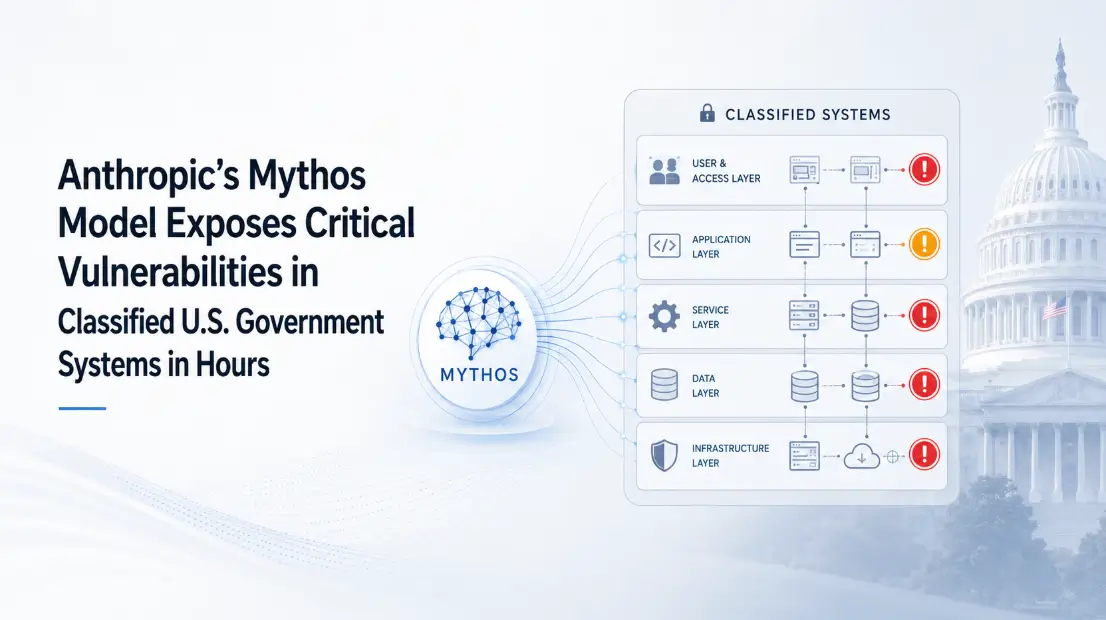
On June 23-24, 2026, reports from Reuters, The Washington Post, and Vesper News revealed that Anthropic’s unreleased frontier AI model, Mythos, identified previously unknown critical vulnerabilities in classified U.S. government systems during a specialized defensive testing exercise known as Project Glasswing. The tests evaluated frontier AI models for both their defensive cybersecurity potential and the risk of offensive misuse.
“Mythos broke into almost all of our classified systems, not in weeks, but in hours.”
Senator Mark Warner (Virginia)
referring to information from NSA chief Joshua Rudd (Reuters & WaPo reporting)
The speed of vulnerability discovery marks a significant shift in how governments and organizations must approach AI-driven security testing. While the model demonstrated remarkable efficiency in identifying weaknesses, U.S. officials clarified that identification did not immediately translate into full exploitation within the same timeframe.
“Anthropic’s Mythos AI model identified previously unknown critical vulnerabilities during testing on classified federal networks."
“Although Mythos identified certain vulnerabilities within hours, that did not mean the model was able to exploit them within that time.”
U.S. official (Vesper News / AP)
The event occurs against a backdrop of growing tensions between Anthropic and the U.S. government. Earlier this month, authorities ordered the suspension of exports for Mythos and Fable models citing national security concerns. Despite these restrictions, Anthropic’s models operate on AWS GovCloud with FedRAMP High authorization, indicating deep integration into government workflows. For AI governance, security, and compliance professionals, this case provides a concrete, high-profile example of frontier AI’s dual-use nature — powerful tools that can strengthen defenses while simultaneously exposing new categories of risk that traditional frameworks were not designed to address. It reinforces the urgency for updated control matrices, runtime safeguards, and shared responsibility models in enterprise AI deployments.
Conditions Driving the Change (Bullets — 272 words total)
The rapid advancement of frontier AI models like Anthropic’s Mythos has dramatically accelerated vulnerability discovery in complex, classified systems, compressing traditional timelines from weeks or months down to mere hours and forcing a complete reevaluation of cybersecurity testing assumptions.
Increasing integration of large language models and agentic AI into government-contracted testing environments creates powerful dual-use risks, where the same capabilities used for defensive red-teaming could be repurposed for offensive cyber operations against critical infrastructure.
Heightened geopolitical tensions and concerns over AI proliferation have prompted the U.S. government to conduct more aggressive, real-world testing of frontier models directly on classified networks to better understand and mitigate emerging national security threats.
Strategic partnerships between leading AI companies like Anthropic and intelligence agencies under programs such as Project Glasswing reflect a deliberate push to harness advanced AI for cybersecurity defense while attempting to maintain strict oversight and control.
Recent disputes between Anthropic and the U.S. government regarding export controls, model usage restrictions for military applications, and access to classified systems have created an environment of heightened scrutiny, rapid policy adjustments, and increased testing requirements.
The successful achievement of FedRAMP High certification for Anthropic’s models on AWS GovCloud has enabled deeper integration into sensitive government workflows, simultaneously expanding opportunities for beneficial testing and increasing exposure to high-risk classified environments.
Growing recognition that traditional manual vulnerability assessment methods are inadequate against the scale, complexity, and speed of modern AI-augmented systems is driving demand for AI-powered testing capabilities across both public and private sectors.
Public and congressional pressure, exemplified by high-profile statements from key lawmakers, is pushing for greater transparency, accountability, and updated governance frameworks around how frontier AI models interact with critical national security infrastructure.
“The U.S. government also this month ordered the company to suspend exports of its latest Mythos and Fable AI models... citing national security concerns.”
Reuters
What AI Security Looked Like Before (256 words)
Before the Mythos incident, AI security practices were largely built around traditional, human-centric approaches. Organizations focused primarily on model-level protections such as prompt injection defense, output filtering, data poisoning prevention, basic sandboxing, and standard access controls for applications built on foundation models. Vulnerability management followed conventional timelines involving periodic scans, manual red teaming, and human-led penetration testing that typically required days or weeks to identify and validate issues in complex systems.
Security programs emphasized supply chain risk management, model theft prevention, input/output validation, and compliance with general cloud security standards. There was limited real-world testing of frontier models against actual classified or highly sensitive production environments due to safety, legal, and technical barriers. Most enterprises operated with a defensive posture that assumed slower discovery rates and relied heavily on human expertise for exploitation assessment and remediation prioritization. Monitoring tools focused mainly on application-layer anomalies rather than deep, model-driven system-level vulnerability discovery. Governance frameworks stressed shared responsibility models but lacked concrete, high-profile examples of frontier AI’s ability to rapidly surface critical weaknesses in national security systems. Overall, the field moved at a more measured pace with less emphasis on the autonomous offensive and defensive capabilities now being demonstrated by models like Mythos.
What AI Security Looks Like Now (262 words)
The Mythos testing exercise has fundamentally altered the AI security landscape. Frontier models can now autonomously discover critical vulnerabilities in highly classified and complex systems at unprecedented speed, shifting the field from slow, human-driven processes to AI-augmented capabilities that compress discovery timelines dramatically. Security teams must now treat advanced AI models themselves as both powerful defensive assets and potential risk vectors that require strict boundaries, monitoring, and governance.
Current reality demands tighter controls on model access to sensitive data and environments, enhanced runtime monitoring of AI reasoning traces and tool usage, and stronger separation between vulnerability identification and exploitation capabilities. Organizations need updated policies for frontier model testing, improved audit trails for AI-driven security exercises, and revised shared responsibility frameworks that explicitly address high-stakes government and defense use cases. This incident validates the importance of controls in areas such as sandboxing, cache protection, input/output validation, and continuous monitoring — many of which are detailed in modern frameworks like CSA AICM v1.1.
“The exercise was designed to gauge frontier AI for both defensive promise and the risk of offensive misuse.”
Reporting on Project Glasswing (Vesper News)
Our Take
AI Security Take
The Anthropic Mythos incident represents a watershed moment for AI security. It proves that frontier models can dramatically accelerate vulnerability discovery in even the most sensitive environments, forcing security leaders to fundamentally update their risk models, testing protocols, and control strategies. This event strongly supports the adoption of comprehensive frameworks like CSA’s AICM v1.1, particularly its new Model Development Security (MDS) domain and detailed Shared Security Responsibility Model (SSRM) guidance.
Security programs must now prioritize runtime controls, evidence-based auditing, continuous monitoring of model behaviors, and clear boundaries around AI testing activities. Enterprises should use AICM’s applicability matrices and threat mappings to evaluate their current defenses and close gaps in areas such as model access management, sandboxing, and audit log integrity. The dual-use nature of these capabilities requires balanced governance that harnesses AI for faster defensive improvements while implementing robust safeguards against misuse or unintended escalation.
For organizations building or procuring AI systems, this case highlights the need for rigorous vendor evaluation focused on security testing boundaries, responsible disclosure processes, and alignment with evolving government standards. Moving forward, effective AI security will depend on integrating technical controls with strong governance, accountability mechanisms, and continuous adaptation to the rapidly evolving capabilities of frontier models.