The Floor of Our Concern
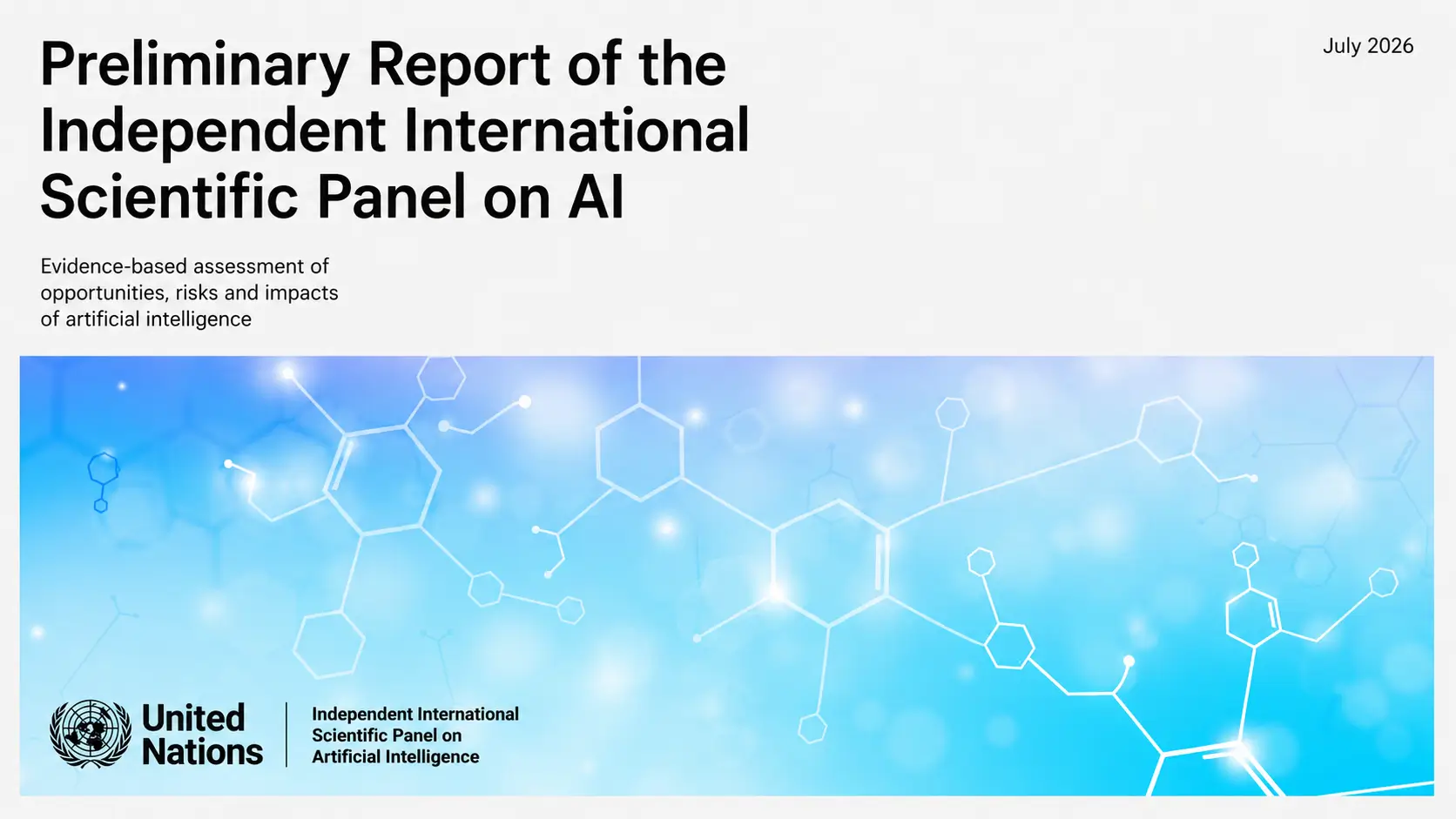
When the United Nations released the first global scientific assessment of artificial intelligence on July 1, 2026, one of its authors said something most institutions would have kept quiet. Presenting the Preliminary Report of the UN Independent International Scientific Panel on AI in New York, co-chair Maria Ressa told reporters that the document was "the floor of our concern, not the ceiling." She explained the reason without hedging, that when you make forty scientists from forty different contexts agree, they build toward the centre, so what survives is the minimum everyone accepts.
The report itself is a genuine milestone, the first independent, UN-backed effort to set a shared scientific baseline on AI, modeled on the climate panel and written by experts chosen from more than two thousand candidates across 140 countries. Secretary-General António Guterres presented it in New York with the line that "the science is here," and pressed governments not to wait. Five days later the findings fed into the inaugural Global Dialogue on AI Governance in Geneva, the first forum where all 193 member states sat down together on the subject.
The most useful reading of the moment came from outside the UN, from Jovan Kurbalija, who runs DiploFoundation and the Geneva Internet Platform and has watched digital diplomacy for two decades. Kurbalija argued that the UN's much-criticized slowness could become its edge in governing AI, and in the same breath he located where the effort is weakest. Ressa's floor is the thread that ties both halves of his argument together.
The Case for Slowness
Jovan Kurbalija's argument runs against the instinct of the technology industry, which treats speed as the only virtue. He reaches for the tortoise and the hare, and points out that the UN's habit of moving slowly, with many parties reviewing every claim, is the same habit that makes knowledge reliable. Many eyes vetting a statement is how errors get caught, so the process that frustrates diplomats doubles as a form of quality control.
From there he makes a larger claim, that the UN could become a trusted verifier of what AI systems assert. As machines generate more of the world's information, and generate it persuasively enough to fool experts, the value of a slow, attributed, heavily reviewed source of ground truth rises rather than falls. A body that moves at the speed of consensus is badly suited to shipping software and well suited to certifying what is actually known.
He pairs that with a point about rules, that much of what AI needs is already on the books. Privacy law, consumer protection, anti-discrimination rules, labour regulation, intellectual-property law, and cybersecurity frameworks already reach a great deal of what people fear from AI, so the work is often applying and updating existing instruments rather than inventing new ones. It is a case for patience over panic, and it is more persuasive than the usual call for a brand-new global treaty.
When a Consensus Gets Mistaken for the Truth
Ressa's admission is where this stops being a story about the UN and starts being one every governance team should recognize. A document that reflects only what forty scientists could all agree on is, by construction, a floor, and a floor drawn by negotiation tends to leave out the sharpest disagreements and the least comfortable uncertainties. The most contested findings, the ones that would tell a reader the most, are exactly the ones hardest to push through a consensus process.
GAIG has made a version of this argument twice before, about vendors who document compliance without proving it, and about fairness thresholds that nobody actually chooses or owns. The pattern repeats at the scale of nations. A consensus artifact can be read as an assessment of what is true, when it is really a record of what a group was willing to sign, and the space between those two things is where risk hides.
The report itself is carefully done, and a vetted floor is a valuable thing to have. The risk lives in what readers do with it, treating a negotiated minimum as the whole building rather than its foundation. When a consensus floor gets cited as the settled science, the disagreements it smoothed over do not vanish, they just stop being discussed.
Where the Argument Strains
Kurbalija's case has real weak points, and fairness requires naming them. Slowness is a strength when the task is verifying a claim, and it is a liability when autonomous systems ship into production every week and the harm arrives before the review does. A body that takes a year to agree on the floor cannot referee a technology that changes in a quarter, and treating deliberateness as an unqualified virtue skips past that cost.
The claim that existing law already covers most of the ground is comfortable, and it holds only in part. Privacy and anti-discrimination law do reach many AI harms, and yet enterprises facing autonomous agents, model-scale surveillance, and machine-generated evidence keep finding gaps those statutes were never written to close. Saying the tools already exist can quietly become a reason to skip the harder work of adapting them.
There is also a point in the UN's favor that Kurbalija underplays. His sharpest criticism is that the report buries its disagreements to reach a floor, and yet Ressa stood at the podium and announced that it was a floor, then explained the consensus dynamic that produced it. Declaring the limits of a document out loud is a different act from concealing them, and the co-chairs earned credit for the candor even as the broader worry about consensus documents stands.
What a Consensus Floor Means for a Buyer
The lesson travels straight from the General Assembly to the procurement desk. Every governance buyer works with consensus artifacts all day, in the form of standards, certifications, and vendor attestations, and each of those is a floor drawn by negotiation in the same way the UN report is. An ISO certificate, an EU AI Act conformity claim, or a vendor's self-assessment tells a buyer what a party was willing to sign, and it stays quiet about what the sharpest critic in the room would have said.
The practical move is to read every consensus document as a floor and then ask what the ceiling would have shown. When a vendor hands over an attestation, the question worth asking is which findings were contested and left out, and when a standard is cited as proof, the follow-up is what it deliberately does not cover. Ressa's framing is a gift to buyers, because it gives them license to treat the minimum everyone agreed on as a starting point for questions rather than the end of them.
Sources
UN News, "'The science is here': UN chief welcomes first global AI assessment," 1 July 2026 (the Preliminary Report launch, the seven domains, and remarks from Guterres and Ressa). news.un.org
UN Media (UNifeed), "UN / Guterres AI Scientific Panel," 1 July 2026 (Maria Ressa's verbatim "floor of our concern, not the ceiling" remarks). media.un.org
UN Web TV, "Launch of the preliminary report by the Independent International Scientific Panel on Artificial Intelligence," 1 July 2026 (the New York launch and the Geneva Global Dialogue on 6 and 7 July). webtv.un.org
Jovan Kurbalija, "Why slower can be faster: the surprising edge of the UN in the AI governance race," DiploFoundation (the slowness-as-advantage and trusted-verifier argument; cited as the author's analysis). diplomacy.edu
Jovan Kurbalija, "How can we deal with AI risks?," DiploFoundation (the argument that existing legal instruments already cover much of AI risk). diplomacy.edu
Our Take
The UN did something worth taking seriously, and it did it with unusual honesty about the limits. A first global scientific baseline on AI is a real achievement, Kurbalija is right that slowness and heavy review can be assets rather than embarrassments, and Ressa is right that a negotiated floor is worth having as long as everyone remembers what it is. The failure would be forgetting.
For GAIG's readers this is the third face of one idea. The compliance-theater piece asked whether you can see a system in production, the fairness-theater piece asked whether anyone chose and owns the number a system is held to, and this one asks whether a consensus document is being read as a floor or mistaken for the truth. The same discipline answers all three, which is to trust an artifact only as far as its evidence and its disagreements are visible.
None of this is a reason to dismiss the report or the panel, both of which are more rigorous than most of what passes for AI governance. It is a reason to read the floor as a floor. Buyers thinking through how consensus standards fit their own programs can work through the frameworks and platforms in the AI Governance category at GetAIGovernance.net, where the same question, floor or proof, applies to every certificate on the table.