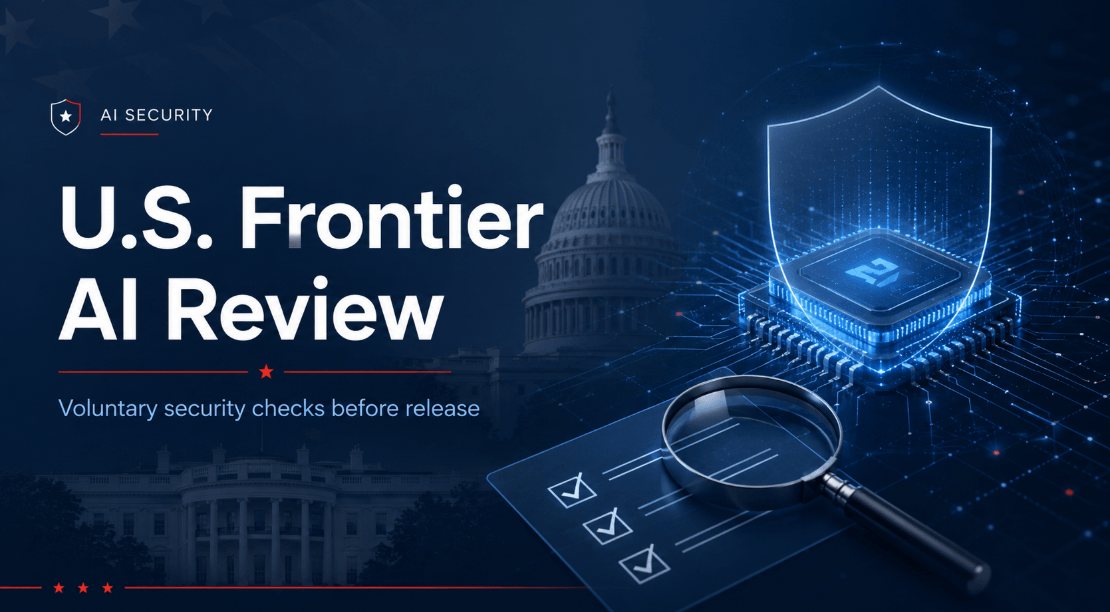
President Donald Trump signed an executive order on June 2, 2026, creating a voluntary framework for AI companies to submit their most powerful frontier models to the federal government for review up to 30 days before they are released to the public. The order is primarily focused on assessing cybersecurity and national security risks associated with advanced AI systems.
The executive order directs agencies, including the National Security Agency, to develop a classified benchmarking process to evaluate the national security implications of advanced AI models. It also calls for the creation of a cybersecurity clearinghouse through voluntary partnerships between AI developers and critical infrastructure operators to identify and address vulnerabilities uncovered by these models.
The order explicitly states that it does not authorize mandatory government licensing, preclearance, or permitting for AI models. This reflects the administration’s stated goal of balancing national security concerns with the need to maintain U.S. leadership in AI innovation.
“Advanced AI capabilities make our Nation stronger, but also introduce new national security considerations that require coordinated action across executive departments and agencies,” the order reads.
administration will “continue to lead an America First cybersecurity effort that enhances both our national security and our global AI dominance.”
Donald Trump
President of United States of America
The move comes after the White House postponed an earlier planned announcement, with Trump previously expressing concern about anything that could slow America’s AI advantage over competitors like China. Several AI companies, including Anthropic, have publicly welcomed the order as a constructive step.
Conditions Driving This Change
The rapid advancement of frontier AI models with sophisticated cyber capabilities has created genuine national security concerns for U.S. government agencies, as these systems can now autonomously discover vulnerabilities, generate exploit code, and potentially disrupt critical infrastructure at a speed and scale previously unseen.
The Trump administration has made clear that it views artificial intelligence as a core domain of strategic competition with China, and it is determined to maintain American technological superiority without imposing regulatory burdens that could slow domestic innovation or drive talent and investment overseas.
Previous attempts to establish more prescriptive oversight of frontier AI models, including drafts considered earlier in the administration, were ultimately scaled back after concerns that mandatory review or licensing requirements would create a chilling effect on innovation and give foreign competitors an advantage.
AI companies themselves have grown increasingly vocal about the risks of fragmented or overly aggressive regulation, pushing instead for predictable, light-touch frameworks that allow them to move quickly while still addressing legitimate government security interests.
The federal government currently lacks systematic visibility into the capabilities of the most advanced AI models before they are released, creating a blind spot around potential new cyber threats that could be exploited by adversaries or misused by malicious actors.
Critical infrastructure operators and government agencies are increasingly exposed to AI-augmented cyber attacks, and there is growing recognition that traditional cybersecurity defenses are being outpaced by AI systems capable of identifying and exploiting vulnerabilities faster than human defenders can respond.
The administration is seeking to establish a middle path between the more regulatory approach taken in the prior administration and a complete hands-off stance, using voluntary mechanisms to gain insight into frontier models while preserving the U.S. position as the global leader in AI development.
Industry leaders have signaled willingness to engage in structured, voluntary information sharing with the government on the most powerful models, provided it does not evolve into mandatory preclearance or create competitive disadvantages for U.S. companies relative to those operating in less regulated jurisdictions.
Geopolitical realities, including China’s aggressive state-backed push in AI and documented efforts to acquire Western AI technology, have heightened the urgency for the U.S. government to develop better mechanisms for understanding and mitigating risks associated with the most advanced AI systems.
The executive order reflects a broader philosophical shift under the current administration toward “America First” technology policy — one that prioritizes national security and economic competitiveness while rejecting what it views as unnecessary bureaucratic obstacles to innovation that were present in earlier regulatory proposals.
What It Looked Like Before
Prior to this executive order, the U.S. government had no formal, standing process to review the most advanced AI models before they were released to the public. While the previous administration had issued a broader executive order on artificial intelligence in 2023 that included reporting requirements for certain large models, many of those provisions were later scaled back or deprioritized under the current administration, which viewed them as overly regulatory and potentially harmful to American innovation.
As a result, frontier AI labs were releasing increasingly powerful models — some with significant cyber capabilities — with very little structured visibility or input from national security agencies. Government officials had expressed growing concern about the speed at which new AI systems could discover vulnerabilities, generate exploits, and potentially be used to target critical infrastructure, yet there was no established mechanism for the intelligence community or cybersecurity agencies to assess these risks in advance.
The absence of a coordinated framework also created uncertainty for AI companies. Some labs voluntarily engaged with government stakeholders on safety and security issues, but these interactions were ad hoc and inconsistent. There was no standardized process for evaluating the national security implications of frontier models, nor was there a clear signal from the federal government about what level of transparency it expected from developers of the most advanced systems. This environment left both policymakers and industry operating with limited visibility into emerging risks at a time when AI capabilities were advancing rapidly.
What It Looks Like Now
The new executive order establishes a voluntary but structured process for the federal government to review frontier AI models with advanced cyber capabilities before they are released. Under the order, AI developers are encouraged to provide the government with access to their most powerful models up to 30 days prior to broader release, giving agencies time to assess potential national security and cybersecurity risks.
The order directs the National Security Agency, in coordination with other agencies, to develop a classified benchmarking process to evaluate the national security implications of advanced AI systems. It also calls for the creation of a cybersecurity clearinghouse to facilitate voluntary information sharing between AI developers and operators of critical infrastructure, with the goal of identifying and mitigating vulnerabilities that these models may uncover or exploit.
Importantly, the order explicitly states that it does not authorize the creation of any mandatory licensing, preclearance, or permitting regime for AI models. This distinction has been welcomed by parts of the AI industry as a more balanced approach.
“Advanced AI capabilities make our Nation stronger, but also introduce new national security considerations that require coordinated action across executive departments and agencies,”
The White House has emphasized that the framework is designed to avoid “chilling effects on free speech and innovation” that could result from heavier-handed oversight.
Several AI companies have responded positively. Anthropic described the order as “an important step in strengthening America’s leadership in AI,” while OpenAI’s Chris Lehane noted that effective safety frameworks should continue to be developed through democratic institutions informed by technical expertise.
Our Take
AI Compliance Take
Trump’s executive order represents a notable shift in the U.S. government’s approach to frontier AI oversight. Rather than pursuing mandatory licensing or broad regulatory requirements, the administration has opted for a voluntary, security-focused framework centered on cybersecurity and national security risks. This reflects a deliberate policy choice to maintain U.S. technological leadership while still creating a structured channel for government visibility into the most powerful AI models.
For compliance and governance teams at AI companies, this order introduces a new set of considerations. While participation is explicitly voluntary, companies developing frontier models — particularly those with advanced cyber capabilities — will likely face increasing expectations from government stakeholders, customers in critical infrastructure sectors, and investors to engage with the review process. The 30-day pre-release window, even if voluntary, creates a practical timeline that organizations will need to factor into their release planning and internal governance processes.
The order also reinforces the growing importance of cybersecurity risk assessments as a core component of frontier AI governance. Companies will need to be prepared to evaluate and articulate the potential national security implications of their most advanced models, not just traditional safety and alignment concerns. This may require new internal capabilities, closer coordination between security, policy, and product teams, and more sophisticated documentation of model capabilities and risks.
At the same time, the explicit rejection of mandatory preclearance or licensing provides meaningful regulatory clarity. Organizations can continue to innovate and release models without needing formal government approval, reducing one of the biggest concerns many AI developers had about potential future regulation. The real compliance challenge going forward will likely center on how companies choose to engage with this voluntary framework — and whether declining to participate creates reputational or commercial risks even in the absence of legal requirements.