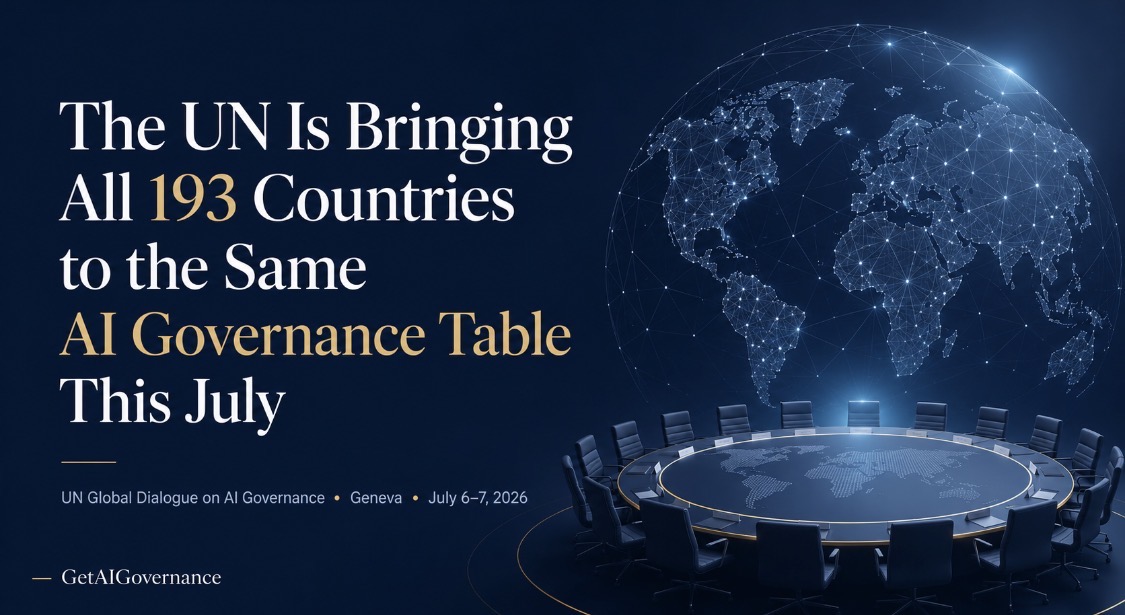
In five weeks, Geneva becomes the center of the most consequential multilateral conversation about AI governance that has ever been attempted. The UN's inaugural Global Dialogue on AI Governance runs July 6 and 7 at the Palexpo convention center, immediately before ITU's AI for Good summit, and it will bring together all 193 UN member states alongside private sector organizations, civil society groups, academia, and the technical community in a format that no prior international AI summit has managed: a room where every country, not just the well-resourced ones, gets to participate in shaping the rules.
A Council on Foreign Relations analysis published today by Tony Oweke — a CFR research fellow who previously represented a bloc of 134 developing nations in the actual UN negotiations that produced this dialogue — gives the most credible available account of what this forum is, what it's trying to accomplish, and what happens if it doesn't work.
"The United Nations remains the sole universal platform through which every country can participate in shaping global governance."
Tony Oweke
Research Fellow, Council on Foreign Relations
May 29, 2026
Oweke's framing is careful and worth taking seriously precisely because he wrote it from the inside. Most analysis of multilateral AI governance comes from observers. This comes from a practitioner who sat in those negotiating rooms and watched how countries with very different economic realities, technological capabilities, and security calculations tried to find common ground — and how quickly fragmentation takes hold when they can't.
What Led The UN To Initiate This?
The summit circuit that produced the Bletchley Declaration in 2023, the Seoul commitments in 2024, the Paris focus on investment and adoption in 2025, and India's February 2026 summit centering Global South voices has generated significant political attention. It has not generated coordinated governance outcomes. Oweke documents this gap plainly: the summits have mobilized attention and resources but have struggled to translate high-level commitments into durable rules that countries actually follow.
The UN Dialogue is designed to address a structural problem those summits couldn't solve. When AI governance has been shaped primarily through exclusive multilateral clubs — the G7, the OECD, bilateral partnerships between the US, EU, and a handful of other first-mover countries — more than 80 countries advancing their own AI strategies or legislation do so based on different regulatory philosophies, different developmental priorities, and different assumptions about whose rules should apply when AI crosses borders. The result, as Oweke describes it, is normative competition: countries racing to extend their governance models to other nations because whichever model wins adoption first tends to lock in the strategic, economic, and regulatory advantages of whoever wrote it.
Delhi, Brasília, and Jakarta have become active participants in this competition over the past two years, each seeking greater control over the AI capabilities, infrastructure, and governance arrangements that will shape their digital futures. More than 80 countries now have AI strategies or legislation in place. When those frameworks are incompatible with each other, an AI system deployed across borders can simultaneously comply with the rules in its country of origin and violate the obligations that apply in the country where its outputs land.
"AI is moving at the speed of light. No country can see the full picture alone. We need shared understandings to build effective guardrails, unlock innovation for the common good, and foster cooperation."
UN Secretary-General António Guterres
February 2026
What the international AI governance landscape looked like before this
Before the Global Digital Compact was adopted in September 2024, international AI governance was a collection of overlapping but uncoordinated initiatives with no universal participation and no mechanism for translating political declarations into binding or even consistent commitments.
The Bletchley Declaration of 2023 was a genuine first step — it created shared vocabulary around frontier AI risk and established AI safety as a matter for coordinated international action. But it was signed by a limited set of countries and produced no enforcement mechanism. The Seoul summit in 2024 established a network of AI safety institutes across ten countries and the EU, which was meaningful but still excluded the majority of the world's nations from the process that produced it.
THE SUMMIT CIRCUIT: WHAT EACH MEETING PRODUCED
Bletchley Park, November 2023:Shared vocabulary on frontier AI risk. AI safety established as a matter for international coordination. Bletchley Declaration signed. AI Safety Institutes catalyzed.
Seoul, May 2024: Commitment to a network of AI safety institutes across ten countries and the EU. Ministerial-level engagement deepened.
Paris, February 2025: Shift from safety focus toward investment and adoption. Funding pledges and commercial deals dominated the agenda.
New Delhi, February 2026: Global South voices centered explicitly. Broad participation but outcomes still non-binding and unevenly implemented.
Geneva, July 2026: First session of the UN Global Dialogue — all 193 member states, binding to no one yet, but with a review process that could produce an international legal instrument on AI by 2028.
The pattern across these summits is consistent: broad political commitment, uneven implementation, no universal participation. The countries doing the most to shape AI governance norms have tended to be the countries with the most resources to develop AI systems, which has produced rules that reflect the concerns and priorities of those countries more than the countries that will live under the rules they didn't write.
Many of the nations that drove the creation of the UN Dialogue frame their participation specifically as a preventive measure. Having watched how difficult it is to change inequitable structures after they've been established — in tax policy, in debt restructuring, in intellectual property frameworks — developing countries are trying to get into the room before the AI governance rules are finalized rather than after. That's the political logic behind why the Global Digital Compact passed with the support it did, and it's why the July session carries weight beyond its immediate agenda.
What Are Actually Trying To Change
The first session of the Global Dialogue convenes July 6 and 7, 2026 at the Palexpo International Exhibition and Congress Centre in Geneva, alongside the AI for Good Global Summit and the annual World Summit on the Information Society meetings. The format includes high-level governmental plenary segments, multistakeholder exchanges, and thematic discussions organized around clusters covering safe and trustworthy AI, human rights and accountability, socioeconomic implications, and bridging AI divides between well-resourced and resource-constrained countries.
Submissions to the call for inputs will help inform the first session, with intergovernmental consultations designed to produce common priority areas for AI governance. Those priorities will feed into the GDC review process, which Oweke describes as the moment when member states will decide whether to deepen the UN's AI mandate — potentially including the launch of an intergovernmental process aimed at producing an international legal instrument on AI — or shut it down if the institutions are judged ineffective.
The Independent International Scientific Panel on AI will present its first annual report at the session. The AI Dialogue is described by the UN as the world's first international platform convened by the UN General Assembly where all governments and stakeholders sit at the same table — which is both an accurate description of the forum's structure and an indicator of how far international AI governance had to travel before reaching even this starting point.
Oweke is careful to note what the Dialogue can and cannot deliver in the near term. The summaries from Geneva and a parallel New York session will inform intergovernmental consultations rather than produce binding outcomes. The concrete impact path runs through the GDC review in 2027 or 2028, not through the July session itself. That timeline is frustrating for anyone who thinks the pace of AI deployment warrants faster governance responses — and it should be, because by the time the GDC review happens, the systems being deployed today will have been operating in production for two or more years under whatever national frameworks exist right now.
Our Take
AI GOVERNANCE TAKE
The CFR analysis is worth reading in full. Tony Oweke is one of the few people who has sat in both the technical AI governance conversations and the multilateral negotiating rooms, and his framing of the Dialogue's value proposition — legitimacy for the countries that have historically been governed by rules they didn't write — is more honest about the political dynamics than most international AI policy coverage manages to be.
The enterprise governance implication is straightforward even if the international policy process isn't. Organizations building AI compliance programs right now are doing so in an environment where the international framework is still being negotiated. The EU AI Act is the most consequential binding instrument in place, with high-risk obligations enforceable in August. Everything above that level — international standards, cross-border accountability frameworks, mutual recognition agreements — is still in process. What Geneva produces in July and what the GDC review produces in 2027 or 2028 will determine how much of the compliance work organizations are doing today needs to be rebuilt when international standards eventually arrive.
Building programs around the EU AI Act's technical documentation and post-market monitoring requirements is the most defensible near-term approach, because those requirements are specific enough to implement and likely to be referenced by whatever international framework comes next. Browse the AI Compliance category in the marketplace for platforms helping organizations navigate this period, or submit an inquiry to get matched with the right compliance infrastructure for your current regulatory footprin