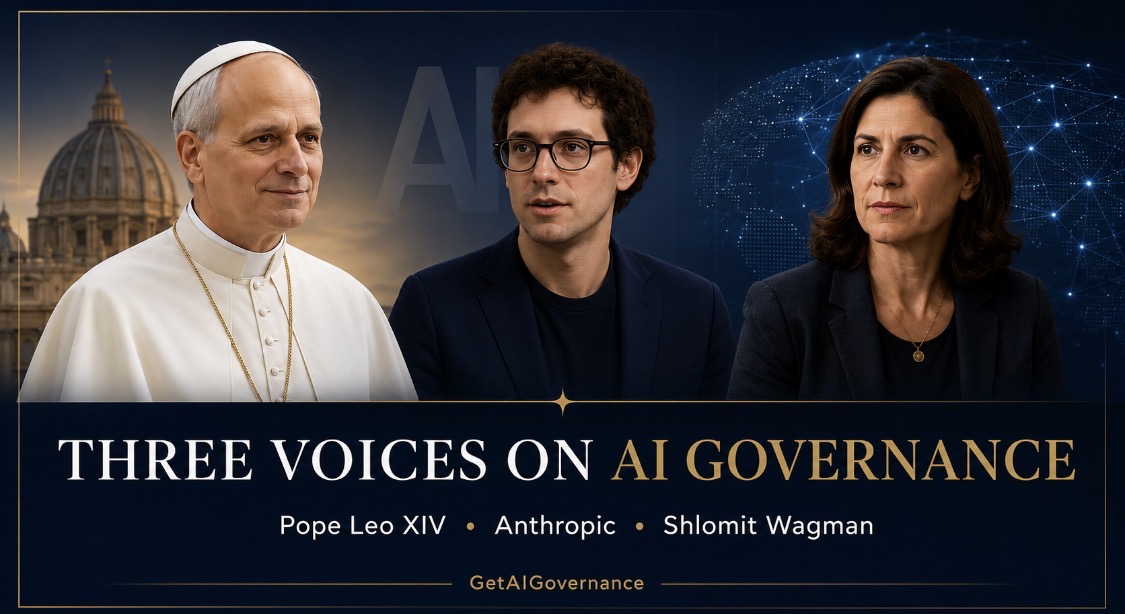
On May 25, Pope Leo XIV released Magnifica Humanitas — his first encyclical, a 42,300-word papal document carrying the full weight of Catholic moral teaching — calling on governments, corporations, and individuals to ensure that AI remains subject to ethical and political oversight. Leo signed the document on May 15, exactly 135 years to the day after his namesake Pope Leo XIII signed Rerum Novarum, his landmark encyclical on the rights of workers during the industrial revolution. The timing was deliberate. Leo has described the rise of AI as the defining moral test of this era in the same terms his predecessor described industrialization.
Standing in the Vatican's Synod Hall that day, seated alongside cardinals and theologians addressing a room assembled specifically for this moment, was Christopher Olah — 33 years old, co-founder of Anthropic, and a self-described atheist. He was there because the Vatican invited him. The presence of an AI lab co-founder at a papal encyclical presentation is the kind of thing that gets noticed in policy circles and dismissed in others, but the substance of what Olah said in that room deserves more attention than the optics of the occasion.
"Every frontier AI lab — including Anthropic — operates inside a set of incentives and constraints that can sometimes conflict with doing the right thing. The pressure to stay commercially viable and to stay at the research frontier."
Christopher Olah Co-founder, Anthropic
Vatican presentation, May 25, 2026
Olah went on to say that if AI is going to go well for humanity, it needs people outside those incentives — people willing to say hard things, willing to be AI companies' earnest and thoughtful critics — paying close attention and insisting on safety. That's an AI company co-founder telling the world, from the Vatican, that his own industry cannot be trusted to govern itself. Not as a regulatory concession or a PR move. As a structural observation about how competitive markets actually work.
KEY TERMS
Magnifica Humanitas
Pope Leo XIV's first encyclical, released May 25, 2026. Title translates as "Magnificent Humanity." A 42,300-word document calling for ethical and political oversight of AI and urging that the technology be developed in service of human dignity rather than as an end in itself.
Encyclical
Among the most authoritative forms of papal teaching in the Catholic Church. Encyclicals carry the pope's full theological and moral weight and are addressed to all Catholic clergy and laity globally — approximately 1.4 billion people.
FATF
The Financial Action Task Force. A G20-established intergovernmental body that sets international standards for combating money laundering and terrorist financing. FATF operates through a system of shared norms, national implementation obligations, independent expert review, and real consequences — including grey-listing and black-listing — for non-compliance.
Constitutional AI
Anthropic's internal alignment methodology, which trains AI systems against a defined set of principles rather than pure human feedback. An example of internal governance that Wagman and Olah both acknowledge cannot substitute for external accountability structures.
Collective Action Failure
A situation where all parties understand a shared risk but none have the individual incentive to absorb the full cost of solving it. Wagman argues AI governance is a textbook example — every company and government understands the risk, but unilateral restraint in a competitive environment is a strategic liability.
What Shlomit Wagman is arguing
Five days after the Vatican presentation, Dr. Shlomit Wagman published a commentary in Fortune that arrives at the same conclusion from a completely different viewpoint. Wagman is a fellow at Harvard Kennedy School's Mossavar-Rahmani Center for Business and Government and founder of Integria AI. Before that, she was Israel's financial intelligence chief. Before that, she spent years designing and evaluating the international standards used to combat money laundering and terrorist financing — including leading international coordination against ISIS financing and shaping the cryptocurrency compliance framework now adopted by more than 120 countries.
Her credentials matter for this specific argument because she's not a policy theorist. She's someone who has sat in rooms where countries that don't trust each other tried to build shared accountability mechanisms for a problem none of them could solve alone — and watched which approaches held and which collapsed. Her argument about what AI governance should look like is built on that operational experience, not on analogies borrowed from other domains.
The analogy most people reach for when discussing AI governance architecture is nuclear arms control. Wagman says this is the wrong analogy, and she explains why with precision. Nuclear weapons were state programs with identifiable facilities and verifiable tests. Inspectors could go somewhere and look for something. Advanced AI is developed by private actors on commercial cloud infrastructure already embedded globally, running on hardware that is itself distributed and commercially available. There is no facility to inspect, no test to detect, no state program to negotiate with. Nuclear arms control architecture was designed for a world where the dangerous thing was big, stationary, and government-owned. AI is none of those things.
The FATF Model Presented
The framework Wagman proposes instead is the one she helped build: the Financial Action Task Force model for global financial crime compliance. The parallel deserves to be laid out carefully because it's more precise than it might initially appear.
WHY FINANCE FITS BETTER THAN NUCLEAR
NUCLEAR ARMS CONTROL
State programs with identifiable facilities. Verifiable tests through detection technology. Governance works through bilateral or multilateral treaties between governments. Decades-long ratification processes. Doesn't address private actors on commercial infrastructure.
FINANCIAL CRIME / FATF MODEL
Private actors competing across jurisdictions, connected in real time, with systemic risk no single institution contains alone. Governance works through shared norms, operational standards, obligations on both governments and private sector, independent expert review, and real consequences for non-compliance. Changed behavior at scale without a treaty ratification process.
Banks compete fiercely across jurisdictions. They are connected in real time across borders. The risks they create — terrorist financing, money laundering, systemic financial instability — cannot be managed by any single institution or government acting alone. These are exactly the structural features that make AI governance hard. And the FATF model addressed them through a mechanism that distributed accountability broadly enough to make evasion genuinely costly rather than merely inconvenient.
HOW THE FATF MODEL ACTUALLY WORKS
Shared norms first. The process starts with high-level standards that command genuine consensus — not technical specifications that become obsolete within months, but outcome-based criteria for what compliant behavior looks like in practice.
National implementation with real obligations. Member countries don't just endorse the norms — they are assessed against them. Independent expert panels review whether governments and the private sector within their jurisdictions are actually meeting the standards, not just claiming to.
Consequences that are real. Non-compliance means grey-listing or black-listing, which carries direct economic consequences: reduced correspondent banking relationships, heightened scrutiny on all financial transactions, capital flight. Compliance unlocks trust, market access, and international cooperation.
Both governments and private sector carry obligations. Financial institutions are not passive objects of government regulation. They have affirmative compliance obligations, reporting requirements, and liability for failures. The accountability is distributed, not concentrated.
Wagman argues that a workable AI governance architecture needs the same four components: shared norms that reflect genuine consensus, criteria based on real-world outcomes rather than technical processes, independent expert review panels with both public and private sector representation, and consequences — compliance unlocks trust and market access, non-compliance carries escalating costs. She specifically calls for a bilateral US-China understanding as necessary but insufficient, and for a broader coalition like the G20 to create the kind of durable pressure that makes restraint rational rather than suicidal from a competitive standpoint.
Why Is This So Important Though?
The reason this week's events sit together is that three different voices — a Pope, an AI company co-founder, and a former financial intelligence chief — have arrived at the same structural diagnosis from entirely different starting points. The diagnosis is this: AI governance is a collective action failure. Everyone understands the risk. Nobody has the individual incentive to absorb the full cost of solving it. Internal governance — Constitutional AI, Responsible Scaling Policies, internal red teams — is serious work but it cannot resolve an external problem. A company that slows down when a rival does not has made itself weaker without making the world safer. The same logic applies to states.
Anthropic's CEO Dario Amodei has said publicly that "the next tier of risk is actually AI companies themselves" and that AI leaders, including himself, should not be the ones deciding the technology's future. Olah said at the Vatican that the incentive problem inside AI companies is real and structural, not a matter of individual character. Leo said in Magnifica Humanitas that the church's moral obligation is to ensure AI remains subject to human oversight. Wagman said in Fortune that the governance architecture to accomplish this already exists in the form of a model that has already worked at comparable scale.
"Some credible estimates place Artificial General Intelligence — systems more capable than humans across most domains — as early as 2030. When machines surpass human capability, humanity's only adequate response is a collective one."
Dr. Shlomit Wagman, Harvard Kennedy School Fellow — Fortune, May 30, 2026
The convergence from opposite ends of human authority — moral and commercial — is the data point that Wagman says policymakers cannot dismiss. She's right about that. The fact that Christopher Olah was in the Vatican at all is a signal that Anthropic views external governance pressure not as a threat to manage but as a structural necessity for the industry to function with any long-term credibility. The fact that Leo chose to frame his first encyclical around AI — not climate, not war, not poverty, but AI — tells you something about the moral weight the Catholic Church assigns to this specific question at this specific moment.
Sources
Dr. Shlomit Wagman — "I helped design the system that brought down ISIS financing. I've got an AI governance idea the Pope and Anthropic would both like." Fortune, May 30, 2026. fortune.com
Anthropic — Full text of Christopher Olah's remarks at the Vatican presentation of Magnifica Humanitas, May 25, 2026. anthropic.com
National Catholic Reporter — "Pope Leo, Anthropic co-founder call for church-tech ethics partnership at 'Magnifica Humanitas' release," May 25, 2026. ncronline.org
National Catholic Reporter — "Pope Leo calls to 'disarm' AI in major document, warns of technologic threats to humanity," May 31, 2026. ncronline.org
TIME — "Pope Leo Uses First Major Papal Text to Warn About Dangers of AI," May 25, 2026. 42,300-word encyclical confirmed. time.com
National Catholic Reporter — "Why is AI company Anthropic helping launch Pope Leo XIV's encyclical?" ncronline.org
PBS NewsHour — "Pope Leo XIV to launch his first encyclical on artificial intelligence with Anthropic's co-founder," May 2026. Vatican presentation format confirmed. pbs.org
America Magazine — "Pope Leo will publish first encyclical, 'Magnifica Humanitas,' on preserving humanity in the A.I. age on May 25." Signing date confirmed as May 15 — 135 years after Leo XIII's Rerum Novarum. americamagazine.org
Dario Amodei quote — "the next tier of risk is actually AI companies themselves" — cited in Wagman's Fortune piece, May 30, 2026.
UN Global Dialogue on AI Governance — July 6-7, 2026, Geneva. GetAIGovernance.net coverage
AI Compliance Certifications, Frameworks, and Laws Explained — GetAIGovernance.net.
Our Take
AI GOVERNANCE TAKE
The FATF model argument is the most operationally grounded proposal for international AI governance architecture that has been put forward by anyone with the direct experience to evaluate whether it would actually work. Wagman isn't speculating about whether distributed accountability across governments and private sector actors is achievable at scale. She helped build a version of it that functioned well enough to disrupt ISIS financing across more than 120 countries. That's a meaningful data point about what's possible, and it makes her proposal worth taking seriously in a policy conversation that has generated a lot of declarations and very few mechanisms with real enforcement teeth.
The enterprise governance implication is direct. The accountability gap that shows up at the international level — everyone understands the risk, nobody has the incentive to solve it alone — is the same gap that shows up inside organizations whose AI governance programs produce documentation without producing accountable human action. The fix at both levels is the same: shared norms, outcome-based criteria, independent review, and consequences that are real. Governance theater exists at every scale. The structural solution is identical regardless of which scale you're working at.