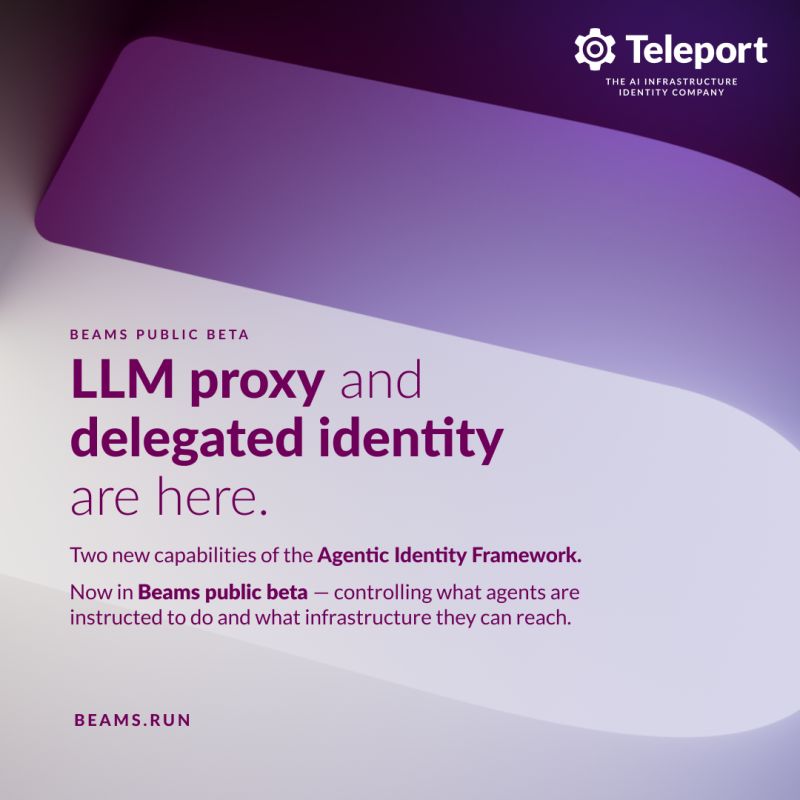
Teleport has launched Beams, an LLM Proxy designed to bring delegated identity and secure access controls to AI agents operating in enterprise environments. The release is part of Teleport’s larger Agentic Identity Framework and represents a significant step toward making agentic AI systems production-ready from a security and access perspective.
As organizations begin moving AI agents beyond simple chat interfaces and into systems that interact with real infrastructure, databases, and internal tools, the need for proper identity and access management becomes critical. Without clear identity boundaries, agents can gain excessive or unclear permissions, creating serious security and compliance risks.
Beams is designed to act as a secure proxy layer between AI models and the systems they need to access. It allows organizations to assign specific, limited identities to agents rather than giving them broad or shared credentials. This approach helps enforce the principle of least privilege while still enabling agents to perform useful work across enterprise systems.
“Delegated identity and LLM Proxy, all parts of Agentic Identity Framework unblock enterprise organizations from deploying agentic workloads interfacing with real infrastructure, making a leap from vibe-coding and prototyping to real production engineering,”
Alexander Klizhentas
CTO of Teleport.
The launch reflects growing demand for infrastructure-level controls that can support the next wave of AI adoption, where agents are expected to take meaningful actions inside production environments rather than remaining isolated in sandboxed settings.
Conditions Driving the Change
Several factors are accelerating the need for delegated identity solutions for AI agents:
Organizations are moving AI agents from experimental use cases into production environments where they must interact with real systems and data.
Traditional identity and access management tools were built for human users and service accounts, not for autonomous AI agents that can make dynamic decisions.
Many current agent implementations rely on overly permissive or shared credentials, creating significant security and compliance risks.
As agents gain more autonomy and tool access, the potential blast radius of a compromised or misbehaving agent increases dramatically.
Security teams are being asked to govern AI agents without clear frameworks or tools designed specifically for this new class of identity.
Regulatory and audit requirements are beginning to extend to AI-driven actions, requiring better traceability and accountability.
Enterprises want to enable useful agentic workflows while maintaining strong security boundaries and least-privilege access.
The gap between rapid AI prototyping and secure production deployment has become a major blocker for many organizations.
Existing infrastructure access tools lack native support for the dynamic, context-aware access patterns that agentic systems require.
There is increasing recognition that AI agents need their own identity layer rather than borrowing human or static service account credentials.
These conditions have created strong demand for solutions that can provide secure, delegated identity specifically designed for AI agents.
What AI Security Looked Like Before
Before tools like Teleport Beams, organizations attempting to give AI agents access to infrastructure typically relied on existing identity systems that were not built for this use case. Most teams either used static service accounts with broad permissions or tried to extend human user identities to agents. Both approaches created serious limitations.
Service accounts often had excessive privileges because it was difficult to define granular, context-aware access rules for agents that might need to perform a wide range of tasks. This approach increased the risk of unauthorized access or unintended actions. At the same time, it made auditing and accountability difficult, since it was often unclear which specific agent or workflow had taken a particular action.
Human user identities were also poorly suited for agents. These identities were designed around human login patterns and approval workflows, not around autonomous systems making decisions in real time. As a result, organizations either gave agents too much access or had to build complex, fragile workarounds to make existing tools work. Overall, AI security and access control in this area was immature. Most solutions treated agents as an afterthought rather than designing identity and access controls specifically for autonomous, tool-using systems.
What AI Security Looks Like Now
With the introduction of solutions like Teleport Beams, organizations now have access to identity and access tools specifically designed for AI agents. Delegated identity allows agents to operate with clearly defined, limited permissions that can be scoped to specific tasks, tools, and time windows. This approach enables more secure and auditable agentic workflows. Instead of relying on overly broad service accounts, organizations can assign agents their own identities with precise access boundaries. This reduces risk while still allowing agents to interact meaningfully with enterprise systems.
The shift also supports better governance. When agents have distinct identities, it becomes easier to track what actions were taken, by which agent, and under what conditions. This level of traceability is increasingly important for both security and compliance purposes.
Additionally, tools like LLM proxies can act as a controlled gateway between models and infrastructure. They can enforce policies, log activity, and apply security controls without requiring every downstream system to be individually modified to understand agent identities. Overall, AI security in this domain is moving from ad-hoc workarounds toward purpose-built identity and access frameworks that treat agents as first-class identities within the enterprise environment.
Our Take
AI Security Take
The launch of Teleport Beams highlights an important evolution in how organizations need to think about identity and access for AI systems. As agents move from isolated prototypes into production environments where they interact with real infrastructure, the old model of borrowing human or static service account credentials is no longer sufficient.
For security teams, this means developing new approaches to identity that are specifically designed for autonomous systems. Delegated identity, scoped permissions, and clear audit trails are becoming essential rather than optional. Without these controls, the risks associated with agentic AI — including unintended actions, privilege escalation, and compliance gaps — will continue to grow.
At the same time, this shift creates an opportunity. When organizations implement proper identity frameworks for agents, they can unlock more valuable and complex agentic workflows while maintaining strong security boundaries. The ability to safely give agents access to real systems is a key requirement for moving beyond simple automation into more sophisticated production use cases.
Teams evaluating tools in this space should focus on how well any solution supports granular, auditable, and policy-driven access for agents. The long-term success of agentic AI in enterprise environments will depend heavily on whether organizations can build identity and access foundations that are as robust as the ones they have developed for human users and traditional applications.