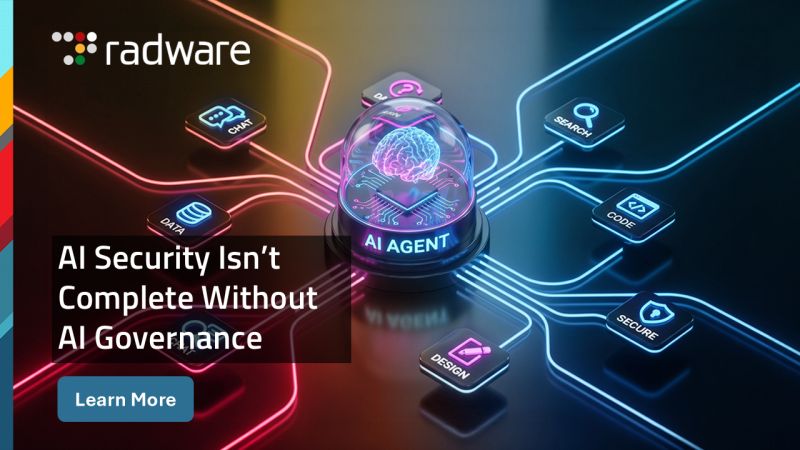
Radware has expanded its agentic AI protection capabilities with new AI governance reporting features and dedicated safeguards for code generated by Anthropic’s Claude model. The enhancements are designed to help organizations better manage the security and compliance challenges that come with widespread AI agent deployment.
As AI agents become more prevalent across enterprise environments, the need for comprehensive visibility, governance, and protection has grown significantly. Radware’s latest updates respond directly to this demand by providing organizations with improved tools to monitor agent behavior, enforce governance policies, and extend security controls to both cloud-based and on-premises AI implementations.
"Organizations are deploying AI agents across increasingly complex environments, creating new requirements for visibility, governance, and security. These enhancements help organizations better understand agent behavior, support their compliance efforts, and help extend protection to AI agents operating across both SaaS and local developer-hosted environments."
David Aviv, Chief Technology Officer at Radware
The new features build upon Radware’s existing agentic AI security platform, aiming to close critical gaps in how organizations monitor, govern, and protect autonomous AI systems. This announcement reflects the broader industry shift toward treating AI agents as a distinct category of digital assets that require specialized security and governance frameworks, similar to how human and machine identities are managed today.
Conditions Driving the Change
Rapid proliferation of autonomous AI agents across enterprise environments is creating new security and governance challenges that traditional security tools were not designed to handle.
Growing complexity of AI deployments spanning SaaS platforms, cloud services, and locally hosted developer environments is making visibility and control increasingly difficult.
Rising regulatory and compliance requirements are pushing organizations to implement stronger governance, auditability, and reporting capabilities for AI systems.
Increasing security risks associated with AI-generated code, particularly from models like Claude, including potential vulnerabilities, backdoors, and supply chain threats.
Expansion of agentic AI workflows that operate with greater autonomy, requiring real-time monitoring, behavior analysis, and policy enforcement.
Demand for unified platforms that can provide comprehensive visibility across human, machine, and AI agent identities and activities.
Pressure on security teams to manage the fast-evolving AI threat landscape while supporting business innovation and digital transformation initiatives.
Need for better integration between AI security tools and existing governance, risk, and compliance (GRC) frameworks to reduce operational silos.
What AI Security Looked Like Before
Before Radware’s latest enhancements, AI security and governance practices were largely fragmented, reactive, and insufficient for the realities of modern agentic AI deployments. Organizations typically relied on a patchwork of general-purpose application security tools, basic monitoring solutions, static code scanners, and manual review processes to attempt to secure AI agents and the code they generated. Visibility into autonomous agent behavior was extremely limited, particularly when agents operated dynamically across hybrid SaaS platforms, cloud services, and locally hosted developer environments. Most security teams lacked unified dashboards or real-time reporting capabilities that could provide comprehensive insights into AI agent activities, credential usage patterns, behavioral anomalies, or potential risks.
Governance efforts were often siloed, with separate tools for human identity management, machine credential security, and basic AI monitoring that rarely communicated with each other. There was little to no specialized protection for code generated by advanced models like Claude, leaving organizations exposed to risks such as hidden vulnerabilities, backdoors, prompt injection attacks, or supply chain compromises introduced during AI-assisted development. Compliance reporting was manual and time-consuming, making it difficult to demonstrate effective oversight of AI systems to regulators or internal auditors. Security teams frequently faced challenges with alert fatigue, delayed threat detection, inconsistent policy enforcement, and the inability to maintain a complete picture of the full lifecycle of AI agents from creation to retirement. Overall, the approach was more about basic perimeter protection and periodic scanning than proactive, real-time governance and lifecycle management of autonomous AI systems. This left significant blind spots as AI adoption accelerated faster than security capabilities could evolve, creating substantial operational, financial, and compliance risks for enterprises operating in increasingly agentic environments.
What AI Security Looks Like Now
With Radware’s new enhancements, AI security has evolved into a more mature, unified, and proactive discipline capable of addressing the complexities of agentic AI. Organizations now have access to advanced AI governance reporting features that deliver real-time visibility into agent behavior, usage patterns, risk indicators, compliance status, and operational metrics across complex, hybrid environments. The addition of dedicated protection for Claude-generated code extends security controls directly to AI-assisted development workflows, helping detect and mitigate vulnerabilities, anomalies, hidden risks, and potential threats introduced by powerful language models. These capabilities enable security teams to maintain a single, comprehensive command center for governing human, machine, and agentic identities together under consistent policies.
The platform now supports improved monitoring of AI agents operating in both SaaS platforms and locally hosted developer environments, significantly reducing previous blind spots and improving response times to emerging risks and compliance violations. Automated policy enforcement, behavioral analysis, anomaly detection, and enhanced reporting features make it easier for organizations to meet regulatory requirements while maintaining a strong security posture. The integration creates a more cohesive approach to the entire lifecycle of AI agents — from initial deployment and active operation to ongoing monitoring, risk assessment, and eventual retirement. Security teams can now more effectively identify unmanaged machine credentials, detect posture drift, enforce least-privilege principles, and generate audit-ready reports. Overall, Radware’s updates represent a clear shift from fragmented, reactive measures to a unified, real-time control plane that better supports the scale, autonomy, and complexity of modern agentic AI systems. This provides organizations with practical, enterprise-grade tools to manage risk, ensure compliance, and maintain visibility as they continue to scale AI initiatives across their digital footprint.
Our Take
AI Security Take
Radware’s expansion of agentic AI protection with new governance reporting features and Claude code safeguards represents a significant advancement in the field of AI governance. As organizations continue to deploy autonomous AI agents at scale, the need for unified visibility, real-time monitoring, and comprehensive policy enforcement has become critical. This announcement directly addresses one of the most pressing challenges in the current AI landscape: the governance gap that exists between rapid innovation and adequate security and compliance controls.
The enhancements allow organizations to move beyond fragmented monitoring toward a more cohesive, enterprise-grade approach. By integrating governance reporting and specific protections for Claude-generated code, Radware is helping security and governance teams gain better insight into agent behavior, usage patterns, and potential risks across hybrid environments. This is particularly important as AI agents operate with increasing autonomy, often across SaaS platforms and locally hosted developer setups, creating new attack surfaces and compliance requirements that traditional tools struggle to cover.
From a governance perspective, the ability to maintain a single command center for human, machine, and agentic identities is a major step forward. It enables organizations to enforce consistent policies, detect posture drift, identify unmanaged credentials, and generate the kind of audit-ready reporting that regulators and internal stakeholders increasingly demand. The inclusion of Claude code protection also highlights the growing importance of securing not just the agents themselves, but the code and models that power them. This end-to-end approach reduces the risk of vulnerabilities being introduced during development while supporting faster, safer AI innovation.
Enterprises should view this development as a call to action. AI governance can no longer be an afterthought or handled through disparate tools. Organizations need to evaluate their current maturity in managing agentic AI and prioritize platforms that offer unified visibility, automated controls, and strong compliance capabilities. Radware’s updates provide a practical example of how vendors are responding to the real-world demands of the AI era. As agentic AI continues to proliferate, solutions that combine technical security with robust governance features will be essential for managing risk, ensuring regulatory compliance, and building stakeholder trust. Companies that invest in these capabilities now will be better positioned to harness the full potential of AI while maintaining appropriate oversight and security standards.