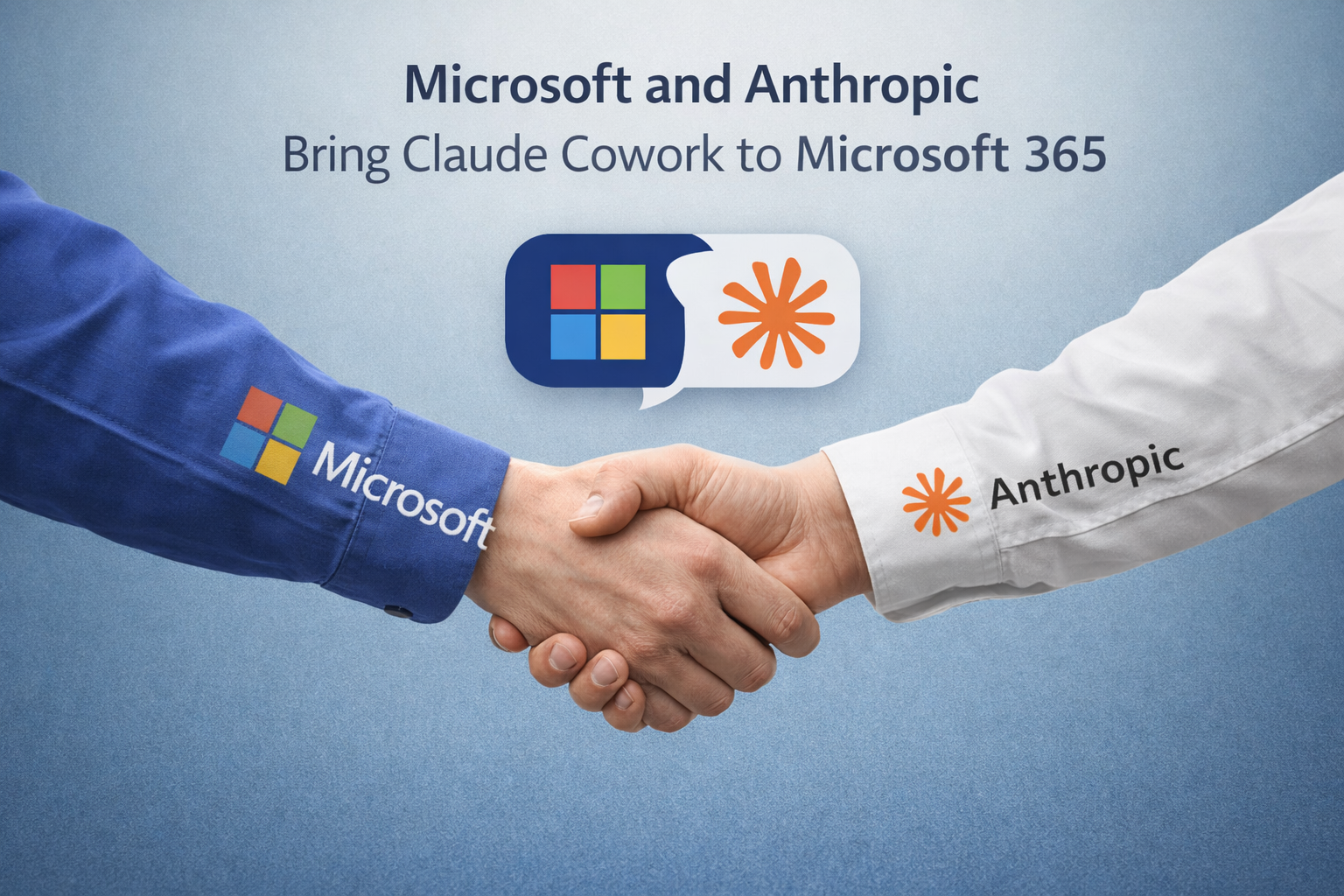
Microsoft and Anthropic announced a partnership that will integrate Anthropic’s Claude models into Microsoft 365 through a new system called Claude Cowork. The assistant is designed to operate inside enterprise productivity workflows, helping employees research information, generate documents and interact with internal knowledge sources directly from within Microsoft’s collaboration environment.
Unlike standalone chatbot tools that operate outside enterprise systems, Claude Cowork functions inside the same infrastructure employees already use for daily work. Documents, collaboration spaces and enterprise knowledge repositories can serve as context for the assistant, allowing the model to help draft content, summarize information and assist with research tasks while operating within Microsoft 365 environments.
This approach reflects a broader shift in enterprise AI adoption. Organizations are moving away from isolated AI experiments and toward assistants embedded directly into the platforms where operational work already occurs. When AI systems begin interacting with internal documents and enterprise data sources, governance teams must consider how those systems retrieve information, how responses are generated and how AI-assisted work is documented inside business processes.
As productivity platforms become the primary distribution channel for advanced language models, the boundary between collaboration software and AI infrastructure is beginning to disappear. The Microsoft and Anthropic partnership highlights how AI assistants are moving closer to the core systems employees rely on to produce reports, communicate with colleagues and make operational decisions.
Definitions
Enterprise AI Assistant
An artificial intelligence system embedded inside enterprise software environments that can generate content, analyze information and assist employees with operational tasks using internal organizational data.
AI Coworker
An AI assistant designed to operate alongside employees inside productivity tools and collaboration platforms rather than functioning as a standalone chatbot application.
Enterprise Knowledge Retrieval
The process where AI systems retrieve internal company documents, knowledge repositories or structured databases in order to generate responses or complete tasks.
Productivity Platform
Enterprise software environments such as Microsoft 365 that host documents, communications and collaborative work across an organization.
Context Retrieval
The mechanism through which an AI system gathers relevant internal data before generating an answer or performing a task.
AI Workflow Assistance
The use of AI systems to support operational processes such as drafting reports, summarizing information or assisting with research tasks inside enterprise environments.
AI Assistants Inside Productivity Platforms Are Expanding Governance Risk
Organizations introducing AI assistants into enterprise productivity environments often discover that governance frameworks designed for traditional software do not fully account for how AI systems behave once they interact with internal knowledge sources. When assistants gain access to documents, collaboration spaces and enterprise databases, they become part of the same workflows used to produce reports, analyze information and communicate decisions.
AI assistants embedded in productivity platforms can retrieve internal documents, messages and files that may contain confidential or regulated information.
Employees frequently use AI tools to draft communications, generate reports or summarize data that later influence operational or strategic decisions.
Many organizations lack a centralized inventory showing which AI assistants are deployed across departments and what internal data sources those systems can access.
AI generated outputs can become part of official business documentation without clear records showing how the content was produced.
Regulatory expectations around AI transparency and documentation are expanding in industries such as finance, healthcare and insurance.
These conditions explain why organizations deploying enterprise AI assistants are beginning to evaluate governance approaches capable of monitoring how these systems retrieve data, generate outputs and influence operational workflows once they become embedded in everyday productivity environments.
Microsoft and Anthropic Move AI Assistance Directly Into Enterprise Workflows
Microsoft and Anthropic are positioning Claude Cowork as an assistant that works inside Microsoft 365 rather than as a separate AI product employees have to open on its own. The model operates within the same environment where documents are written, files are shared and internal knowledge is stored, allowing the assistant to reference that material while helping with everyday tasks.
In practical terms, employees interact with the assistant while doing normal work. Someone drafting a report, reviewing documents or researching a topic can ask the assistant to summarize material, draft sections of text or locate relevant information without leaving the workspace where that work is happening.
That shift changes the role AI plays inside organizations. Instead of being an experimental tool used occasionally, the assistant becomes part of the systems employees rely on to produce real business output. When AI tools operate inside collaboration platforms, they affect how information is gathered, written and circulated across teams.
As large model providers integrate their systems into productivity platforms, the enterprise AI market is increasingly defined by these kinds of platform partnerships. The Microsoft and Anthropic collaboration reflects a broader direction in which language models are becoming embedded into the infrastructure that supports everyday work across companies.
Microsoft Embeds AI Agent Capability and Governance Into the Same Platform Surface
Claude Cowork places an AI assistant directly inside Microsoft 365 documents and collaboration spaces. Employees can draft text, summarize material or search internal knowledge while working inside the same interface used for reports, emails and shared files. The assistant appears inside the workflow rather than in a separate AI application.
Microsoft pairs that capability with administrative oversight through Agent 365. The administrative layer allows IT teams to see which assistants are active across the organization, what Microsoft 365 data sources those assistants can reach and which departments are using them. This visibility gives security and governance teams a starting point for supervising how AI is being used across the platform.
Agent 365 also introduces policy controls for how assistants interact with enterprise information. Administrators can define restrictions on which internal repositories the model can access and monitor how the assistant retrieves information during normal employee activity inside Microsoft 365.
The pricing structure signals how Microsoft expects these capabilities to spread across organizations. Claude Cowork access begins around $15 per user per month, while the broader Agent 365 governance and administration layer is positioned closer to $99 per user. The pricing separates everyday AI assistance from enterprise oversight and policy control.
For organizations operating in regulated sectors such as financial services, healthcare and insurance, the governance layer carries particular weight. When AI systems interact with internal documents and knowledge bases, compliance teams must be able to explain how access is controlled and how AI generated content enters official business records.
Our Take
AI Governance Take
The governance story in this announcement centers on Agent 365. The platform introduces administrative visibility into how AI assistants operate across Microsoft 365 environments, including which internal knowledge sources they access and how employees interact with them inside document workflows.
For organizations in regulated industries this visibility addresses a real operational problem. Compliance teams often struggle to document how AI tools interact with enterprise data. Administrative dashboards that track assistant activity, document access and policy enforcement create a clearer audit trail when AI generated content becomes part of business operations.
The system does not eliminate every governance challenge. Organizations running AI agents outside Microsoft 365 environments will still face a visibility gap. Activity occurring in external applications or custom agent systems will not appear inside the Agent 365 administrative view.
Before deploying enterprise assistants broadly, organizations should evaluate how much of their AI activity occurs inside Microsoft environments versus external systems. The GAIG marketplace compares governance capabilities across vendors so teams can see how different platforms supervise model behavior, data access and policy enforcement across enterprise environments.