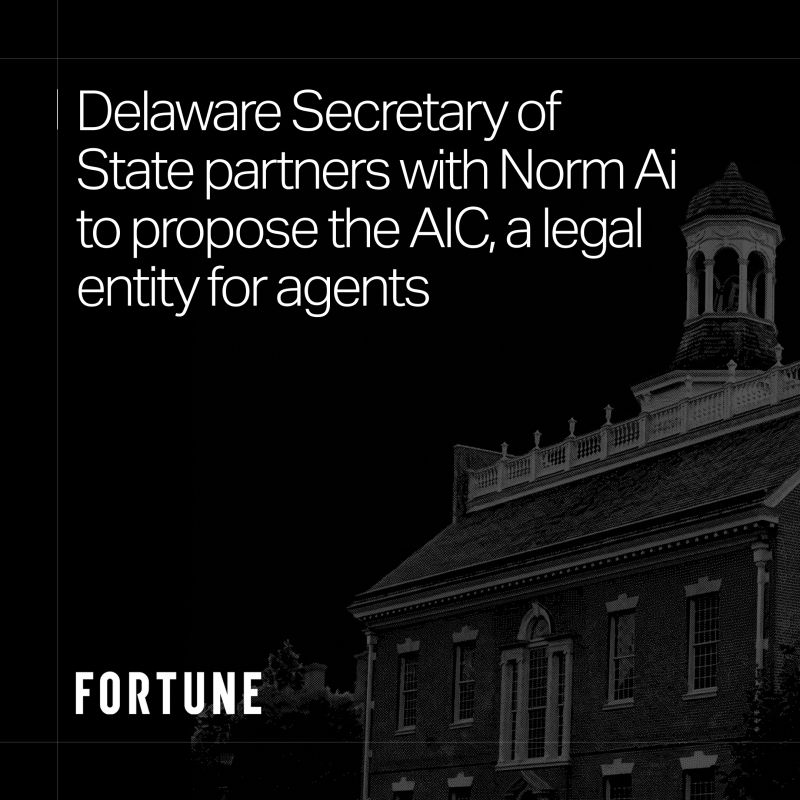
Delaware has proposed a new kind of legal entity built to be run by an artificial intelligence agent rather than a person, and the state wants to test it inside a supervised regulatory sandbox. The proposal went public on July 14 in a Fortune commentary co-authored by Delaware Secretary of State Charuni Patibanda-Sanchez and Norm Ai chief executive John Nay, who together call the structure an Artificial Intelligence Company, or AIC. A drafting committee spent June working through the mechanics, and the enabling legislation is expected to reach the General Assembly next year. The framework for how industry engages with AICs is being built through a public-private partnership that Norm Ai leads.
An AIC would be a separate legal entity whose daily affairs an agent manages directly. At the agent's direction it could sue and be sued, hold and sell property, and take on obligations, all in its own name. Behind each one sits a single human or corporate member responsible for keeping the entity capitalized and for maintaining a running log of what the agent does. That member is shielded from the AIC's debts, with carve-outs for fraud, willful lawbreaking, and failing to fund the company.
For anyone who runs an AI governance program, this is the accountability question moving out of internal policy and into corporate law. Delaware is trying to name who owns the consequences when software starts signing contracts without a human in the loop.
Conditions Driving This Change
AI agents already contract, pay suppliers, and transact on their own, so the question of who answers for their conduct stopped being hypothetical and became a live commercial problem.
Nothing in the corporate law of most states clearly stops an AI agent from running a company with no human at the helm, which leaves counterparties unsure who they are actually dealing with across the table.
John Nay raised this gap with co-authors in a 2023 Science essay on interspecific law, and the three years since have only made agents more capable and the gap more urgent.
Delaware collects more than $2 billion a year in fees and taxes from its two million registered entities, roughly a third of the state budget, which gives it a direct financial reason to define a new entity form before rival jurisdictions do.
If the United States offers no accountable home for autonomous commerce, that activity can migrate offshore onto anonymous infrastructure that sits beyond the reach of any American court.
Structures like the LLC and the public benefit corporation each drew objections when they first appeared and were adopted widely afterward, which gives Delaware a template for introducing a contested entity form through a controlled test.
Corporate lawyers are already split on whether a state-granted liability shield for AI owners would survive when a resident of another state brings a tort claim, so Delaware needs real cases and data rather than theory.
What AI Governance Looked Like Before This
Until now, the law recognized two kinds of actors in commerce: people, and the entities people control. An AI agent was treated as a tool inside one of those entities, and responsibility for its behavior ran back to whoever deployed it. When an agent booked a bad trade or signed a contract it should not have, a plaintiff had to trace the harm through the software to the vendor, the operator, or the customer who switched it on. That tracing was slow, and it often failed.
Governance teams filled the gap with machinery they built themselves. They wrote agent-use policies, ran model risk reviews, and stood up their own audit logs, because no statute required an agent to keep a record of its own decisions. Accountability depended on the discipline of the company running the agent rather than on any external rule. A firm with a strong program could show its work, and a sloppy one could hide inside the complexity of its own system.
The result was a market where counterparties often could not tell whether the thing on the other side of a transaction answered to anyone. Two companies could run nearly identical agents, and only one of them might be able to say who was accountable when the agent caused damage. That uncertainty is exactly what Delaware is now trying to price and contain.
What It Looks Like Now
The AIC gives the agent a body the law can grab. Rather than chasing responsibility through layers of software and service agreements, a counterparty deals with a named entity that can be sued, that holds its own assets, and that a court can dissolve. The structure attaches a defined target to the agent's conduct, which is the entire point of giving it legal form.
Delaware wraps that target in controls a governance officer would recognize. Every AIC runs only inside the sandbox, admitted by a committee that includes the Secretary of State, the Attorney General, the Chief Justice of the state Supreme Court, and the chair of Delaware's AI Commission. Each one must meet capitalization requirements, must tell counterparties in writing that it is an authorized test entity the state does not endorse, and must post when the test ends and how to file a complaint. Officials can suspend an AIC, pull its authorization, and ask the Court of Chancery to shut it down.
Two limits keep the pilot narrow. Banking stays off the table, and the program sunsets after 30 months, which hands the legislature a full record before it writes any permanent law. The liability shield holds only inside the sandbox and only for members who follow the rules, and consumer-protection and criminal law still apply in full.
Our Take
The AI Governance Take
The AIC is the first serious attempt to answer a question governance teams have been carrying alone: when an agent acts, who is on the hook, and how do you prove what it did. Delaware ties capital to liability and requires the agent to keep a log of its activity. A funded member who can be sued and a mandatory record of decisions are the same two things a mature AI governance program already builds on its own. Delaware is turning good internal practice into a condition of doing business.
The weak point is the liability shield, and the drafters know it. Corporate law professor Ann Lipton has already asked whether other states will honor Delaware's shield when their own residents sue over harm an agent caused. A shield that holds in Wilmington and evaporates in California is a governance problem wearing a corporate costume. Buyers should watch how the sandbox handles cross-border claims before they treat an AIC as a safe place to park agent risk.
For governance teams, the practical move is to build the accountability structure the AIC assumes, now, before any statute forces it. Name a responsible owner for every agent, capitalize the risk it carries, and keep an audit trail the agent cannot quietly edit. Compare the platforms that handle accountability structure, policy alignment, and audit-trail production in the AI Governance category at GetAIGovernance.net.