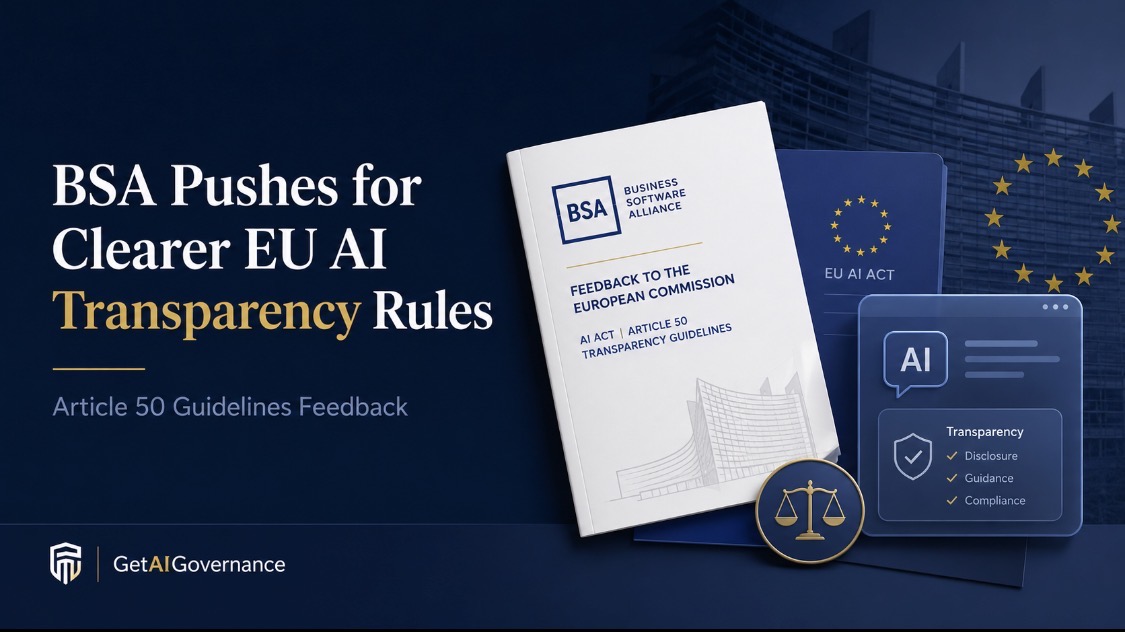
The Business Software Alliance (BSA), a leading advocate for the global software industry, has submitted comprehensive feedback to the European Commission on the draft Guidelines for transparency obligations under Article 50 of the AI Act. The response, filed by Hadrien Valembois, Director of Policy – EMEA at BSA, addresses multiple sections of the draft and emphasizes the need for greater legal certainty, proportionality, and practical implementation pathways for providers and deployers.
Article 50 obligations, which require transparency around AI-generated content and interactions with AI systems, become applicable on 2 August 2026. The Commission is currently refining the accompanying Guidelines following a broad stakeholder consultation, with the current targeted feedback period running until 3 June 2026.
In its submission, BSA stresses the importance of aligning the Guidelines closely with the Level 1 text of the AI Act. The organization calls for clearer scoping of obligations — particularly for agentic and multi-agent systems, B2B deployments, and interactive AI tools used within enterprise environments. It also advocates for explicit safe harbors for underlying technology providers when deployers customize or disable built-in disclosure features, and for greater reliance on interoperable industry standards such as C2PA for marking and detecting AI-generated content.
BSA further urges the Commission to avoid expanding obligations beyond what is strictly required by the AI Act, to recognize technical feasibility limitations across different modalities, and to ensure a clear distinction between provider and deployer responsibilities. The submission reflects growing industry concern that overly broad or ambiguous guidance could create compliance uncertainty and hinder responsible AI adoption in enterprise settings.
Conditions Driving This Change
The EU AI Act’s Article 50 transparency obligations become directly applicable across the Union on 2 August 2026, creating a hard deadline that is forcing both the European Commission and industry stakeholders to urgently clarify how these rules will apply to the wide variety of AI systems and deployment models now in use.
The rapid proliferation of agentic and multi-agent AI systems has exposed significant ambiguities in the draft Guidelines, particularly around when and how transparency obligations should apply when AI systems interact with other AI systems rather than directly with natural persons, or when content is generated, reviewed, and modified through multiple layers before reaching an end user.
Enterprises across sectors are increasingly deploying generative AI tools in closed, contractually governed B2B environments for internal documentation, business communications, software development, and data analysis — contexts where the original consumer-protection rationale of Article 50 is much weaker, prompting calls for explicit carve-outs and safe harbors.
Industry has reached broad consensus on the value of interoperable, open technical standards such as C2PA for content provenance and detection, and BSA is urging the Commission to formally recognize these standards as valid, proportionate compliance mechanisms rather than leaving providers to develop fragmented, bespoke solutions.
There is mounting concern within the global software industry that overly broad, ambiguous, or prescriptive guidance could create significant compliance uncertainty, increase legal risk for providers, and ultimately slow the responsible adoption of AI technologies by European enterprises.
The Commission’s drafting process for the Guidelines — which has already incorporated input from a broad earlier consultation and the AI Board — has now reached a critical stage where targeted, technical feedback from major industry associations like BSA can directly influence the final text before formal adoption.
Many organizations are struggling to distinguish between provider and deployer responsibilities in modern AI platforms that are highly configurable after purchase, creating a practical need for clear safe harbors so that underlying technology providers are not held liable for decisions made by their enterprise customers.
Technical limitations in current marking and detection technologies — especially for text-based content — combined with the high cost and complexity of implementing robust solutions across all modalities, are pushing stakeholders to demand that the Guidelines explicitly incorporate principles of technical feasibility and proportionality.
What It Looked Like Before
Before BSA submitted its detailed response and before the current targeted consultation round, significant uncertainty surrounded the practical application of Article 50 transparency obligations under the EU AI Act. While the Level 1 text had been finalized and the 2 August 2026 application date was known, organizations lacked clear, authoritative guidance on how the rules would apply to the rapidly evolving landscape of generative and agentic AI systems. Many companies were preparing compliance programs based on their own interpretations of the legal text, leading to inconsistent approaches across the market.
The absence of detailed Guidelines created particular challenges for providers of configurable AI platforms and for enterprises deploying these tools in closed B2B environments. Questions around scope — such as whether transparency obligations applied to internal enterprise tools, multi-agent systems, or content that passed through human review before publication — remained open. This ambiguity forced legal, product, and compliance teams to make conservative assumptions, often resulting in over-engineering of disclosure mechanisms or delayed deployment of AI features while waiting for greater clarity.
Furthermore, there was limited official direction on the respective responsibilities of providers versus deployers in situations where enterprise customers customize or disable built-in controls after purchase. Technology providers faced potential exposure for decisions made downstream by their customers, while deployers lacked clear signals on what compliance steps they needed to take independently. The lack of explicit safe harbors and the absence of strong endorsement for established technical standards like C2PA also left organizations uncertain about which technical approaches would satisfy the requirements. Overall, the pre-Guidelines environment was characterized by high compliance uncertainty, fragmented implementation efforts, and a widespread call from industry for the Commission to provide more precise, workable direction before the obligations took effect.
What It Looks Like Now
With BSA’s comprehensive submission now on record, the process of refining the Article 50 Guidelines has gained important concrete input from one of the software industry’s most influential voices. The response provides the European Commission with detailed, paragraph-specific recommendations across multiple sections, including clear proposals for scoping limitations on agentic and interactive AI systems, explicit safe harbors for providers when deployers customize platforms, and stronger recognition of technical feasibility and proportionality.
The submission also advances a coherent industry position on the use of interoperable standards such as C2PA for meeting marking and detection obligations, while pushing back against interpretations that would extend obligations beyond the original intent of the AI Act. This gives the Commission tangible material to work with as it finalizes the Guidelines ahead of the 2 August 2026 deadline.
For enterprises and providers, the filing signals that major industry players are actively engaged in shaping implementation and are prepared to advocate for practical, risk-based outcomes. While the final Guidelines have not yet been adopted, the existence of this level of detailed, technical feedback increases the likelihood that the final text will include meaningful clarifications on provider versus deployer responsibilities, B2B carve-outs, and technically feasible compliance pathways. The current environment is therefore more constructive than the earlier period of uncertainty: stakeholders now have a clearer channel to influence the rules, and the Commission has received structured recommendations that directly address the most pressing implementation challenges facing the software industry.
Our Take
AI Compliance Take
BSA’s detailed submission to the European Commission represents a significant industry intervention at a critical moment in the implementation of the EU AI Act. With Article 50 transparency obligations set to apply from 2 August 2026, the response highlights the growing tension between the Act’s legitimate goals of user awareness and trust, and the practical challenges of applying broad transparency rules to modern enterprise AI systems.
The submission makes a strong case for greater precision in the final Guidelines. By calling for explicit safe harbors for providers, clearer scoping for agentic and B2B deployments, and formal recognition of industry standards such as C2PA, BSA is pushing the Commission to produce rules that are both effective and workable. This is not resistance to transparency itself, but rather a call for rules that reflect how AI is actually built, deployed, and customized in real enterprise environments.
The feedback also underscores a broader point: successful implementation of the AI Act will depend heavily on the quality of the supporting Guidelines and Codes of Practice. If the final text imposes disproportionate burdens or creates legal uncertainty for providers and deployers, it risks slowing responsible AI adoption in Europe rather than accelerating it. BSA’s intervention is therefore valuable not only for the specific recommendations it contains, but also as a signal that major industry players are prepared to engage constructively to help shape practical, innovation-friendly outcomes.
For governance and compliance teams, this submission is a useful reference point. It shows where leading software companies see the biggest implementation risks and where they believe the Commission still has room to provide clearer, more proportionate guidance before the August 2026 deadline.