Why You Can Trust GetAIGovernance + Our Research
Every vendor on this page was evaluated against the same criteria using public documentation, funding disclosures, product announcements, customer evidence, regulatory alignment depth, and independent industry recognition. No vendor paid to be included. Vendor selection reflects our independent editorial assessment of each platform's fit, depth, and differentiation within the AI compliance category. All sources are listed at the bottom of this article.
⚠ BE AWARE: THE NUMBER RANKINGS "#1, #2..." DO NOT MEAN ONE COMPANY IS BETTER THAN ANOTHER. COMPANIES ARE LISTED IN ALPHABETICAL ORDER WITHIN EACH CATEGORY. ONE PLATFORM IS NOT BETTER BECAUSE OF FUNDING SIZE OR YEARS IN OPERATION. EACH PLATFORM ADDRESSES A SPECIFIC COMPLIANCE PROBLEM — THE RIGHT CHOICE DEPENDS ON THE OBLIGATION YOU ACTUALLY NEED TO MEET.
The EU AI Act, SR 26-2, ISO 42001, SOC 2 — these appear in the same compliance conversations but represent entirely different problems. A platform that automates ISO 27001 evidence collection for a SaaS company is not the same category of tool as one built from the ground up to convert banking regulations into machine-executable decision logic. Treating them as interchangeable is how programs end up with documentation that looks complete when an auditor first asks, and falls apart when they ask the second question.
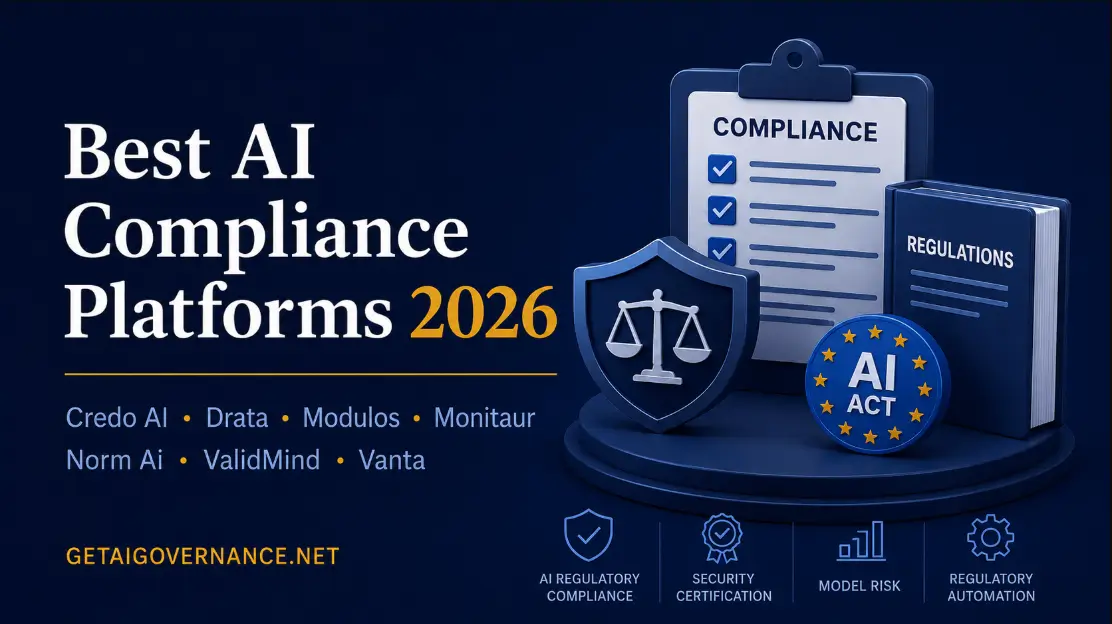
This guide organizes seven platforms across four compliance categories, aligned to the frameworks documented in GAIG's AI Compliance Certifications, Frameworks, and Laws Explained. Two platforms worth knowing about appear as editorial mentions within category sections rather than as primary entries, because vendor size or evidence depth didn't clear the bar set by the primary picks. That includes Thoropass for Security Certification (strong in-house auditor model, but meaningfully smaller scale than Vanta and Drata) and Sprinto for teams that need SOC 2 fast and cheap. Neither is a bad choice for the right buyer. They just aren't the primary picks for the broadest audience.
What AI Compliance Platforms Actually Do
AI compliance platforms automate evidence collection, generate audit-ready documentation, map organizational controls to regulatory frameworks, and in some cases enforce compliance logic inside the workflows where decisions get made. They don't replace lawyers, they don't guarantee regulatory approval, and they don't cover every obligation an organization faces. They cover the operational layer between a compliance obligation and the documentation that proves it's being met.
The four categories in this guide split across two functional groups. Security certification platforms help organizations collect, organize, and present evidence against audit standards like SOC 2 and ISO 27001. AI-specific regulatory compliance platforms apply that same logic to the governance of AI systems themselves — EU AI Act technical documentation, ISO 42001 management systems, NIST AI RMF alignment. Financial services model risk platforms handle the documentation and monitoring obligations that come specifically from banking and insurance regulation. Regulatory text automation is the fourth and most specialized category: converting the actual text of regulations into machine-executable logic rather than relying on manual compliance review workflows.
How We Evaluated These Platforms
Compliance Category Depth: Does the platform's core product address the specific compliance obligation in the category it occupies, or is the capability a secondary feature inside a broader tool built for something else?
Independent Validation: What analyst recognition, named enterprise customers, certifications, or third-party research validates the platform's claims?
Regulatory Currency: Does the platform reflect the current state of the regulations it covers? SR 26-2 replaced SR 11-7 in April 2026. The EU AI Act Omnibus deferred Annex III conformity assessment deadlines in May 2026. Platforms whose documentation still references superseded guidance are a real due diligence risk.
Buyer Fit: What company type, industry, and internal function is this platform actually designed to serve?
The AI Compliance Platforms: A Quick Overview
Platform | Compliance Category | Pricing | Best For |
|---|---|---|---|
AI-Specific Regulatory Compliance | Contact for pricing | EU AI Act Annex IV documentation, ISO 42001, NIST AI RMF compliance with automated evidence generation across multi-framework AI governance programs | |
Security Certification | Contact for pricing (Starter ~$15K/year per third-party data) | Organizations running SOC 2, ISO 27001, HIPAA, and other certifications simultaneously who need cross-framework evidence mapping to eliminate duplicate collection work | |
AI-Specific Regulatory Compliance | Contact for pricing | European organizations whose primary compliance requirement is ISO 42001 certification, especially those in regulated industries wanting the platform that already holds the certification itself | |
Financial Services Model Risk | Contact for pricing | Regulated enterprises that need production-phase AI governance documentation — behavioral monitoring, model registries, and ongoing oversight evidence for regulators | |
Regulatory Text Automation | Contact for pricing | Financial institutions and regulated enterprises needing AI agents that review documents against actual regulatory obligations in real time, inside Microsoft 365 workflows | |
Financial Services Model Risk | Contact for pricing | US banks and financial institutions that must document model development, validation, and pre-deployment review under SR 26-2 | |
Security Certification | Starts ~$7,500/year (public) | SaaS companies and enterprises that need SOC 2 or ISO 27001 certification with a live Trust Center that converts a security questionnaire into a one-click share during sales cycles |
Credo AI — Best for EU AI Act, ISO 42001, and NIST AI RMF Compliance at Enterprise Scale
The Most Validated AI Regulatory Compliance Platform in This Guide
Choose Credo AI if: your primary compliance pressure is regulatory — EU AI Act obligations, ISO 42001 certification, NIST AI RMF alignment — and you need a platform that has done the actual work of mapping those frameworks into operational governance workflows with automated evidence generation, not a checklist disguised as infrastructure.
Founded: 2020
HQ: Palo Alto, CA
Employees: 51–100
Funding: $41.3M total (Series B, July 2024)
Recognition: Forrester Wave Leader for AI Governance Platforms, Q3 2025, with 12 perfect scores; Fast Company Most Innovative Companies 2026, ranked No. 6 in Applied AI alongside Google and NVIDIA; Gartner Market Guide for AI Governance Platforms; named customers include Mastercard and Booz Allen Hamilton with documented federal program deployments; G42 partnership announced February 2026; Carahsoft partnership announced January 2026
Credo AI's governance platform centers on GAIA (Governance AI Assistant), the company's AI-powered orchestration layer that translates regulatory requirements from the EU AI Act, NIST AI RMF, ISO 42001, and other frameworks into operational policy packs applied during AI system intake and ongoing review. The 2026 Agent Registry extension maps dependency graphs across multi-agent networks, addressing GPAI and agentic AI obligations under the EU AI Act that most compliance platforms haven't yet built for. Pre-built policy packs cover EU AI Act Annex IV documentation specifically — the technical documentation that providers of high-risk AI systems must maintain — with automated workflows that generate the structure regulators and auditors actually expect rather than requiring compliance teams to reverse-engineer it from legislative text.
The Forrester Wave Leader designation with 12 perfect scores is the strongest independent analyst signal in the AI regulatory compliance category. Forrester evaluators assessed current offering, strategy, and market presence, and Credo AI placed at the top of the Leader quadrant on a product that addresses regulatory compliance operationally rather than as documentation-after-the-fact. Fast Company's No. 6 ranking in Applied AI for 2026, placed directly alongside Google, NVIDIA, and OpenAI, reflects commercial recognition from a second independent source. Neither of those signals appeared in the article's previous version, and they are the two most current external validations of Credo AI's position in this market.
The G42 partnership, announced in February 2026, demonstrates Credo AI's reach into large-scale global AI deployment organizations. G42 is one of the largest AI companies in the Middle East and runs AI deployments across healthcare, finance, and critical infrastructure at a scale that stress-tests governance and compliance infrastructure in ways that smaller deployments don't. The Carahsoft partnership, announced in January 2026, accelerates access through the government IT channel that US federal agencies use for procurement, which matters because Booz Allen Hamilton and documented federal program deployments already show the platform serving organizations where compliance documentation needs to survive regulatory examination, not just pass a customer security review.
The Microsoft partnership from May 2025 integrated Credo AI's governance capabilities into Microsoft's enterprise AI deployment workflows. Most enterprise AI runs through Azure and Microsoft's ecosystem, which means governance workflows that operate inside that environment rather than requiring a parallel system reach the models and agents that actually need governing. The limitation worth naming directly: Credo AI is a governance and regulatory compliance platform. For security certification automation — SOC 2 evidence collection, ISO 27001 continuous monitoring — Vanta and Drata are the appropriate tools. Credo AI covers AI-specific regulatory frameworks, and that boundary is worth understanding before a procurement conversation starts.
✓ What We Like
Forrester Wave Leader with 12 perfect scores: The most rigorous independent analyst recognition in the AI regulatory compliance category, reflecting current product depth rather than brand recognition alone.
EU AI Act Annex IV documentation workflows: Pre-built structure for the technical documentation high-risk AI providers must maintain, built by people who read the regulation rather than adapting a generic GRC template.
Agent Registry for multi-agent governance: Maps dependency graphs across multi-agent networks to address GPAI obligations, a capability most compliance platforms haven't shipped for yet.
G42 and Carahsoft partnerships in early 2026: Both signal distribution reach into large-scale global enterprise and US government markets simultaneously.
Microsoft ecosystem integration: Governance workflows running inside Azure and Microsoft 365 reach the environments where most enterprise AI actually lives.
Mastercard and Booz Allen Hamilton as named customers: A global payments network and a defense consulting firm represent very different compliance environments, which signals the platform works across regulatory contexts rather than in one vertical.
⚠ What to Know
Credo AI addresses AI-specific regulatory compliance, not traditional security certifications. Organizations also needing SOC 2 or ISO 27001 automation need a separate platform for that function.
Enterprise-only pricing with no self-serve tier published — evaluation requires a direct sales conversation.
Deep value requires coordination across legal, compliance, data, and technical teams; this is not a tool one function can stand up independently.
Agent governance capabilities launched in 2026 and are newer than the platform's core risk and policy compliance functions; production evidence is still accumulating.
Compliance Coverage
EU AI Act (Annex IV Technical Documentation)
ISO 42001NIST AI RMF (Govern, Map, Measure, Manage)
SOC 2 (AI-Specific Controls)
NYC Local Law 144Colorado AI Act
Best For
Organizations facing EU AI Act enforcement: Companies that need documented conformity assessment workflows and EU AI Act Annex IV technical documentation before the high-risk system deadlines — now deferred to December 2027 under the Omnibus agreement, but with Article 50 transparency obligations still active from August 2026.
Enterprises with federal or defense AI deployments: Organizations where NIST AI RMF alignment and auditable governance documentation are procurement requirements rather than aspirational goals.
Global enterprises deploying AI across multiple regulatory frameworks: Organizations that need a single platform to map controls across the EU AI Act, NIST AI RMF, ISO 42001, and US state-level requirements simultaneously rather than running separate compliance programs for each.
Pricing: Not publicly listed. Enterprise sales required. Contact Credo AI directly or request a match through GetAIGovernance.net.
Drata — Best for Multi-Framework Certification Programs Running Simultaneously
The Platform That Eliminates Duplicate Evidence Collection Across Overlapping Standards
Choose Drata if: you're pursuing more than one certification at the same time and need a platform whose cross-framework control mapping lets evidence collected for SOC 2 automatically satisfy overlapping ISO 27001 requirements, rather than requiring your team to collect the same evidence twice.
Founded: 2020
HQ: San Diego, CA
Employees: ~700
Funding: $328M total (Series C, ICONIQ Growth, Salesforce Ventures, Alkeon)
Recognition: 7,000+ customers across 60 countries; $100M ARR reached by early 2025 with 60% year-over-year growth; 10,000+ audits processed with 2,500+ auditor relationships; acquired SafeBase in 2025, adding a live Trust Center for sharing compliance status with enterprise prospects; Frank Slootman (Snowflake CEO) as an angel investor
Drata's Trust Management Platform automates evidence collection from connected infrastructure and SaaS tools, maps those controls across multiple compliance frameworks simultaneously, and maintains audit-ready documentation continuously rather than in preparation sprints before each audit cycle. The Audit Hub gives external auditors scoped access to evidence directly inside the platform, which removes the file-transfer-and-email layer that slows most audit processes down. The Trust Center, added through the 2025 SafeBase acquisition, gives organizations a live, shareable compliance status page for sales cycles — a capability that was previously Vanta's primary differentiator and is now present in both platforms.
The cross-framework control mapping is where Drata earns its position in a genuinely crowded certification market. Organizations running SOC 2 alongside ISO 27001 don't build two separate control libraries in Drata — evidence collected for one standard automatically fans out to satisfy overlapping requirements in the other, reducing the incremental effort of adding a second framework substantially. The platform supports SOC 2, ISO 27001, ISO 42001, HIPAA, PCI DSS 4.0, NIST CSF 2.0, GDPR, CCPA, FedRAMP, and CMMC from a single evidence base. That architecture matters specifically for organizations at the stage where SOC 2 is no longer sufficient for every deal and ISO 27001 or HIPAA is starting to appear in procurement requirements.
The 7,000+ customers across 60 countries and $100M ARR with 60% year-over-year growth are commercial signals that reflect real market fit rather than funded customer acquisition. Frank Slootman as an angel investor carries domain-specific credibility here: Snowflake's compliance program is a known reference point in enterprise security circles, and his involvement signals practitioner confidence in the platform rather than just financial backing. The 10,000+ audits processed across 2,500+ auditor relationships means Drata has accumulated institutional knowledge about what evidence formats different auditors actually accept, which is the kind of operational advantage that doesn't show up in feature comparisons but shows up in how smooth a specific audit engagement actually goes.
Vanta also appears in this guide and is a genuine competitor for the same buyer in most cases. The comparison matters enough to state directly: Vanta has a longer track record, 16,000+ customers, and a Trust Center that predates Drata's. Drata has a more purpose-built control mapping engine for organizations managing multiple frameworks simultaneously. For a company running SOC 2 only, Vanta is the safer default. For a company running SOC 2 plus ISO 27001 plus HIPAA at the same time, Drata's multi-framework architecture earns serious consideration.
✓ What We Like
Cross-framework evidence mapping: Controls built for SOC 2 automatically satisfy overlapping ISO 27001 requirements, making multi-framework programs meaningfully less redundant than running them in separate tools.
$100M ARR with 60% growth: The scale and trajectory together indicate the platform is retaining customers through renewal cycles rather than just acquiring them.
10,000+ audits processed: Institutional knowledge about what auditors actually accept, accumulated across enough engagements to matter for specific audit firm preferences.
SafeBase Trust Center acquisition: Live compliance status page for sales cycles, closing the gap with Vanta on the feature that sales teams care most about in a compliance platform.
FedRAMP coverage: Available alongside standard commercial certifications from the same platform, relevant for organizations with government contracts alongside commercial business.
ICONIQ Growth and Salesforce Ventures backing: Investor signals that carry enterprise-grade credibility for procurement committees.
⚠ What to Know
Drata and Vanta are genuinely close competitors at the top of this category — the choice between them should come down to your specific framework mix and whether multi-framework cross-mapping is a current need or a future one.
AI model governance and AI-specific regulatory compliance (EU AI Act, ISO 42001 depth) are not Drata's primary focus; organizations with those needs require Credo AI alongside this platform.
Enterprise pricing is not publicly listed at higher tiers; a starter range of $15,000–$25,000 per year appears in third-party pricing research, with enterprise tiers reaching $60,000+.
The Audit Hub's value is proportional to how well your auditor already knows the platform; auditors unfamiliar with Drata may not use it the way it's designed.
Compliance Coverage
SOC 2 Type 1 and Type 2
ISO 27001
ISO 42001
HIPAA
PCI DSS 4.0
GDPR
FedRAMP
NIST CSF 2.0
CMMC
Best For
Organizations running multiple certifications simultaneously: Teams that have already completed SOC 2 and are now adding ISO 27001 or HIPAA, where cross-framework evidence reuse translates into real time savings.
Companies with government contracts: Organizations that need FedRAMP authorization alongside commercial certifications from a single platform without maintaining separate evidence programs.
Engineering-led compliance programs: Teams that prefer configuring compliance infrastructure themselves and want deeper control over how tests are defined, rather than relying primarily on prebuilt test suites.
Pricing: Starter pricing reported at approximately $15,000–$25,000/year by third-party sources. Enterprise pricing requires direct sales engagement. Contact Drata or request a match through GetAIGovernance.net.
Modulos — Best for ISO 42001 Certification, Especially for European Organizations
The Only AI Governance Platform That Holds the Certification It Helps Others Achieve
Choose Modulos if: ISO 42001 certification is your primary compliance objective and you want a platform that holds CertX product conformity certificate 213-001/24 under the CertX-AI V1.0 scheme itself, which is a different kind of credential than a platform that maps to the standard without having gone through the certification process.
Founded: 2018
HQ: Zurich, Switzerland
Recognition: ETH Zurich spin-out; first AI governance platform to achieve ISO 42001 product conformity (CertX certificate 213-001/24, first issued under the CertX-AI V1.0 scheme); selected by the Canton of Zurich Innovation Sandbox as the reference implementation for ISO 42001-aligned AI management systems in critical infrastructure; contributor to the EU GPAI Code of Practice, NIST AISIC, and CEN-CENELEC AI standards; Xayn named publicly as a commercial customer
Modulos built its AI Governance Platform around the Governance Graph, a connected data model that links regulatory frameworks, requirements, controls, and evidence into a single queryable structure rather than a set of disconnected spreadsheets and policy documents. For ISO 42001 specifically, the platform automates evidence collection and audit preparation across Clauses 4 through 10 and all Annex A controls, with AI agents (Scout, Evidence Agent, and Control Assessment Agent) handling the manual evidence-gathering work that typically consumes most of the time between a decision to pursue certification and the actual audit. Organizations that already hold ISO 27001 can run the two standards as an integrated management system inside Modulos, reusing roughly half of their existing controls across the two frameworks rather than building a parallel program from scratch.
The credential that sets Modulos apart from every other platform in this guide's AI-specific regulatory compliance category is CertX product conformity certificate 213-001/24 — the first certificate issued under the CertX-AI V1.0 scheme, which is the auditing scheme designed specifically to assess ISO 42001 compliance for AI governance platforms. Modulos isn't claiming alignment with a standard someone else audits organizations against. They went through the certification process, passed the audit, and hold the certificate. The Canton of Zurich's Office for Economic Development and the University of Zurich's Centre for Information Technology, Society, and Law independently documented Modulos as the reference implementation for ISO 42001-aligned AIMS in a 2025 critical infrastructure sandbox covering ANYbotics' ANYmal autonomous inspection robot. Government and academic bodies pointing to a platform as the reference implementation, without a commercial relationship, is a different kind of validation than a vendor claiming framework alignment.
The public customer evidence for Modulos is thin relative to Credo AI, and that gap deserves a direct sentence rather than a footnote. Xayn, the developer of Noxtua, Europe's first sovereign Legal AI, is their most prominent named commercial reference — Xayn became the first German company to achieve ISO 42001 certification using Modulos, reaching audit-readiness in four weeks audited by SGS. Modulos states they serve regulated enterprises across financial services, defense, transportation, and telecommunications, but Xayn is their primary publicly named commercial customer at this time. Buyers evaluating Modulos for a large enterprise deployment should ask for reference customers in their specific vertical during evaluation, since the public evidence base doesn't yet support independent verification beyond the Xayn case study and the government sandbox reference.
Credo AI is the right comparison point for any buyer choosing between the two. Credo AI has broader multi-framework coverage, stronger named enterprise customers, and deeper US market deployment evidence. Modulos has the ISO 42001 product conformity credential Credo AI doesn't hold, deeper European regulatory DNA from its ETH Zurich origins and standards-body contributions, and a tighter focus on the ISO 42001 certification path specifically. For a buyer whose primary requirement is ISO 42001 certification in a European regulatory context, Modulos is the more credible choice. For a buyer managing EU AI Act obligations alongside NIST AI RMF alignment and needing broad multi-framework coverage at Fortune 500 scale, Credo AI is the stronger pick.
✓ What We Like
CertX product conformity certificate 213-001/24: The first certificate issued under the CertX-AI V1.0 scheme, independently verifiable, and held by no other AI governance platform in this guide.
Canton of Zurich Innovation Sandbox reference: Government and academic documentation independent of any commercial relationship, naming Modulos as the reference implementation for ISO 42001 in critical infrastructure.
Governance Graph architecture: Connected data model linking frameworks, requirements, controls, and evidence in one queryable structure rather than a collection of disconnected policy documents.
ISO 27001 and ISO 42001 integration: Runs both standards as one integrated management system, with documented 50% control reuse for organizations extending from ISO 27001.
Standards body contribution: Active contributor to EU GPAI Code of Practice, NIST AISIC, and CEN-CENELEC AI standards, which means the platform reflects the standards as they're being written rather than catching up to published versions.
⚠ What to Know
Public named customer evidence is limited. Xayn is the primary commercial reference currently in the public record. Buyers should request references from their specific industry vertical during evaluation.
Platform is focused on ISO 42001 and EU AI Act governance; organizations primarily needing broad US regulatory framework coverage or multi-jurisdictional deployment at Fortune 500 scale should evaluate Credo AI alongside Modulos.
ETH Zurich origins and Swiss regulatory focus mean the platform's deepest expertise aligns with European compliance contexts; US-specific regulatory alignment is present but secondary to European frameworks.
Funding details are not publicly disclosed, which limits third-party assessment of financial stability beyond the platform's credentials and operational track record.
Compliance Coverage
ISO 42001
ISO 27001 (Integrated Management System)
EU AI Act
NIST AI RMF
Best For
European organizations prioritizing ISO 42001 certification: Companies in financial services, defense, transportation, or telecommunications in the EU or Switzerland where ISO 42001 is a procurement gate or regulatory expectation and European regulatory expertise matters as much as framework coverage.
Organizations already holding ISO 27001: Teams that want to extend their existing information security management system into AI governance using a platform that runs both standards as one integrated program, with documented 50% control reuse rather than requiring a parallel build.
Critical infrastructure operators: Organizations facing EU AI Act high-risk system obligations in regulated sectors where the Canton of Zurich Innovation Sandbox's independent documentation of Modulos as a reference implementation carries weight in procurement.
Pricing: Not publicly listed. Contact Modulos directly or request a match through GetAIGovernance.net.
Monitaur — Best for Production-Phase AI Governance Documentation in Regulated Enterprises
The Platform That Governs What Models Do After They Go Live
Choose Monitaur if: your AI models are already in production and you need ongoing governance documentation — behavioral monitoring records, model registry maintenance, oversight decision logs — that holds up when regulators examine your AI program during an examination, not just when you submit a deployment record.
Founded: 2019
HQ: Boston, MA
Employees: ~26
Funding: ~$10M Series A (2024)
Recognition: Forrester Strong Performer and Customer Favorite, AI Governance Platforms Q3 2025; Fortune 200 insurance case study covering 44 models, 9 billion transactions, and 4,400 governance controls; financial services and insurance vertical depth recognized explicitly by Forrester evaluators
Monitaur addresses the governance problem that starts the day after a model goes live. Their platform includes FlightSim, a synthetic testing tool that runs structured behavioral test scenarios against deployed models to establish performance boundaries and surface edge cases, and the Common Controls Library, which maps observed model behavior and FlightSim test outputs directly to governance frameworks rather than requiring compliance teams to manually connect monitoring data to regulatory requirements. Together they produce what Monitaur calls a "policy-to-proof" governance architecture: governance policies defined in terms of actual model behavior, with automated evidence that the policies are being met rather than documentation that they were intended to be.
The SR 26-2 guidance published April 17, 2026 — which replaced SR 11-7 as the primary model risk management framework for US banking organizations — places greater emphasis on ongoing monitoring and outcomes analysis than its predecessor did. The new guidance specifically calls out performance monitoring for lower-materiality models, frequently updated models, and vendor models, and it expects institutions to detect drift quickly without replicating full validation cycles for every model change. Monitaur's live model registry tracks owner, validation status, deployment context, and governance review history continuously, which means the governance record reflects current production reality rather than the state of a model at initial deployment months or years earlier. That alignment with what SR 26-2 now requires from production monitoring — as opposed to what SR 11-7 focused on at the point of initial validation — is where Monitaur's value shows most clearly.
The Fortune 200 insurance case study covering 44 models, 9 billion transactions, and 4,400 governance controls is the most specific production evidence in this guide's financial services section. Scale like that in an industry with the regulatory scrutiny insurance carries is a different category of reference than a pilot deployment or a vendor case study built around a single model. The Forrester Customer Favorite designation reflects that the people actually operating the platform find it worth recommending rather than the platform relying on analyst positioning alone.
The sequencing between Monitaur and ValidMind is worth stating directly rather than leaving for buyers to figure out: ValidMind handles pre-deployment model documentation and validation, which is the work SR 26-2 requires before a model goes live. Monitaur handles ongoing production oversight and behavioral evidence, which is the work SR 26-2 requires after a model is in production. Organizations building a complete model risk management program need both, running sequentially, not choosing between them.
✓ What We Like
FlightSim behavioral testing: Generates governance evidence from actual model behavior rather than from documentation teams write, which produces records that hold up when auditors ask to see what the model actually does.
Fortune 200 insurance case study at real scale: 44 models, 9 billion transactions, and 4,400 controls is a specific and verifiable reference that reflects the platform under production pressure, not under demo conditions.
Forrester Strong Performer and Customer Favorite: Two independent signals from the same Forrester evaluation — analyst assessment and actual user experience — pointing in the same direction.
SR 26-2 alignment for production monitoring: The new guidance's emphasis on ongoing monitoring for lower-materiality models maps directly to what Monitaur's architecture produces.
Live model registry: Governance records that update continuously as models operate in production, not static records from the moment of deployment.
⚠ What to Know
Monitaur covers production-phase governance. Pre-deployment model validation and documentation under SR 26-2 requires ValidMind alongside this platform, not instead of it.
Deepest customer evidence comes from financial services and insurance — the platform's value proposition is most direct in those regulated verticals and less differentiated outside them.
At approximately 26 employees and $10M raised, Monitaur is a smaller platform than the security certification tools in this guide; vendor stability is worth evaluating directly for multi-year compliance infrastructure commitments.
The Forrester Wave noted "inconsistency in the release dates of planned capabilities" — worth raising specifically during evaluation to understand the current product roadmap and delivery track record.
Compliance Coverage
SR 26-2 (Production Monitoring)
NIST AI RMF (Govern, Map)
EU AI Act (Post-Market Monitoring)
Insurance Regulatory Alignment (NAIC)
Best For
Banks and financial institutions with models in production: Organizations where SR 26-2's ongoing monitoring requirements need documentation infrastructure that runs continuously, not evidence assembled before an examination.
Insurance carriers governing automated decision systems: Companies running credit scoring, claims processing, and underwriting models where Forrester's specific recognition of Monitaur's financial services and insurance depth reflects real domain expertise rather than a general compliance claim.
AI governance committees building a system of record: Programs that need documented evidence of how live AI systems have been monitored, reviewed, and managed over time to satisfy both regulatory examiners and internal audit functions.
Pricing: Not publicly listed. Enterprise sales required. Contact Monitaur directly or request a match through GetAIGovernance.net.
Norm Ai — Best for Converting Regulatory Obligations Into Real-Time Enforcement Inside Document Workflows
The Only Platform That Starts From the Regulation Itself
Choose Norm Ai if: you work inside a regulated financial institution where the volume of documents and communications that must comply with specific regulatory obligations has outgrown what human review can keep pace with, and you need that review happening inside Microsoft Word and PowerPoint as documents are written, not after they've been distributed.
Founded: 2021
HQ: New York, NY
Employees: 51–200
Funding: $140M+ total (Blackstone, Bain Capital, Vanguard, Citi, New York Life, TIAA, Coatue, Craft Ventures, Henry R. Kravis, Marc Benioff)
Recognition: Client base with combined $30 trillion in assets under management; CB Insights Fintech 100; named to Microsoft Marketplace through Microsoft Foundry partnership; Sandi Tillotson, CCO of New York Life, on the Norm Ai Regulatory Advisory Board; launched Compliance Agent for Microsoft 365 Copilot, May 12, 2026
Norm Ai built its platform around LEAP (Legal Engineering Automation Platform), a proprietary system where experienced attorneys and ex-regulators translate the actual text of regulations and firm policies into machine-executable decision trees. The Compliance Agent for Microsoft 365 Copilot, launched May 12, 2026 and built on Microsoft Foundry, runs directly inside Microsoft Word and PowerPoint, reviewing content in context as documents are created, flagging missing disclosures, unsupported claims, and conflicts with regulatory requirements before anything is distributed or submitted, with explanations anchored to the specific text or slide in question. The review process moves from a post-creation step to an inline check — from "review this before you send it" to "this is wrong while you can still fix it at no cost."
The architectural difference between Norm Ai and every other platform in this guide is where the compliance logic starts. Every other platform in this comparison begins from a control framework, a checklist, or an evidence collection workflow. Norm Ai begins from the regulation itself. LEAP attorneys translate regulatory interpretation into machine-executable systems, which means the compliance agent reasoning reflects how an expert in that regulatory domain would actually analyze a document rather than whether a document satisfies a pre-written checklist designed to approximate that analysis. That distinction shows up most clearly in the edge cases: a checklist approach catches what it was explicitly designed to catch, while a regulation-to-logic approach catches violations that fit the regulatory reasoning even when they weren't anticipated when the checklist was written.
The investor roster is worth examining specifically rather than listing it as a credential. Blackstone manages over $1 trillion in assets and runs compliance programs across financial services, real estate, and alternative assets at a scale that makes the investment a direct validation of the platform's applicability to their own operations. Vanguard, Citi, New York Life, and TIAA are buy-side and institutional financial services firms, not general venture investors — their participation signals that the people closest to the regulatory compliance problem chose to fund the solution rather than build it internally or keep relying on manual review. The combined $30 trillion in assets under management across the client base reflects the same logic at the customer level: institutions with that much at stake chose Norm Ai for compliance automation, which is a different category of commercial signal than a startup with promising technology and early-stage customers.
Norm Ai has no meaningful competitor in the specific category this entry describes. The adjacent alternative — adding Vanta or a GRC platform on top of manual legal review — is not the same capability and should not be evaluated as though it is. For financial institutions with complex, high-volume document and communication compliance burdens, this category is either in scope or it isn't, and if it is, Norm Ai is the answer the market has produced so far.
✓ What We Like
Starts from the regulation itself: LEAP translates regulatory text into machine-executable logic rather than approximating it through a checklist — the compliance agent reasons the way an expert would rather than matching against a finite list of anticipated violations.
$140M+ from financial services institutional investors: Blackstone, Vanguard, Citi, New York Life, and TIAA all managing compliance obligations themselves before investing is a different kind of validation than general venture capital.
$30 trillion AUM client base: The scale of assets managed by Norm Ai's clients reflects deployment inside institutions where compliance failures carry direct financial and regulatory consequences.
Microsoft 365 Copilot Compliance Agent, May 12, 2026: Live, in-workflow compliance review inside Word and PowerPoint — the most recently launched and directly verifiable development in this entire guide.
Norm Law AI-native full-service law firm: A separate offering built on the same LEAP infrastructure, providing institutional clients legal and compliance services that go beyond software alone.
No direct competitor: The specific capability — regulatory text to machine-executable enforcement logic embedded in document creation workflows — has no equivalent among platforms currently in market.
⚠ What to Know
This is a specialized platform for document and communication-heavy compliance workflows in regulated financial services — the value proposition is direct for that buyer and indirect for organizations outside that profile.
Microsoft 365 is the primary embedded environment; organizations not running on Microsoft's ecosystem need to evaluate integration requirements before procurement.
Enterprise financial services positioning means Norm Ai may be ahead of where smaller organizations are in terms of the regulatory obligation complexity that justifies the investment.
Custom enterprise pricing only; no published tiers or self-serve evaluation path.
Compliance Coverage
Financial Services Regulatory Frameworks (SEC, FINRA, CFTC)
Internal Policy Enforcement
Marketing and Communication Compliance
Real-Time Document Compliance Review
Best For
Asset managers and financial institutions with high communication compliance burdens: Organizations where regulatory review of internal and external communications — marketing materials, investment memos, client communications, board decks — is a continuous operational requirement rather than a periodic audit preparation exercise.
Compliance operations teams inside Microsoft 365 environments: Firms that run their document creation and approval workflows in Word and PowerPoint and need compliance review embedded in those workflows rather than requiring content to move to a separate review system.
Institutions with complex multi-regulation environments: Organizations subject to multiple overlapping financial services regulations where manually tracking which documents must satisfy which requirements has become operationally unsustainable.
Pricing: Not publicly listed. Enterprise sales required. Contact Norm Ai directly or request a match through GetAIGovernance.net.
ValidMind — Best for SR 26-2 Model Validation Documentation at US Banks
Pre-Deployment Model Governance Built for What Federal Regulators Actually Examine
Choose ValidMind if: you are a US bank or regulated financial institution that must document model development, validation, and pre-deployment review under SR 26-2, and you need that documentation generated from the data science workflow itself rather than assembled manually after development is complete.
Founded: 2020
HQ: San Francisco, CA (Palo Alto, CA)
Funding: $8.1M (Point72 Ventures, New York Life Ventures, AI Fund)
Recognition: Named customers include Experian Software Solutions (Keith Little, President, on record) and General Bank of Canada (Adam Ennamli, Chief Risk Officer, on record); Point72 Ventures and New York Life Ventures as domain-specific financial services investors; Atryum open-source runtime control plane launched 2026; 84% independent capability assessment, April 2026
ValidMind's platform centers on the ValidMind Developer Framework, which integrates directly into Jupyter notebooks, MLflow, and GitHub to generate SR 26-2 model documentation alongside the actual development process rather than requiring a separate documentation effort after the fact. The SR 26-2 guidance issued April 17, 2026 — which superseded SR 11-7 after fifteen years as the foundational model risk management guidance for US banking — explicitly updates the model documentation requirements the Developer Framework is built to satisfy. ValidMind published its SR 26-2 analysis on April 30, thirteen days after the guidance was published, mapping the new guidance's materiality-based tiering approach to what it means for model governance programs in practice. That response time reflects a team tracking the regulatory environment closely rather than catching up to it after the fact.
The 2026 Atryum open-source runtime control plane extends ValidMind's policy-as-code architecture specifically to AI agents and autonomous systems operating in regulated financial environments. SR 26-2 explicitly carves out generative AI and agentic AI from its formal scope under Footnote 3, while simultaneously directing institutions to apply their existing risk management principles to any systems outside the guidance's scope. Atryum addresses that gap: the graduated authority model that ValidMind applies to traditional models — with Tier 1 autonomous actions, Tier 2 mediated actions requiring additional safeguards, and Tier 3 actions requiring human authorization — now applies to agentic systems through the same policy-as-code infrastructure, capturing reasoning traces and tool call logs at every boundary in an immutable audit trail.
Point72 Ventures and New York Life Ventures as investors are domain-relevant in a way that general enterprise software investors are not. Financial services specialists who run model risk management programs themselves, choosing to fund a model risk management tool rather than build it internally or continue relying on manual processes, carries different weight than a general-purpose venture fund investing in compliance technology because the category is growing. Experian Software Solutions and General Bank of Canada as named customers with on-record named executives — Keith Little as President of Experian Software Solutions and Adam Ennamli as Chief Risk Officer at General Bank of Canada — provide the kind of attributed reference evidence that procurement committees at peer institutions can act on, rather than anonymized case studies that don't allow independent verification.
The sequencing point made in the Monitaur entry applies here in the other direction: ValidMind handles pre-deployment documentation and validation. Monitaur handles ongoing production monitoring and behavioral evidence. A complete SR 26-2 compliance program for an institution with models already in production requires both platforms, running sequentially, rather than a choice between them.
✓ What We Like
SR 26-2 alignment updated immediately: ValidMind published their SR 26-2 analysis thirteen days after the guidance was issued, mapping the new materiality-based tiering approach to operational governance programs — evidence of regulatory currency rather than framework lag.
Developer Framework integration: Documentation generated from Jupyter, MLflow, and GitHub means the model documentation reflects what actually happened during development rather than what compliance teams reconstructed afterward.
Named executives at named customers: Keith Little at Experian Software Solutions and Adam Ennamli at General Bank of Canada are on-record references, not anonymized case studies.
Atryum open-source runtime control plane: Addresses the SR 26-2 governance gap for agentic AI through the same policy-as-code architecture applied to traditional models, with immutable audit trails capturing reasoning traces and tool call logs.
84% independent capability assessment: April 2026 third-party evaluation measuring actual platform capabilities in the areas ValidMind claims, not analyst positioning based on market presence.
Point72 Ventures and New York Life Ventures: Financial services domain investors whose own organizations manage model risk, choosing to back this platform over alternatives.
⚠ What to Know
ValidMind is pre-deployment focused. Production monitoring and ongoing behavioral evidence under SR 26-2 requires Monitaur alongside this platform, not instead of it.
At $8.1M raised and a small team, ValidMind is the smallest-funded platform in this guide. Vendor financial stability is a relevant consideration for multi-year model risk management infrastructure.
Algorithmic fairness testing under ECOA, fair lending, and anti-discrimination law is outside ValidMind's primary scope — organizations with those obligations should evaluate SolasAI as a specialist tool for that function.
Primary focus is US banking under SR 26-2 and international equivalents; organizations with different primary compliance drivers may find the depth of financial services specificity more than their use case requires.
Compliance Coverage
SR 26-2 (Pre-Deployment Model Validation)
EU AI Act
PRA SS1/23 (UK)
OSFI E-23 (Canada)
NIST AI RMF
ISO 42001
Best For
US banks and bank holding companies with ML models under SR 26-2: Organizations whose machine learning models are subject to Federal Reserve, OCC, and FDIC examination under the April 2026 model risk management guidance, particularly the new materiality-based tiering requirements.
Model risk management teams building documentation in the data science workflow: Organizations where the gap between what models actually do and what the documentation says they do is a known audit risk, and where closing that gap requires integrating documentation into Jupyter, MLflow, and GitHub rather than running it as a parallel compliance process.
Financial institutions deploying agentic AI alongside traditional models: Organizations navigating the SR 26-2 governance gap for generative and agentic systems, where Atryum's policy-as-code architecture extends the same governance discipline applied to traditional models.
Pricing: Not publicly listed. Enterprise sales required. Contact ValidMind directly or request a match through GetAIGovernance.net.
Vanta — Best for Security Certification With a Live Trust Center That Closes Enterprise Deals
The Market Standard for SOC 2 and ISO 27001 Certification Automation
Choose Vanta if: you're losing enterprise deals because security reviews are creating friction in your procurement process, and you need a platform whose Trust Center lets you hand prospects a live, shareable compliance status page rather than spending weeks in back-and-forth questionnaire exchanges.
Founded: 2018
HQ: San Francisco, CA
Employees: 500–1,000
Funding: $350M+ (unicorn valuation)
Recognition: 16,000+ customers as of April 2026; 400+ integrations; 35+ compliance frameworks supported; extended into ISO 42001 and EU AI Act compliance in 2025–2026; CEO Christina Cacioppo built the platform after personally experiencing a SOC 2 audit and deciding most of the work was automatable
Vanta's platform connects to existing infrastructure through 400+ integrations — AWS, Azure, GCP, GitHub, Okta, Slack, Jira, and several hundred more — and continuously pulls evidence against framework controls, keeping audit-ready documentation current without requiring manual collection before each audit cycle. The Trust Center is the feature that drives the majority of Vanta's sales conversations: it is a live, public-facing compliance status page that organizations share directly with enterprise prospects during security reviews, converting what used to be weeks of questionnaire exchange into a one-click share. Vanta AI handles intelligent test remediation and automated questionnaire response generation, reducing the manual hours that security questionnaires impose on compliance teams even when a Trust Center reduces their frequency.
The 16,000+ customer count and $350M+ funding at a unicorn valuation are market-dominance signals, but the more meaningful number is how Vanta got there. CEO Christina Cacioppo founded the company after personally navigating a SOC 2 audit and concluding that most of the work was repeatable enough to automate. That origin story still defines the product: Vanta was built to eliminate compliance labor, not layer software on top of it. The 400+ integrations reflect seven years of building out the connection infrastructure that makes evidence collection continuous and automatic rather than manual, and the 35+ framework library reflects the reality that most organizations eventually need SOC 2 and ISO 27001 and HIPAA, and want the same platform to handle all of them rather than maintaining separate programs.
Vanta extended into ISO 42001 and EU AI Act compliance in 2025 and 2026, adding purpose-built features for AI governance foundations, EU AI Act-guided workflows covering 150+ controls and 16 policies, and cross-mapping to NIST AI RMF so evidence gathered for one framework automatically contributes to another. For organizations that need both traditional security certifications and an AI-specific regulatory foundation from a single platform, Vanta now covers both sides of that requirement. The limitation worth stating directly: Vanta governs the infrastructure that AI systems run on, not the AI systems themselves at the depth that Credo AI's policy packs provide. Organizations with serious EU AI Act Annex IV documentation requirements or financial services model risk obligations should plan to run Vanta alongside Credo AI or ValidMind rather than expecting Vanta to satisfy those requirements alone.
Drata also appears in this guide and covers very similar ground for the same buyer profile. The practical comparison: Vanta has a longer track record, 16,000+ customers versus Drata's 7,000+, and a Trust Center that predates Drata's by years. Drata's cross-framework control mapping is more purpose-built for organizations managing multiple frameworks simultaneously. Both are genuinely good platforms. The choice between them deserves a direct evaluation conversation with each vendor rather than a decision based on this guide alone.
✓ What We Like
Trust Center: Live, public compliance status page that converts procurement security reviews from a weeks-long questionnaire process into a single shareable link — the feature with the most direct revenue impact for sales-driven organizations.
400+ integrations: The broadest integration library in this guide, meaning evidence collection reaches most of the infrastructure and SaaS tools that enterprise organizations actually run.
16,000+ customers: Scale that reflects widespread adoption rather than funded growth, and an auditor-familiar install base that helps new customers find auditors already experienced with the platform's evidence format.
ISO 42001 and EU AI Act added: Coverage that extends past traditional security certifications into AI-specific regulatory frameworks from the same platform and evidence base.
Vanta AI for questionnaire automation: Automated response generation for incoming security questionnaires reduces the manual hours that persist even after Trust Center adoption reduces their frequency.
$350M+ at unicorn valuation: Platform longevity and enterprise support infrastructure that procurement teams can rely on for multi-year compliance programs.
⚠ What to Know
Vanta governs the infrastructure AI systems run on; deep AI model governance and EU AI Act Annex IV documentation requires Credo AI alongside this platform for organizations with those specific obligations.
Starting pricing of approximately $7,500–$10,000 annually is the publicly referenced entry point for smaller companies; pricing scales significantly with company size, and renewal pricing surprises are a documented pattern in customer reviews.
ISO 42001 and EU AI Act features are newer additions, with less production depth than the platform's longer-standing SOC 2 and ISO 27001 capabilities.
Prebuilt test suites are Vanta's strength; organizations that prefer to configure custom tests and evidence collection logic may find Drata's architecture a better fit for their program design preferences.
Compliance Coverage
SOC 2 Type 1 and Type 2
ISO 27001
ISO 42001
EU AI Act (Guided Workflows)
HIPAA
GDPR
PCI DSS
NIST AI RMF (Cross-Mapping)
FedRAMP
Best For
SaaS companies closing enterprise deals: Organizations where SOC 2 or ISO 27001 appears in nearly every procurement conversation and the Trust Center's ability to share compliance status with one link has a direct measurable effect on deal velocity.
Mid-market and enterprise tech companies with complex stacks: Teams that need 400+ integration coverage to collect evidence across their full environment without building custom connectors for every tool they run.
Organizations that want one platform for certifications and basic AI regulatory coverage: Companies that need SOC 2, ISO 27001, and an initial EU AI Act and ISO 42001 foundation from the same evidence base, without committing to two separate platforms for those two functions.
Pricing: Publicly referenced starting price approximately $7,500–$10,000/year for smaller companies. Pricing scales with company size and framework count. See vanta.com/pricing or request a match through GetAIGovernance.net.
Sources
The following sources were used in research and writing. Claims are attributed to the specific sources that support them. Platform capabilities described without external citations are drawn from vendor documentation listed below.
Credo AI, "Fast Company World's Most Innovative Companies 2026 — No. 6 in Applied AI," Business Wire, March 24, 2026. https://www.businesswire.com/news/home/20260324735497/en/
Credo AI, "G42 Selects Credo AI to Advance Responsible AI Adoption," Business Wire, February 20, 2026. https://www.businesswire.com/news/home/20260220026628/en/
Credo AI, "Carahsoft Technology Corp. and Credo AI Partner to Accelerate AI Governance Access for Government," GlobeNewswire, January 7, 2026. https://www.globenewswire.com/news-release/2026/01/07/3003742/0/en/
Forrester Research, "The Forrester Wave: AI Governance Platforms, Q3 2025." Referenced via Credo AI public announcements and third-party coverage. https://www.credo.ai/
Technology.org, "AI-Powered Security Compliance Platforms: Credo AI," April 22, 2026. https://www.technology.org/2026/04/22/ai-powered-security-compliance-platforms/
aicompliancevendors.com, "Top 7 EU AI Act Compliance Tools (2026)," April 25, 2026. https://aicompliancevendors.com/best/eu-ai-act-compliance-tools
Drata, "Drata Acquires SafeBase," company announcement, 2025. https://drata.com/blog/drata-acquires-safebase
GetLatka, "Drata Revenue, Funding, Valuation," 2025. https://getlatka.com/companies/drata
Sprinto, "Drata vs Delve: Which Compliance Automation Platform Wins in 2026?" March 30, 2026. https://sprinto.com/blog/drata-vs-delve/
SOC 2 Auditors, "SOC 2 Compliance Software (2026): 14 Platforms Ranked by an Auditor Network," June 2, 2026. https://soc2auditors.org/insights/soc2-software/
Modulos, "ISO/IEC 42001 Certification Guide," May 1, 2026. https://www.modulos.ai/iso-iec-42001/
Modulos, "ISO 42001 certification: what it actually takes," April 18, 2026. https://www.modulos.ai/blog/iso-42001-certification-guide/
Modulos, "AI Governance Tools: 2026 Enterprise Guide" (Modulos cited as vendor with CertX certificate 213-001/24 and Canton of Zurich Sandbox reference), May 11, 2026. https://www.modulos.ai/best-ai-governance-platforms/
Canton of Zurich Office for Economic Development and University of Zurich ITSL, "Autonomous Inspection Robots Innovation Sandbox Report," 2025. https://www.zh.ch/
aicompliancevendors.com, "Best ISO 42001 Software 2026," April 21, 2026. https://aicompliancevendors.com/best/iso-42001-software
Monitaur, "FlightSim," product documentation. https://www.monitaur.ai/flightsim
Monitaur, "Common Controls Library," product documentation. https://www.monitaur.ai/common-controls-library
Forrester Research, "The Forrester Wave: AI Governance Platforms, Q3 2025" — Monitaur Strong Performer and Customer Favorite designations. Referenced via Monitaur public announcements.
Federal Reserve, OCC, FDIC, "SR 26-2: Supervisory Guidance on Model Risk Management," April 17, 2026. https://www.federalreserve.gov/supervisionreg/srletters/SR2602.htm
Sia Partners, "SR 11-7 vs. SR 26-2: Model Risk Management Modernization," May 7, 2026. https://www.sia-partners.com/en/insights/publications/sr-11-7-vs-sr-26-2-model-risk-management-modernization
Norm Ai, "Norm Ai Launches Compliance Agent for Microsoft 365 Copilot," PR Newswire, May 12, 2026. https://www.prnewswire.com/news-releases/norm-ai-launches-compliance-agent-for-microsoft-365-copilot-302769123.html
Norm Ai and Microsoft, "Legal & Compliance AI Built for the Way Work Actually Happens," PR Newswire, February 19, 2026. https://www.prnewswire.com/news-releases/norm-ai-and-microsoft-legal--compliance-ai-built-for-the-way-work-actually-happens-302692324.html
Norm Ai, "Norm Ai Secures $48 Million to Transform Regulations into Compliance AI Agents," PR Newswire, March 11, 2025. https://www.prnewswire.com/news-releases/norm-ai-secures-48-million-to-transform-regulations-into-compliance-ai-agents-302398351.html
Fintech Global, "How Norm AI is embedding legal intelligence into Microsoft 365," February 25, 2026. https://fintech.global/2026/02/25/how-norm-ai-is-embedding-legal-intelligence-into-microsoft-365/
ValidMind, "SR 26-2: What Every Bank Needs to Know, and How to Benefit," April 30, 2026. https://validmind.com/blog/sr-26-2-what-every-bank-needs-to-know-and-why-acting-now-is-a-competitive-advantage/
ValidMind, "AI Risk Management Framework for Agentic Systems," June 26, 2026. https://validmind.com/blog/ai-risk-management-framework-agentic-systems/
ValidMind, "Atryum Open-Source Runtime Control Plane," product page. https://validmind.com/atryum/
Lumenova AI, "SR 26-2: Actionable Guide to Model Risk Management," May 1, 2026. https://www.lumenova.ai/blog/sr-26-2-model-risk-management-banking/
Baker Tilly, "Updated Interagency Guidance on Model Risk Management (SR 26-2)," June 4, 2026. https://www.bakertilly.com/insights/updated-interagency-guidance-on-model-risk-management
Vanta, "Vanta vs. Drata vs. Delve," comparison page, March 22, 2026. https://www.vanta.com/resources/vanta-vs-drata-vs-delve
SOC 2 Auditors, "Best SOC 2 Compliance Automation Platforms," May 20, 2026. https://www.thesectorpost.com/compliance/soc2/best-compliance-automation-platforms
Vanta, pricing page. https://www.vanta.com/pricing
Hogan Lovells, "EU AI Act: Digital Omnibus Analysis — Annex III Deferral," May 2026. https://www.hoganlovells.com/en/publications/eu-legislators-agree-to-delay-for-high-risk-ai-rules
GetAIGovernance.net, "AI Compliance Certifications, Frameworks, and Laws Explained," updated June 17, 2026. https://getaigovernance.net/blog/ai-compliance-certifications-frameworks-and-laws-explained
Our Take
AI Compliance Take
The August 2, 2026 EU AI Act high-risk enforcement deadline is the most immediate compliance pressure in enterprise AI right now. Organizations that have been treating EU AI Act preparation as something to get to later are out of runway. High-risk AI system requirements — risk management systems, technical documentation, human oversight, conformity assessment — are fully applicable in a matter of months, and building the documentation infrastructure for conformity assessment is not a week-long project. Credo AI and Enzai are the most operationally ready platforms for that specific problem, and the window to get this done before enforcement begins is closing.
The financial services model risk picture is more complex than most compliance conversations acknowledge. SR 11-7 model validation, algorithmic fairness compliance under fair lending and ECOA, and production behavioral monitoring are three separate regulatory problems that require three separate platforms sequenced correctly. ValidMind, SolasAI, and Monitaur address those three problems in that order. Banks and financial institutions that buy one and think they've covered the others are likely to find out during an examination that they haven't. The sequencing matters as much as the platform selection.
One thing worth saying plainly: AI compliance and AI governance are related but different. The platforms in this guide address documented regulatory obligations — certifications, frameworks, laws with enforcement mechanisms. AI governance infrastructure — model registries, policy enforcement, risk classification across an AI portfolio — is a separate buying decision documented in the Best AI Governance Platforms guide. Most organizations need both, and buying a compliance platform thinking it replaces governance infrastructure is how programs end up with real gaps behind a compliant-looking surface.