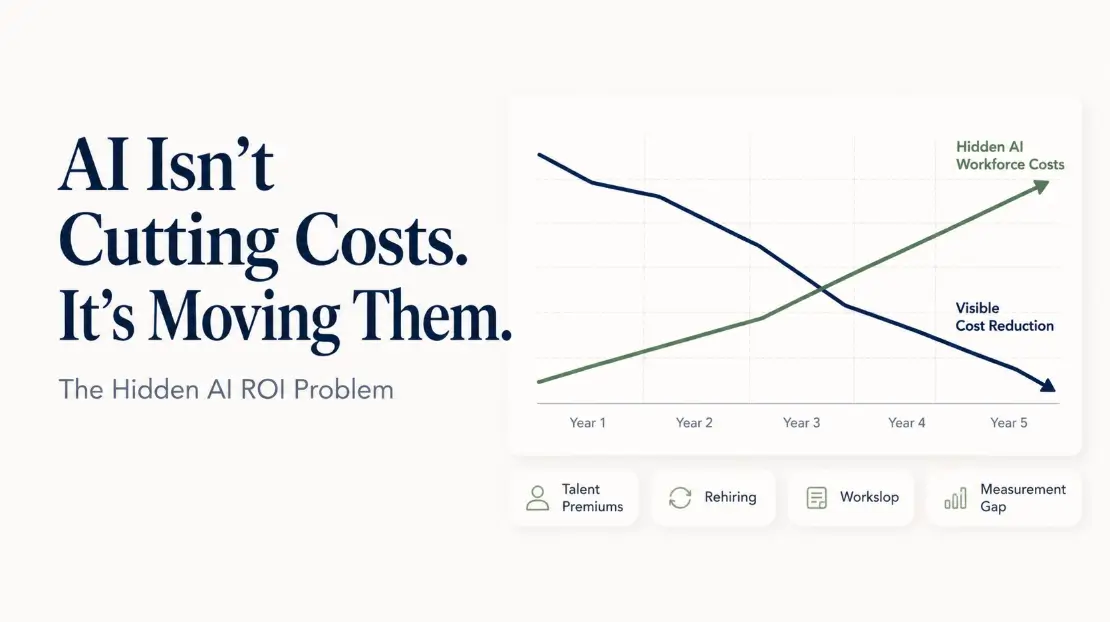
Gartner published research today directed at chief human resources officers (CHRO), but the findings belong in front of every executive who has ever presented an AI business case to a board. The headline conclusion: AI is not reducing enterprise workforce costs. It is moving those costs into new categories — higher compensation for scarce AI talent, future rehiring expenses after premature cuts, structural changes to workforce composition, and a productivity drag from low-quality AI output that employees spend time correcting. Most organizations have no system to track any of these costs, which means they have no system to determine whether their AI investment is returning what they told the board it would.
The research lands at a specific moment. Enterprises have been increasing AI spend aggressively — 88% plan to spend more this year than last, according to Gartner's own survey data. Boards have been asking for proof that the investment is working. The response from many executive teams has been to point at workforce reductions as evidence of AI efficiency. Gartner's findings published today suggest that response is answering a different question than the board is asking.
The board's question is whether AI is generating more value than it costs. The answer requires a system that connects AI spend to business output. Most enterprises don't have one. Without it, every workforce decision tied to AI is, at best, an educated guess about where the costs and returns actually are.
80% Organizations deploying AI that have conducted workforce reductions — but with no ROI correlation to show for it. Gartner, May 2026.
1% Share of layoffs in H1 2025 that were actually caused by proven AI productivity gains. Gartner Future of Work Trends.
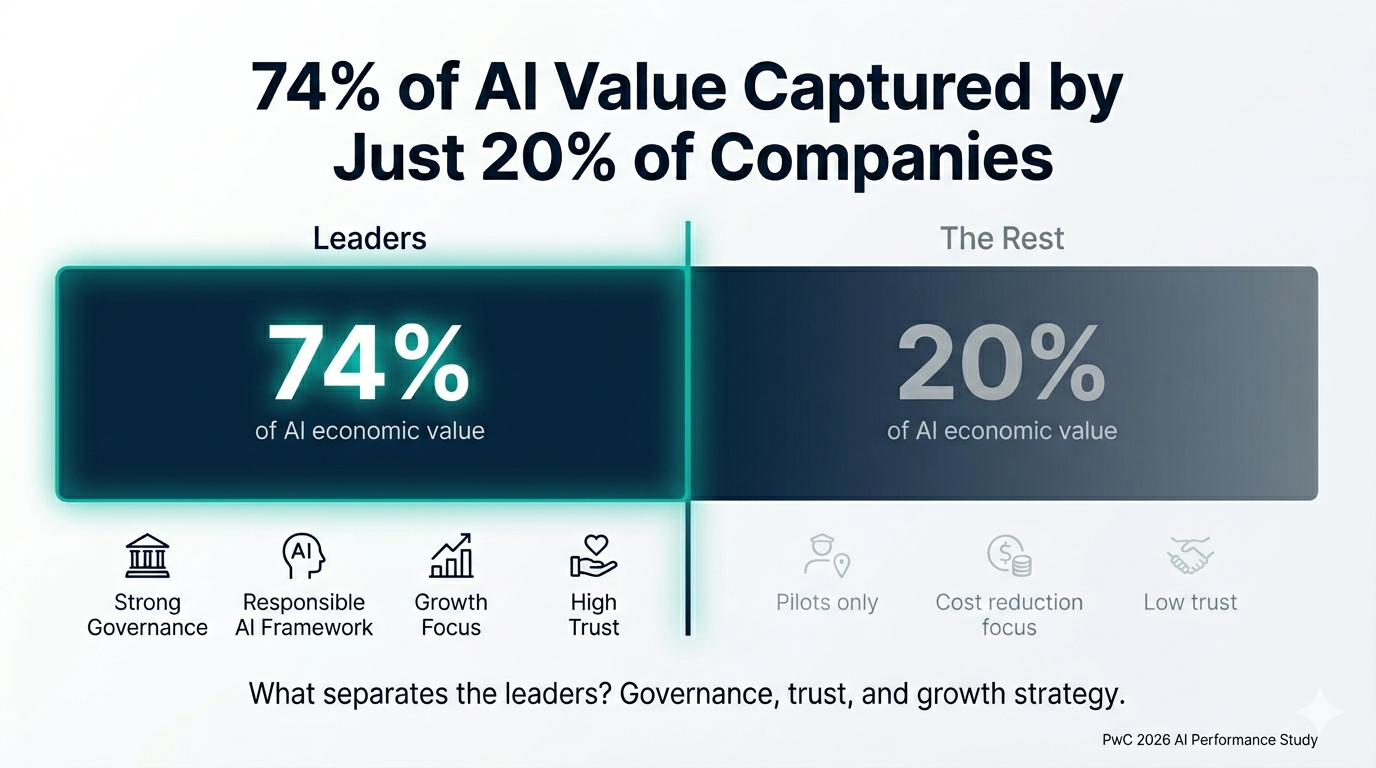
20% Organizations that say AI has grown revenue today, vs. 74% that expect it to. Deloitte 2026 State of AI in the Enterprise.
18% Organizations currently tracking ROI on their agentic AI deployments. Thomson Reuters / MarketScale, 2026.
The Data
In May 2026, Gartner surveyed 350 global business executives across organizations with at least $1 billion in annual revenue, all of whom were piloting or deploying AI agents, intelligent automation, or autonomous technologies. Eighty percent reported conducting workforce reductions. The ROI data showed no correlation between those reductions and better returns. Organizations cutting headcount in the name of AI efficiency were performing nearly identically on ROI metrics to organizations that were not cutting.
"Many CEOs turn to layoffs to demonstrate quick AI returns; however, this disposition is misplaced. Workforce reductions may create budget room, but they do not create return. Organizations that improve ROI are those that amplify people rather than eliminate them — aggressively investing in skills, roles, and operating models that allow humans to guide and scale autonomous systems."
Helen Poitevin
Distinguished VP Analyst, Gartner, May 2026
The 1% statistic from Gartner's January 2026 Future of Work Trends research is the sharper finding. Of all the layoffs that occurred in the first half of 2025, only 1% were the result of AI actually increasing employees' productivity to the point where fewer people were needed. The other 99% were cuts made in anticipation of AI returns that had not yet materialized — and, based on the May research, may never materialize through headcount reduction alone.
Deloitte's 2026 State of AI in the Enterprise survey found that 74% of organizations expect AI to grow revenue, while 20% say it has. That 54-point gap between expectation and documented outcome is the measurement problem made visible. Organizations have been committing to AI investment theses they cannot verify because they have no infrastructure to verify them. Thomson Reuters research, cited by MarketScale, found that only 18% of organizations currently track return on investment for their agentic AI deployments. The other 82% are running autonomous AI systems through enterprise environments without any structured way to answer the question their boards are asking.
What Was Missed
Gartner's June 29 research names four specific categories of workforce cost that AI adoption is generating — none of which appear in the dashboards or financial reports most enterprises use to track AI spending.
AI Talent Premiums
Hiring for AI-skilled roles requires paying compensation well above market rates for equivalent non-AI positions. That premium creates a fixed cost structure that can outpace the productivity gains those roles are supposed to deliver. Organizations that build AI teams quickly during market enthusiasm often find themselves locked into salary structures that made sense when AI talent was scarce and don't make sense once the labor market stabilizes.
Rehiring Costs
Gartner projects that up to 30% of roles displaced by AI will be rehired by 2029, frequently at higher compensation than the original positions paid. The rehiring cycle — job description, search, offer, onboarding, ramp time — typically costs 50 to 200 percent of the annual salary for the role. For organizations that cut aggressively, the cumulative rehiring bill in 2028 and 2029 may exceed what the original cuts saved by a significant margin.
Workforce Composition Shifts
AI-related reductions tend to concentrate in early-career roles, which weakens internal talent pipelines and increases dependence on external hiring for mid-level and senior positions. External hiring is more expensive than internal promotion. Changes in workforce composition also affect benefit cost structures in ways that don't appear in simple headcount metrics. An organization that replaces ten junior employees with two senior hires and an AI subscription has changed its total cost of employment in ways that standard productivity calculations rarely capture.
Productivity Drag
Gartner's 2026 Future of Work Trends research introduced the term "workslop" to describe the cost of employees reviewing, correcting, and managing low-quality AI-generated output. An employee who produces twice as much AI-generated content but spends a third of their day fixing it has not become more productive. The time spent on correction is a direct cost of AI adoption that generates no output of its own. Most organizations have no mechanism for tracking this cost because it doesn't appear in any AI tool's usage metrics.
The pattern across all four categories is the same. The costs are real, they accumulate over months and years, and they don't show up in the reports enterprises use to justify their AI investments. An organization can show the board a spreadsheet demonstrating that AI reduced their headcount cost by $2 million in 2026 while those four categories are quietly building a $3 million bill that won't appear until 2028.
The ROI Problem Comes Down to Infrastructure That Most Don't Have
The governance platforms in GAIG's marketplace answer whether AI systems are operating within policy. The security platforms answer whether AI systems are being used safely. What almost no organization has is a system that answers the more fundamental question: is this AI producing enough value to justify what it costs? That's a measurement infrastructure problem, and it's why the gap between expected and realized AI returns remains so wide.
Every CEO who has declared their company AI-first has created an accountability gap. They've committed to a posture they have no system to verify. Their CIOs can show adoption metrics — licenses issued, tools deployed, prompts sent — but adoption and value are different things, and the measurement infrastructure to connect them hasn't existed as a standard enterprise capability. Cloud computing had this problem in 2015. The FinOps category emerged to solve it: platforms that tied cloud spend to cloud output, identified waste, and gave finance teams the data to manage cloud investment as a business asset rather than an IT line item. AI is at the same inflection point, and the measurement layer is only now being built.
"Long term, autonomous business will create more work for humans, not less. The organizations improving ROI are those that amplify people — not eliminate them."
Helen Poitevin
Distinguished VP Analyst, Gartner, May 2026
The enterprises that currently have any measurement at all are mostly tracking input metrics: spending per model, token consumption per team, license utilization rates. These measure how much AI is being consumed, not what it's producing. The gap between consumption measurement and output measurement is where the hidden costs accumulate undetected. GAIG is covering the platforms built to close that gap under the AI ROI category in the marketplace — platforms that tie AI usage to business output at the level of individual teams, tools, and users, so the CIO can walk into the board meeting with an answer to the question that actually gets asked.
Our Take
AI Governance Take
Gartner's projection that up to 30% of AI-displaced roles will be rehired by 2029 at higher cost is the clearest single consequence of making workforce decisions without measurement infrastructure. Those rehiring cycles won't feel like AI failures at the time — they'll feel like business adjustments, talent strategy corrections, growth-phase hiring. The connection to the original AI-driven cuts will be three years removed and easy to miss. But the math will be there.
The organizations that avoid this cycle are the ones that build the measurement layer before they make the workforce decisions. If you can tie AI spend to output at the team and user level, you can see which tools are generating productivity gains worth the investment and which are generating activity without returns. You can make workforce decisions based on where AI is actually replacing work rather than where your competitors claim it is. That's the difference between AI ROI measurement and AI ROI aspiration.
GAIG is launching the AI ROI category in the marketplace because this measurement layer is now a prerequisite for any enterprise AI program making serious decisions. The compliance and governance tools answer whether your AI programs are safe and policy-compliant. The AI ROI tools answer whether they're worth running at all. Both questions matter. The boards that are currently asking only about returns will eventually ask about governance too. The boards asking about governance have always been implicitly asking about returns. The measurement infrastructure connects those two conversations.