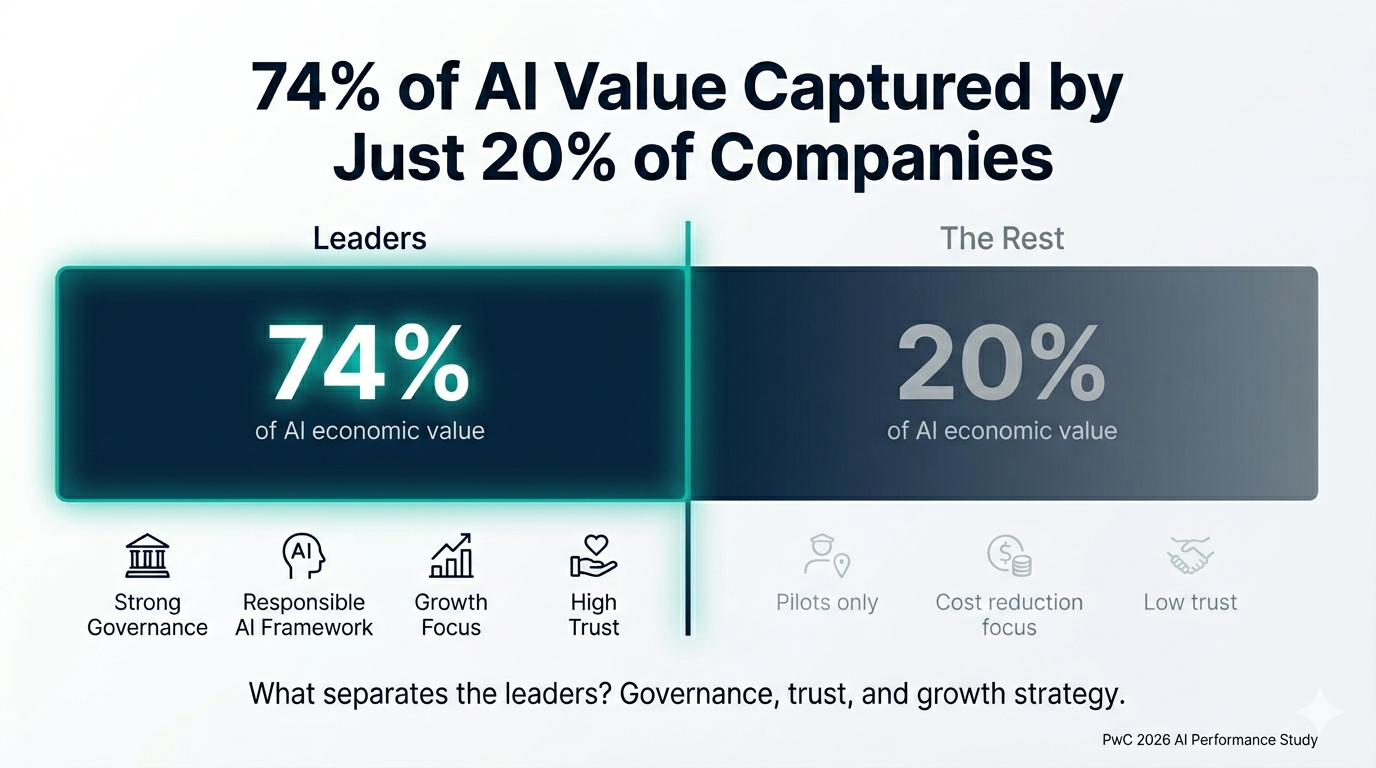
A small group of organisations is pulling sharply ahead in the race to generate real financial returns from artificial intelligence. According to PwC’s 2026 AI Performance Study, nearly three-quarters (74%) of AI’s total economic value is being captured by just one-fifth (20%) of companies. The global survey of 1,217 senior executives across 25 sectors shows that most organisations remain stuck in pilot mode, while a minority have moved decisively from experimentation to measurable, scalable impact.
“Many companies are busy rolling out AI pilots, but only a minority are converting that activity into measurable financial returns. The leaders stand out because they point AI at growth, not just cost reduction, and back that ambition with the foundations that make AI scalable and reliable,”
Joe Atkinson, Global Chief AI Officer, PwC.
What the Leaders Are Doing Differently
What separates the leaders is not simply the volume of AI tools deployed. The top performers are using AI as a catalyst for business reinvention. They are 2.6 times more likely than peers to report that AI improves their ability to reshape business models. They are also two to three times more likely to use AI to identify and pursue growth opportunities arising from industry convergence. In PwC’s analysis, capturing these convergence-driven opportunities emerged as the single strongest predictor of AI-driven financial performance.
Leading companies are also redesigning workflows rather than simply layering AI onto existing processes. They are nearly twice as likely to deploy AI in advanced ways: executing multiple tasks within guardrails or operating in autonomous, self-optimising modes. As a result, these organisations are increasing the number of decisions made without human intervention at almost three times the rate of their peers.
Governance as the Real Differentiator
Governance and trust are proving to be decisive differentiators. Companies achieving the strongest financial outcomes are 1.7 times more likely to have a Responsible AI framework in place and 1.5 times more likely to maintain a cross-functional AI governance board. These structural foundations translate directly into higher confidence inside the organisation: employees at AI-leading companies are twice as likely to trust AI outputs compared with those at peer organisations.
Why the Gap Is Likely to Widen
Without a corresponding shift in approach, the performance gap between AI leaders and the majority of organisations is likely to widen further. Most companies continue to treat AI as a collection of isolated experiments rather than a governed, scalable capability. They remain focused primarily on productivity improvements while the true economic upside comes from using AI to reinvent how value is created and delivered.
Our Take
The PwC study makes one conclusion unmistakable: governance, observability, and trust mechanisms are no longer optional add-ons. They are now the primary drivers that determine whether AI investments deliver meaningful financial returns or remain confined to pilot-stage activity.
This widening divide confirms that the governance gap is now directly measurable in revenue and efficiency outcomes. Organisations that rely primarily on documentation-heavy approval workflows or fragmented tooling will increasingly find themselves on the wrong side of the 74/20 split.
The market is already responding with platforms designed for continuous visibility, model observability, and responsible AI enforcement. GAIG continues to track vendors building the visibility and usage tracking capabilities that address the exact foundations PwC identifies as critical for scalable, trustworthy AI.
Enterprise teams evaluating solutions for this performance gap can explore the GAIG marketplace at GetAIGovernance.net, particularly platforms in the Usage Tracking, Model Observability, Responsible AI, and Governance Platforms categories, to compare how each tool supports the shift from pilots to measurable, governed outcomes.