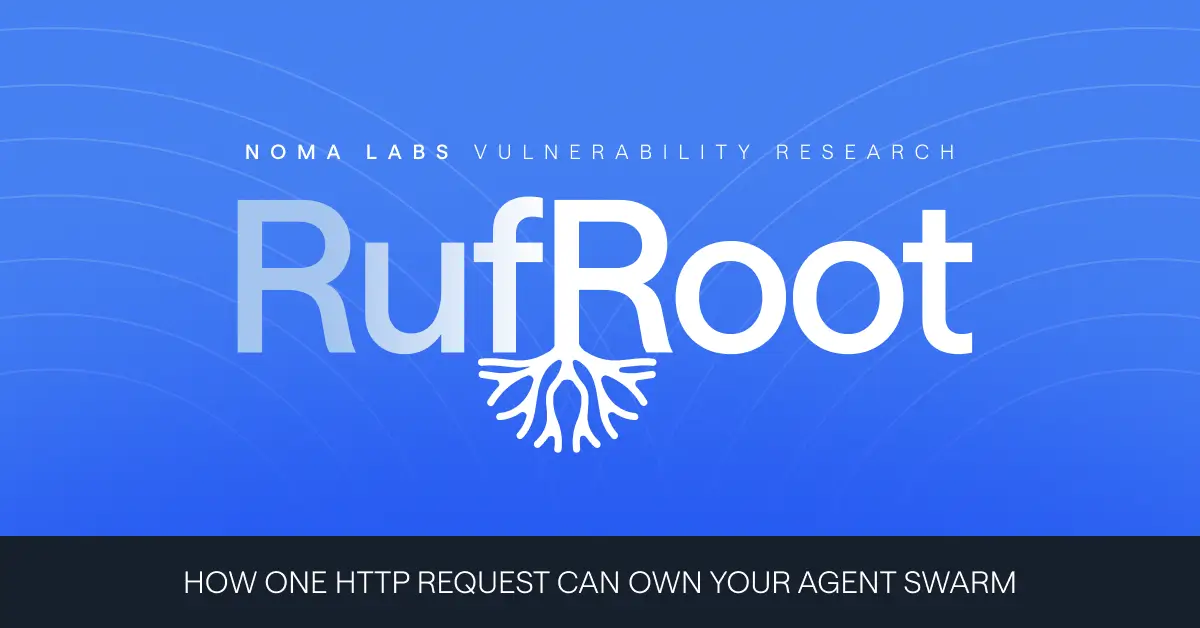
Noma Labs has published research detailing a critical vulnerability in Ruflo, an open-source AI agent meta-harness used to build, deploy, and manage agent swarms. Tracked as CVE-2026-59726 and scored CVSS 10, the flaw centers on the platform’s MCP Bridge — an Express.js server that handles all tool invocations. In default configurations, the bridge exposed 233 tools over HTTP with no authentication, no token checks, and no network restrictions beyond whatever firewall rules the operator happened to apply.
What is RufRoot for those who don’t know? RufRoot is the name Noma Labs gave to this vulnerability. It refers to the ability of an unauthenticated attacker to turn a Ruflo deployment into a fully compromised agent platform by abusing the unprotected MCP Bridge. A single HTTP POST to the /mcp endpoint could invoke the ruflo__terminal_execute tool and run arbitrary shell commands inside the container.
Ruflo ships with chat UI, persistent memory, agent swarm orchestration, and deep MCP-based tool calling. Because the MCP Bridge is the central nervous system through which every agent action flows, unauthenticated access effectively grants control over shell execution, databases, memory stores, and agent lifecycle management. Default Docker Compose configurations bound the bridge to 0.0.0.0, making any network-reachable instance immediately exploitable.
Noma Labs demonstrated a full attack chain: remote code execution, theft of LLM provider API keys from environment variables, spawning of attacker-controlled agent swarms, injection of malicious patterns into the AI memory store, exfiltration of conversation data from an unauthenticated MongoDB instance, and installation of a persistent backdoor that survived container restarts. The Ruflo team responded quickly, merging a comprehensive fix, publishing a security advisory, and providing clear remediation steps for existing deployments.
The research underscores a broader risk: as MCP-based agent platforms proliferate — often deployed as Shadow AI by individual developers or teams — missing authentication and overly permissive defaults can turn powerful automation tools into high-impact attack surfaces.
Key Findings
Noma Labs discovered a critical vulnerability (CVE-2026-59726, CVSS 10) in Ruflo, a popular open-source AI agent orchestration platform with more than 67,000 GitHub stars and significant real-world adoption.
Ruflo’s MCP Bridge, the Express.js server that handles all tool invocations, exposed 233 tools over HTTP with zero authentication by default, including a terminal execution tool capable of running arbitrary shell commands.
A single unauthenticated HTTP POST request to the /mcp endpoint was sufficient to achieve remote code execution inside the container, with no token, API key, header check, or IP allowlist required.
Default Docker Compose configurations bound the MCP Bridge to 0.0.0.0, making any network-reachable instance fully exploitable depending only on external firewall or security-group rules.
Once code execution was obtained, researchers demonstrated a complete attack chain: theft of LLM provider API keys from environment variables, spawning of attacker-controlled agent swarms, poisoning of the AI memory/pattern store, exfiltration of conversation data from an unauthenticated MongoDB instance, and installation of a persistent backdoor that survived container restarts.
The command blocklist present in Ruflo applied only to the autopilot flow and was completely bypassed by direct calls to the /mcp endpoint.
Ruflo responded rapidly to the responsible disclosure: a comprehensive fix was merged within hours, a public security advisory was published, and the issue was scored CVSS 10/10.
The remediation hardened defaults significantly — the bridge now binds to loopback by default, requires an authentication token for public binding, disables terminal execution by default, enforces MongoDB authentication, runs the container read-only, and adds CI regression tests.
The finding highlights a systemic risk in the rapidly growing MCP ecosystem: powerful agent platforms that expose tool bridges without authentication or least-privilege defaults create high-impact attack surfaces, especially when deployed as Shadow AI inside enterprise environments.
Organizations running self-hosted agentic platforms should treat MCP endpoints as sensitive infrastructure, require authentication on every request, restrict dangerous tools by default, and avoid exposing them to the network unless strictly necessary.
What the Report Covers
Noma Labs’ research post, RufRoot: The MCP Bridge Vulnerability That Turns Agents Into Rogue Admins (CVE-2026-59726), provides a detailed technical disclosure of a critical security flaw in the open-source Ruflo AI agent orchestration platform. The document combines vulnerability analysis, a complete proof-of-concept attack chain, vendor response details, and practical defensive guidance for organizations running similar agentic systems.
Key sections include:
Executive Overview / TL;DR — Summarizes the critical (CVSS 10) finding: an unauthenticated MCP Bridge exposing 233 tools over HTTP, enabling remote code execution with a single request.
Platform Background — Explains what Ruflo is (an open-source AI agent meta-harness with chat UI, agent swarms, persistent memory, and MCP-based tool calling), its popularity, and how it is typically deployed.
MCP Bridge Architecture — Details how the Express.js MCP Bridge serves as the central control point for all tool invocations and why unauthenticated access equates to full platform compromise.
Shadow AI Risk Context — Discusses how self-hosted agent platforms like Ruflo frequently enter enterprise environments outside formal security review, increasing exposure.
Root Cause and Exploitation — Walks through the unauthenticated /mcp endpoint, the bypass of existing command blocklists, and the one-request remote code execution via the ruflo__terminal_execute tool.
Full Attack Chain — Documents an eight-step proof of concept covering reconnaissance, RCE, API key theft, agent weaponization, memory poisoning, conversation exfiltration, persistent backdoor installation, and cleanup.
Vendor Response and Remediation — Covers the rapid fix by the Ruflo team, the security advisory, and the specific hardening measures implemented (authentication, loopback binding, terminal gating, MongoDB auth, read-only container, and CI tests).
Broader MCP Security Lessons — Emphasizes that MCP endpoints providing tool access must be treated as sensitive infrastructure requiring authentication, least privilege, and careful network exposure decisions.
Overall, the research serves both as a concrete vulnerability disclosure and as a case study on the security risks of unauthenticated tool bridges in agentic AI platforms.
Our Take
AI Security Take
The RufRoot vulnerability (CVE-2026-59726) is a clear illustration of how quickly powerful agentic platforms can become high-impact attack surfaces when basic security controls are missing. An unauthenticated MCP Bridge that exposes shell execution, memory stores, agent lifecycle controls, and database access effectively hands an attacker the keys to the entire system. In Ruflo’s case, a single HTTP request was enough to begin a full compromise chain ending in persistent access and the ability to influence future agent behavior.
The broader lesson extends well beyond one open-source project. Model Context Protocol has become a popular way to give large language models real-world capabilities. That same design — direct tool invocation with high privileges — makes authentication, least-privilege defaults, and careful network exposure non-negotiable. When these controls are absent or optional, self-hosted agent platforms that enter environments as Shadow AI create exactly the kind of critical exposure Noma Labs demonstrated.
Several practical takeaways stand out for security and platform teams:
Treat every MCP endpoint as sensitive infrastructure. Require authentication on every request and fail closed if credentials are missing.
Dangerous tools such as terminal or arbitrary code execution should be disabled by default and only enabled with explicit configuration and strong access controls.
Default network bindings matter. Binding powerful services to all interfaces without authentication is an invitation to remote compromise.
Memory and pattern stores that influence agent behavior must be protected; poisoning them can turn a one-time intrusion into ongoing, hard-to-detect influence over AI outputs.
Rapid vendor response, as seen from the Ruflo team, is valuable — but organizations still need to audit existing deployments for prior compromise, rotate credentials, and verify that malicious patterns or backdoors have not already been introduced.
As agentic systems proliferate, the security bar for the infrastructure that supports them must rise accordingly. Platforms that grant agents the ability to act on the real world cannot ship with unauthenticated control planes. RufRoot shows both the severity of the risk and the concrete steps required to reduce it. Organizations deploying or allowing self-hosted agent frameworks should assume that any exposed, unauthenticated tool bridge is a critical finding until proven otherwise.