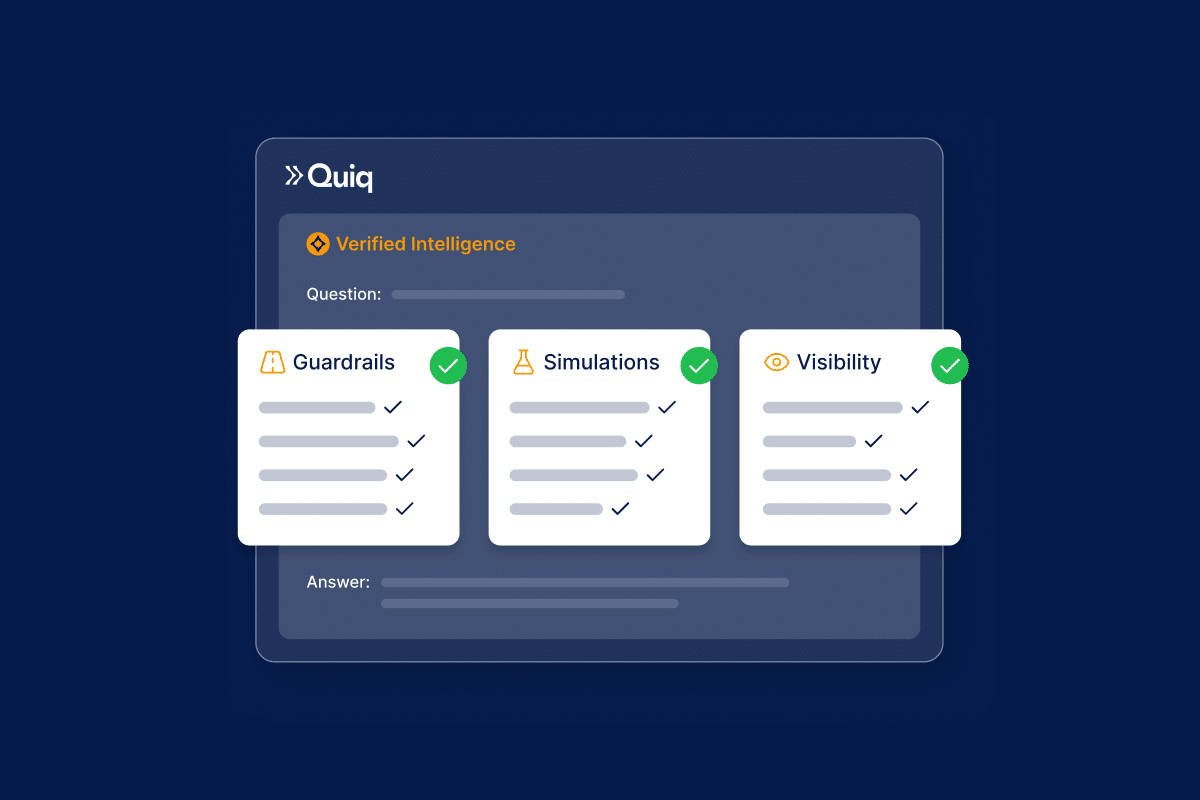
Quiq has introduced Verified Intelligence, a new set of capabilities designed to strengthen control over agentic AI systems in enterprise environments. The launch includes a three-part control layer focused on guardrails, simulation testing, and detailed decision visibility.
The company positioned the release as a response to the challenges organizations face when moving AI agents into production. Many vendors demonstrate impressive capabilities in controlled demos but provide limited tools for ongoing governance and risk management once systems are live. Verified Intelligence aims to close that gap by adding structured controls before responses reach customers, enabling realistic testing scenarios, and providing full transparency into how AI agents make decisions.
The new capabilities include Verify Claim, which cross-references AI responses against enterprise data and knowledge bases before delivery. Process Guides allow brands to encode standards, tone, and escalation rules directly into agent behavior. Simulation tools let teams run hundreds of multi-turn conversations to test edge cases and policy adherence prior to deployment. Additionally, the system provides step-by-step reasoning traces for every interaction, making AI decisions auditable and explainable.
This development reflects the broader industry shift toward treating agentic AI as systems that require robust operational controls rather than simple prompt-and-respond interfaces. As enterprises increase investment in autonomous AI agents, the ability to verify claims, simulate behavior, and audit decisions is becoming a key requirement for responsible deployment at scale.
Conditions Driving the Change
Rapid deployment of autonomous AI agents across customer-facing environments is creating new operational risks that traditional monitoring and security tools are not equipped to handle.
Growing pressure from boards and executives to scale AI initiatives while maintaining brand safety, compliance, and customer trust is forcing organizations to seek stronger governance mechanisms.
The gap between impressive AI demos and real-world production behavior is becoming more apparent, with many agents behaving unpredictably when faced with edge cases, manipulation attempts, or complex multi-turn interactions.
Increasing regulatory scrutiny and internal compliance requirements are demanding better auditability, explainability, and policy enforcement for AI systems.
Proliferation of AI-generated code and agentic workflows is expanding the attack surface, particularly around credential management, data handling, and decision-making transparency.
Security and CX teams are facing operational overload from managing fragmented tools that lack unified visibility into both human and AI agent activities.
The rise of multi-step, autonomous AI interactions is making it harder to predict outcomes without robust pre-deployment simulation and real-time verification capabilities.
Enterprises are realizing that basic prompt engineering and post-incident monitoring are insufficient for high-stakes agentic AI use cases, driving demand for built-in guardrails and decision-level transparency.
What AI Security Looked Like Before
Before Quiq’s Verified Intelligence launch, AI security and governance for agentic systems were typically fragmented, reactive, and insufficient for the complexity of real-world deployments. Most organizations relied on basic prompt engineering, simple output filtering, and general-purpose application security tools that were never designed to handle autonomous, multi-step AI agents operating at scale. Visibility into agent behavior was limited to high-level conversation logs or after-the-fact analysis, with little insight into the internal reasoning, tool calls, or decision paths that led to specific outputs.
Guardrails were often minimal, inconsistently applied, or entirely absent, leaving agents vulnerable to manipulation, off-topic requests, or policy violations. Simulation testing, when it existed, was usually narrow in scope and failed to replicate the messy, unpredictable nature of actual customer interactions, including edge cases, attempts to game the system, or complex multi-turn conversations. Compliance and audit readiness depended heavily on manual documentation and retrospective reviews, making it difficult to provide regulators or internal stakeholders with clear evidence of consistent policy enforcement or explainability. Many enterprises only discovered serious problems after agents were already in production, resulting in brand incidents, compliance violations, customer trust issues, or costly remediation efforts. Overall, the prevailing approach treated AI agents more like enhanced chatbots than sophisticated autonomous systems requiring dedicated governance frameworks, proactive risk controls, lifecycle management, and comprehensive visibility. This created substantial blind spots as AI adoption accelerated faster than the supporting security and governance capabilities could evolve.
What AI Security Looks Like Now
With the introduction of Verified Intelligence, AI security and governance for agentic systems have taken a substantial step forward toward more structured, proactive, and enterprise-ready practices. Organizations can now implement layered guardrails that verify AI claims against trusted knowledge bases and data sources before any response reaches the customer. Brand standards, tone guidelines, and escalation rules can be directly encoded into agent behavior, providing consistent protection across interactions. The simulation capabilities allow teams to run hundreds of realistic, multi-turn conversations in a controlled environment, surfacing policy failures, edge cases, and regressions before any customer ever interacts with the live agent.
Full decision visibility delivers step-by-step reasoning traces for every interaction, including tool calls, data lookups, and decision points, making AI actions fully auditable and explainable. This level of transparency helps security, compliance, and CX teams quickly understand not only what an agent did, but exactly why it made each decision. The platform integrates these controls natively, so every AI agent deployment benefits from guardrails, simulation testing, and detailed visibility from day one. The result is a more cohesive control layer that supports confident scaling of agentic AI while reducing brand risk, compliance exposure, and operational surprises. This shift moves enterprises from reactive, fragmented approaches to a unified, real-time governance framework specifically built for the demands of autonomous AI systems.
Our Take
AI Security Take
Quiq’s launch of Verified Intelligence represents a meaningful advancement in agentic AI security. By introducing pre-response guardrails, realistic simulation testing, and full decision-level visibility, the company is addressing some of the core security challenges that have emerged as organizations move autonomous AI agents into production environments. The ability to verify claims against trusted data sources before responses are delivered, test agents against complex multi-turn scenarios, and audit every reasoning step provides security teams with much-needed controls in an area that has historically been difficult to secure.
The timing is significant. As AI agents take on more complex customer-facing tasks, the risks of unpredictable behavior, credential misuse, policy violations, and brand-damaging outputs have become more pronounced. Traditional security tools often lack the granularity and real-time capabilities required to manage these dynamic, autonomous systems effectively. Verified Intelligence attempts to close that gap by shifting from reactive monitoring to proactive prevention and explainability.
For security leaders, the most practical benefit may be the combination of prevention and visibility. Guardrails and simulation reduce the likelihood of incidents reaching customers, while step-by-step decision traces make investigations faster and more effective when issues do occur. This level of transparency is particularly valuable for compliance, incident response, and demonstrating due diligence to auditors and regulators.
That said, success will depend on how well these capabilities integrate into existing security operations and scale across diverse enterprise environments. Organizations should evaluate not only the technical features but also the operational impact on security workflows, alert fatigue, and overall risk posture. The launch highlights a broader industry trend: agentic AI requires a new category of security controls that go beyond traditional application security to include agent behavior governance, simulation-based testing, and comprehensive auditability. Quiq’s move is one example of vendors responding to this evolving threat and control landscape. Enterprises that prioritize these types of layered security capabilities will be better positioned to deploy AI agents confidently while managing the associated risks.