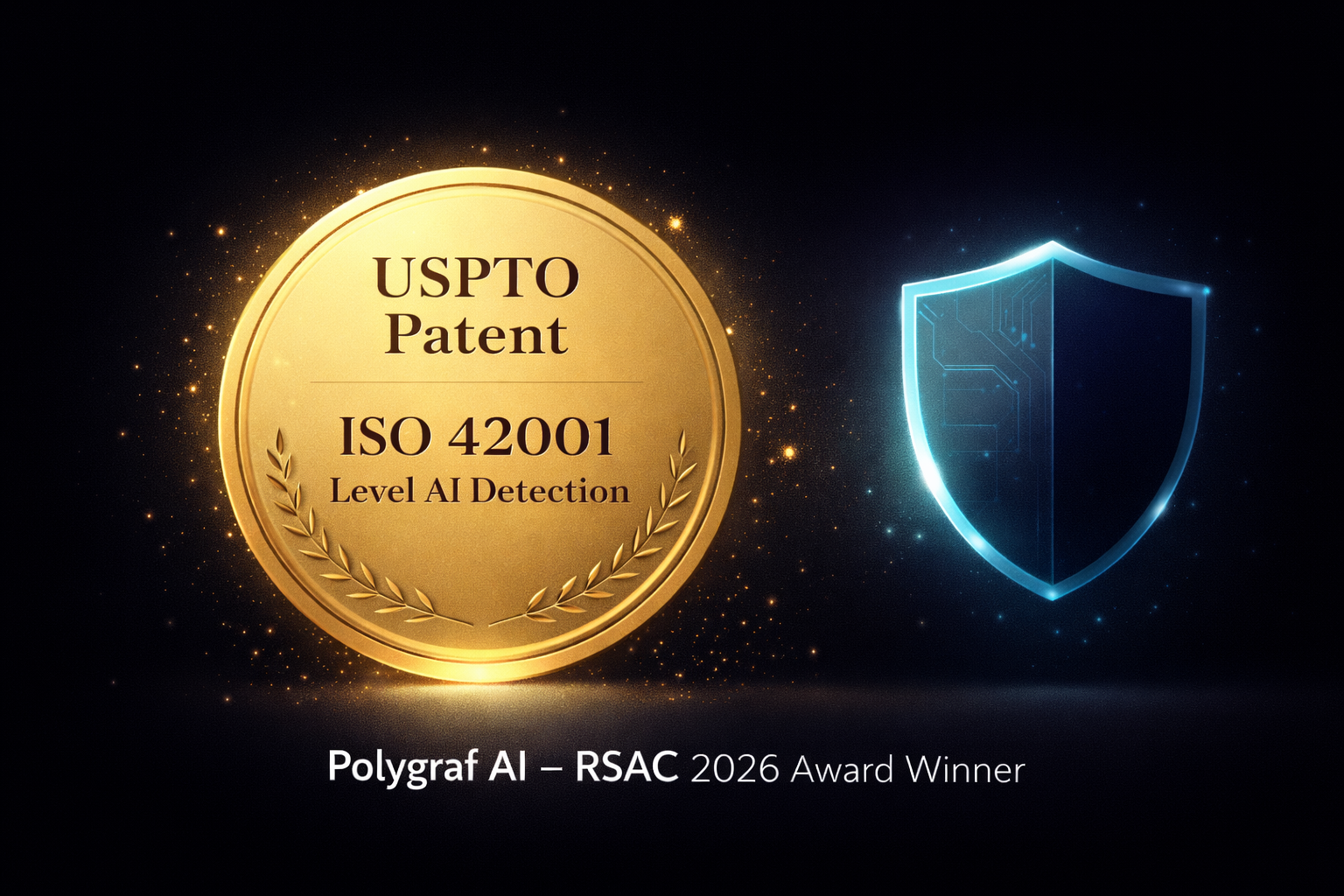
Polygraf AI announced it has been granted a USPTO patent for its proprietary Content Source Detection AI model. The company also won “Most Innovative AI Usage Control for Security and Compliance” at the 14th Annual Global InfoSec Awards during RSAC 2026, along with Gold in AI Data Security & Governance and Silver at the Globee Awards.
The patent covers technology that identifies the origin of digital content with high precision, even in mixed human/AI documents or those with intentional manipulation. It uses a shifting window analysis to distinguish AI-generated text from human-written content. This capability addresses a growing need for accountability as AI-generated material proliferates in regulated sectors.
Polygraf positions the patent as part of its AI Behavioral Control Plane, which keeps sensitive data within client-controlled environments and provides full traceability across prompts, uploads, and outputs. The platform uses task-specific Small Language Models deployed from edge to air-gapped and cloud setups, supporting standards such as NIST RMF, HIPAA, and GDPR.
This announcement signals increasing maturity in the AI security market, where vendors are moving from reactive detection to proactive, explainable controls that can withstand regulatory scrutiny.
Key Terms
Content Source Detection
Polygraf’s patented model that determines whether text (or mixed content) was generated by AI or written by a human, even when manipulation is present. It uses shifting window analysis for forensic-level precision.
AI Behavioral Control Plane (ABC)
Polygraf’s overarching architecture that enforces privacy and compliance at the moment of interaction rather than after a leak occurs. It provides traceability and auditability while keeping regulated data inside the trust boundary.
Shifting Window Analysis
A forensic detection method that examines overlapping segments of text to identify patterns consistent with AI generation versus human writing.
Small Language Models (SLMs)
Task-specific models deployed locally or in air-gapped environments. Polygraf uses them for real-time detection while maintaining data control and compliance.
What the Patent Actually Enables
The USPTO patent covers Polygraf’s Content Source Detection AI model, which identifies the origin of digital content with high precision, even in mixed human/AI documents or those with intentional manipulation. It uses a shifting window analysis that examines overlapping segments of text to detect patterns consistent with AI generation versus human writing.
This capability goes beyond simple classification. It provides forensic-level explainability, showing exactly which parts of a document are likely AI-generated and why. In regulated environments where proving the integrity and origin of information is critical, this level of traceability becomes a practical control rather than a theoretical one.
The patent is integrated into Polygraf’s AI Behavioral Control Plane, an architecture designed to keep sensitive data within client-controlled environments. It supports full auditability across prompts, uploads, and outputs while using task-specific Small Language Models deployed from edge to air-gapped and cloud setups. This design helps organizations meet standards such as NIST RMF, HIPAA, and GDPR without sacrificing performance or data sovereignty.
What This Means for Polygraf and the Market
For Polygraf, the patent and RSAC 2026 awards serve as independent validation of its technical approach. Winning “Most Innovative AI Usage Control for Security and Compliance,” Gold in AI Data Security & Governance, and Silver at the Globee Awards signals that its focus on explainable, locally deployed detection is gaining recognition from both CISOs and industry analysts.
From a buyer perspective, this type of patent and award recognition can act as a credibility signal when evaluating AI security or governance tools. Enterprises in finance, government, healthcare, and other regulated sectors often look for evidence that a vendor’s technology has been independently reviewed and meets formal standards. Certification and patents help reduce perceived risk and create a baseline level of confidence that internal controls exist.
At the same time, the market is beginning to recognize the limits of what patents and awards represent. A patent for content source detection is valuable for forensic and compliance use cases, but organizations also need continuous behavioral monitoring, runtime enforcement, and auditable decision chains once systems are live. As adoption scales, buyers are starting to look beyond individual innovations toward how vendors connect detection capabilities to real-time control and evidence generation in production.
Our Take
AI Security Take
Polygraf’s new USPTO patent and strong showing at RSAC 2026 highlight a healthy trend in the AI security market. Vendors are investing in explainable, forensic-level detection to address synthetic content risks and content provenance. This is particularly valuable in regulated environments where proving the origin and integrity of information is becoming a compliance requirement.
At the same time, the announcement underscores an important distinction. Strong detection capabilities are useful, but they are only one part of effective AI governance. Organizations also need continuous behavioral monitoring, runtime enforcement, and auditable decision chains to ensure agents stay within defined boundaries once they are live in production.
As more vendors pursue patents and formal recognitions, the baseline for credibility is rising. Buyers should treat these milestones as positive signals of technical maturity, then evaluate how well the platform connects detection to real-time control and verifiable evidence. The gap between forensic insight and operational governance is where many programs still fall short.
GAIG tracks platforms that combine advanced detection with runtime visibility and enforcement. Enterprise teams evaluating AI security tools can compare options in the AI Security and AI Monitoring categories at GetAIGovernance.net based on how effectively they deliver both forensic detection and ongoing behavioral control.