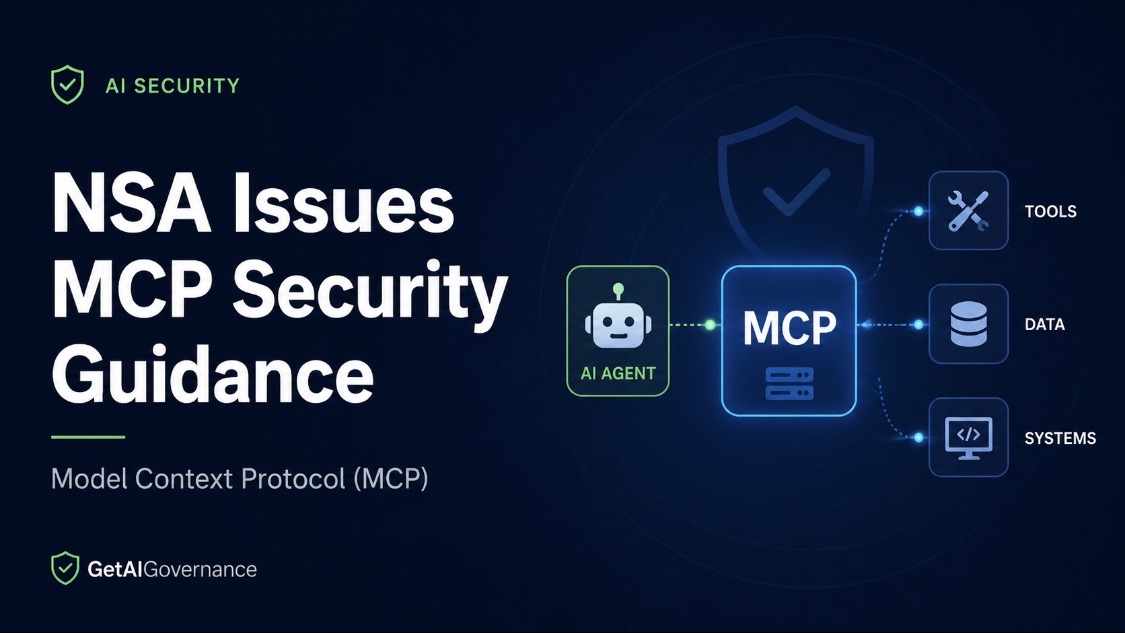
The National Security Agency (NSA) has released a Cybersecurity Information Sheet (CSI) titled “Model Context Protocol (MCP): Security Design Considerations for AI-Driven Automation.” This document provides one of the most authoritative technical assessments to date on the security implications of MCP — the open protocol popularized by Anthropic and now widely used to connect large language models with external tools, data sources, and other agents.
MCP has become a foundational building block for agentic AI systems. It enables models to discover available tools, call functions, maintain context across interactions, and orchestrate complex workflows. However, the NSA report cautions that the protocol’s rapid adoption in both experimental and production settings has outpaced secure implementation practices.
The guidance outlines multiple categories of risk, including arbitrary code execution vulnerabilities, insufficient authentication and authorization mechanisms, insecure serialization of context data, weak approval workflows for sensitive actions, token and session management issues, and inadequate audit logging. These problems are especially concerning because MCP servers are increasingly deployed in enterprise environments where agents have access to sensitive systems and data.
This NSA document arrives at a pivotal moment. With major platforms and tools integrating MCP support, organizations face growing pressure to balance the productivity gains of autonomous agents against the new attack surfaces they introduce. The report serves as both a warning and a practical reference for security and governance teams tasked with evaluating or deploying MCP-based systems.
Key Findings
The NSA identifies arbitrary code execution as one of the most severe risks in MCP implementations, where malicious actors can exploit poorly sanitized tool calls or context data to execute harmful commands on the host system.
Weak or missing authentication mechanisms in many MCP servers allow unauthorized agents or users to invoke sensitive tools without proper identity verification, significantly expanding the attack surface.
Insecure context serialization practices enable attackers to inject malicious payloads through manipulated context data, which agents then process without adequate validation.
The report highlights insufficient approval workflows for high-impact actions, noting that many MCP deployments lack human-in-the-loop controls or granular permission boundaries for autonomous agents.
Token and session management in MCP implementations often fail to follow security best practices, leading to risks of session hijacking and replay attacks in long-running agent conversations.
Misconfigurations of MCP servers are widespread, with default settings frequently exposing overly permissive tool access and inadequate rate limiting.
The absence of comprehensive audit logging makes it difficult for organizations to detect, investigate, or attribute malicious or erroneous agent behavior in production environments.
The NSA emphasizes that MCP’s flexibility, while powerful for agentic workflows, has created inconsistent security implementations across different vendors and open-source projects.
Many current MCP deployments do not properly isolate agent contexts, allowing one compromised agent to potentially influence or extract data from other agents sharing the same server.
The guidance stresses that organizations adopting MCP for enterprise use must implement defense-in-depth strategies, including runtime monitoring, strict input validation, and regular security assessments of their MCP infrastructure.
The report notes that the rapid proliferation of MCP support in tools and platforms has outpaced the development of standardized security controls, leaving many early adopters exposed to preventable vulnerabilities.
What the NSA Report Covers
The NSA’s Cybersecurity Information Sheet provides a structured, technical deep dive into the security implications of the Model Context Protocol (MCP). It begins by explaining MCP’s core purpose: serving as a standardized interface that allows AI agents and large language models to discover, invoke, and interact with external tools, data sources, and other agents in a consistent manner. The report acknowledges MCP’s growing popularity as a foundational enabler for agentic AI workflows, citing its use in everything from simple tool-calling assistants to complex autonomous systems that orchestrate multi-step processes across enterprise environments.
The document then systematically breaks down the protocol’s architecture and highlights where security assumptions break down in real-world implementations. It details how MCP servers typically expose tool registries, handle context passing between the model and tools, manage authentication for agent identities, and serialize data exchanged during interactions. A major focus is placed on the risks introduced by MCP’s design philosophy, which prioritizes flexibility and ease of integration over strict security controls by default.
Key technical areas covered include:
Arbitrary Code Execution Risks: The report explains how insufficient input sanitization in tool definitions or context handling can allow attackers to inject and execute malicious commands on the underlying host system through crafted MCP requests.
Authentication and Authorization Weaknesses: It examines common failures in agent identity verification, session management, and permission enforcement, noting that many deployments rely on weak or missing controls that permit unauthorized tool invocation.
Insecure Context Handling and Serialization: Detailed analysis of how context data (including tool outputs, memory, and intermediate results) is passed between components, with warnings about injection attacks, improper escaping, and deserialization vulnerabilities.
Approval and Human Oversight Gaps: The guidance stresses the importance of human-in-the-loop mechanisms for high-risk actions and criticizes implementations that allow fully autonomous execution without appropriate safeguards or auditability.
Logging, Monitoring, and Visibility Deficiencies: The report calls out the frequent lack of comprehensive audit trails, making incident response and forensic analysis extremely difficult in compromised MCP environments.
Configuration and Deployment Pitfalls: It includes practical examples of dangerous default settings, overly broad tool exposure, missing rate limiting, and failure to isolate different agent contexts on shared servers.
Throughout the document, the NSA provides concrete examples of vulnerable patterns, real-world attack scenarios, and a set of actionable security design recommendations. These range from architectural best practices (such as strict least-privilege tool scoping and sandboxing) to operational controls (regular security reviews, runtime behavioral monitoring, and integration with enterprise identity systems).
The report concludes by framing MCP security as a critical emerging concern for any organization moving toward production agentic AI, urging security teams to treat MCP servers with the same rigor applied to traditional API gateways and privileged access management systems.
This section is highly detailed and positions the NSA guidance as essential reading for enterprises actively deploying or evaluating MCP-based agent platforms.
Our Take
AI Security Take
The NSA’s detailed Cybersecurity Information Sheet on the Model Context Protocol (MCP) is a significant and timely warning for any organization deploying or considering agentic AI systems. By publicly highlighting serious risks — including arbitrary code execution, weak authentication, insecure context serialization, and inadequate audit logging — the agency underscores that MCP, while powerful, has become a high-value attack surface that many current implementations are not adequately protecting.
This report validates what we have observed across multiple MCP-related deployments: the protocol’s flexibility and ease of integration have encouraged rapid adoption, but security and governance practices have lagged dangerously behind. MCP servers are often stood up with default configurations, insufficient isolation, and minimal runtime controls, creating exactly the kind of environment where small misconfigurations can lead to major breaches.
For enterprise security and governance teams, this document should serve as a call to action. Treating MCP as “just another integration layer” is no longer acceptable. Organizations need to implement defense-in-depth: strong agent identity management (leveraging solutions like Idira or similar), strict least-privilege tool scoping, robust input validation and sandboxing, comprehensive audit logging, and human oversight mechanisms for high-impact actions.
The NSA guidance reinforces a core principle in the agentic era: runtime governance and security controls must be architectural, not optional. Enterprises that continue treating MCP security as an afterthought will accumulate serious Pre-Failure Signals. Those that treat MCP servers with the same rigor as privileged access management systems and API gateways will be far better positioned to scale agentic AI safely and responsibly.
This report is essential reading for any CISO, AI governance lead, or platform team currently working with or evaluating MCP-based solutions.