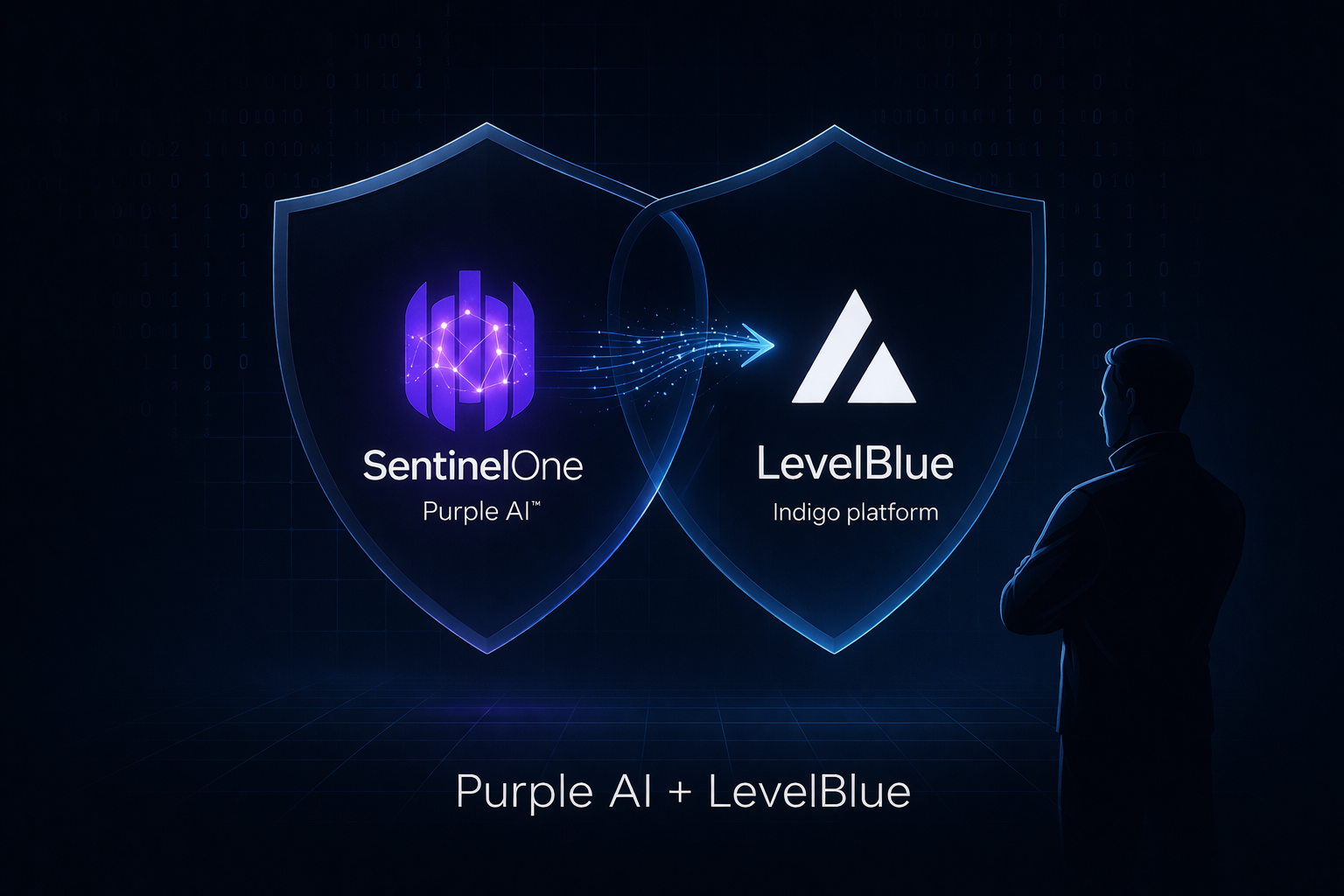
LevelBlue and SentinelOne announced today — March 24, 2026 — an expanded strategic global partnership to deliver AI-powered managed security operations and incident response. In plain terms, the world’s largest pure-play managed security services provider is deepening its integration with SentinelOne’s Purple AI and Singularity Platform so organizations get faster, smarter, and more unified security outcomes instead of just more alerts.
Here’s why this actually matters. Security teams are buried under tool sprawl, exploding threat volume, and attacks that move at machine speed. Purple AI (SentinelOne’s agentic AI security analyst) already does autonomous investigations, but pairing it with LevelBlue’s Indigo™ platform, global threat intelligence, and 300+ digital forensics pros creates a closed loop: AI spots the threat, humans triage and respond, and everything gets documented in one operational layer.
Picture a typical breach scenario: a sophisticated attacker slips past perimeter defenses and starts moving laterally across endpoints and cloud workloads. In the old world, your MDR provider flags something, your SIEM lights up, and your IR team scrambles days later. With this partnership, Purple AI runs a full cross-stack investigation in minutes, hands curated context to LevelBlue’s analysts, and the whole thing escalates seamlessly into coordinated containment and recovery.
Key Terms
Purple AI
SentinelOne’s agentic AI security analyst that autonomously investigates, reasons across data sources, and shrinks multi-hour forensic work into minutes. It powers detection, auto-investigation, and decision support inside the Singularity Platform.
Managed Detection and Response (MDR)
A fully outsourced service where experts monitor your environment 24/7, detect threats, and handle initial response using your tools (or theirs). LevelBlue is now a preferred global MDR provider for SentinelOne customers.
Managed SIEM
Outsourced security information and event management — centralized logging, correlation, and analytics so teams don’t have to manage the SIEM infrastructure themselves.
Incident Response (IR)
The full lifecycle of preparing for, containing, eradicating, and recovering from a breach. LevelBlue is now a preferred SentinelOne IR provider with CREST-certified teams and flexible retainers.
MXDR
Managed Extended Detection and Response — MDR that spans endpoints, cloud, identity, email, and more for broader visibility.
Conditions Driving the Partnership
Security operations have hit a breaking point that pure technology or pure services can’t fix alone. The partnership addresses several structural realities now shaping the market:
• Attackers use AI to move faster than human teams can react, creating a speed gap no single vendor can close.
• Tool sprawl and alert fatigue mean most SOCs spend more time triaging noise than stopping real threats.
• Organizations need measurable outcomes (dwell time, time-to-containment, recovery success) rather than just “more alerts” for boards and regulators.
• AI-driven detection like Purple AI is powerful but still needs human expertise, context, and global scale to turn insights into decisive action.
• Threat intelligence and digital forensics talent are in short supply — LevelBlue brings 300+ specialists while SentinelOne brings the AI layer.
• Hybrid and multi-cloud environments make visibility and response exponentially harder without a unified operational model.
• Regulations and cyber insurance now demand proof of rapid, coordinated response, not just detection capability.
Put together, the industry is moving from “AI everywhere” to “AI that actually works with people at scale.”
What Security Operations Looked Like Before This Shift
A couple of years ago most enterprises ran MDR and SIEM as completely separate services from different vendors. One provider watched endpoints and gave you basic alerts. Another handled logging and correlation in a SIEM you still had to manage or pay someone else to babysit. When something bad actually happened, you called in a third-party incident response team that had never seen your environment before.
The result was painful: delayed hand-offs between tools, duplicated effort, and investigations that dragged on for days while attackers kept moving. Teams had plenty of data but no unified way to turn it into fast, defensible action. Purple AI might have flagged something suspicious on an endpoint, but that signal still had to be manually copied into a SIEM ticket, then handed off to a separate MDR analyst, and finally escalated to an IR retainer that started from scratch. In the meantime, the attacker had already pivoted to the next system.
SOC analysts were drowning in thousands of alerts a day, most of them false positives. Boards and regulators kept asking for proof of “mature response capabilities,” but all anyone could show were disconnected logs and after-the-fact reports. The entire process felt like trying to fight a fire with three different hoses that didn’t connect. That fragmented model simply couldn’t keep up with the speed and sophistication of modern threats — especially once attackers started using their own AI tools. The gap between detection and actual resolution grew wider every quarter.
What LevelBlue and SentinelOne Are Actually Changing
Here’s the new part that feels different. LevelBlue becomes SentinelOne’s preferred global partner for MDR, managed SIEM, and full incident response. Purple AI’s agentic investigations now feed directly and seamlessly into LevelBlue’s Indigo™ platform and threat-intelligence-led operations.
The moment Purple AI flags something, it runs a complete cross-source forensic investigation at machine speed — pulling data from endpoints, cloud workloads, identity systems, and more — then hands clean, prioritized context and recommended actions straight to LevelBlue’s analysts. Containment, eradication, and recovery happen under one operational layer instead of bouncing between tools and teams. Customers get end-to-end coverage from prevention all the way through recovery, with measurable reductions in dwell time and operational complexity. The partnership also includes flexible consumption models and CREST-certified IR retainers, so organizations can scale services exactly as needed without signing yet another vendor contract. In practice, the AI no longer stops at “here’s what I found” — it becomes the starting point for coordinated human action at global scale.
Our Take
This partnership shifts how companies prove they’re managing cyber risk in the AI era. Before, governance was mostly about showing you had the right tools and policies on paper. Now you can show auditors and boards exactly how quickly AI-driven detection turned into human-led response — with logs, timelines, clear hand-offs, and measurable outcomes attached.
It turns SecOps from fragmented firefighting into continuous, outcome-focused resilience. The uncertainty shrinks. The blind spots between detection and recovery close. And the everyday security operation — the same one that used to feel overwhelming — becomes the place where AI and human expertise finally meet in real time. Over time this kind of closed-loop model could become the new baseline for what “mature” AI-powered security operations actually look like.
It’s not flashy. But it might be one of the most practical steps yet toward making AI-powered security operations actually deliver on its promise in the real world.