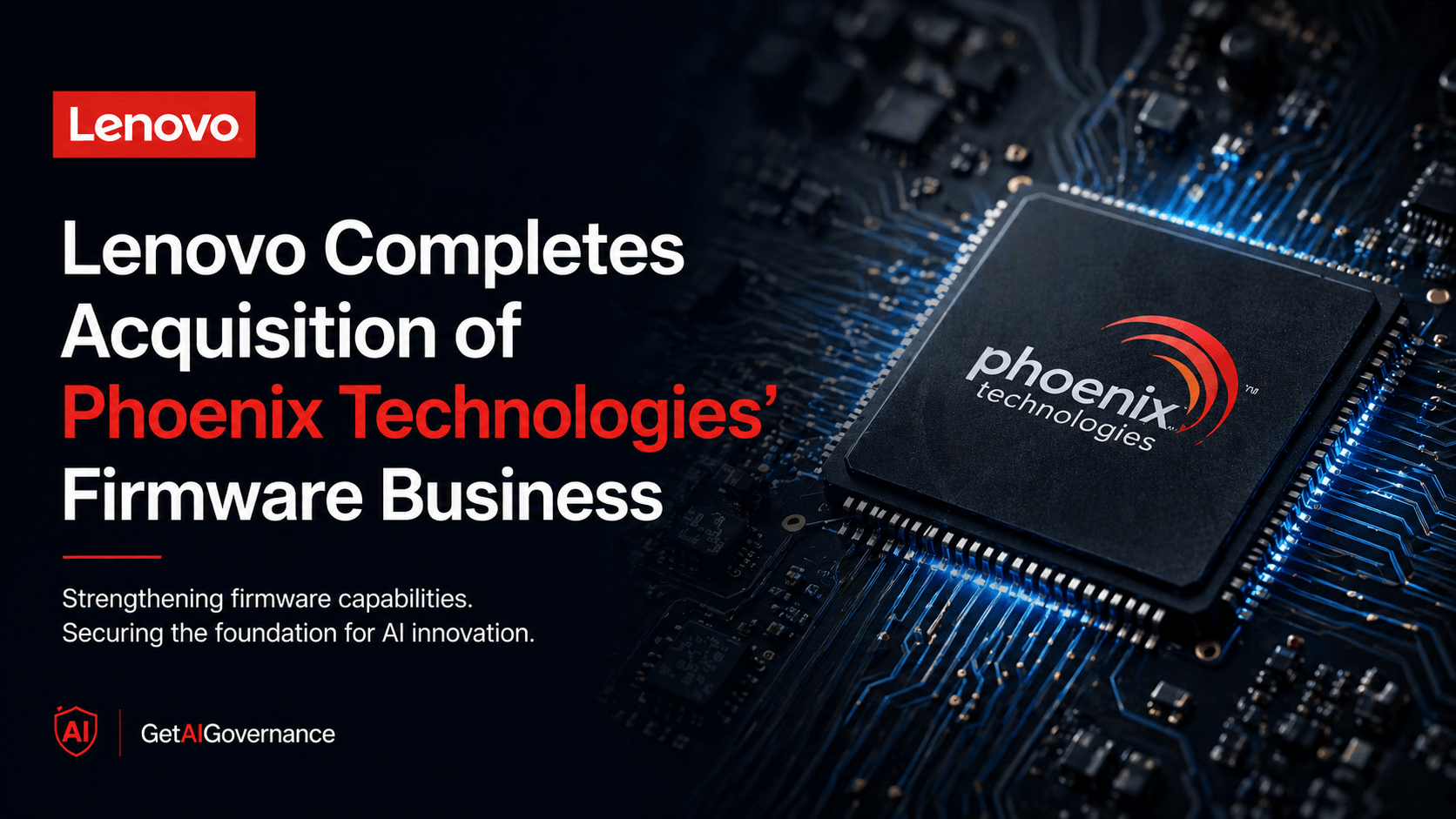
Today, April 27, 2026 Lenovo completed their acquisition of Phoenix Technologies firmware business. This acquisition represents a foundational shift in how hardware manufacturers approach the security of agentic AI ecosystems. As AI moves from the cloud to the "edge" on specialized AI PCs, the security of the Unified Extensible Firmware Interface (UEFI) and the Basic Input/Output System (BIOS) becomes the primary line of defense. By bringing Phoenix Technologies’ firmware expertise in-house, Lenovo is effectively securing the "Sub-OS" layer—the software that runs before the operating system even boots. In an era where autonomous agents have direct access to hardware resources, any vulnerability at the firmware level could allow an attacker to bypass every high-level security control in the stack.
The move is a direct response to the increasing sophistication of "low-and-slow" attacks that target the hardware-software interface. By controlling the firmware, Lenovo can implement a "Root of Trust" that is physically tied to the silicon. This ensures that the AI models and the agentic logic running on the device are executing in a verified, untampered environment. “The acquisition of Phoenix Technologies’ firmware business is a significant milestone in our journey to lead in the AI PC era,” the announcement suggests, highlighting that owning the firmware is no longer just about booting a computer; it is about providing the immutable foundation required for trusted autonomous computing.
Key Terms
Firmware: Permanent software programmed into a hardware device's read-only memory, acting as the bridge between hardware and the operating system.
Root of Trust (RoT): A hardware-based source that is inherently trusted and used to verify the integrity of the system's software and data.
UEFI/BIOS: The low-level firmware that initializes hardware during the booting process and provides runtime services for operating systems.
Sub-OS Exploit: A type of cyberattack that targets vulnerabilities below the operating system level, making it nearly invisible to traditional antivirus and EDR tools.
AI PC: A personal computer specifically designed with dedicated hardware (like NPUs) to process AI workloads locally rather than relying on the cloud.
Conditions Driving Firmware Consolidation
Rise of Edge AI Agents: As autonomous agents begin to operate locally on user devices, the hardware-software interface becomes a high-value target for hijacking and logic manipulation.
Persistence of UEFI Malware: Modern threats like BlackLotus have proven that firmware-level persistence allows attackers to survive OS reinstalls and hard drive wipes, necessitating better manufacturer control.
Supply Chain Transparency: Enterprises now demand full visibility into the origin and integrity of every code layer, including the proprietary firmware that traditionally lived in a "black box."
Hardware-Accelerated Governance: New AI-specific hardware (NPUs) requires specialized, secure firmware to manage the distribution of weights and the isolation of sensitive model data.
The "Clean Boot" Mandate: Global regulatory bodies are increasingly requiring a verifiable "chain of custody" for hardware, starting from the moment power is applied to the device.
Geopolitical Technology Sovereignty: Major hardware players are moving to eliminate third-party dependencies in critical code layers to ensure their products remain compliant with national security standards.
Complexity of AI PCs: The coordination between CPUs, GPUs, and NPUs in modern machines requires a highly integrated firmware layer that can only be optimized if developed in-house.
Zero-Trust Hardware Architectures: The transition to zero-trust models requires that the device itself can prove its integrity to the network at the firmware level before being granted access.
What AI Security Looked Like Before
Before the consolidation of firmware expertise by hardware leaders, AI security was largely an "above-the-line" concern. Security teams assumed the hardware was a neutral, safe platform and focused their efforts on protecting the model weights, the API keys, and the application logic. Firmware was treated as a commodity component provided by third-party vendors. If a vulnerability was discovered in the BIOS, the hardware manufacturer had to wait for the firmware vendor to issue a patch, creating a lag time that attackers exploited to gain deep persistence in enterprise networks.
In this era, there was a disconnect between the "Software Root of Trust" and the "Hardware Root of Trust." You could have a perfectly secure, encrypted AI agent, but if the firmware was compromised, a "Sub-OS" bootkit could intercept every token the agent processed before it reached the encrypted memory space. Security was reactive and fragmented. Because the hardware manufacturer didn't own the low-level code, they couldn't optimize it for the specific security needs of AI workloads, leaving a "shadow layer" of unmonitored code that sat between the physical silicon and the high-level governance tools.
What AI Security Looks Like After
With Lenovo’s acquisition of Phoenix Technologies, AI security moves toward a "Silicon-to-Agent" integrated model. Security is now rooted in the firmware, allowing for a verified boot process that checks the integrity of the AI environment before the agentic workforce is even initialized. Because the firmware is developed in-house, it can be specifically hardened to protect the memory regions where AI models are stored. This creates a "Hardware-Shielded Runtime" that is virtually inaccessible to traditional malware, providing a level of physical isolation that software-only solutions cannot match.
Security and governance are now verified at the power-on stage. The device can provide a cryptographic attestation of its health directly to the enterprise governance platform. If the firmware detects any unauthorized change in the boot sequence, it can prevent the AI agent from accessing sensitive API tokens or local data silos. This turns the hardware itself into an active participant in the security strategy. By owning the firmware, the manufacturer can push "micro-patches" at the hardware level to close exploit paths as soon as they are discovered, significantly reducing the "window of vulnerability" for edge-based AI deployments.
Submit an inquiry today to conduct an Infrastructure-Level AI Security Audit and ensure your hardware-rooted trust is ready for the agentic transition.
Our Take
AI Security Take
The Lenovo acquisition of Phoenix Technologies proves that in the AI era, you cannot separate hardware from security. If you do not control the firmware, you do not control the device, and if you do not control the device, you cannot trust the agent. For enterprises deploying "Agentic AI" on local hardware, the BIOS is no longer a background utility; it is the most critical security control in the entire stack. This move signals the end of the "commodity hardware" era and the beginning of the "Trusted Compute" era.
The takeaway for IT and security leaders is that your vendor's supply chain is your security perimeter. When evaluating hardware for your AI workforce, you must ask who owns the firmware and how it is secured against Sub-OS exploits. A gap in the firmware is an open door to your most sensitive autonomous workflows.