Gartner published its first Market Guide for Guardian Agents on February 25, 2026, and gave a name to a category that governance teams had been circling for a year. The firm defined a guardian agent as a blend of AI governance and AI runtime controls within its AI TRiSM framework, a piece of software whose job is to watch other AI agents, judge their actions against policy, and step in when an agent moves outside its intended boundaries. The authors, a group led by Avivah Litan, described a market in its infancy, with most products able to observe and assess an agent while doing very little to stop one in real time.
GAIG is covering that document four months after its release, and the delay is the point. When Gartner wrote the guide, the category was mostly a forecast. In the months since, a run of product launches has started to fill in the outline the firm drew, which makes the guide more useful to read now than it was in February.
The corroboration has shown up in GAIG's own coverage. DataRobot built its July governance launch around giving each agent a scoped identity and a continuous record of what it touches, and ServiceNow moved into agent identity after buying Veza. The United Nations scientific panel on AI reported in July that oversight built for static models fails once systems begin to act. This piece works through what Gartner actually defined, what holds up against that later evidence, and where the firm's forecasts run ahead of the products enterprises can buy today.
Key findings
The guide runs long and names dozens of vendors. Seven findings carry the weight for an enterprise deciding whether this category belongs in its plans.
Gartner defines a guardian agent as a blend of AI governance and runtime controls that supervises other AI agents as they work with tools, data, APIs, and people. The firm expects these agents to try cheap deterministic checks first and to call on a language model only when the simpler methods cannot settle a question of intent.
The independence argument sits at the center of the guide. Platform-native controls stop at the edge of their own cloud, so a governance layer owned by one provider loses the agent the moment it crosses into another, which is why Gartner says enterprises need a neutral, cross-platform layer to enforce policy everywhere an agent goes.
Gartner sets a high bar for the category. A product has to deliver visibility and traceability, continuous assurance and evaluation, and runtime inspection and enforcement, and the firm excludes vendors that cover only part of that range through partnerships.
The guide gives buyers four requirements to judge a vendor against, which are agent discovery, identity and access management, information governance, and policy enforcement. Gartner names discovery as the first move, because an organization cannot govern the agents it has not found, including the ones running without anyone's sign-off.
The guide insists the guardian agents themselves need governing. Gartner calls this "guard the guardians" and lists controls such as scoped identities, sandboxing, and immutable logs to stop a supervisory agent from becoming a fresh source of failure.
Gartner is candid about how early the market is. It describes most tools as weighted toward observation and posture management, with very limited in-line blocking or remediation today, and it places most deployments in pilots and prototypes.
The forecasts are bold. Gartner expects guardian agent spending to climb from under 1 percent of agentic AI budgets to between 5 and 7 percent by 2028, and it predicts independent guardian agents will remove the need for almost half of the security systems that protect AI agents today, in more than 70 percent of organizations, by 2029.
What the guide covers
A Market Guide is a particular kind of Gartner document, and the label matters for how much weight to give each part. It is the firm's first pass at an emerging market, a definition-and-landscape piece rather than a Magic Quadrant that ranks vendors on a grid. The guide names the category, sets the mandatory and common features, sizes where the market is heading, and lists representative vendors without scoring them against one another. The vendor list is meant as a sample rather than a full census, and Gartner is explicit that a place on it carries no endorsement.
What Gartner maps is the shape of the problem and the field forming around it. The problem is agent risk moving faster than human review can keep up, worsened by fragmented ownership inside most companies and the plain difficulty of finding every agent already running. The field is scattered across segments, from risk and security specialists to identity vendors to the embedded tools the hyperscalers ship with their own platforms, and Gartner points to recent deals, such as Palo Alto Networks buying Protect AI and Check Point buying Lakera, as the early signs of consolidation.
The guide carries a caution that a reader should hold onto. Gartner positions the whole category as young, held back by the absence of standard interfaces between agent platforms, which makes it hard to wire oversight across tools from different vendors. It reports that 17 percent of surveyed CIOs had already deployed AI agents and another 42 percent planned to within a year, which is the adoption curve that turns this from a research topic into a buying decision.
What AI governance looks like now
Set against how enterprises run AI today, Gartner's findings land on familiar ground. Most governance programs still lean on pre-deployment review, written documentation, and periodic audit, all of it built for a model that answers a prompt and stops. An agent that plans, calls tools, writes to systems, and moves between clouds breaks those assumptions, because the review happened once and the agent keeps acting long after.
The structural gap Gartner names is the one GAIG has written about as the deployer problem. Controls that live inside a single platform lose the agent the moment it crosses into another cloud, another identity system, or a third-party tool, and the governance stops at that border. Gartner puts the point sharply, describing an independent oversight layer as "the missing universal enforcement mechanism," the thing that can hold policy together across providers that will not defer to one another. DataRobot's July launch, which GAIG covered, is one read on the same problem, giving each agent a scoped identity and a continuous log so the record survives when the agent leaves home.
Gartner also hands buyers four questions to ask of any agent, which are what the agent is doing, what it can reach, what safeguards are live, and who owns it. Those four line up almost exactly with the governance review GAIG described in its guide to building reliable agents, where observability and guardrails answer the first three and ownership stays a decision a human has to make on purpose. The lesson holds across both pieces, that visibility and control mean little until the answers work across every platform an agent touches, rather than inside one.
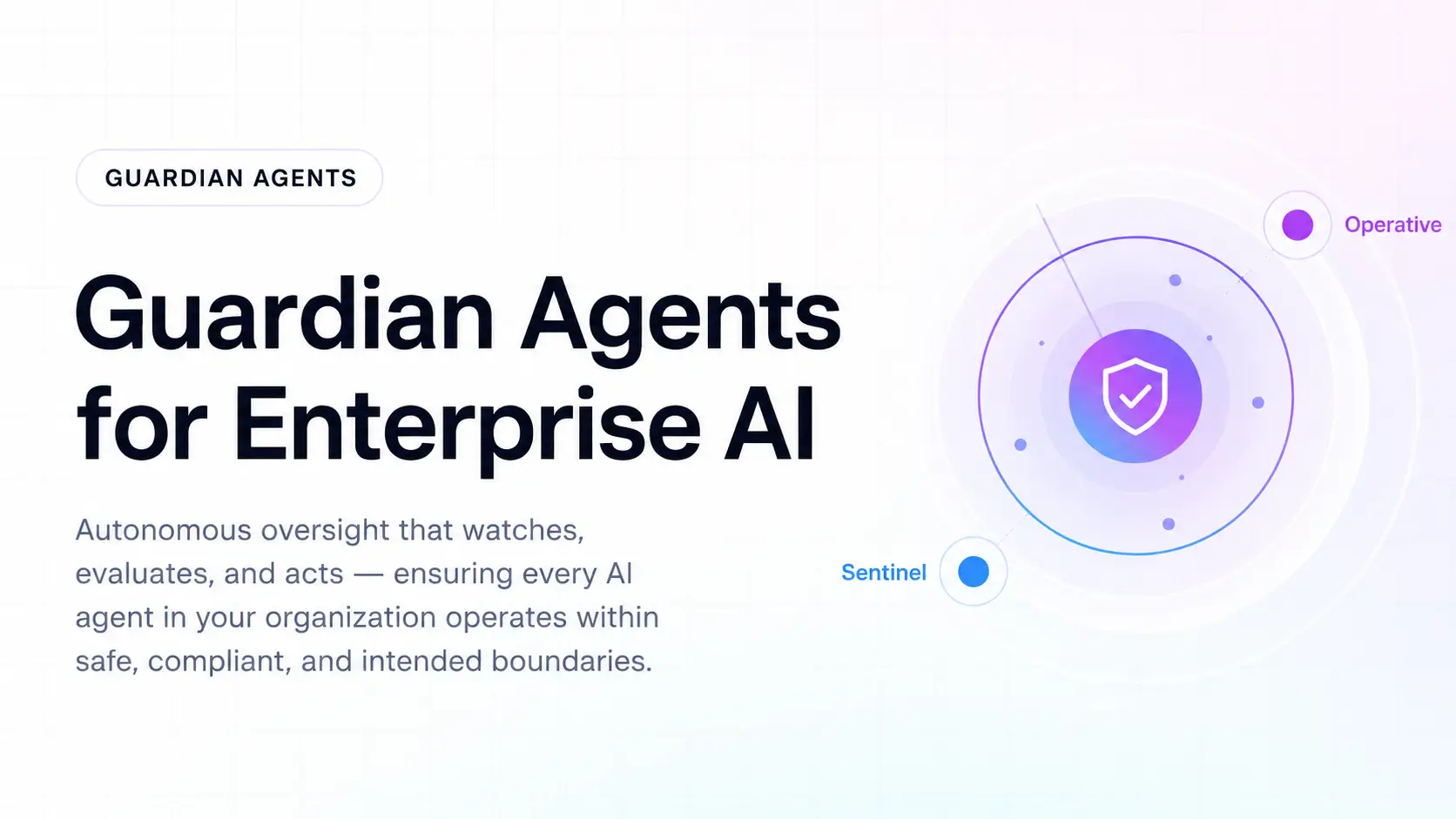
The live choice for an enterprise is independent oversight against the controls embedded in each AI platform, and Gartner argues for a layer that works across both. Vendors are already building to that model. Holistic AI, one of the risk and security specialists Gartner lists, splits the job between what it calls Sentinel agents that watch and score behavior and Operative agents that block, quarantine, or revoke access in real time, and it markets that oversight as running across AWS, Azure, Google Cloud, and on-premises systems. The design is the shape Gartner sketched, and the fair caveat is that cross-environment enforcement is easy to describe and hard to prove, which is where a buyer should ask for evidence.
Sources
Gartner, "Market Guide for Guardian Agents" (ID G00836388), by Avivah Litan, Daryl Plummer, Carlton Sapp, Dionisio Zumerle, Tom Coshow, Max Goss, and Lauren Kornutick, February 25, 2026. Licensed Gartner reprint, access-controlled and reproduction-restricted; paraphrased throughout with no figures or vendor table reproduced. Reprint (Gartner subscription/reprint access)
DataRobot, "DataRobot Unifies AI Governance Beyond the Cloud," July 2, 2026 (per-agent identity and lineage; cross-reference for the cross-environment gap). datarobot.com
Independent International Scientific Panel on Artificial Intelligence, "Preliminary Report," United Nations, July 2026 (oversight built for static models fails once agents act). Full report (PDF)
Holistic AI, "What Are Guardian Agents?" (Sentinel and Operative agent model; cross-cloud coverage across AWS, Azure, GCP, and on-premises). holisticai.com/learn/what-are-guardian-agents
GetAIGovernance.net (internal reference), "How to Build Reliable AI Agents" (the four governance questions bridge). getaigovernance.net/blog/how-to-build-reliable-ai-agents
GetAIGovernance.net (internal reference), "ServiceNow Introduces the Enterprise Identity Control Plane Following Its Acquisition of Veza." getaigovernance.net/blog/servicenow-ai-security-veza
GetAIGovernance.net (internal reference), "The GPAI Deployer Compliance Gap." getaigovernance.net/blog/gpai-deployer-gap
Our Take
AI Governance Take
The credit here is real and worth stating first. When an analyst firm names a category and puts numbers behind it, an argument that independent oversight of AI agents is a distinct job moves from something GAIG has argued into something a buyer's board will recognize. Gartner's insistence on a neutral layer that works across platforms, rather than a set of controls locked to one vendor's cloud, is the position GAIG launched on, and it helps to have it stated by a firm that enterprises already pay to hear from.
The harder point comes out of the guide itself. Gartner defines the category by what it will eventually do while conceding that the products barely do the enforcing part yet, since today's tools mostly watch and score with very limited real-time blocking. A category defined by its promise is worth watching and risky to buy on faith. The prediction that independent guardian agents will retire almost half of the incumbent security systems protecting AI agents by 2029 runs well ahead of tooling that cannot reliably block in line today, and the direction looks right even where the timeline reads like a stretch.
The instruction that follows from the evidence is plain. Discovery and inventory are the honest first move, and Gartner puts them first for a reason, because an organization cannot govern or even count the agents it has never found. An enterprise scaling agents should trial this category now, in a bounded way, and treat the real-time enforcement claims as a roadmap to test rather than a feature to trust. The governance-by-documentation model that most programs still run has reached the end of its usefulness, and the teams that start building the oversight layer early will be the ones ready when agents move into the core of the business.
Gartner has given this category a name, a shape, and a market size, and that is a genuine service to anyone trying to plan. The work of proving that these agents can actually enforce, across every environment they claim to cover, still belongs to the vendors, and a buyer's job is to make them show it.