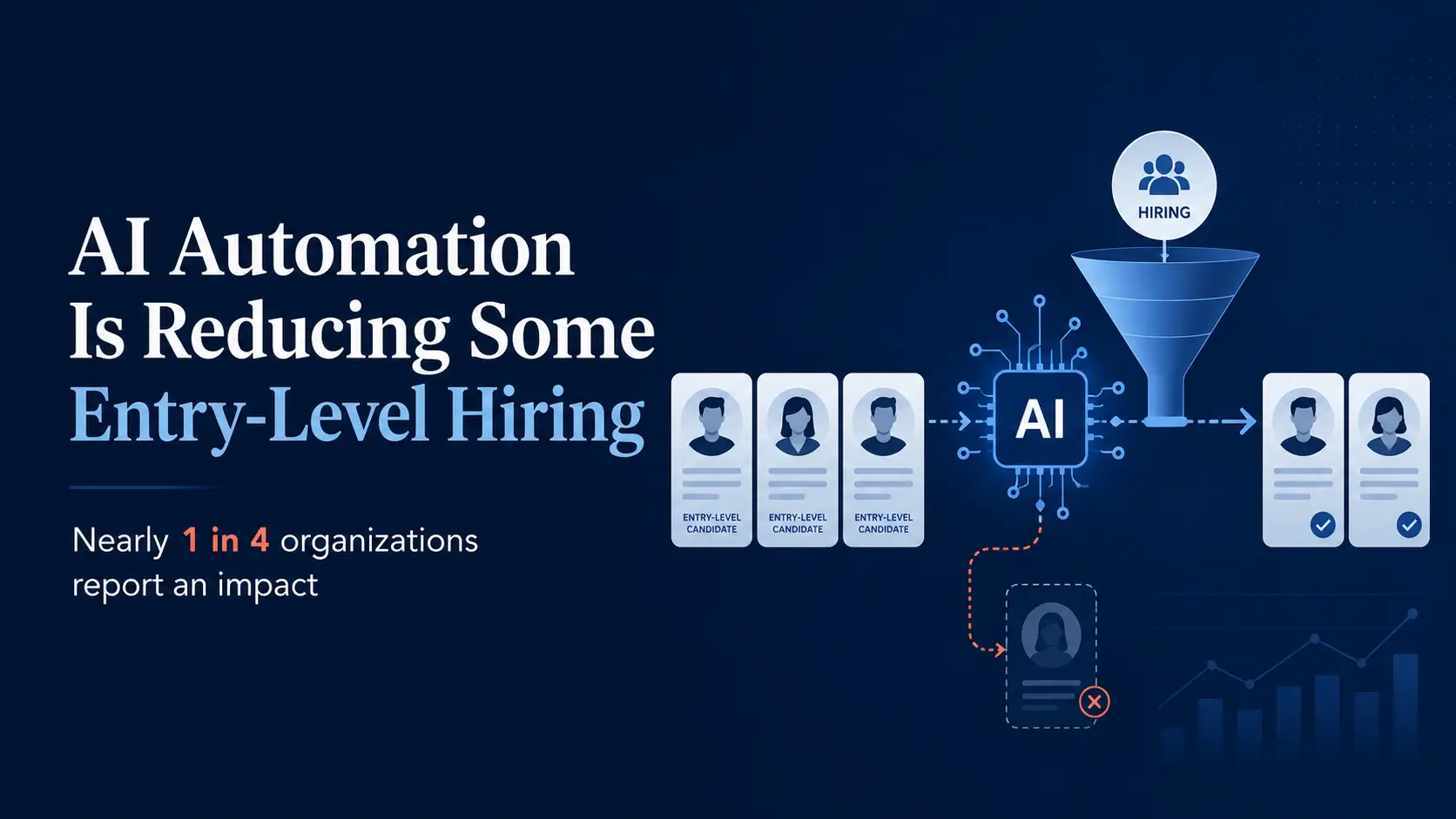
Gartner says nearly one-quarter of organizations are already reducing entry-level hiring because of AI automation. In a survey of 110 CHROs, 22% reported that at least one business leader in their organization had stopped hiring for some entry-level roles for that reason.
The same research shows a wide gap between adoption and results. Ninety-five percent of organizations implemented AI in some capacity over the last year, but only one in five realized significant or transformational value from it. Gartner’s analysis is that current deployments are concentrated on less complex tasks that entry-level workers traditionally performed, which shrinks the pool of routine work those roles used to absorb.
“Organizations that respond by cutting their early career talent pipelines altogether risk creating significant workforce challenges down the road,”
“Instead of eliminating these early career roles, organizations should redefine them to enable earlier contributions to higher-value work and build the talent they will need in the future.”
Kaelyn Lowmaster, Director Analyst in the Gartner HR practice
Gartner’s concern is practical. When junior roles disappear, companies lose low-risk settings where people build skills, networks, and institutional knowledge. They also become more dependent on paying premiums for experienced talent hired from outside. The survey frames the issue as a workforce design problem created by AI adoption that has not yet delivered broad, measurable value.
Key Findings
Twenty-two percent of CHROs reported that at least one business leader in their organization has stopped hiring for some entry-level roles because of AI automation.
Ninety-five percent of organizations implemented AI in some capacity over the last year, according to the same Gartner survey of 110 heads of HR.
Only one in five organizations realized significant or transformational value from those AI implementations.
Current AI deployments are concentrated on less complex tasks that entry-level workers traditionally performed, creating a mismatch between early-career skill profiles and the work that remains.
Eliminating entry-level roles increases reliance on external hiring of experienced talent, which Gartner notes typically comes at a pay premium.
Cutting early-career pipelines reduces low-risk opportunities for employees to build skills, personal networks, and institutional knowledge on the job.
Gartner’s analysts argue that organizations should redefine early-career roles so junior employees contribute to higher-value work earlier, rather than removing those roles entirely.
A separate December 2025 Gartner survey of 3,086 employees found that people are 3.8 times more likely to report high skills preparedness when they can build on a foundation of adaptable skills.
Traditional gradual skill-building through routine work is becoming less available as AI absorbs those tasks, which raises the need for deliberate development structures around more complex, judgment-intensive work.
Gartner frames the core risk as long-term workforce weakness: organizations that shut down junior pipelines to accommodate AI may struggle later to supply the experienced talent those same AI-enabled operations will still require.
What AI ROI and Workforce Planning Looked Like Before
Before this wave of cuts, most organizations treated entry-level hiring as a standard part of talent supply. Junior roles absorbed routine work, gave people room to learn the business, and created a low-risk path into more complex jobs. AI was already present in many of those environments, but it was usually framed as assistance on discrete tasks rather than as a reason to close the bottom of the hiring funnel.
Workforce planning and AI investment were still largely separate conversations. HR owned the pipeline. Technology and operations owned automation. The assumption was that efficiency gains from AI would free capacity without requiring a redesign of how early-career talent entered the organization. Value from AI was often described in terms of activity completed or time saved, not in terms of whether the organization could still develop the judgment and institutional knowledge it would need later.
In that model, cutting entry-level roles was a last resort, not a first response to automation. Companies that wanted higher productivity still expected to train people on simpler work first. The cost of removing that layer was not yet a central part of AI business cases. The risk of paying more later for external experienced hires, or of losing internal knowledge transfer, sat outside most ROI discussions.
What AI ROI and Workforce Planning Look Like Now
The Gartner survey shows that pattern breaking. Twenty-two percent of CHROs report that at least one business leader has already stopped some entry-level hiring because of AI automation. At the same time, only one in five organizations say they have realized significant or transformational value from AI, even though 95% have implemented it in some form.
AI is landing first on the less complex work that junior employees used to do. That shrinks the natural training ground inside the company. Organizations that respond by closing those roles gain short-term efficiency on paper, then face a harder problem: they still need people who can handle ambiguity, business context, and higher-judgment tasks, but they have fewer internal paths to produce them.
Gartner’s analysts are explicit about the downstream cost. Removing early-career roles pushes companies toward external hiring of experienced talent at a premium. It also reduces the informal learning, networks, and institutional knowledge that used to form on the job. The ROI conversation is no longer only about what AI automates. It now includes whether the automation is destroying the mechanism the organization used to build the next generation of capable staff.
In practical terms, workforce planning and AI value measurement have merged. A program that reports time saved while quietly eliminating the junior pipeline is not showing full return. It is shifting cost into future hiring, slower internal development, and weaker continuity. The organizations treating that as a design problem, rather than a simple headcount reduction, are the ones still trying to keep a path for early-career talent into higher-value work.
Our Take
AI ROI Take
The important number in this survey is not only the 22% cutting entry-level hiring. It is the combination of that figure with the one-in-five rate of significant AI value.
Organizations are removing the bottom of the talent pipeline in response to automation that, in most cases, has not yet produced transformational return. That is a measurement failure as much as a hiring decision. If AI ROI only counts tasks automated or hours reduced, it will look positive while the company deletes the mechanism it used to develop people who can do the work AI cannot.
The hidden cost shows up later. External experienced hires cost more. Internal knowledge transfer weakens. The organization has fewer low-risk settings in which people learn judgment, business context, and institutional norms. Those costs rarely appear in the same dashboard as AI productivity gains, which is why the tradeoff is easy to miss in the moment.
A usable AI ROI model has to include the workforce effects of automation, not just the unit economics of the tools. That means tracking whether early-career roles are being redesigned or simply removed, whether junior employees are being moved into higher-judgment work, and whether the company is becoming more dependent on premium external hiring to replace the pipeline it shut down.
Cutting entry-level roles to make room for AI is only a return if the organization can still produce the capability it will need next. If it cannot, the savings are temporary and the cost is deferred. Boards and CFOs asking for AI ROI should ask a direct follow-up: did this program improve productivity, or did it mainly transfer cost from today’s headcount to tomorrow’s hiring and development gap?