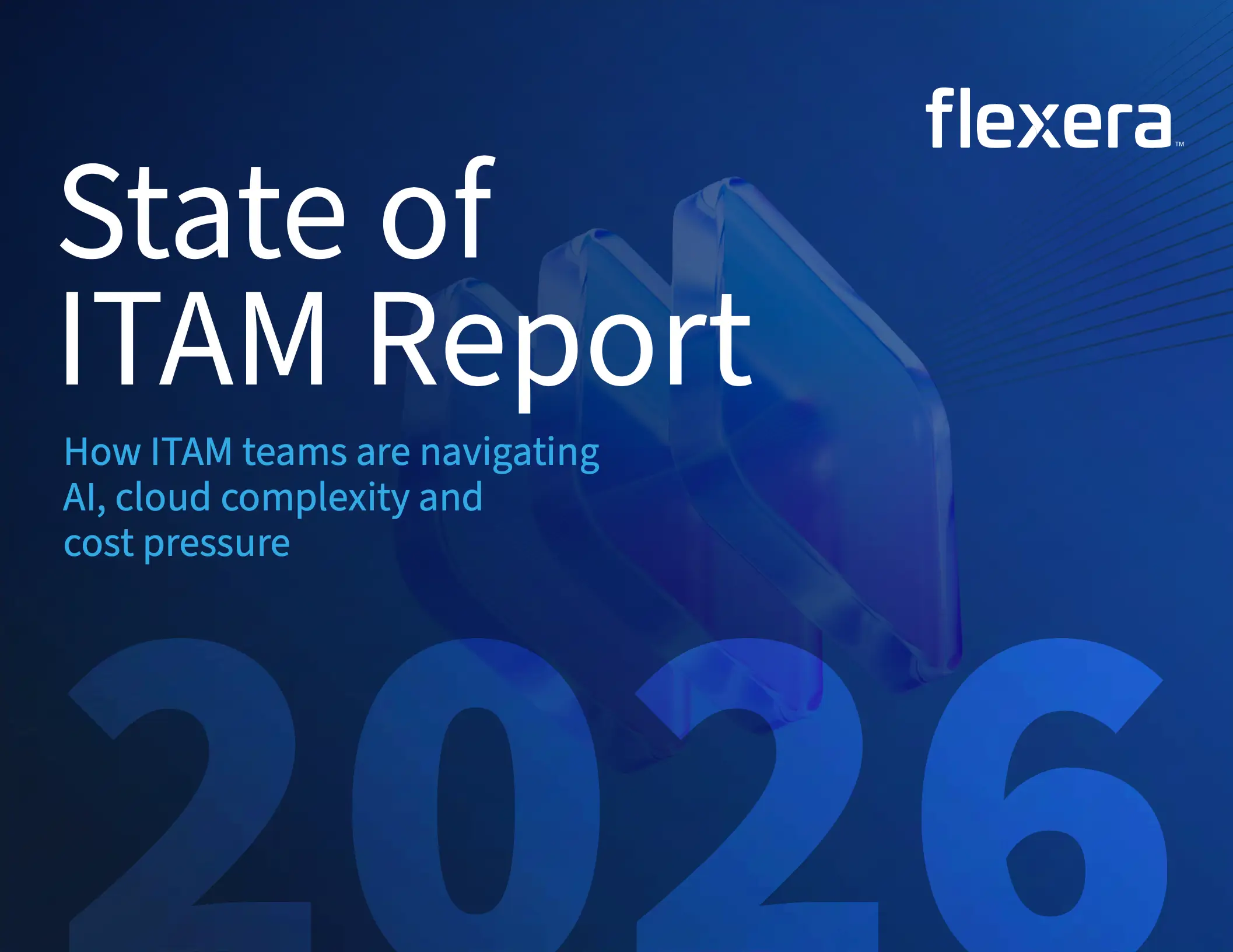
The Flexera 2026 State of ITAM Report, released in 2026, offers a detailed snapshot of how IT Asset Management (ITAM) teams worldwide are responding to the growing complexities of AI adoption, cloud expansion, and persistent cost pressures. Based on a global survey of 512 professionals responsible for IT asset management, the report highlights both progress and significant challenges facing the function today.
What is ITAM for those who don’t know? ITAM, or IT Asset Management, is the strategic discipline of tracking, managing, optimizing, and governing an organization’s entire technology portfolio. This includes hardware assets (HAM), software licenses (SAM), SaaS applications, cloud resources, and increasingly AI-powered tools and services. Effective ITAM programs focus on maintaining accurate inventories, ensuring license compliance, reducing wasted spend, preparing for audits, supporting regulatory requirements, and enabling better technology decision-making across the business.
The report shows ITAM evolving from a primarily operational and compliance-focused activity into a more strategic function. ITAM teams are increasingly collaborating with FinOps and cloud teams, taking on responsibilities for cloud software licensing, SaaS optimization, and even AI spend visibility. However, major gaps persist — only 31% of organizations have clear visibility into their AI software, while 59% report that wasted AI spend has increased over the past year. At the same time, audit activity remains high, with nearly half (48%) of organizations receiving a software audit in the last year.
This year’s findings underscore a critical moment for ITAM: as AI and cloud usage accelerate, organizations need stronger visibility, better cross-team alignment, and more mature governance practices to control costs and manage risk effectively.
Key Findings
The Flexera 2026 State of ITAM Report reveals that at least half of all organizations are now tracking AI spend as part of their overall software budget, signaling that AI has officially entered mainstream IT asset management considerations.
Nearly half (48%) of organizations reported receiving a software audit in the past year, highlighting continued high audit pressure from major vendors, particularly Microsoft which accounted for 64% of those audits.
Optimizing and finding savings in software spend remains the clear top priority for SAM teams, leading all other initiatives by a significant margin and reflecting sustained cost pressure across organizations of all sizes.
Despite growing AI adoption, visibility remains critically low — only 31% of organizations report having accurate visibility into their AI software assets, creating major governance and cost control blind spots.
59% of organizations indicated that wasted AI spend has increased over the past year, underscoring the gap between rapid AI experimentation and mature governance practices.
78% of organizations now have a dedicated FinOps team, and ITAM professionals are increasingly taking on FinOps-related responsibilities, with 75% managing cloud software licenses and 64% handling SaaS licenses.
Responsibility for generating software savings in public cloud environments is now nearly evenly split between ITAM/SAM teams (47%) and FinOps teams (46%), showing significant convergence and blurring of traditional role boundaries.
ITAM teams continue to mature, with more organizations operating at intermediate or advanced SAM levels and fewer remaining at beginner stages focused primarily on audit response.
Maintaining an accurate inventory of licensed software remains the top responsibility for ITAM teams (78%), reinforcing that clean, enriched data is still the foundation of effective asset management.
Reporting structures are shifting, with fewer ITAM teams reporting directly to CIOs or CTOs and more aligning under cloud management or FinOps, reflecting the function’s growing strategic importance in cloud-heavy environments.
What the Report Covers
The Flexera 2026 State of ITAM Report is a comprehensive 98-page analysis based on a global survey of 512 IT asset management professionals. It provides deep insights into how ITAM teams are adapting to AI adoption, cloud complexity, cost pressures, and the growing convergence with FinOps practices.
The report opens with Report Highlights and Key Findings, showcasing critical statistics such as AI spend tracking, audit frequency (48% in the past year), top SAM initiatives, and visibility gaps across on-premises, cloud, SaaS, and AI assets.
A major section titled “ITAM is a critical and strategic function — and it’s evolving” examines organizational structure, reporting lines (with fewer teams reporting directly to CIOs/CTOs and more aligning with cloud/FinOps), the prevalence of dedicated FinOps teams (78%), and the nature of collaboration between ITAM and FinOps. It also covers upskilling efforts and cross-team interactions with security, procurement, and infrastructure groups.
The ITAM Challenges section analyzes staffing levels (FTEs for HAM and SAM), program maturity (beginner, intermediate, advanced), specific SAM and HAM responsibilities, AI spend measurement practices, MSP usage, and estimated wasted spend across the IT estate. It highlights how AI visibility remains limited while audit activity and cost optimization demands continue to intensify.
Top Initiatives for SAM Teams explores current practices for managing SaaS, expected shifts in focus over the next three years, and the highest-priority initiatives such as optimizing software spend and reclaiming unused licenses.
The Vendor Snapshot section evaluates relevance of major software vendors, SaaS providers, and technologies to SAM programs, along with audit history and spending patterns on key vendors like Microsoft, IBM, ServiceNow, and Oracle.
Additional sections cover SAM and HAM Success Metrics, Role of CMDBs, European Spotlight (with regional comparisons), and Demographics. The report concludes with forward-looking guidance on positioning ITAM for the future.
Overall, the document combines quantitative survey data, charts, maturity benchmarks, and practical insights to help ITAM, SAM, and FinOps professionals understand current trends and plan strategic improvements in a rapidly changing technology landscape.
Our Take
AI Governance Take
The Flexera 2026 State of ITAM Report sends a clear and urgent message to AI governance leaders: AI assets are now part of the core technology estate, but governance and visibility have not kept pace with adoption.
While organizations are rapidly deploying AI tools, only 31% have accurate visibility into their AI software, and 59% report that wasted AI spend has increased year over year. This visibility gap creates serious risks around cost control, compliance, security, and accountability. The report shows that effective ITAM is becoming a foundational pillar of responsible AI governance. Mature ITAM practices — accurate inventory management, license optimization, audit readiness, and cross-functional collaboration with FinOps and security teams — directly support stronger AI risk and controls programs.
For governance teams, the key takeaway is that AI cannot be treated as a separate experiment. It must be integrated into existing asset management frameworks with clear ownership, tracking mechanisms, and optimization processes. The convergence between ITAM and FinOps is particularly important, as cloud and AI spend responsibilities continue to blur. Organizations that strengthen their ITAM programs today will be better positioned to implement frameworks like CSA’s AICM v1.1, enforce shared responsibility models, and generate credible evidence for audits and regulatory requirements.
The report reinforces a fundamental governance truth: you cannot govern what you cannot see. Companies that invest in better AI asset visibility, mature SAM practices, and tighter integration between ITAM, FinOps, and security teams will reduce risk, control costs, and build more trustworthy AI programs. Those that continue treating AI as an ungoverned shadow asset do so at their own peril.