Fiddler just announced it acquired Lumeus, a cloud security startup that specializes in data governance and zero-trust visibility. Krishna Gade (CEO Fiddler AI) and Satish Veerapuneni (CEO Lumeus AI) say
"It started with a conversation two years ago. Fiddler has been steadily building the runtime AI Control Plane. Lumeus was securing workflows where coding agents actually operate in the IDE, CLI, and MCP boundary."
You probably saw this coming if you’ve spent five minutes trying to explain to a CISO why an LLM needs access to a raw production database. Most companies are currently flying blind, watching their models for drift while completely ignoring the sensitive data leaking out the back door. Fiddler wants to end that disconnect by baking security directly into the monitoring stack.
The move signals a major shift in how we think about "observability." For years, we treated model performance like a separate island from data privacy. Engineers watched the weights and biases while security teams scanned the buckets and hoped for the best. That siloed approach is dying because it doesn't work in a world of agentic AI and RAG pipelines. You can’t claim a model is healthy if it’s currently hallucinating a customer’s credit card number into a public chat log.
Lumeus brings a layer of "context-aware" security that most monitoring tools lack. It doesn't just look at the traffic; it understands the sensitivity of the data moving through the pipes. By folding this into Fiddler’s existing platform, they’re creating a control plane that watches the model and the data simultaneously. It’s a pragmatic response to the reality that AI risk is rarely just about the math. Usually, the risk is about the data.
Key Terms
Model Observability: The practice of monitoring AI health, drift, and performance in real-time.
Data Governance: Rules and controls that dictate how data is accessed, stored, and protected.
Zero-Trust Visibility: A security model where every request is verified, regardless of where it originates.
Shadow AI: The unsanctioned use of AI tools or models within an organization without IT oversight.
PII Redaction: Automatically identifying and obscuring personally identifiable information.
Conditions Driving This Change
Enterprise leaders are exhausted by the current state of AI deployment. They’ve spent millions on fancy models only to have their legal teams shut them down because of "unquantifiable risk." Every time a new LLM goes live, the attack surface grows, and the traditional security tools can’t keep up with the speed of inference.
A few specific pressures forced Fiddler to make this grab:
Shadow AI Proliferation: Employees are plugging sensitive company data into unauthorized models every single day.
Regulatory Screws: New laws are demanding that companies prove they know exactly where their training and prompt data is going.
RAG Complexity: Retrieval-Augmented Generation has made data security a real-time problem instead of a static one.
Data Leakage Scares: High-profile incidents of LLMs spitting out proprietary code or internal memos have scared the boardrooms.
Silo Fatigue: Companies are tired of paying for ten different tools that don't talk to each other.
The Rise of Agents: Autonomous agents need more than just monitoring; they need hard rails on what they can touch.
Identity Collapse: It’s getting harder to tell if a request came from a human or a rogue script.
Compliance Audits: Manual reporting for AI security is a nightmare that takes hundreds of man-hours to complete.
The industry is moving toward a "single throat to choke" model for AI infrastructure. Buyers want one platform that tells them if the model is broken and if it’s being a liability at the same time. Fiddler realized that being "the monitoring guy" wasn't enough to win the enterprise. You have to be the security guy, too.
What AI Security Looked Like Before
Traditional security was a gatekeeper that stood outside the ML lab. You had your data scientists building models in a vacuum, focusing on accuracy and latency. Once they were ready to ship, the security team would show up with a checklist of questions the scientists couldn't answer. They’d ask about data lineage and encryption at rest, while the scientists were worried about F1 scores and GPU utilization.
Security teams used standard cloud security posture management (CSPM) tools that looked for open S3 buckets. These tools are great for catching basic mistakes, but they are completely blind to what happens inside a prompt. They couldn't tell you if a model was extracting sensitive data from a "secure" database and then repeating it to a user. The context was missing because the security tools didn't understand the AI, and the AI tools didn't care about security.
The result was a constant state of friction. Teams would either ship slow and safe, or fast and dangerous. Governance was a manual process involving spreadsheets and awkward meetings where nobody spoke the same language. If a breach happened, it took weeks to figure out which model was responsible and which data source was compromised. It was a mess of disconnected logs and "best guesses" from overworked engineers.
What’s Changing Now
Fiddler and Lumeus are mashing these two worlds together to create a unified visibility layer. Instead of a model monitoring tool and a data security tool, you get a single view of the entire pipeline. You can see the data as it leaves the source, as it enters the model, and as it comes out the other side as a response. This visibility makes it possible to set policies that actually mean something in the real world.
Permissions are moving from the infrastructure level to the data level. If a model tries to access a file it shouldn't, the system can block it before the inference even starts. We’re seeing the rise of "active governance" where the platform can redact PII in a prompt before the LLM even sees it. You don't have to trust the model to be safe when the platform is enforcing safety for you.
Auditing becomes a push-button affair. Since the platform tracks the model performance and the data access simultaneously, the paper trail is created automatically. You can show a regulator exactly how your model behaved and prove that no sensitive data was leaked during the process. It turns security from a "no" department into an "enablement" department that helps the business move faster.
Our Take
AI Monitoring Take
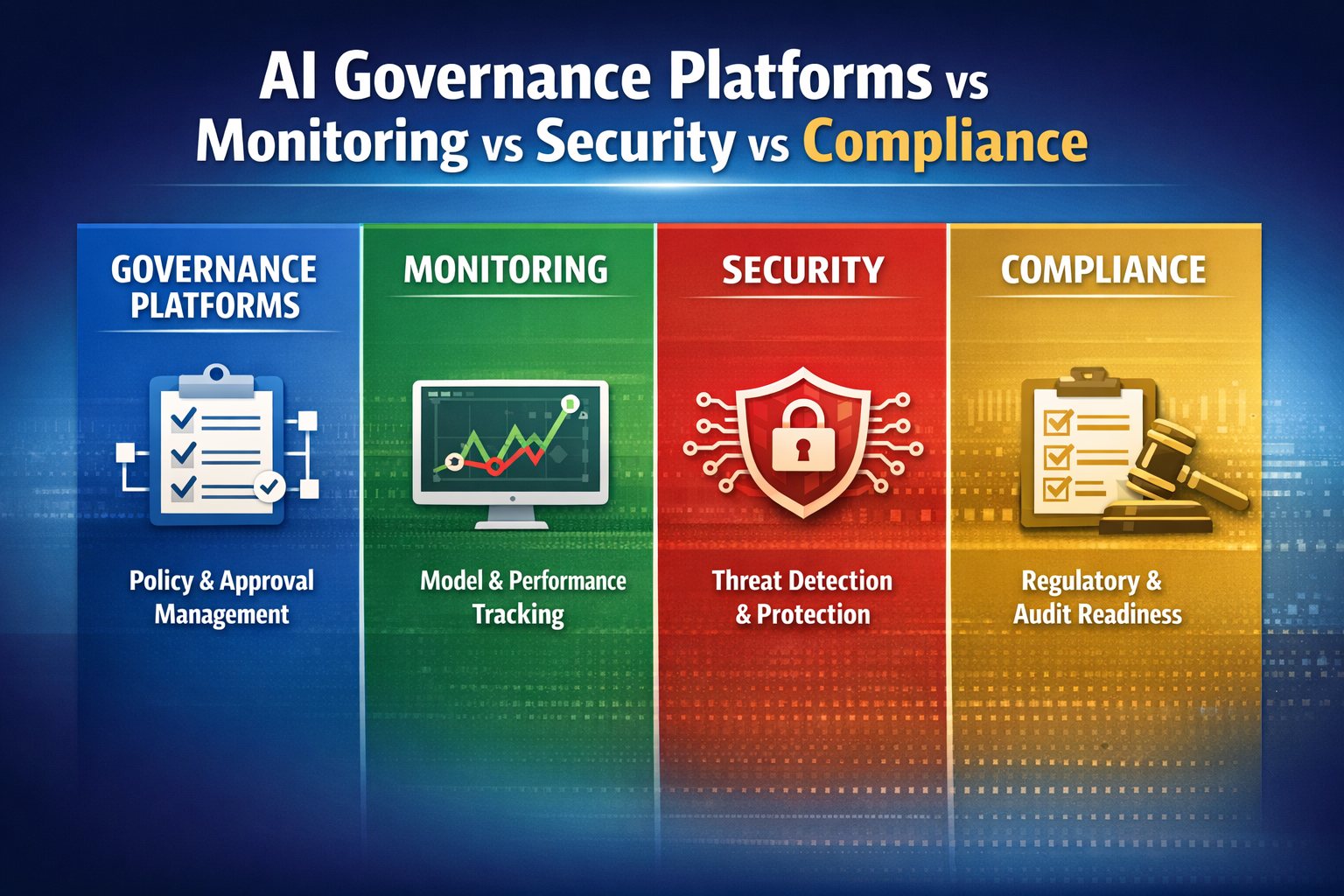
Fiddler’s move is a clear signal that the market for standalone observability is shrinking. If you’re just selling charts that show a model is drifting, you’re becoming a feature, not a product. The real value is in the "control plane"—the layer that actually stops bad things from happening. By buying Lumeus, Fiddler is positioning itself as the guardian of the entire AI lifecycle, which is exactly what enterprise buyers are screaming for right now.
We expect to see more of these "observability-meets-security" acquisitions in the next twelve months. The companies that survive will be the ones that can bridge the gap between the ML lab and the CISO’s office. You can’t have one without the other anymore. Governance is the bridge, and Fiddler just laid a lot of heavy-duty concrete.
Every enterprise needs to look at their current stack and ask if their security team can see what their models are doing. If the answer is "we have a meeting about it once a month," you’re already behind. You need tools that automate the trust so your engineers can go back to building things that actually make money.