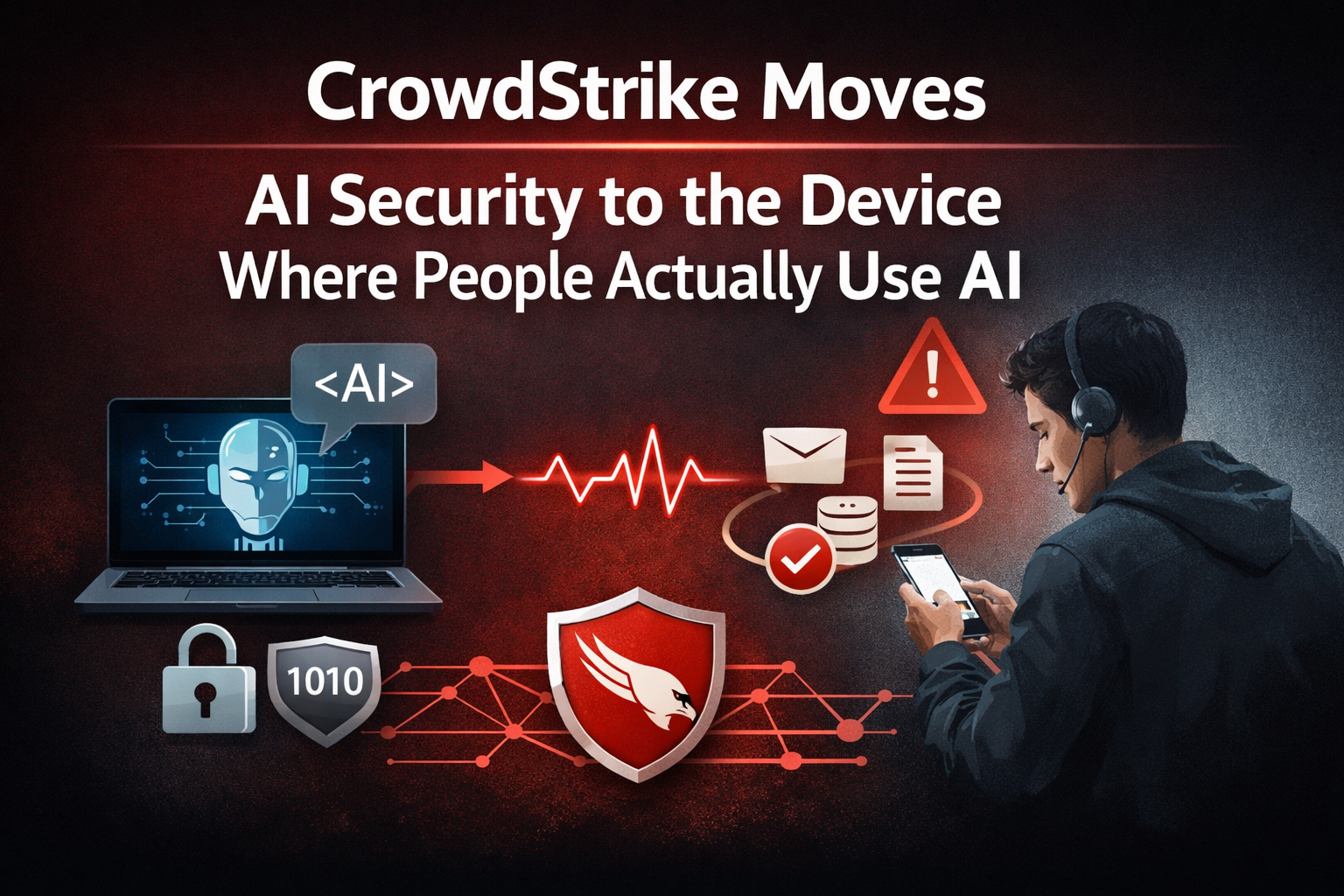
CrowdStrike announced today — March 23, 2026 — that it is establishing the endpoint as the epicenter for AI security. In plain English, they’re saying the device you’re working on right now (laptop, desktop, whatever) is no longer just a place where work happens. It’s the new frontline for catching AI risks the second they appear.
Here’s why this matters more than the usual press-release hype. AI isn’t stuck in a controlled dashboard anymore. People open their browser, fire up ChatGPT or Copilot, paste customer data to summarize a report, get an answer, and drop it straight into an email or slide deck. Sometimes they even let AI agents start running terminal commands or triggering workflows. All of that — the typing, the pasting, the agent doing its thing — happens on the device, in plain sight of the person doing the work.
Picture your average Tuesday afternoon: an analyst pastes a chunk of sensitive CRM data into the desktop version of ChatGPT to “make it sound better.” The moment that data hits the box, the risk clock starts ticking. CrowdStrike’s point is simple: if your security tools aren’t watching right there, on that device, you’re already behind.
Key Terms
Endpoint Detection and Response (EDR)
This is the security software that watches everything happening on laptops and desktops in real time — keystrokes, file changes, network calls, the works. It’s the closest thing we have to a security camera sitting on the user’s desk.
Extended Detection and Response (XDR)
EDR on steroids. It pulls in data from devices, networks, email, cloud apps — everything — so teams can see how one suspicious action on a laptop connects to something weird happening in the cloud.
Prompt Injection
When someone (or something) slips tricky instructions into an AI chat that make the model ignore its rules and spill data, run code, or do things it shouldn’t. It’s the digital equivalent of social engineering the AI itself.
Data Leakage in AI Systems
Sensitive information accidentally (or not so accidentally) leaving the company because someone pasted it into an AI tool. Once it’s out of the device and inside a model, good luck getting it back under control.
Conditions Driving CrowdStrike’s Move
These conditions are what forced CrowdStrike to establish the endpoint as the epicenter for AI security rather than treat it as an afterthought in the cloud or a backend governance checkbox.
AI use has exploded way beyond the nice, tidy enterprise platforms companies once thought they could control. People are now using desktop apps, browser extensions, and autonomous agents every single day, often in ways that bypass central approval entirely.
The real danger shows up the instant someone types or pastes something — not hours later when a backend system finally notices. Once data leaves the device and enters an external model, control becomes exponentially harder.
AI agents can now run terminal commands, edit files, and trigger workflows while looking exactly like a legitimate user. That indistinguishability creates new risks that traditional cloud-based tools simply cannot see in time.
Shadow AI is everywhere. CrowdStrike’s own sensors already detect more than 1,800 distinct AI apps running on enterprise devices — nearly 160 million instances across their customer base — most of them unknown to central IT or governance teams.
Old-school governance tools excel at checking policies and approvals before launch, but they’re completely blind to what’s actually happening in the moment of use on the endpoint.
Security teams already have the Falcon sensor and EDR sitting on every device. Adding AI-specific controls there leverages infrastructure that’s already deployed and trusted, avoiding the need for yet another new system.
Regulations are starting to demand proof that companies actually control AI in real life, not just on paper. Auditors and boards want evidence of behavior during daily operations, not just pre-deployment reviews.
Many real problems come from simple human actions: copying data, trusting an AI answer too quickly, or letting an agent act autonomously. These moments happen at the device level, and central monitoring often misses them completely.
As AI use spreads across every team and geography, managing everything from one central point becomes impossible. The device is where people and AI actually meet — and that’s exactly where control now has to live.
What AI Security Looked Like Before This Shift
A couple of years ago most companies still treated AI security like regular software security. You approved the tool, set some rules in a central console, scanned for known threats, and called it a day. That worked fine when AI lived inside a few locked-down platforms.
But real life moved on fast. Someone could open the desktop ChatGPT app, paste confidential data, hit enter, copy the polished output, and paste it into a company doc — all in under 30 seconds. The network might see some traffic, the central governance tool might log that the app was used, but nobody could see the exact prompt, the exact response, or whether an AI agent then took that data and started doing things on its own.
The gap was quiet but huge. Teams thought they had control because the policies existed and the architecture looked solid on paper. In reality, the most dangerous moments were happening on millions of endpoints where no one was really watching the conversation between human and machine. That mismatch is exactly what CrowdStrike is now trying to fix.
What CrowdStrike Is Actually Changing at the Device Level
Here’s the new part that actually feels different. CrowdStrike is pushing three big things straight to the endpoint via the Falcon sensor, turning the device into the active control layer instead of just another place where work gets done.
First, EDR AI Runtime Protection gives real-time visibility into every command, script, file change, and network call that an AI app or agent makes. It can trace the activity back to the exact process and isolate the device instantly if something starts going sideways — all before the action spreads to SaaS, browser, or cloud environments.
Second, Shadow AI Discovery for Endpoint automatically finds every AI application, agent, LLM runtime, MCP server, and development tool running on the device. It shows who’s using it and what privileges it has, so you can actually see (and prioritize) the blast radius instead of discovering problems weeks later in a log.
Third, AIDR for Endpoint brings prompt-layer guardrails right to the desktop. It inspects what people type into ChatGPT, Gemini, Claude, DeepSeek, Microsoft Copilot, O365 Copilot, GitHub Copilot, Cursor, and dozens of others — in real time — and blocks prompt injections, data leaks, and policy violations before the request even leaves the device.
Think about that same analyst again. The second they paste sensitive data into ChatGPT, AIDR can flag it, block it, or log it with full context. If an autonomous agent then tries to run a command or pull more data, the Falcon sensor sees it and can stop it on the spot. That’s control at the exact moment the risk is born — not ten minutes later when it’s already too late. The shift extends from endpoint all the way to SaaS, browser, and cloud, but everything starts where the human actually types.
Our Take
AI Security Take
This shift quietly changes the entire game for how companies prove they’re using AI safely. Before, governance was mostly paperwork — policies, approvals, architecture reviews. You could show auditors a nice diagram and a list of approved tools. Now you can actually show them what happened on Tuesday at 2:14 p.m. when Sarah pasted that customer list.
That’s huge as regulators and boards start asking harder questions. “Show me exactly how you prevented data from leaving through AI last quarter” is no longer answered with “we have a policy.” It’s answered with “here’s the log from the device itself.”
Over time this turns governance from something you review every few months into something that runs continuously, quietly, in the background of every laptop. The uncertainty shrinks. The blind spots close. And the device — the same machine people complain about being slow — becomes the smartest, most honest witness in the entire security stack.
It’s not flashy. But it might be the most practical step anyone has taken yet to make AI governance actually work in the real world. As AI agents become more autonomous and shadow use keeps growing, this endpoint-first approach feels less like a new feature and more like the only way forward that matches how people actually work.