Enterprises have moved past the pilot stage and are now running AI agents inside finance, healthcare, legal, and HR workflows where wrong answers carry real consequences. The conversation inside those organizations has started to shift in a noticeable way, because the question is no longer whether the system runs, but whether the system is actually producing correct outputs that can be trusted in decision-making environments.
Most enterprises, when you actually look at how these systems are managed, cannot answer that question with any level of precision. They can tell you latency, token cost, and uptime because those are easy to measure, but they cannot tell you what percentage of their AI agent’s responses were accurate over time. There is no baseline, no consistent number, and no audit trail that holds up under scrutiny, so three months after deployment many teams are effectively operating without visibility into whether the system is still performing correctly.
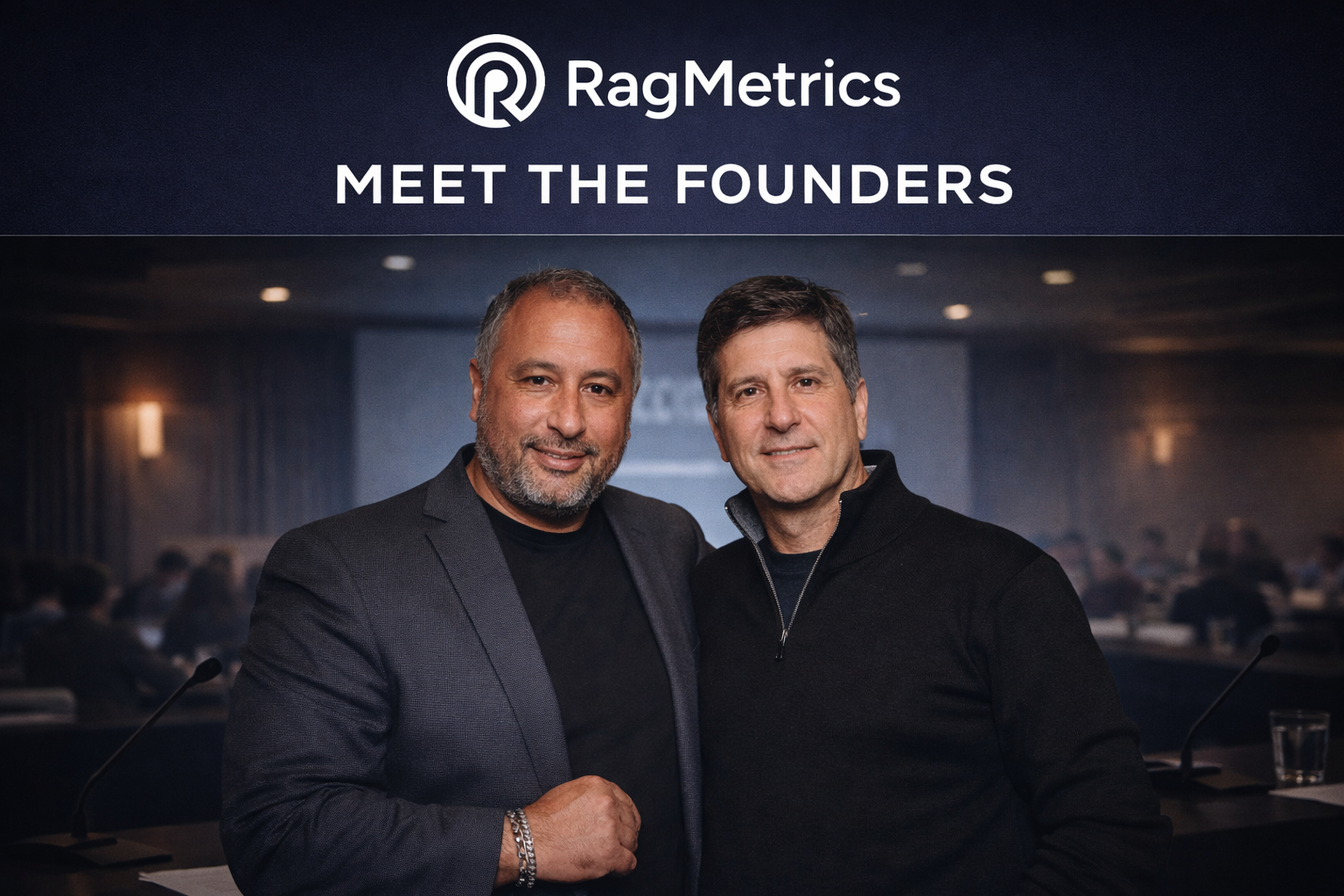
This is not really a monitoring issue in the way most people describe it. It is a measurement problem that has been sitting underneath the surface of enterprise AI adoption, and until recently there has not been a system built specifically to solve it. Olivier Cohen and Hernan Lardiez acquired RagMetrics in September 2025 with the goal of building that missing layer directly into how AI systems are evaluated in production.
Who Olivier Cohen and Hernan Lardiez Are
Cohen has spent his career building and scaling enterprise software companies, which gives him a very specific perspective on how products are actually evaluated once they reach large organizations. He understands how procurement teams think, what makes enterprise buyers trust a system, and what kind of documentation is required before a deal moves forward, so when he looks at AI adoption he is not focused on the model itself as much as he is focused on what happens when that model is pushed through a security review, a compliance audit, or a formal enterprise RFP process.
Lardiez brings the technical side of that equation, with a background in AI and machine learning infrastructure focused on building evaluation systems that can operate at production speed. Most evaluation tooling has historically been designed by researchers for development workflows, where the goal is to test before deployment, but Lardiez has been working on systems that serve a different audience, which includes compliance teams, procurement stakeholders, and operators who need a clear and defensible number rather than a set of experimental results they have to interpret.
Together, the two founders cover both sides of the problem in a way that is fairly uncommon. One understands how enterprises buy and validate technology, and the other understands how to build the infrastructure required to support that validation in real-world environments where systems are constantly changing.
What RagMetrics Actually Does
The setup process is intentionally simple, which matters more than it sounds when you are dealing with enterprise systems that are already running in production. Companies can point RagMetrics at their existing AI stack without making code changes or replacing components, and within minutes the platform begins scoring every query that the AI agent processes, marking responses as accurate or not and building a live view of system performance from the start.
Underneath that workflow is an assessment engine that handles how risk and control are mapped to each response. Every interaction receives a timestamp and an accuracy score, and when performance drops below a defined threshold the system generates alerts so teams can investigate what changed. Over time, that creates a continuous record of how the system behaves across all queries, rather than a snapshot taken during testing.
The result is something enterprises have not really had access to before. Instead of relying on assumptions about whether an AI system is working, teams have a measurable output they can point to. When a regulator asks about accuracy, there is evidence. When a buyer includes accuracy requirements in an RFP, there is documentation ready. The conversation moves from belief to proof in a way that aligns with how enterprise decisions are actually made.
"The moment it clicked was realizing this wasn't a tooling problem — it was a category problem. The category didn't exist yet."
Why This Matters Right Now
There are a few pressures hitting enterprise AI teams at the same time, and when you look at them together it becomes clear why this problem is surfacing now rather than earlier. The EU AI Act is introducing requirements around continuous monitoring for high-risk systems, procurement teams are beginning to include accuracy expectations in vendor evaluations, and the industries deploying these agents are ones where incorrect outputs can lead to operational or regulatory consequences that cannot be ignored.
A few years ago, most AI systems were still in pilot phases, which meant the stakes were lower and the need for continuous validation was not as visible. Today those systems are being used in environments where decisions carry weight, and the pressure is coming from multiple directions at once, including regulators, buyers, and internal stakeholders who need to justify how these systems are being used. The tools that existed were built for earlier stages of adoption, which is why a gap has opened as usage has expanded.
The Insight Nobody Else Has Said
The evaluation problem in production environments is fundamentally different from the evaluation problem in development, even though those two are often treated as if they are the same. Most existing tools focus on testing systems before they are deployed, which is useful but does not address what happens after launch when inputs change, data shifts, and system behavior evolves over time in ways that are not always immediately visible.
The more realistic failure mode is not a system that fails on day one, but a system that gradually degrades over weeks or months without clear signals until something goes wrong. That might be a customer complaint, a failed audit, or a decision that exposes risk, and by that point the issue has already been present for some time. RagMetrics is built around that reality, focusing on continuous evaluation as part of the infrastructure rather than as a one-time testing step.
Where RagMetrics Is Today
RagMetrics was acquired by Cohen and Lardiez in September 2025 and is based in Miami. The company has early customers and is already operating inside production environments, where it is being used to track and evaluate AI system performance on an ongoing basis. This is not a concept stage product or a future roadmap, but a system that is currently in use and continuing to develop as adoption grows.
The Ask
The companies that tend to be the best fit for RagMetrics are those that have already moved beyond experimentation and are now running AI agents inside production environments within regulated industries such as financial services, healthcare, legal, or clinical research. In many of these organizations, there is a clear owner of the deployment, often a VP of AI or head of data, alongside a compliance function that is starting to ask more detailed questions about how accuracy is being measured and documented.
For teams in that position, the next step is usually a conversation about how their current evaluation process works and where gaps might exist once systems are running at scale. Companies can connect with Olivier Cohen directly on LinkedIn or visit RagMetrics to learn more, where they can expect a discussion focused on their current setup and whether a continuous measurement layer is needed for their environment.
Our Take
GetAIGovernance covers the companies and technologies helping organizations manage AI systems in production environments. RagMetrics is building infrastructure around a problem that is only beginning to be clearly defined, which is how to measure accuracy continuously once systems are live. That places it in a category that is still forming, That is exactly the kind of early signal GetAIGovernance exists to cover.